St. Nicholas Church, Old Town Square: Prague's Free Baroque Gem
Standing in the north-west corner of Old Town Square, St. Nicholas Church is a compact Baroque masterpiece built between 1732 and 1737. Entry is free, the interior is genuinely beautiful, and most visitors walk past it without stopping. Here is why they should not.
Quick Facts
- Location
- Staroměstské náměstí (Old Town Square), northwest corner, Prague 1
- Getting There
- Metro Line A – Staroměstská station, approx. 250m walk
- Time Needed
- 20–40 minutes for the interior; longer if attending a concert
- Cost
- Free entry for sightseeing (except during Mass); concerts priced separately
- Best for
- Architecture lovers, quiet moments away from the square's crowds, classical music
- Official website
- svmikulas.cz
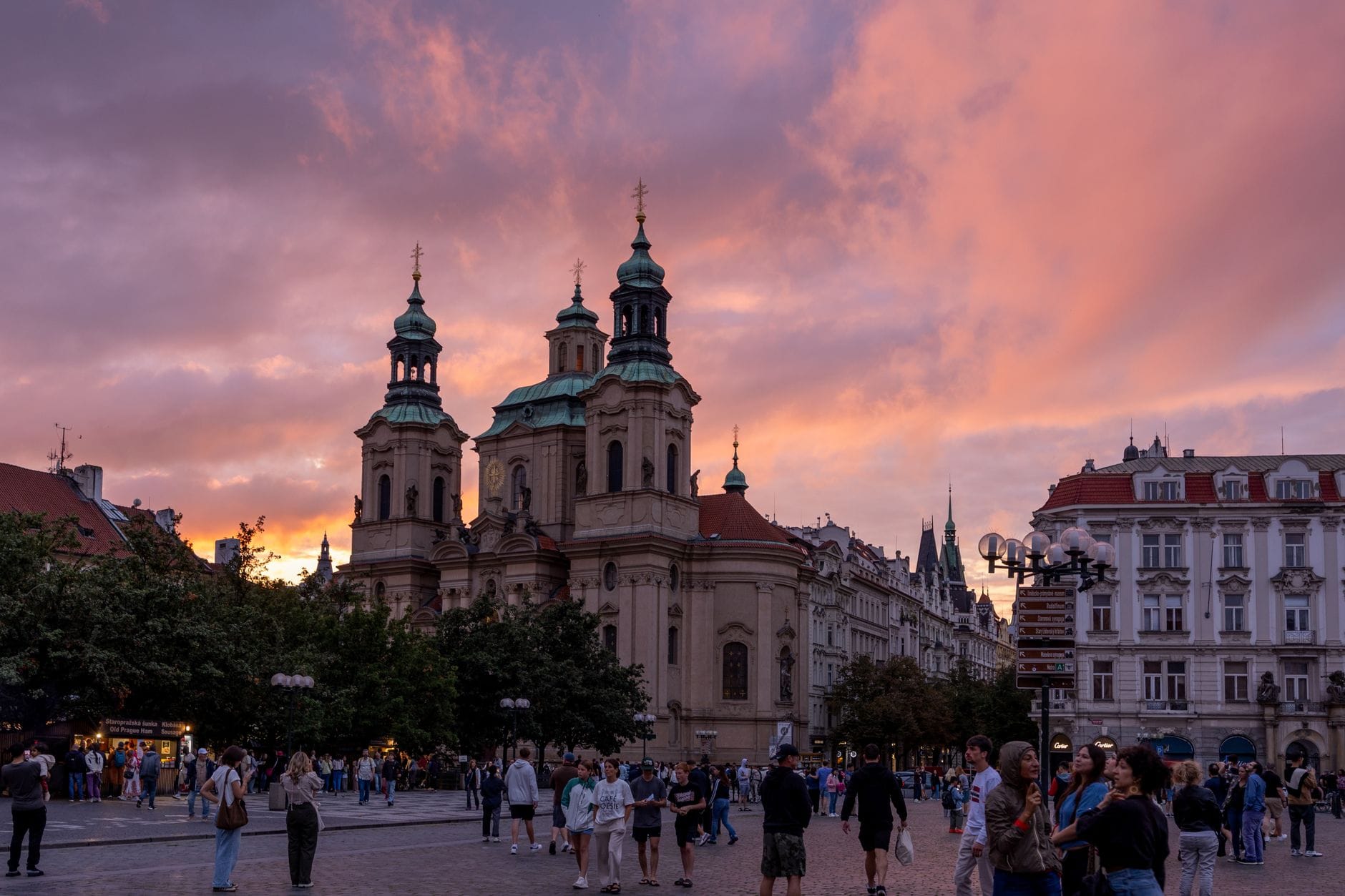
What Is St. Nicholas Church, Old Town?
St. Nicholas Church on Old Town Square (Czech: Kostel sv. Mikuláše na Staroměstském náměstí) is one of Prague's finest Baroque buildings, yet it is consistently overlooked by the crowds gathering around the Astronomical Clock a few dozen metres away. The church occupies the north-west corner of the square, its cream-and-ochre facade rising above the roofline of surrounding buildings with a confidence that rewards anyone who bothers to look up.
This is not the more famous St. Nicholas Church in Malá Strana, which is larger and more ornate. The Old Town version is smaller and more intimate, which actually works in its favour. You can take it in thoroughly in under half an hour, and there is rarely a queue at the door.
ℹ️ Good to know
Opening hours: daily 10:00–17:00 (Saturday often closes at 16:00 – verify on site). Sightseeing is not permitted during Mass, held on Sundays and public holidays at 10:00. Entry is free.
History: From Gothic Origins to a Baroque Rebuild
A church has stood on this site since the medieval period. The original Gothic structure served the German merchants who lived around Old Town Square and was an important part of the neighbourhood's commercial and religious life. That earlier building was demolished in the early eighteenth century to make way for the current Baroque structure, which was built between 1732 and 1737.
The architects were Christoph Dientzenhofer and his son Kilian Ignaz Dientzenhofer, the same father-and-son partnership responsible for some of the most significant Baroque buildings in central Europe. Their work on St. Nicholas Old Town is more restrained than their output in Malá Strana, but the proportions are precise and the facade detail is worth studying closely: layered pilasters, curved window surrounds, and a roofline that manages to feel both heavy and graceful simultaneously.
The church's modern religious identity carries an unexpected historical weight. In January 1920, the Czechoslovak Hussite Church was formally founded here, making this building the originating site of a denomination that emerged directly from the upheaval of post-World War I Czechoslovakia. St. Nicholas remains the main church of that denomination today. Few visitors are aware of this connection, but it gives the building a significance that extends well beyond its architecture.
Tickets & tours
Hand-picked options from our booking partner. Prices are indicative; availability and final rates are confirmed when you complete your booking.
Classical Concert in St. Nicholas church
From 33 €Instant confirmationFree cancellationOnline audio guide of Prague Orloj and Old Town Square
From 5 €Instant confirmationFree cancellationPrague's Old Town, astronomical clock and underground guided tour
From 56 €Instant confirmationFree cancellationPrague Old and Jewish Town: guided tour with entrance tickets, coffee and cake
From 48 €Instant confirmationFree cancellation
Inside the Church: What You Actually See
The interior is a single nave space with lateral chapels, relatively modest by Prague Baroque standards but cohesive in a way that more elaborately decorated churches sometimes are not. The ceiling fresco draws the eye upward immediately upon entry. Light enters through tall, arched windows that flood the nave with a diffuse glow on bright days, shifting from warm to cool depending on the cloud cover outside.
The columbarium, which is also included in the free entry, is located in a lower section of the building. This is where the church stores cremated remains, a practice associated with the Czechoslovak Hussite Church. It is a quiet, slightly unusual feature that most visitors do not expect to find in a Baroque church, and it adds a layer of contemporary use to what could otherwise feel like a preserved-in-amber monument.
The acoustic quality of the interior is notable. The stone walls and vaulted ceiling create a natural resonance that has made the church a regular venue for chamber music and classical concerts. These are ticketed events, typically starting around early evening hours, and the setting significantly enhances the listening experience compared to a conventional concert hall. If you are in Prague for several days and enjoy live classical music, checking the concert schedule at svmikulas.cz is worth the effort.
💡 Local tip
Photography tip: The interior is well-lit by natural light during midday. If you want cleaner shots of the ceiling fresco without harsh shadows, visit on a slightly overcast day when the diffuse light is more even. A wide-angle lens or a phone with an ultra-wide mode handles the proportions far better than a standard focal length.
How the Experience Changes by Time of Day
Old Town Square is one of the most visited public spaces in central Europe, and the noise level outside reflects that. First thing in the morning, before the tour groups arrive in force, the square has a completely different character: fewer people, cooler air, and the church facade catching early light from the east. The building does not open until 10:00, so the earliest you can enter is mid-morning, by which point the square is already filling up.
Midday is when the square is at its most crowded, but stepping inside the church provides an immediate contrast. The thick Baroque walls do a reasonable job of muffling the noise from outside, and the interior tends to have far fewer people than the square itself at any given moment. It functions as an accidental refuge. The light is also at its strongest during these hours, which suits interior photography.
Late afternoon, from around 15:00 onwards, the square crowds begin to thin and the light changes quality outside. The church closes at 17:00, so arriving at 16:00 gives you a full hour with noticeably fewer visitors than the midday rush. This is generally the most comfortable time to visit if your schedule allows it.
Getting There and Getting In
The most direct public transport route is Metro Line A to Staroměstská station. From the exit, Old Town Square is roughly a 250-metre walk east through a short stretch of pedestrianised streets. The walk takes about three minutes at a normal pace. Trams also serve the Staroměstská stop, which sits at the edge of the square's surrounding street grid. For broader guidance on moving around the city, the getting around Prague guide covers the metro, trams, and ticket options in detail.
The church entrance faces directly onto Old Town Square. There are no stairs at the main door, but the square itself is paved with uneven cobblestones that can be challenging for pushchairs and wheelchairs. The interior entrance has limited accessibility information available from official sources; visitors with specific requirements should contact the church directly or check svmikulas.cz before visiting.
Entry for sightseeing is free, which means there is no ticket booth, no queue to manage, and no need to book ahead. You simply walk in during opening hours, provided Mass is not underway. If you arrive at 10:00 on a Sunday, the service will be in progress and sightseeing access will not be available until it concludes.
Fitting It Into a Wider Old Town Visit
St. Nicholas Church works naturally as part of a walking circuit around Old Town Square. The square itself contains several points of interest that reward attention beyond the Astronomical Clock, including the Church of Our Lady Before Týn on the opposite side of the square, with its distinctive Gothic twin towers. Between the two churches you get a clear sense of how Prague's religious architecture evolved across several centuries: Gothic austerity giving way to Baroque elaboration, and then back again.
The Old Town Hall Tower is steps away and offers one of the better elevated views of the square if you want to see the St. Nicholas roofline from above. If you are building a longer walk through the historic core, the Prague walking tour guide maps out a logical route that connects these landmarks without unnecessary backtracking.
For visitors with a particular interest in Baroque architecture, comparing this church against its larger counterpart across the river is worthwhile. The Church of St. Nicholas in Malá Strana is by the same architects and represents a more ambitious execution of the same design vocabulary. Visiting both in one day gives you an unusually clear picture of how the Dientzenhofers approached different scales and contexts.
Honest Assessment: Is It Worth Your Time?
For most visitors, St. Nicholas Church takes 20 to 30 minutes and costs nothing. Given those parameters, the question of whether it is worth visiting almost answers itself. The interior is genuinely attractive, the historical background is interesting, and it provides a brief pause from one of the busiest public spaces in the Czech Republic.
That said, if your primary interest is religious art and you have limited time, the St. Nicholas in Malá Strana is more impressive by a significant margin. The Old Town version is worth seeing for its own qualities, but it should not be prioritised over the Malá Strana church if you can only visit one.
Visitors who have no particular interest in Baroque churches and are already feeling saturated by historic buildings can reasonably skip the interior. The facade is visible from the square at no cost and at any hour, and simply registering it as part of the square's visual composition is a legitimate way to engage with it.
⚠️ What to skip
Do not confuse this church with the Church of St. Nicholas in Malá Strana. They are different buildings by the same architects, in different neighbourhoods, with different opening hours and admission policies. Prague maps sometimes list both simply as 'St. Nicholas Church', which causes confusion.
Insider Tips
- Check the concert schedule at svmikulas.cz before your trip. Evening chamber concerts in this space are ticketed but often modestly priced, and the acoustic quality of the Baroque interior makes them a very different experience from standard tourist concerts held in hotel ballrooms.
- Arrive at the church first thing after opening at 10:00 on a weekday. The square fills quickly, but the church interior at 10:05 on a Tuesday morning can have fewer than ten people in it.
- The building's north-west position on the square means its facade is in shadow during morning hours. If you want to photograph the exterior with direct light on the details, come back in the early afternoon when the sun has moved around.
- The columbarium is included in free entry and is genuinely unusual. It is easy to miss if you only look at the nave and leave. Ask at the entrance or look for signage to the lower level.
- On Sunday mornings, sightseeing is closed until after the 10:00 Mass concludes. Plan around this if Sunday is your only available day, or attend the service itself, which is open to all.
Who Is Church of St. Nicholas (Old Town) For?
- Travellers interested in Central European Baroque architecture who want a direct comparison point for the more famous Malá Strana St. Nicholas
- Anyone needing a quiet, cool pause from the noise and density of Old Town Square in summer
- Classical music enthusiasts looking for intimate evening concert venues with authentic historical settings
- History-focused visitors interested in the founding of the Czechoslovak Hussite Church in 1920
- Budget travellers: free entry means this is one of the few genuinely worthwhile stops in the tourist centre that costs nothing
Nearby Attractions
Other things to see while in Old Town (Staré Město):
- Church of Our Lady before Týn
The Church of Our Lady before Týn is Prague's most recognizable Gothic landmark, its twin 80-metre spires rising sharply above the rooflines of Old Town Square. Entry is free, but visiting hours are short and the interior tells a story most visitors walk past without ever stepping inside.
- Clementinum
The Clementinum is one of the largest building complexes in Prague, stretching over 2 hectares in the heart of Old Town. Its guided tours take visitors into a breathtaking Baroque library hall and up a narrow tower for panoramic rooftop views over the city's spires.
- Estates Theatre (Stavovské divadlo)
The Estates Theatre in Prague's Old Town is one of the best-preserved 18th-century opera houses in Europe, and one of the surviving venues where Mozart himself conducted. Built in 1783, it staged the world premiere of Don Giovanni and remains an active performance space under the National Theatre umbrella.
- House of the Black Madonna (Czech Cubism Museum)
Built in 1911–1912 by Josef Gočár, the House of the Black Madonna is the first Cubist building in Prague and one of the most architecturally significant structures in Old Town Prague. Today it houses the Czech Cubism permanent exhibition of the Museum of Decorative Arts, alongside the Grand Café Orient and a specialist design shop.