Prague Astronomical Clock (Orloj): What to Expect Before You Go
Mounted on the Old Town Hall since 1410, the Prague Astronomical Clock is the oldest still-operating astronomical clock in the world. Free to view from the square, with paid tower access available. Here is what the experience actually looks like, hour by hour.
Quick Facts
- Location
- Staroměstské náměstí 1, Old Town Square, Prague 1
- Getting There
- Staroměstská (Metro Line A), then a 5-minute walk
- Time Needed
- 15–30 min for the square and clock face; 60–90 min if you add the tower
- Cost
- Free to view from the square; paid admission for Old Town Hall interior and tower (verify current price at prague.eu)
- Best for
- First-time visitors, history enthusiasts, early-morning walkers
What Is the Prague Astronomical Clock?
The Prague Astronomical Clock, known locally as the Pražský orloj, is mounted on the southern wall of the Old Town Hall on Old Town Square. First installed in 1410, it holds the distinction of being the oldest continuously operating astronomical clock in the world. That is not marketing copy; it is a measurable, verifiable fact that makes this mechanism genuinely remarkable.
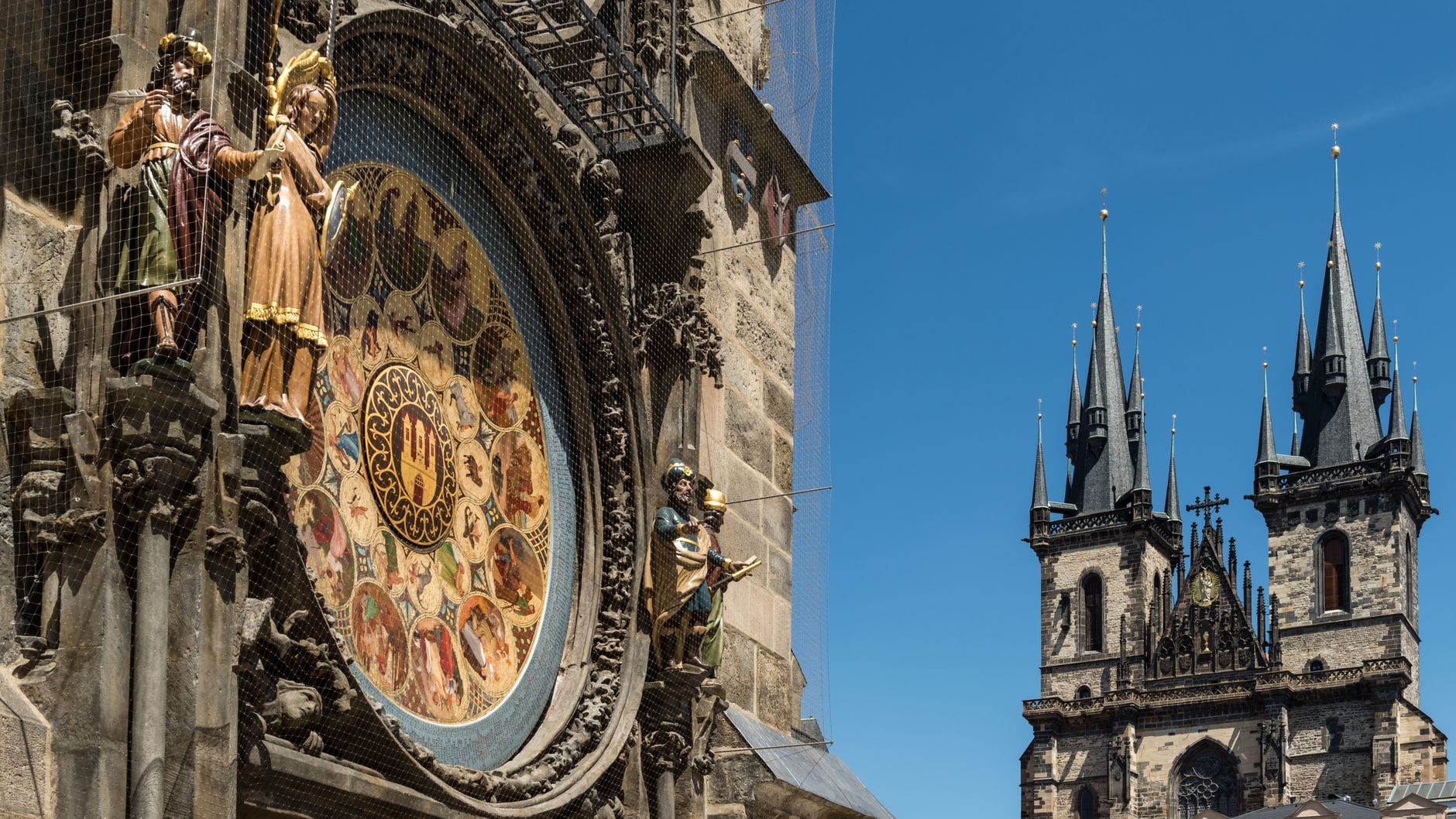
The clock is composed of three main sections stacked vertically on the tower wall. At the top, the astronomical dial tracks the position of the sun and moon across the sky, displays the time in multiple systems (including Old Bohemian time and Babylonian time), and shows the zodiac calendar. Below it sits the calendar dial, a circular face painted with medallions representing the months of the year. Between these two dials, a set of animated figures performs the hourly apostle show that draws the densest crowds.
💡 Local tip
The clock is free to observe from Old Town Square at any time. Paying for the tower only makes sense if you want a rooftop view over the square, not to get closer to the clock mechanism itself.
The Hourly Show: Honest Assessment
Every hour typically between 8:00 and 23:00, the clock's upper windows open and a procession of wooden apostle figures rotates past, accompanied by a crowing rooster and the chiming of the bell. The whole sequence lasts roughly 45 seconds. Crowds begin gathering 10 to 15 minutes before the hour, particularly from mid-morning onward, and the square can become genuinely packed by the top of the hour during summer.
The show itself is compact and over quickly. If you are expecting a dramatic mechanical spectacle, you may feel the crowd buildup outweighs the payoff. The real reward is understanding what you are looking at: a late-medieval engineer's attempt to represent the cosmos on a single dial, still functioning after more than six centuries. For travelers who take a moment to read the face before the procession begins, the clock becomes considerably more interesting.
⚠️ What to skip
Do not spend your entire visit staring straight up at the clock during the show. Pickpockets target dense, distracted crowds. Keep bags in front and valuables secured before the hour strikes.
Tickets & tours
Hand-picked options from our booking partner. Prices are indicative; availability and final rates are confirmed when you complete your booking.
Online audio guide of Prague Orloj and Old Town Square
From 5 €Instant confirmationFree cancellationPrague's Old Town, astronomical clock and underground guided tour
From 56 €Instant confirmationFree cancellationPrague highlights half-day tour with lunch and river cruise
From 75 €Instant confirmationFree cancellationPrague highlights half-day tour with lunch and river cruise
From 0 €Instant confirmationFree cancellation
Reading the Clock Face
The astronomical dial is a geocentric model of the universe as understood in medieval Bohemia. The Earth sits at the center, and the dial rotates to show the apparent path of the sun through the sky and against the zodiac. The golden sun hand indicates solar time; the background disk of stars rotates to show sidereal time. The outermost ring, marked with Gothic numerals, tracks Old Bohemian time, which measures hours from sunset.
Below the astronomical dial, the calendar dial carries painted scenes for each month of the year. The original calendar dial, painted by Josef Mánes in 1866, was removed for preservation and is now held in the Prague City Museum. What you see on the building today is a reproduction from the 20th century.
Understanding these layers transforms the clock from a curiosity into a document of medieval cosmology. For deeper historical context, the Prague history guide covers the intellectual and political climate of the early 15th century when the mechanism was first constructed.
How the Experience Changes by Time of Day
Before 9:00, the square belongs to delivery trucks, street cleaners, and a handful of early walkers. The light is low and raking, which picks out the sculptural detail on the clock tower in sharp relief. There are almost no other tourists. This is the single best time to observe the clock face without distraction and to understand the geometry of Old Town Square as a space.
By 10:00, tour groups are already forming. By noon, the square is at its most congested, with the area directly in front of the clock packed shoulder to shoulder before each hour. The ambient noise level rises significantly, and the smell of grilled sausage from nearby market stalls drifts across the cobblestones in warmer months.
Late afternoon, particularly around 17:00 to 19:00, offers a middle ground: the worst of the midday crowds have thinned, but the light is warmer and better for photography. After 20:00, the square quiets noticeably and the illuminated clock tower against a darkening sky is a different experience entirely. The 21:00 and 22:00 shows attract far smaller gatherings than the daytime equivalent.
The Old Town Hall Tower: Is It Worth the Climb?
Paid admission covers entry to the Old Town Hall interior and the tower observation platform. The tower lifts visitors to a rooftop terrace with open views across Old Town Square and, on clear days, toward Prague Castle on the opposite bank of the Vltava.
The view is good but not exceptional by Prague standards. If you want the best elevated perspective over the city, the observation deck of the Old Town Hall Tower competes with several other options, including the bell towers of Týn Church and the top of Petřín. Check opening hours in advance, as the tower schedule differs by season: April through December from 9:00 to 20:00, and January through March from 10:00 to 19:00.
ℹ️ Good to know
The tower is not fully accessible for visitors with limited mobility. There are stairs involved, and the upper section is narrow. Confirm specific accessibility conditions directly with the Old Town Hall before visiting.
Getting There and Arriving Smart
The clock is a 5-minute walk from Staroměstská metro station on Line A. Exit the station, cross the bridge approach road, and follow Kaprova Street into the square. Trams 2 and 17 stop nearby at Staroměstská as well. The square itself is pedestrianized, so there is no driving directly to the clock.
Old Town Square and the surrounding streets form the core of Old Town Prague, a compact neighborhood where most key sights are within a 10-minute walk of the clock. Plan the Orloj as a natural starting point for a walking loop that takes in the surrounding architecture, rather than treating it as an isolated destination.
If you are spending multiple days in the city, the clock fits naturally into a broader itinerary. The 3-day Prague itinerary places the Orloj on the first morning for exactly this reason: it orients you in the Old Town, and everything else radiates outward from there.
Photography Tips
The clock face is on the south-facing wall of the tower, which means direct sunlight hits it from mid-morning through early afternoon on clear days. In summer, this creates harsh contrast on the clock's blue-and-gold surface. Overcast days produce more even light on the face and allow better exposure of the sculptural figures around the dial.
For a clean shot of the clock without crowds in the frame, arrive before 8:30. The wider square, including the clock tower in context, photographs well from the café terraces on the eastern side of the square, which give a slightly elevated angle. The clock at night, when spotlit against a dark sky, is worth the return visit if you have a camera capable of handling low light.
Who Should Skip the Tower (But Not the Clock)
Travelers who are short on time, traveling with young children, or simply not interested in medieval cosmology will get full value from a free 20-minute visit to the square itself. The clock face is entirely visible from ground level, and the hourly show can be watched without paying anything. Paying for the tower makes most sense for first-time visitors to Prague who want a rooftop orientation point early in their trip, or for those with a specific interest in the Old Town Hall's Gothic interior.
Repeat visitors who have already seen the tower might spend that time more productively at other nearby sights, such as the wider Old Town Square with its mix of Gothic, Baroque, and Romanesque facades, or the Municipal House a short walk north toward the Powder Tower.
Insider Tips
- The 9:00 show is reliably the least crowded of the day. If you are already in the area for an early breakfast, position yourself in the square at 8:50 and you will have an unobstructed view that afternoon crowds rarely allow.
- Look at the figures flanking the astronomical dial, not just the clock face. The four allegorical sculptures (representing Vanity, Greed, Death, and a Turkish figure representing external threat) are medieval political commentary carved in stone and easy to miss while craning upward.
- The calendar dial you are looking at is a 20th-century reproduction. The original by Josef Mánes is in the Prague City Museum in New Town, and is worth seeing separately if you want to compare the quality of the painted medallions up close.
- On rainy days, the crowds around the clock thin considerably. The clock itself is unaffected by weather, and the Old Town Hall tower offers a covered platform. Rain gear and a visit timed to just before the hour can give you a more contemplative experience than any dry summer afternoon.
- The clock tower houses a visitor center run by Prague City Tourism. Staff there can answer questions about the mechanism's history and current restoration status, which is useful context given that the clock has undergone several significant restorations, most recently after damage in 2018.
Who Is Prague Astronomical Clock (Orloj) For?
- First-time visitors to Prague who want an immediate historical anchor in the Old Town
- Architecture and history enthusiasts interested in medieval engineering
- Photographers working in early morning or evening light
- Travelers using the Old Town Hall tower as an orientation point before exploring the wider city
- Anyone building a walking route through Old Town who wants a logical geographic starting point
Nearby Attractions
Other things to see while in Old Town (Staré Město):
- Church of Our Lady before Týn
The Church of Our Lady before Týn is Prague's most recognizable Gothic landmark, its twin 80-metre spires rising sharply above the rooflines of Old Town Square. Entry is free, but visiting hours are short and the interior tells a story most visitors walk past without ever stepping inside.
- Church of St. Nicholas (Old Town)
Standing in the north-west corner of Old Town Square, St. Nicholas Church is a compact Baroque masterpiece built between 1732 and 1737. Entry is free, the interior is genuinely beautiful, and most visitors walk past it without stopping. Here is why they should not.
- Clementinum
The Clementinum is one of the largest building complexes in Prague, stretching over 2 hectares in the heart of Old Town. Its guided tours take visitors into a breathtaking Baroque library hall and up a narrow tower for panoramic rooftop views over the city's spires.
- Estates Theatre (Stavovské divadlo)
The Estates Theatre in Prague's Old Town is one of the best-preserved 18th-century opera houses in Europe, and one of the surviving venues where Mozart himself conducted. Built in 1783, it staged the world premiere of Don Giovanni and remains an active performance space under the National Theatre umbrella.