Municipal House (Obecní dům): Prague's Art Nouveau Masterpiece
Completed in 1912, Prague's Municipal House is the most accomplished Art Nouveau civic building in Central Europe. It hosted the proclamation of Czechoslovak independence in 1918 and today operates as a concert hall, exhibition space, restaurant, and café, all wrapped in one of the city's most ornate facades.
Quick Facts
- Location
- Náměstí Republiky 1090/5, Praha 1 – Staré Město (Old Town, at the border of New Town)
- Getting There
- Metro Line B: Náměstí Republiky station (exit at Republic Square); Metro Line A: Můstek station (~4 min walk); tram lines 6, 8, 15, 26 at Náměstí Republiky stop
- Time Needed
- 30 min (exterior + café) to 2 hours (guided tour + interior)
- Cost
- Exterior free; guided tour approx. 320 CZK adults / 270 CZK concessions (verify current rates at obecnidum.cz)
- Best for
- Architecture lovers, classical music, history, couples, solo explorers
- Official website
- www.obecnidum.cz/en
What Is the Municipal House?
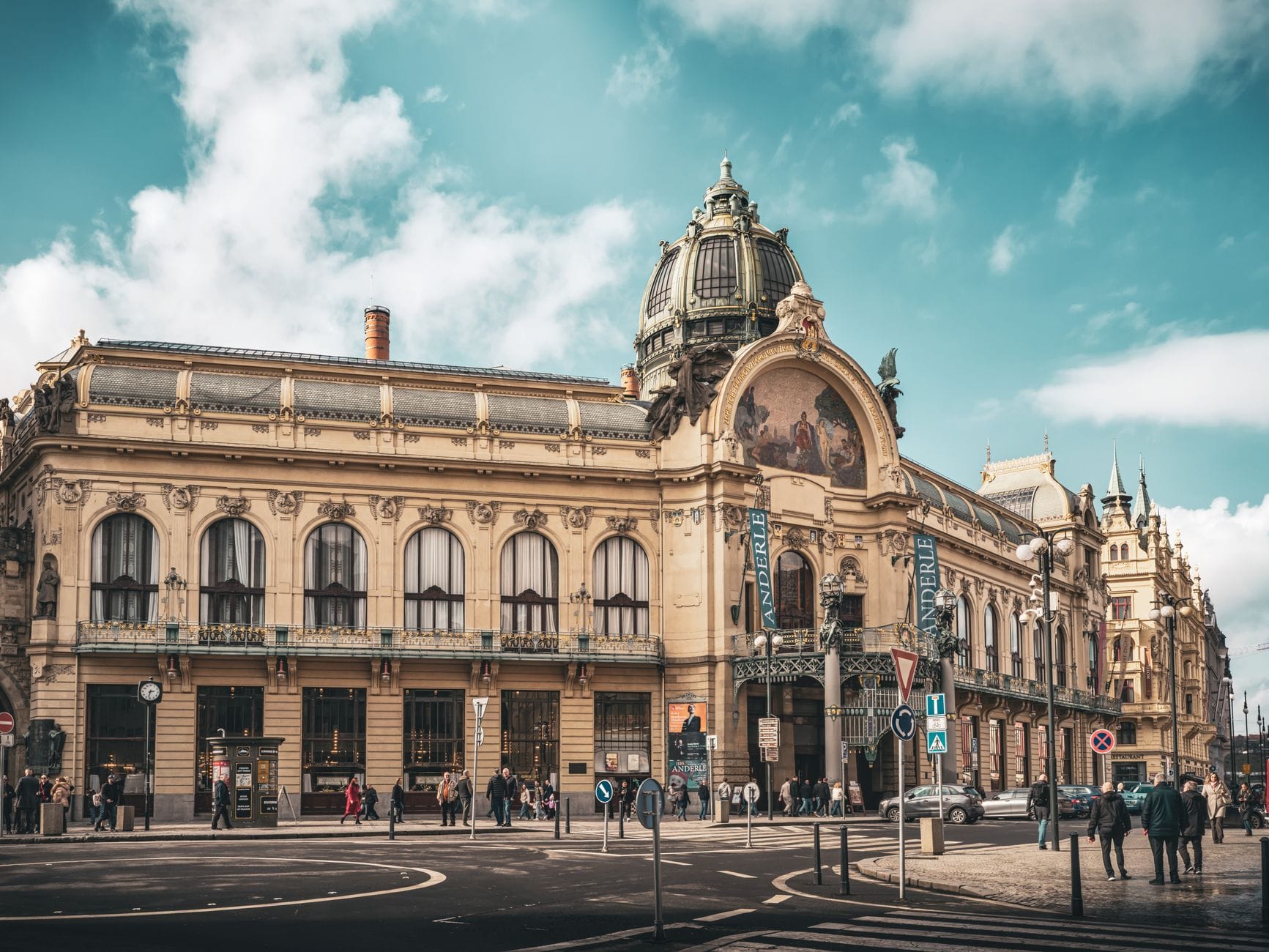
The Municipal House, known in Czech as Obecní dům, stands at Náměstí Republiky (Republic Square) on the eastern edge of Prague's Old Town. Built between 1905 and 1912, it is widely regarded as the most fully realized Art Nouveau civic building in the Czech Republic, and arguably in all of Central Europe. Unlike many decorated facades that conceal ordinary interiors, the Municipal House delivers on its visual promise at every turn.
The building was constructed on the site of the former Royal Court palace, a medieval residence of Czech kings that fell into disrepair by the 19th century. The replacement project was intended as a statement of Czech cultural ambition at a time when the country was still part of the Austro-Hungarian Empire. Architects Antonín Balšánek and Osvald Polívka oversaw the structure, while virtually every decorative element inside, from ceiling paintings to ironwork, was carried out by Czech artists. Alfons Mucha painted the celebrated Mayor's Hall (Primátorský sál); Karel Spillar executed the large mosaic above the main entrance.
Its civic role was confirmed dramatically in October 1918, when Czechoslovak independence was proclaimed here, making the building not just an architectural landmark but a significant site in European political history.
💡 Local tip
The visitor information desk and ticket office are generally open daily 10:00–19:00. Guided tour slots are limited; book in advance on the official website, especially in peak summer months (July–August).
The Exterior: Reading the Facade
Stand across Republic Square in the late afternoon, when the western light catches the copper green of the dome and throws the stone details into sharp relief. The central element above the main entrance is a large semi-circular mosaic by Karel Spillar titled 'Homage to Prague.' Two allegorical sculptural groups frame it on either side. The ironwork canopy at street level is detailed to a degree that most visitors walk past without stopping, but spend a few minutes studying it and you will notice leaf motifs, intertwined stems, and figural elements worked into what appears at first glance to be a functional awning.
The building sits directly beside the Powder Tower (Prašná brána), a Gothic gate from the 15th century. The contrast is deliberate, not accidental: the Municipal House was designed with full awareness of its medieval neighbor. The pairing makes this corner of Prague one of the most photographed urban junctions in the city. Early morning, before 8:00, the square is quiet enough to photograph without other visitors filling the frame.
If you are approaching from Old Town Square, walk the full length of Celetná Street, about ten minutes. You will pass several Baroque and Renaissance facades before the Art Nouveau eruption of the Municipal House appears ahead. It is also a rewarding stretch for architecture enthusiasts; the House of the Black Madonna sits along this route and represents the Czech Cubist architectural tradition, a striking counterpoint to the Municipal House's sinuous ornamentalism.
Tickets & tours
Hand-picked options from our booking partner. Prices are indicative; availability and final rates are confirmed when you complete your booking.
Self guided tour with interactive city game of Prague
From 5 €Instant confirmationFree cancellationPrague by night city tour
From 27 €Instant confirmationFree cancellationPrague city tour with Vltava River cruise
From 38 €Instant confirmationFree cancellationPrague Castle online audio guide
From 5 €Instant confirmationFree cancellation
Inside: What the Tours Actually Show You
The guided tour (available in Czech and English, duration roughly one hour) takes visitors through rooms that are not accessible otherwise. The Mayor's Hall is the centerpiece: Alfons Mucha designed every element of this circular room, from the painted ceiling depicting Slavic unity to the stained glass, the leather furnishings, and the portrait medallions on the walls. The effect is overwhelming in a specific, contained way. Unlike the grand spectacle of the full building, this room is intimate, and the coherence of its design is immediately apparent.
Other rooms on the tour include the Sladkovský Hall, the Palacký Hall, and the Rieger Hall, each decorated by a different Czech artist and each with a different atmosphere. Ceiling heights vary; some rooms feel almost domestic, others are tall and ceremonial. The guide's commentary is typically well-informed on the historical and artistic context, though the pace can feel brisk in larger groups.
The Smetana Hall, the building's main concert venue and home to the Prague Symphony Orchestra, is included on some tour routes. This is a large concert hall with an ornate ceiling and distinctive Art Nouveau detailing. The hall hosts the opening concerts of the Prague Spring International Music Festival each May, one of Central Europe's notable classical music events. If your visit coincides with a public rehearsal or concert, the acoustics are best experienced from the middle stalls.
ℹ️ Good to know
Guided tours run multiple times daily but vary seasonally. Children under 10 are admitted free on guided tours. A family ticket (1–2 adults with 1–3 children under 18) is available. Verify current pricing at obecnidum.cz before visiting.
The Café and Restaurant: Worth the Visit on Their Own
Even visitors with no interest in the formal tour should consider entering the building for the Kavárna Obecní dům, the ground-floor café. The space retains its original Art Nouveau fittings: curved brass lamps, tiled floors, arched ceilings, and mirrored walls. Coffee and cakes are priced at levels you would expect in a historic venue, but the quality is reliable and the setting is unlike any other café in the city. At midday it fills quickly, but mid-morning and mid-afternoon are generally quieter.
The formal restaurant occupying part of the ground floor is more expensive and requires a reservation for dinner service. It operates in the same lavish interior and serves Czech and European cuisine. Lunch service is more accessible without advance booking.
When to Go: Time of Day and Season
The exterior is best seen in daylight, and the late afternoon light from the west gives the facade the most depth. However, the building is also illuminated at night, and the mosaic above the entrance reads clearly after dark. Evening visits, when the square is less crowded than at midday, offer a cleaner view and a different atmosphere.
Interior tours are least crowded on weekday mornings outside of peak summer. In July and August, the first English tour of the day, typically in the morning, tends to fill up fastest. The shoulder seasons, May and September, are the most comfortable overall: temperatures are moderate, queues are shorter, and the lighting inside the hall is easier for photography.
If your schedule is flexible, cross-reference with the Prague Spring festival calendar and with the broader best time to visit Prague patterns. A concert at the Smetana Hall during May is a genuinely special experience if you can secure tickets, but book several weeks ahead.
⚠️ What to skip
The Smetana Hall and several interior rooms are occasionally closed for private events or performances. If seeing a specific room matters to you, check the events calendar on the official website before booking a tour.
Getting There and Practical Details
The simplest approach is Metro Line B (yellow line) to Náměstí Republiky station, whose exit brings you out at Republic Square near the building. Metro Line A (green line) to Můstek station is about a four-minute walk. Multiple tram lines (including 6, 8, 15, and 26) stop at Náměstí Republiky, making the Municipal House one of the better-connected major attractions in the city center. There is no need to use a taxi or ride-hailing service unless you are arriving with luggage or from a distant neighborhood.
On foot from Old Town Square, walk east along Celetná Street. The entire walk takes under ten minutes on flat ground and passes through one of the more architecturally interesting streets in the old city.
Wheelchair access is available, though some interior areas and tour routes have constraints due to the historic nature of the building. Contact the venue directly to confirm which tour routes are fully accessible before your visit. Nearby parking garages include the Palladium shopping center car park on the adjacent block.
Photography Notes
The interior rooms are lit primarily by artificial light and stained glass, which means a camera or phone that handles low-light conditions reasonably well will produce usable results. The Mayor's Hall in particular is dark enough that a steady hand or a surface to brace against is helpful. Tripods are generally not permitted on guided tours. The café, with its natural light from street-facing windows, photographs more easily.
For exterior shots, the building shares the frame with the Gothic Powder Tower. Including both in a wide shot provides a useful sense of Prague's architectural layering. Those with a broader interest in the city's architectural range might also find the Prague architecture guide useful for planning a coherent route.
Insider Tips
- The basement wine bar (Francouzský restaurace level) is less visited than the ground-floor café and offers a quieter experience of the building's lower spaces. Check if it is open during your visit.
- The Powder Tower next door (Prašná brána) offers elevated views across to the Municipal House roof and dome. The combination of both in one visit takes under two hours and adds architectural context.
- If you are attending a concert in the Smetana Hall, arrive at least 20 minutes early to walk through the foyer and ground-floor spaces before the crowd concentrates at the entrance.
- Photography of the main mosaic above the entrance is easiest from the far side of the square rather than standing directly below it. Step back to Palladium's side of the square for a clean angle.
- The visitor information desk inside the entrance can tell you which rooms are currently open and whether any events are affecting the tour route that day. Ask before buying your tour ticket.
Who Is Municipal House (Obecní dům) For?
- Architecture and design enthusiasts wanting to understand Art Nouveau at its most complete
- Classical music listeners, especially during Prague Spring Festival (May) or regular Smetana Hall concerts
- History-focused visitors interested in the founding of Czechoslovakia in 1918
- Couples looking for a refined café setting without venturing far from the Old Town core
- Travelers following a broader Prague cultural itinerary who want context beyond the Castle and Charles Bridge
Nearby Attractions
Other things to see while in Old Town (Staré Město):
- Church of Our Lady before Týn
The Church of Our Lady before Týn is Prague's most recognizable Gothic landmark, its twin 80-metre spires rising sharply above the rooflines of Old Town Square. Entry is free, but visiting hours are short and the interior tells a story most visitors walk past without ever stepping inside.
- Church of St. Nicholas (Old Town)
Standing in the north-west corner of Old Town Square, St. Nicholas Church is a compact Baroque masterpiece built between 1732 and 1737. Entry is free, the interior is genuinely beautiful, and most visitors walk past it without stopping. Here is why they should not.
- Clementinum
The Clementinum is one of the largest building complexes in Prague, stretching over 2 hectares in the heart of Old Town. Its guided tours take visitors into a breathtaking Baroque library hall and up a narrow tower for panoramic rooftop views over the city's spires.
- Estates Theatre (Stavovské divadlo)
The Estates Theatre in Prague's Old Town is one of the best-preserved 18th-century opera houses in Europe, and one of the surviving venues where Mozart himself conducted. Built in 1783, it staged the world premiere of Don Giovanni and remains an active performance space under the National Theatre umbrella.