Old Town Square (Staroměstské náměstí): Prague's Historic Heart
Old Town Square is Prague's oldest and most architecturally layered public space, tracing its origins to a 12th-century marketplace at the crossroads of European trade routes. Free to enter at any hour, it frames the Astronomical Clock, the Church of Our Lady before Týn, and a thousand years of Czech history in a single open hectare.
Quick Facts
- Location
- Staroměstské náměstí, 110 00 Praha 1 — Old Town, between Charles Bridge and Wenceslas Square
- Getting There
- Metro Staroměstská (Line A), Náměstí Republiky (Line B), or Můstek (Lines A & B) — each 5–7 min walk
- Time Needed
- 45–90 minutes for the square itself; allow a half-day if visiting the Old Town Hall Tower and surrounding churches
- Cost
- Free to enter the square. Individual sights (Old Town Hall Tower, churches) charge separate admission — verify current prices before visiting
- Best for
- Architecture, Czech history, photography, first-time visitors, Christmas and Easter market season
- Official website
- prague.eu/en/objevujte/old-town-square-staromestske-namesti
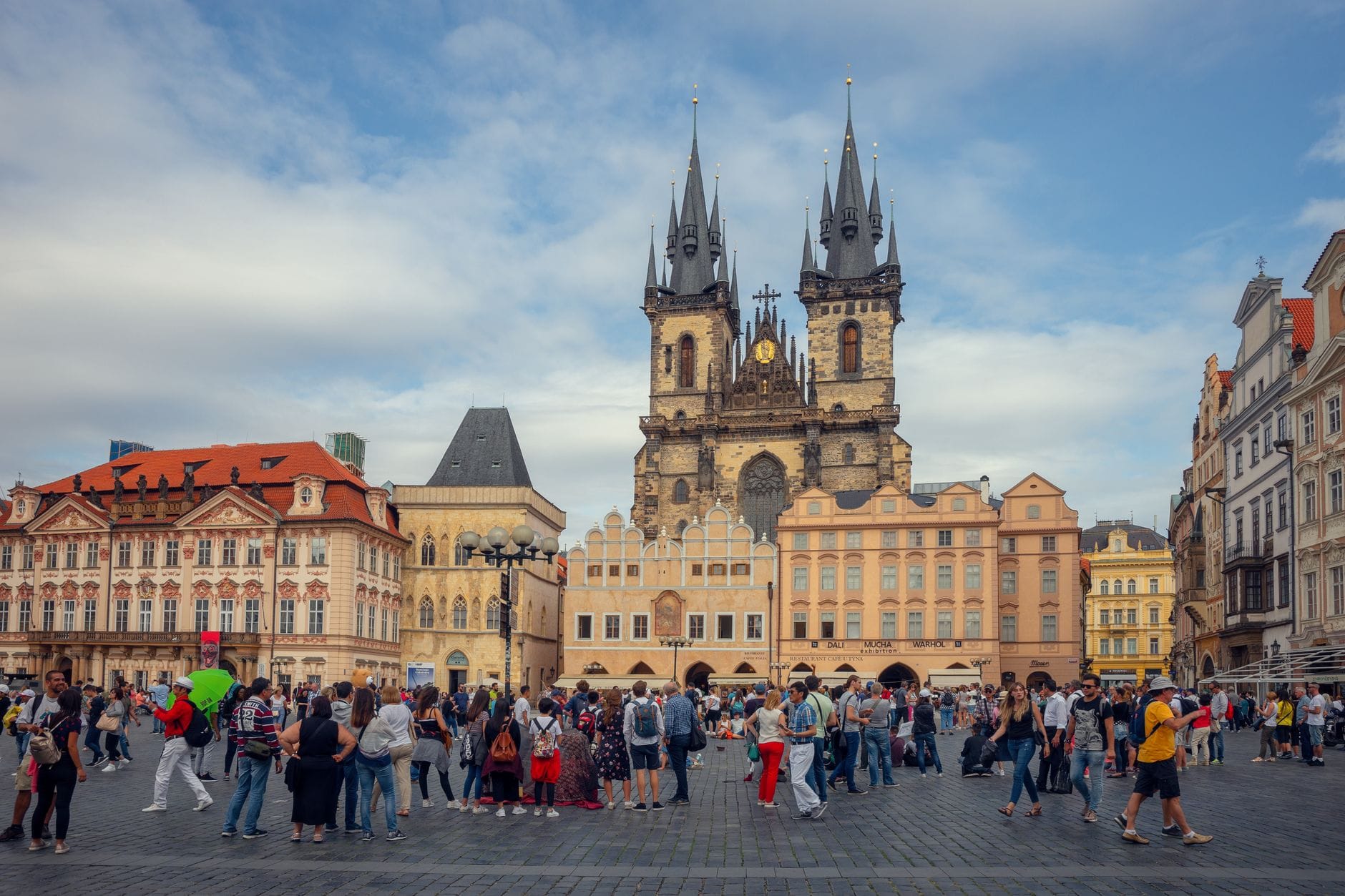
What Old Town Square Actually Is
Old Town Square, known in Czech as Staroměstské náměstí, is the historic and ceremonial center of Prague's Old Town. Covering around one hectare (roughly 9,000 m²), it is the largest and oldest square in Prague's historic core, and one of the best-preserved medieval market squares anywhere in Central Europe. The square is an open public space with no admission fee and no gates: it is accessible 24 hours a day, every day of the year.
Unlike a single monument or a museum, Old Town Square is a compound experience: a complete ensemble of Gothic towers, Baroque facades, Romanesque foundations, and layers of Czech national memory compressed into one place. It sits geographically between Charles Bridge to the west and Wenceslas Square to the south, making it a natural pivot point for any walk through Prague's Old Town.
💡 Local tip
Arrive before 9am to see the square at its calmest. Tour groups typically arrive from 9:30am onward, and by midday the space around the Astronomical Clock is densely packed. Early mornings also offer the best light for photography of the Týn Church's twin Gothic spires.
A Thousand Years of Market History
The square's origins date to the 10th and 11th centuries, when it developed as a marketplace at the intersection of major European trade routes crossing Bohemia. Merchants from across the continent traded here, and the surrounding buildings evolved over centuries to reflect the successive architectural tastes — and ambitions — of whoever controlled the city. By the late medieval period, the square had become the civic heart of Prague's Old Town, anchored by the Old Town Hall, which received its famous Astronomical Clock in 1410.
The most sobering element of the square's history is embedded in the pavement itself. Twenty-seven white crosses and memorial stones mark the spot where 27 Czech Protestant nobles and burghers were publicly executed on June 21, 1621, following the Battle of White Mountain. The execution ended the Bohemian phase of the Thirty Years' War and marked the beginning of Habsburg re-Catholicization across Bohemia. Walking over those stones without knowing what they represent is easy; understanding what they mean transforms a walk across the square entirely.
A second detail set into the pavement near the Old Town Hall is the Prague meridian, a brass strip marking the historical zero-meridian used to set local time before international standardization. For a broader look at Prague's layered history, the Prague history guide provides essential context before you visit.
Tickets & tours
Hand-picked options from our booking partner. Prices are indicative; availability and final rates are confirmed when you complete your booking.
Online audio guide of Prague Orloj and Old Town Square
From 5 €Instant confirmationFree cancellationPrague's Old Town, astronomical clock and underground guided tour
From 56 €Instant confirmationFree cancellationPrague Old and Jewish Town: guided tour with entrance tickets, coffee and cake
From 48 €Instant confirmationFree cancellationPrague old town, river cruise and Prague castle sightseeing tour including lunch
From 98 €Instant confirmationFree cancellation
The Architecture Around You
Standing in the center of the square, you are surrounded by buildings from at least five distinct architectural periods. The effect is not chaotic: centuries of layering have produced a remarkably coherent skyline that rewards slow observation.
The dominant silhouette belongs to the Church of Our Lady before Týn, whose twin Gothic towers rise 80 meters above the square. Construction began in the 14th century and continued in stages over more than a century. The towers are asymmetrical — one is slightly wider than the other, a detail you notice only once you look carefully. The church's interior is rarely as crowded as the square itself, and its Gothic nave contains the tomb of astronomer Tycho Brahe, who died in Prague in 1601 while serving at the court of Emperor Rudolf II.
Along the north edge of the square stands St. Nicholas Church (not to be confused with the more famous church of the same name in Malá Strana), a Baroque structure built in the early 18th century. The Old Town Hall stretches across the west side, a Gothic complex assembled from several medieval townhouses, its most recognizable feature being the 69-meter tower. The south and east sides of the square are framed by Baroque and Renaissance facades, including the Kinský Palace and the Stone Bell House, which now functions as a Prague City Gallery venue.
For travelers with a serious interest in how these styles developed across Prague's streets and centuries, the Prague architecture guide covers the full arc from Romanesque cellars to 20th-century Cubism.
The Astronomical Clock: What to Actually Expect
The Prague Astronomical Clock (Orloj) is mounted on the south face of the Old Town Hall tower and is one of the most recognized images of the city. It was installed in 1410 and is the third-oldest astronomical clock in the world and the oldest still in operation. The clock face displays solar time, lunar phases, the position of the sun and moon in the zodiac, and the time in multiple historical systems simultaneously. It is a genuine piece of medieval scientific and mechanical craftsmanship.
Every hour on the hour, typically from 9am until evening (extended to around 11pm in peak summer), a short mechanical procession plays: a small figure of Death rings a bell, two windows open above the clock face, and twelve carved Apostle figures pass by. The show lasts roughly 45 seconds. Crowds of 50 to 200 people can gather for the top-of-the-hour performance at peak times, often facing directly up at the clock on a narrow cobbled strip. Manage expectations: the procession is short, and the figures are small. The clock face itself, studied up close without the crowd pressure, is the more rewarding experience. A dedicated page on the Prague Astronomical Clock explains the clock's mechanics and history in full detail.
⚠️ What to skip
Pickpocketing is most common in the crowd that gathers around the Astronomical Clock during the hourly procession. Keep bags closed and in front of you, particularly at 11am and 12pm when the largest groups gather.
How the Square Changes Through the Day
At 7am on a weekday, the square is almost quiet: delivery vans make their runs along the edges, pigeons occupy the center, and the Týn Church towers catch the early light from the east. The smell of fresh bread drifts out from the few cafes already open on the surrounding streets. The cobblestones are damp from overnight cleaning. This is the square as locals cross it on the way to work: functional, unperformed.
By 10am, tour groups begin to fill the space. Languages mix: German, Japanese, Italian, Spanish, English in multiple accents. The souvenir stalls around the square's edges are open and doing business. The hourly clock ceremony draws a dense knot of smartphones and upturned faces. By midday in summer, navigating the square requires patience. Temperatures on a July afternoon can exceed 25°C, and the large open paving radiates heat with little shade available.
Late afternoon brings a shift: the organized tour groups thin out, day-trippers move on, and the square settles into a more relaxed rhythm of people sitting on the steps of the Jan Hus Monument, eating at the outdoor restaurant terraces that line the south side, and lingering without particular urgency. After 8pm in summer, the light goes golden and the crowds become manageable again. This is one of the better windows for photography. In winter, the square is lit by hundreds of festive lights from November through January, and the Christmas market fills much of the central space.
The Jan Hus Monument and Czech National Memory
The large bronze monument at the center of the square depicts Jan Hus, the Czech theologian and church reformer who was burned at the Council of Constance in 1415 for heresy against the Catholic Church. Designed by sculptor Ladislav Šaloun, the monument was unveiled on July 6, 1915, exactly 500 years after Hus's execution. It shows Hus standing among both his followers and his defeated opponents, with the inscription 'Pravda vítězí' — 'Truth prevails' — a phrase that became a key motto of Czech national identity. The monument is not decorative background: it is a statement about Czech Protestant tradition, Habsburg suppression, and national resilience that echoes directly to the execution stones set into the pavement nearby.
Practical Navigation: Getting There and Getting Around
The square has no single entrance point: it is reached through a network of medieval lanes radiating outward in all directions. From metro station Staroměstská (Line A), the walk takes roughly five to seven minutes through Maiselova Street or along the riverside. From Náměstí Republiky (Line B), the route runs west along Celetná Street, passing the Powder Tower, and arrives directly at the east end of the square near the Týn Church. From Můstek (Lines A and B at the top of Wenceslas Square), a northward walk through the lanes of the Old Town takes about seven minutes.
The square itself is a large open cobbled space with no internal barriers. It slopes very slightly toward its center and the pavement surface is uneven in places, which can be challenging for wheelchairs, strollers, or anyone with mobility issues. Flat shoes with grip are practical; high heels on historic cobblestones are a genuine inconvenience rather than a style choice. The surrounding lanes — Celetná, Pařížská, Melantrichova — are narrow and also cobbled.
For those planning a longer walk linking the square to other major sights, the Prague walking tour guide maps a logical route that includes the square alongside Charles Bridge, Malá Strana, and Prague Castle. If you are planning your first or second day, three days in Prague offers a time-efficient structure built around visits like this one.
When to Visit and Who Should Skip It
The square is worth visiting in every season, but the experience differs substantially. Spring and autumn shoulder seasons — May, early June, September, October — offer mild temperatures and thinner crowds than the July and August peak. Winter brings the Christmas market, which runs from late November through December and fills the square with wooden stalls, mulled wine, and a large tree. The atmosphere is genuine rather than manufactured, and evening visits during this period are among the most atmospheric in Prague.
Summer (July to August) brings the highest visitor numbers and the most heat. The square does not have meaningful shade. If visiting in peak summer, early morning or evening are the practical choices. For seasonal guidance covering the whole city, see the best time to visit Prague.
Who might not find this worthwhile: travelers who dislike large crowds at any hour, people seeking quiet contemplation (possible only early morning), and those who have already visited Prague multiple times and want less-covered ground. The square is, by design and by function, the most tourist-dense space in the city. That density is a real factor. Visitors who prioritize authenticity over spectacle might spend twenty minutes here and then redirect toward the quieter lanes of Josefov or the residential streets behind the square.
Insider Tips
- The best elevated view of the square is from the Old Town Hall Tower, which you can climb for a fee. Go early in the day before queues form, and you will see the full geometry of the square, the Týn spires up close, and clear sight lines to Prague Castle on the horizon.
- Celetná Street, which leads east from the square toward the Powder Tower, contains one of Prague's few intact Cubist facades at the House of the Black Madonna. Most visitors walk past it. Look up at the building on the corner as you leave the square.
- The 27 white crosses embedded in the pavement in front of the Old Town Hall are easy to miss underfoot. Stand back and look down near the base of the tower: each cross is marked with a name and date, commemorating the 1621 execution. They are not decorative.
- For the hourly Astronomical Clock procession with significantly fewer people around you, attend at 9am or at 9pm in summer — these are the least crowded times compared to the midday and early afternoon performances.
- Pařížská Street, running north from the square toward Josefov, is lined with luxury brand boutiques and Art Nouveau facades. Even if shopping is not your goal, the architecture of the street itself is worth the five-minute detour.
Who Is Old Town Square For?
- First-time visitors to Prague who want a single orientation point for the city's history and architecture
- Architecture enthusiasts seeking a concentrated comparison of Gothic, Baroque, and Renaissance styles in one space
- Photographers, particularly at early morning or late evening when light and crowd density align
- Visitors during the Christmas market season (late November through December) for one of Central Europe's most intact festive markets
- History travelers with an interest in Bohemian Reformation history, the Thirty Years' War, and Czech national identity
Nearby Attractions
Other things to see while in Old Town (Staré Město):
- Church of Our Lady before Týn
The Church of Our Lady before Týn is Prague's most recognizable Gothic landmark, its twin 80-metre spires rising sharply above the rooflines of Old Town Square. Entry is free, but visiting hours are short and the interior tells a story most visitors walk past without ever stepping inside.
- Church of St. Nicholas (Old Town)
Standing in the north-west corner of Old Town Square, St. Nicholas Church is a compact Baroque masterpiece built between 1732 and 1737. Entry is free, the interior is genuinely beautiful, and most visitors walk past it without stopping. Here is why they should not.
- Clementinum
The Clementinum is one of the largest building complexes in Prague, stretching over 2 hectares in the heart of Old Town. Its guided tours take visitors into a breathtaking Baroque library hall and up a narrow tower for panoramic rooftop views over the city's spires.
- Estates Theatre (Stavovské divadlo)
The Estates Theatre in Prague's Old Town is one of the best-preserved 18th-century opera houses in Europe, and one of the surviving venues where Mozart himself conducted. Built in 1783, it staged the world premiere of Don Giovanni and remains an active performance space under the National Theatre umbrella.