Church of Our Lady before Týn: Gothic Towers Above Old Town Square
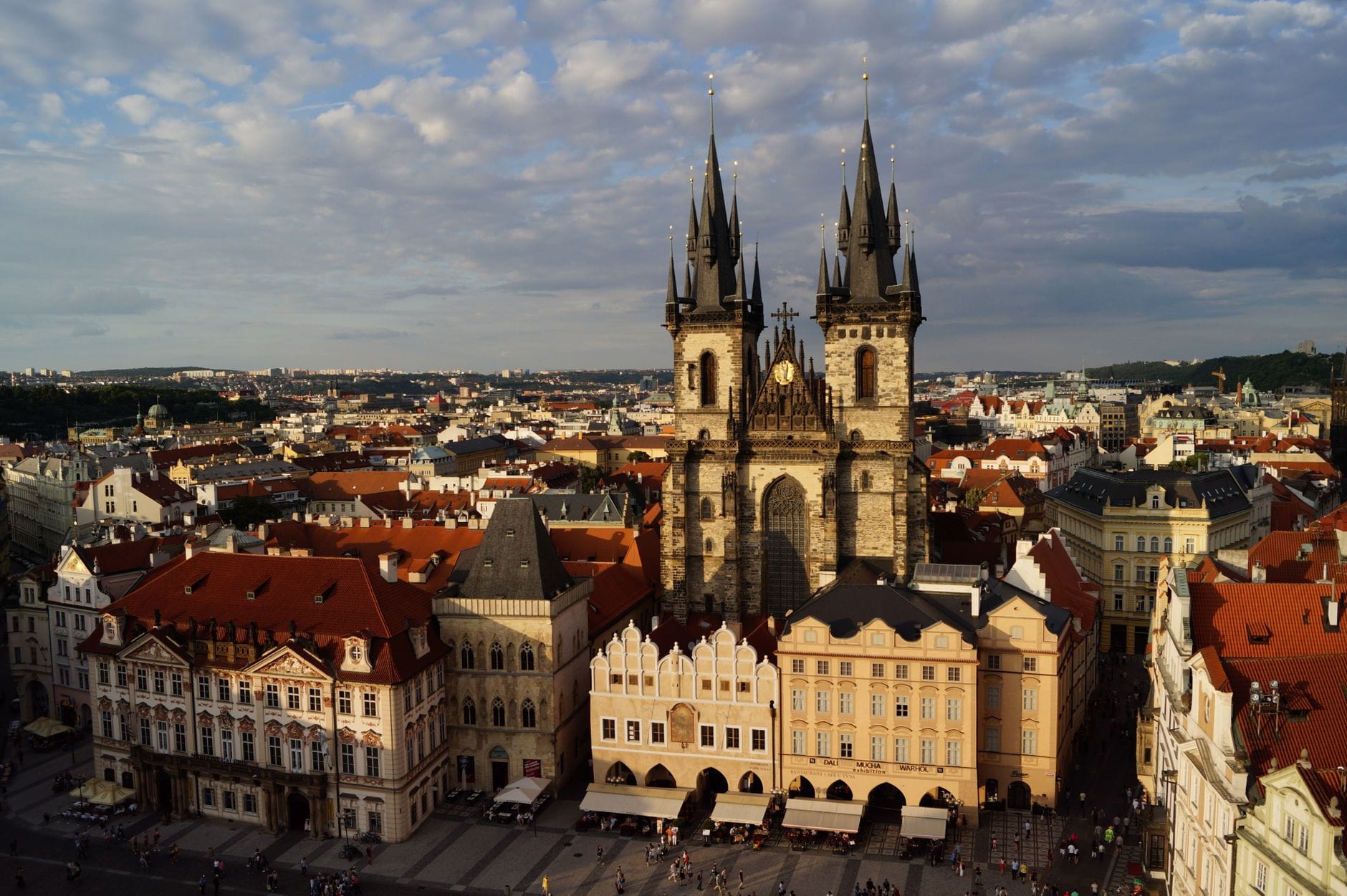
The Church of Our Lady before Týn is Prague's most recognizable Gothic landmark, its twin 80-metre spires rising sharply above the rooflines of Old Town Square. Entry is free, but visiting hours are short and the interior tells a story most visitors walk past without ever stepping inside.
Quick Facts
- Location
- Staroměstské náměstí 604, Old Town (Staré Město), Prague 1
- Getting There
- Metro A: Staroměstská; Metro B: Náměstí Republiky; Trams 6, 8, 15, 26 to Náměstí Republiky
- Time Needed
- 30–45 minutes inside; allow extra time on Old Town Square
- Cost
- Free entry; recommended donation approx. 25–40 CZK
- Best for
- Architecture enthusiasts, history buffs, visitors wanting a quiet moment away from the square's crowds
- Official website
- http://www.tyn.cz
The Church You Keep Photographing But May Never Enter
The Church of Our Lady before Týn (Czech: Kostel Matky Boží před Týnem) is the defining silhouette of Prague's Old Town Square. Its twin Gothic spires, each rising to about 80 metres, pierce the skyline in a way that feels almost theatrical, especially when framed against a grey winter sky or lit from below at night. Yet a surprising number of visitors photograph the exterior and never step inside, partly because the entrance is easy to miss.
The facade is concealed behind a row of Renaissance and Baroque houses that line the square. To enter, you pass through a narrow archway tucked beneath those buildings and follow a short passage that opens into the church's north portal. It is an anticlimactic approach for such a grand building, and in peak season the passage can feel uncertain to first-time visitors who aren't sure they've found the right door. You have.
💡 Local tip
The entrance to Týn Church is NOT directly from Old Town Square. Look for the archway through the houses on the north side of the square. A small sign marks the passage.
Six Centuries of Gothic and Baroque in One Building
Construction of the current church began in the mid-14th century on the site of an earlier Romanesque structure, and continued well into the early 16th century. The result is a mature Gothic building with soaring nave vaulting and the characteristic vertical emphasis of Central European late Gothic architecture. The spires were completed around 1511, each crowned with a small gold sphere and star, which catch light unpredictably throughout the day.
The interior was substantially reworked in Baroque style at the end of the 17th century, meaning what you walk into today is a layered space, Gothic bones with Baroque furnishings. The main altar, painted in the high Baroque manner, occupies the east end with considerable theatricality. Side altars and chapels are richly decorated, some still with medieval elements visible. The contrast between the soaring Gothic ribbed vaulting overhead and the heavily ornamented Baroque furnishings below is not always harmonious, but it is genuinely interesting to read.
The church also houses what is documented as the oldest organ in Prague, dating from 1673. It sits in the organ loft above the entrance and, while not always audible during visitor hours, is occasionally used for concerts. If organ music is your interest, checking the church's official concert schedule at tyn.cz is worthwhile.
For context on how Týn fits into Prague's broader architectural story, the Prague architecture guide covers the city's Gothic, Baroque, and Art Nouveau layers in more depth.
Tickets & tours
Hand-picked options from our booking partner. Prices are indicative; availability and final rates are confirmed when you complete your booking.
Self guided tour with interactive city game of Prague
From 5 €Instant confirmationFree cancellationPrague by night city tour
From 27 €Instant confirmationFree cancellationPrague city tour with Vltava River cruise
From 38 €Instant confirmationFree cancellationPrague 6-Hour tour with river boat cruise and lunch
From 89 €Instant confirmationFree cancellation
What the Interior Actually Looks Like
Inside, the space is darker than many visitors expect. The windows, though Gothic in form, do not admit as much light as equivalents in French cathedrals, and the Baroque alterations added further dark-toned paintings and gilded detail that absorbs rather than reflects light. On a bright summer morning, shafts of light move across the stone floor and pews in ways that are worth pausing to watch. On an overcast afternoon, the atmosphere tips toward the sombre and genuinely contemplative.
The nave is long and relatively narrow, flanked by side aisles separated by clustered Gothic pillars. Underfoot, the floor is uneven in places, worn stone that has been walked on for centuries. The smell is typical of an active Catholic church: cold stone, faint incense residue, and candlewax from the votive stands near the side chapels. It is quiet inside during normal visiting hours, and that quietness, a few steps from one of Europe's most photographed public squares, is itself notable.
⚠️ What to skip
Photography is not permitted inside the church. Silence is expected throughout. These rules are enforced, so plan to observe rather than document.
Týn Church and the Hussite History of Prague
Týn Church carries significant weight in Czech religious history. In the early 15th century, it was the principal church of the Hussite movement in Prague, a reformist religious movement that predated the Protestant Reformation by nearly a century. The Utraquists, one of the main Hussite factions, held the church from around 1419 until the Habsburgs reasserted Catholic dominance after the Battle of White Mountain in 1620. For roughly two hundred years, Týn was effectively the spiritual centre of reformed Christianity in Bohemia.
After 1620, the church was recatholicised and the Baroque remodelling followed. A gilded chalice, the Hussite symbol that had been mounted on the facade, was melted down and recast into the halo of the Virgin Mary that still decorates the tympanum above the main portal. That detail, a symbol of one faith literally transformed into an emblem of another, is one of the more pointed pieces of religious history visible anywhere in Central Europe.
The full sweep of Prague's religious and political upheavals, including the Hussite period and the Baroque Counter-Reformation, is covered in the Prague history guide.
How the Experience Changes by Time of Day
Visiting early in the morning, as soon as the church opens at 10:00, gives you the quietest interior. Old Town Square outside is already accumulating tour groups by that hour, but inside Týn the first thirty minutes of opening are often nearly empty. The light at that time enters from the east end and catches the main altar paintings directly.
Midday visits in summer tend to coincide with guided tour groups flowing in and out. The church is not large by cathedral standards, and a group of twenty people fills a side aisle noticeably. The afternoon slot, 15:00 to 17:00, tends to be calmer on weekdays outside peak summer. On Sundays, the visiting window is much shorter (around 10:30 to 12:00) and often disrupted by the tail end of morning mass.
At night, once the church is closed, the exterior is floodlit and the towers read magnificently against a dark sky. The square fills with people in the evening, and a long lens pointed up at the spires from the middle of the square, with the Astronomical Clock to your left, produces the most iconic Prague composition there is. No entry required for that.
Old Town Square after dark, and how Týn Church looks from different angles around it, is covered in the guide to the best views in Prague.
Practical Visiting Information
Visiting hours are limited compared to most major European churches. Standard public visiting hours run Tuesday through Saturday, 10:00 to 13:00 and again 15:00 to 17:00. On Sundays the church is open approximately 10:30 to 12:00. It is closed to tourists on Mondays. These hours are subject to change for religious services, holidays, and special events, so confirming at tyn.cz before your visit is recommended, particularly around Easter and Christmas.
Entry is free. A donation box near the entrance suggests contributions of around 25 to 40 CZK. There are no timed slots or advance bookings required. The church can be reached on foot from both the Staroměstská metro station (Line A, green line) in about five minutes, or from Náměstí Republiky (Line B, yellow line) in about eight minutes. Trams 5, 8, 24, and 26 also serve Náměstí Republiky. The Old Town is largely pedestrianised, so arriving by car is impractical.
Mobility access to the interior is limited by the passage entrance and the age of the building. There are no formal disability access facilities documented. Visitors with significant mobility needs should contact the church directly before visiting. The interior floor is uneven stone in places.
ℹ️ Good to know
The church is an active Catholic parish, not a museum. Services take precedence over tourist visits. If you arrive during a service, visitor access will be suspended until it concludes.
Is It Worth Your Time?
The honest answer is yes, but with calibrated expectations. Týn Church is not Cologne Cathedral or Chartres. It is a significant Gothic church with a genuinely interesting interior and a history that most guidebook summaries underserve. The combination of Gothic architecture, Baroque layering, and specific Hussite historical resonance makes it worth thirty to forty minutes for anyone with even moderate interest in European religious history or architecture.
Visitors who are primarily interested in photographing the exterior and moving on should know that the best views are from Old Town Square itself, at any hour, free of charge, and unaffected by opening times. The interior rewards those who go in with some background knowledge of what they are looking at. Without it, the space can read as simply a dark old church.
If you are planning a full day in the Old Town, the Old Town Square and the nearby Prague Astronomical Clock can be combined with a Týn visit in a single morning walk.
Insider Tips
- The passage entrance beneath the Týn School building is easy to walk past. Look for the arch at street level on the north side of Old Town Square, between the school facade and the neighbouring houses. A modest sign is usually visible, but it does not shout for attention.
- If you want organ music, Týn Church hosts occasional classical concerts using its 1673 organ. Check the schedule at tyn.cz for upcoming performances. The acoustics inside, while not perfect, are far better suited to baroque organ than to crowd noise.
- The best exterior photography is from the far south side of Old Town Square, near the Jan Hus monument, pointing north-northeast toward the spires. Early morning light strikes the facade directly, and the square has notably fewer people before 9:00 AM, even in summer.
- The church observes silence strictly. Staff or wardens will intervene if visitors speak loudly, use flash photography, or attempt to film. Going in with the mindset of a respectful visitor rather than a tourist attraction guest will make the experience noticeably better.
- In December, the Christmas market on Old Town Square frames the illuminated Týn spires in a way that turns the exterior into one of the most atmospheric Christmas scenes in Central Europe. The market adds crowd pressure, but the evening view of the church above the market stalls is worth the company.
Who Is Church of Our Lady before Týn For?
- Architecture enthusiasts interested in Gothic and Baroque layering within a single building
- History-focused travellers who want to understand the Hussite Reformation in a physical context
- Visitors looking for a few quiet minutes away from Old Town Square without walking far
- Classical music lovers, for the concert programme featuring Prague's oldest organ
- Photographers working the Old Town Square skyline at dawn, dusk, or during the Christmas market season
Nearby Attractions
Other things to see while in Old Town (Staré Město):
- Church of St. Nicholas (Old Town)
Standing in the north-west corner of Old Town Square, St. Nicholas Church is a compact Baroque masterpiece built between 1732 and 1737. Entry is free, the interior is genuinely beautiful, and most visitors walk past it without stopping. Here is why they should not.
- Clementinum
The Clementinum is one of the largest building complexes in Prague, stretching over 2 hectares in the heart of Old Town. Its guided tours take visitors into a breathtaking Baroque library hall and up a narrow tower for panoramic rooftop views over the city's spires.
- Estates Theatre (Stavovské divadlo)
The Estates Theatre in Prague's Old Town is one of the best-preserved 18th-century opera houses in Europe, and one of the surviving venues where Mozart himself conducted. Built in 1783, it staged the world premiere of Don Giovanni and remains an active performance space under the National Theatre umbrella.
- House of the Black Madonna (Czech Cubism Museum)
Built in 1911–1912 by Josef Gočár, the House of the Black Madonna is the first Cubist building in Prague and one of the most architecturally significant structures in Old Town Prague. Today it houses the Czech Cubism permanent exhibition of the Museum of Decorative Arts, alongside the Grand Café Orient and a specialist design shop.