Powder Tower (Prašná brána): The Gothic Gate at the Edge of Old Town
Standing 65 metres tall at the boundary of Prague's Old Town, the Powder Tower is a late-Gothic gate tower with a viewing gallery at 44 metres. Built in 1475 under King Vladislav II, it offers close-up views of the Municipal House facade and a bird's-eye perspective over the rooftops toward Wenceslas Square. The climb is steep and narrow, but the tower itself is among the most architecturally refined medieval structures still standing in central Prague.
Quick Facts
- Location
- Náměstí Republiky 5, Staré Město, Praha 1 — at the eastern edge of Old Town
- Getting There
- Metro Line B (yellow): Náměstí Republiky. Trams 5, 8, 24, 26: stop Náměstí Republiky
- Time Needed
- 30–45 minutes for the tower; allow extra time to explore the Municipal House next door
- Cost
- Adults 200 CZK, concessions 130 CZK, family ticket 400 CZK, under-5s free. First hour: 50% discount. Prices subject to change — verify at prague.eu before visiting.
- Best for
- Architecture enthusiasts, rooftop views, history of medieval Prague, photography
- Official website
- prague.eu/en/objevujte/powder-gate-tower-prasna-brana
What the Powder Tower Actually Is
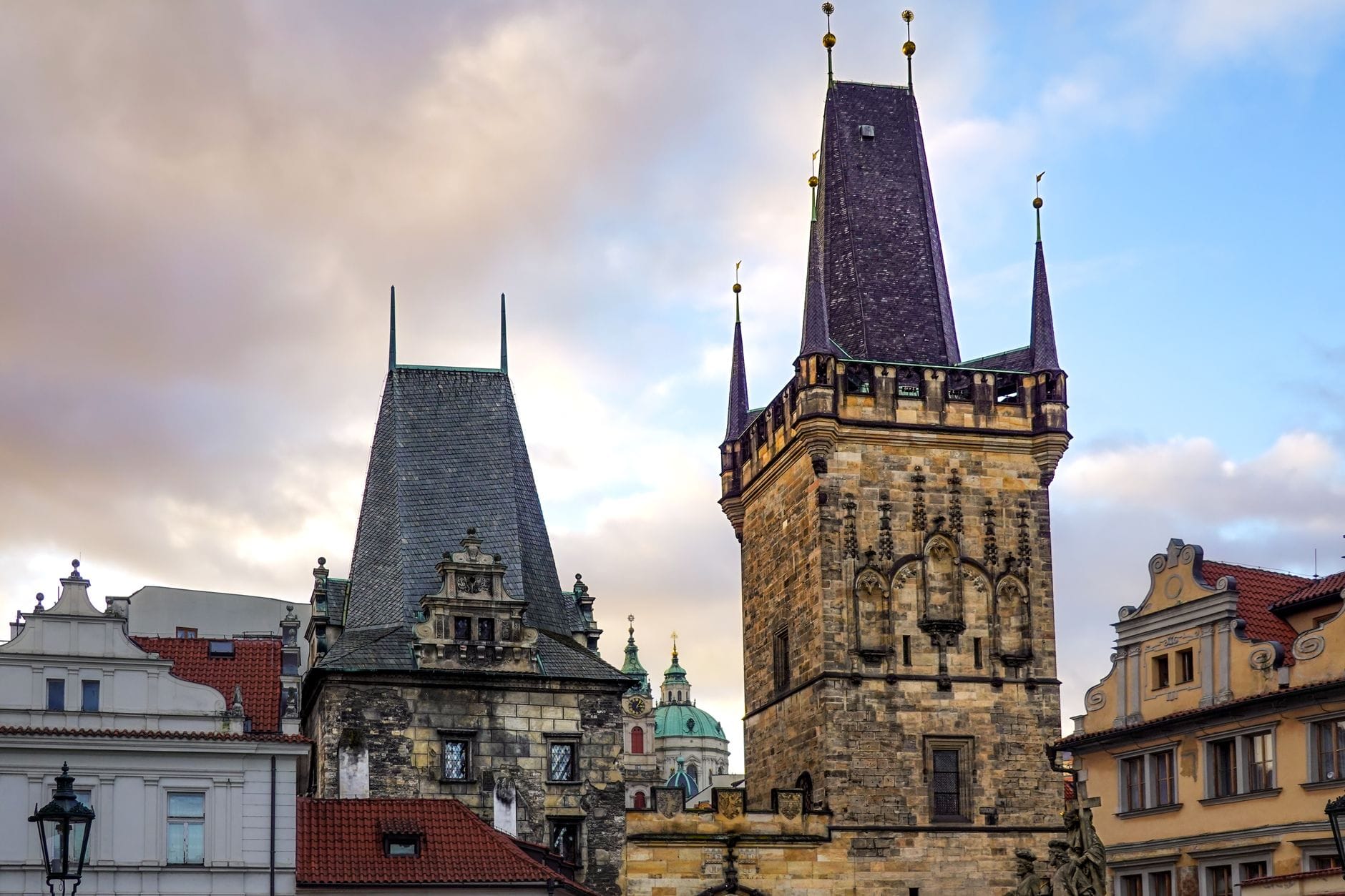
The Powder Tower (Czech: Prašná brána) is a free-standing Gothic gate tower that once marked one of the 13 entrances into Prague's Old Town. At roughly 65 metres tall, with a public viewing gallery at 44 metres, it is both an observation point and a piece of medieval urban infrastructure that has survived more than five centuries in one of Europe's most historically dense city centres.
Construction began in 1475 under King Vladislav II, who intended it as the ceremonial entrance gate adjacent to the Royal Court — the royal residence at the time. The tower was originally called the 'New Tower.' It was never completed to its original design during the medieval period. After the royal residence moved to Prague Castle, the project stalled, and the unfinished tower sat in a reduced state for centuries. In the 17th century, it began serving a more mundane purpose: storing gunpowder. That functional role gave it the name it still carries today.
The tower's current appearance owes much to a neo-Gothic restoration carried out between 1875 and 1886 under architect Josef Mocker, who was also responsible for restorations at St. Vitus Cathedral. Mocker's work gave the tower its densely carved upper section and the pointed spire visible from street level. The distinction between original 15th-century stonework and 19th-century restoration is subtle from the ground, but the overall effect is a convincingly Gothic structure, richer in decorative detail than most visitors expect.
💡 Local tip
Arrive in the first hour after opening to get the 50% admission discount. On weekdays in spring and autumn, that window (10:00–11:00 outside summer) is also when crowd pressure is lowest.
The Climb: What You'll Encounter on the Way Up
The ascent to the gallery involves 186 stone steps arranged in a tight, dimly lit spiral staircase. The steps are worn smooth in places from centuries of foot traffic, and the stairwell is narrow enough that two people passing in opposite directions requires one party to press against the wall. Handrails are present on one side. The climb takes most visitors around 5 to 10 minutes depending on pace, but the confined space and continuous rotation can cause disorientation for anyone prone to dizziness.
There is no elevator. The tower is not accessible to wheelchair users or visitors with significant mobility limitations. This is not a criticism — it is a 15th-century gate tower — but it is worth stating plainly before purchasing tickets. Children under about 6 or 7 may find the steps challenging, and the gallery railing height, while adequate for adults, should be taken into account for very young children.
Partway up, there is a small exhibition space inside the tower body covering the history of the structure, the Royal Court, and the surrounding area. The displays are informative without being exhaustive — worth a few minutes before continuing upward rather than on the way down when the main staircase tends to back up with descending visitors.
⚠️ What to skip
The spiral staircase is stone, steep, and can be slippery when wet. Wear closed, flat-soled shoes. Avoid visiting immediately after heavy rain if you have any concerns about grip on smooth stone.
Tickets & tours
Hand-picked options from our booking partner. Prices are indicative; availability and final rates are confirmed when you complete your booking.
Prague Evening Walk and Bridge Tower Entrance Ticket
From 35 €Instant confirmationFree cancellationPrague Walking Tour with Admission to the Astronomical Clock Tower
From 45 €Instant confirmationFree cancellationKarlovy Vary Tour from Prague with Watchtower and Funicular
From 83 €Instant confirmationFree cancellationTicket to Prague Žižkov Television Tower with online audio guide
From 16 €Instant confirmationFree cancellation
The View from 44 Metres: What You Actually See
The gallery wraps around the exterior of the tower and offers views in all directions. The most striking is the view directly below and to the west: the Art Nouveau facade of the Municipal House fills the immediate foreground, its copper dome and ornate detail visible at a level you cannot appreciate from street level. It is one of the better architectural viewpoints in the city for that specific building.
Looking southwest, the spires of the Church of Our Lady Before Týn rise above the roofline of Old Town Square, with the red-roofed expanse of Staré Město stretching behind them. On a clear day, the hills of Žižkov and Vinohrady are visible to the east, and the Žižkov Television Tower is easily identifiable.
Toward the north, the view opens over the commercial streets leading toward Náměstí Republiky and beyond. This is not a panoramic alpine overlook — Prague's Old Town is not particularly hilly — but the gallery height is enough to frame the roofscape in a way that gives genuine spatial context to the neighbourhood. Photography toward the west in the afternoon, when the Municipal House is in shadow and the light is diffuse, tends to produce cleaner results than shooting into midday sun.
💡 Local tip
For the best light on the Municipal House facade from the gallery, visit in morning hours when the sun is to the east and the building's Art Nouveau details catch soft, directional light. Late afternoon works well for views westward over the Old Town rooftops.
How the Experience Changes by Time of Day and Season
Morning visits before 11:00, particularly on weekdays outside of summer peak months, offer the most comfortable experience. The narrow staircase can become a single-file queue during busy afternoon periods in July and August, when the tower's limited capacity and the one-way stairwell system create waiting time both going up and coming down.
In summer (June to September), the tower opens at 9:00 and stays open until 20:30, which makes late-afternoon and early-evening visits genuinely pleasant. The gallery at dusk, with the Municipal House lit below and the Old Town beginning to settle, is a different atmosphere from the midday tourist peak. In winter months, the tower closes at 18:00, and the shorter days mean the gallery is in full daylight only during a narrow midday window. December does offer one advantage: the views down toward Náměstí Republiky occasionally include Christmas market stalls and crowds below, which gives the standard rooftop view an additional layer of seasonal interest.
Rain does not prevent entry, but the outdoor gallery can be unpleasant in heavy downpours, and wind at 44 metres is noticeably stronger than at street level. A light layer is advisable even in summer. In winter, the stone staircase interior is cold throughout.
Historical and Architectural Context
The Powder Tower sits at the former eastern boundary of medieval Prague's Old Town, adjacent to what was once the Royal Court (Královský dvůr), the residence of Bohemian kings before Prague Castle was refashioned as the primary royal seat. The tower's original purpose was ceremonial as much as defensive: it was the formal entry point through which coronation processions passed en route from the Royal Court toward the castle across the river. That Royal Route — from Náměstí Republiky along Celetná Street through Old Town Square and across Charles Bridge — remains one of the most historically coherent walks in Prague.
The tower's location on the boundary between Old Town and New Town (Nové Město) also reflects medieval Prague's layered development. Old Town was established by the early 13th century; New Town was laid out in the 14th century under Charles IV in a planned expansion that is still evident in the wider street grid to the south. The Powder Tower marks that seam between two distinct urban layers, which explains its position at what now feels like a major commercial intersection rather than at the edge of a fortification system.
For visitors interested in the broader arc of Prague's medieval and Baroque development, the Prague history guide provides useful background on how the city's various districts evolved across different eras.
Opening Hours and Getting There
The Powder Tower is open daily year-round with seasonal hours. January through March and October through November: 10:00 to 18:00. April through May: 10:00 to 19:00. June through September: 9:00 to 20:30. December: 10:00 to 19:30. These hours are subject to change — confirm at prague.eu before planning your visit.
The tower is directly at Náměstí Republiky, served by Metro Line B (yellow line) at the station of the same name. Tram lines 5, 8, 24, and 26 also stop directly at Náměstí Republiky. From the metro exit, the tower is visible immediately — it takes under a minute to walk to the entrance. From the Old Town Square, it is a straightforward 8-minute walk east along Celetná Street.
If you are planning a full day in the area, the tower fits naturally into a morning walk through Old Town Prague that includes the Municipal House, Celetná Street, and Old Town Square. The Prague walking tour guide covers this route in practical detail.
Is It Worth It? An Honest Assessment
The Powder Tower is worth the admission for anyone with genuine interest in Gothic architecture, the history of medieval Bohemia, or rooftop photography of Old Town's skyline. The tower itself — its stonework, its scale, its position — is impressive, and the close-up view of the Municipal House from the gallery is something you cannot replicate from the street.
It is not, however, Prague's best viewpoint. The gallery is relatively narrow, the views are partially obstructed by the tower's own architectural elements in certain directions, and the height is modest compared to Petrin Lookout Tower or the Old Town Hall Tower. Visitors whose primary goal is a sweeping 360-degree panorama of Prague may find those alternatives more satisfying. The Powder Tower rewards curiosity about architecture and medieval urban history more than it rewards pure sightseeing.
For a comparison of Prague's main elevated viewpoints, the best views in Prague guide lays out the trade-offs between the main options clearly.
Insider Tips
- Buy your ticket in the first hour after opening for a 50% discount — this is an official discount, and it applies every day.
- The exhibition space mid-tower is easy to rush past. It contains scale models and documents relating to the Royal Court that once stood next door, and it gives the tower's history considerably more texture than the entry signage does.
- If you plan to also visit the Municipal House (which has its own ticketed interiors and a free-access Art Nouveau café), do it after the tower rather than before — the gallery view makes the building's facade far more meaningful when you have just seen it from above.
- The staircase narrows significantly in its upper section. Larger bags and backpacks become cumbersome; leave anything bulky in a locker or at your accommodation.
- Weekday mornings in April, May, September, and October are the quietest periods. Summer Saturday afternoons between 13:00 and 16:00 are the most crowded, and the stairwell can develop a queue in both directions.
Who Is Powder Tower (Prašná brána) For?
- Architecture and history enthusiasts who want to understand Prague's medieval layout from an elevated perspective
- Photographers looking for an unusual angle on the Municipal House facade and Old Town roofscape
- Visitors following the historic Royal Route who want to understand the ceremonial geography of medieval Bohemia
- Travellers on a Prague city break with a half-day in Old Town and interest in going beyond the surface-level sights
- Anyone who wants a rooftop view with genuine historical context, rather than just altitude
Nearby Attractions
Other things to see while in Old Town (Staré Město):
- Church of Our Lady before Týn
The Church of Our Lady before Týn is Prague's most recognizable Gothic landmark, its twin 80-metre spires rising sharply above the rooflines of Old Town Square. Entry is free, but visiting hours are short and the interior tells a story most visitors walk past without ever stepping inside.
- Church of St. Nicholas (Old Town)
Standing in the north-west corner of Old Town Square, St. Nicholas Church is a compact Baroque masterpiece built between 1732 and 1737. Entry is free, the interior is genuinely beautiful, and most visitors walk past it without stopping. Here is why they should not.
- Clementinum
The Clementinum is one of the largest building complexes in Prague, stretching over 2 hectares in the heart of Old Town. Its guided tours take visitors into a breathtaking Baroque library hall and up a narrow tower for panoramic rooftop views over the city's spires.
- Estates Theatre (Stavovské divadlo)
The Estates Theatre in Prague's Old Town is one of the best-preserved 18th-century opera houses in Europe, and one of the surviving venues where Mozart himself conducted. Built in 1783, it staged the world premiere of Don Giovanni and remains an active performance space under the National Theatre umbrella.