Vrtba Garden (Vrtbovská zahrada): Prague's Most Refined Baroque Garden
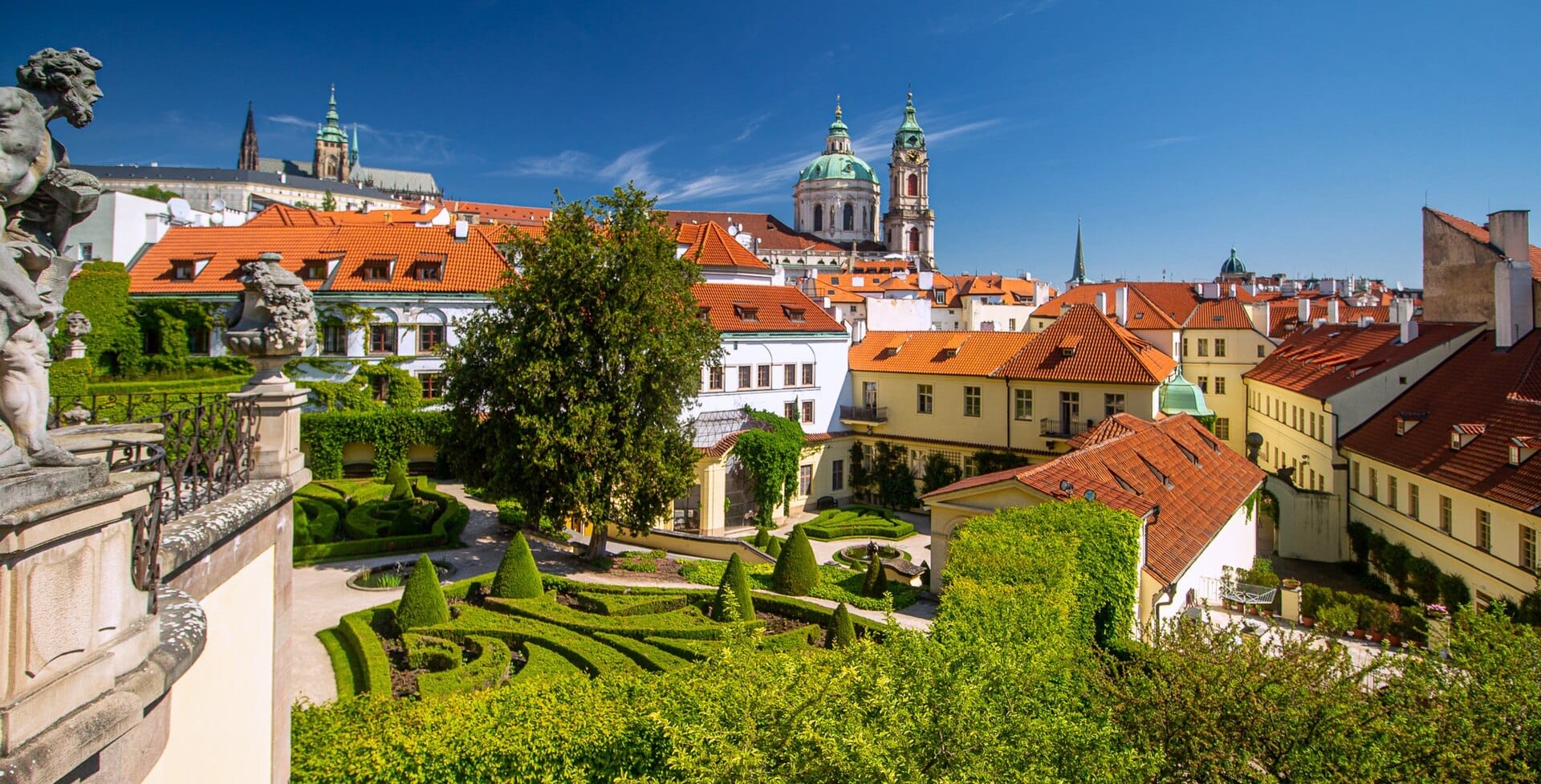
Tucked behind an unassuming palace gate on Karmelitská Street in Malá Strana, Vrtba Garden is a tiered Baroque masterpiece designed around 1715–1720. Small, quiet, and sculpted into the slope of Petřín Hill, it offers one of the most composed views of Prague's rooftops — and a genuine break from the street-level crowds.
Quick Facts
- Location
- Karmelitská 25, Malá Strana, Prague 1
- Getting There
- Tram to Malostranské náměstí (lines 12, 20, 22)
- Time Needed
- 45–75 minutes
- Cost
- 150 CZK adult; reduced rates available. Verify current prices before visiting.
- Best for
- Architecture lovers, photographers, couples, anyone seeking calm above the Malá Strana crowd
- Official website
- www.vrtbovska.cz/en
What Vrtba Garden Actually Is
Vrtba Garden (Czech: Vrtbovská zahrada) is a terraced Baroque garden on the lower slope of Petřín Hill in Malá Strana, Prague's historic left-bank quarter. Covering just 0.31 hectares, it is one of the smallest major gardens in the city — and, by most measures, the most architecturally composed. It climbs from around 197 to 212 metres above sea level across several stone-balustraded terraces, connected by formal staircases and punctuated by sculptures and ornamental plantings.
The entrance sits through the courtyard of Vrtba Palace on Karmelitská Street. There is no dramatic signage. Many people walk past the gate without realising what lies beyond it, which partly explains why the garden remains quieter than its quality warrants. Once inside the palace courtyard, a modest door leads to the lowest terrace, and the climb begins.
💡 Local tip
The entrance is easy to miss. Look for the gate at Karmelitská 25, just a short walk south from Malostranské náměstí tram stop. If you reach the Church of Our Lady Victorious, you've gone slightly too far.
History and Architectural Significance
The garden was created in the early 18th century for Count Jan Josef of Vrtba, one of the senior court officials of Bohemia. The design was executed around 1715–1720 by František Maxmilián Kaňka, a leading Czech Baroque architect whose work was closely tied to the circle of Johann Bernhard Fischer von Erlach. Kaňka's plan follows strict Italian Renaissance terracing principles, adapted to the natural gradient of Petřín's lower flank.
The sculptures are the work of Matyáš Bernard Braun, the most celebrated stone carver of the Czech Baroque period, whose figures of mythological figures and caryatids give the balustrades an expressive, almost theatrical weight. The sala terrena (the garden pavilion at the base) carries ceiling frescoes painted by Václav Vavřinec Reiner. Together, Kaňka, Braun, and Reiner represent the finest artistic collaboration of Bohemian Baroque — and this garden is arguably the most intact surviving product of that partnership.
The garden fell into disrepair over the 20th century and underwent eight years of painstaking restoration before reopening to the public in 1998. It is part of the UNESCO World Heritage Site designation covering Malá Strana and the historic core of Prague. That designation is not incidental — the garden represents a rare, nearly complete example of high Baroque landscape design within the city.
Tickets & tours
Hand-picked options from our booking partner. Prices are indicative; availability and final rates are confirmed when you complete your booking.
Must-sees of Prague guided tour with Wallenstein Palace Gardens
From 26 €Instant confirmationFree cancellationPrague Renaissance and Baroque gardens tour with a friendly historian
From 43 €Instant confirmationSelf guided tour with interactive city game of Prague
From 5 €Instant confirmationFree cancellationPrague by night city tour
From 27 €Instant confirmationFree cancellation
The Experience: Moving Through the Garden
From the first terrace, the garden feels orderly and restrained. Low clipped hedgerows border the paths, rose beds anchor the central axes, and the stone balustrades frame the views without overwhelming them. The planting is formal but not sterile — in late spring and summer, the roses are in strong colour, and the scent at mid-morning, before the stone warms fully, is one of the more pleasant sensory surprises the garden offers.
As you climb, the city gradually reveals itself. By the upper terrace, the view across the orange-tiled rooftops of Malá Strana toward the Old Town and the curve of the Vltava is clear and largely unobstructed. The copper dome of St. Nicholas Church anchors the middle distance. This is one of the better rooftop-level views in Prague, achieved without a tower, a queue, or a ticket machine — just the steady ascent through a Baroque garden.
The sala terrena at the base is worth a close look. Braun's carved figures frame the entrance, and Reiner's frescoes inside have survived in reasonable condition. Photographers often focus on the upper terrace view, but the detail work in the pavilion — the grain of the stone, the expression in the masks, the faded warmth of the painted ceiling — rewards slower attention. For broader context on Prague's Baroque streetscape, Prague's architecture guide covers how this period shaped the city's visual character.
How the Garden Changes by Time of Day
Morning visits, from opening until around noon, offer the clearest light for photography and the fewest people. The garden faces generally south and west, so morning light falls obliquely across the terraces, throwing the balustrade sculpture into clear relief. By midday in summer, the stone surfaces hold heat and the open terraces feel exposed — not unpleasant, but noticeably warm.
Late afternoon is probably the most photogenic window. From roughly 3pm onward, the low western light catches the Braun sculptures directly and the city rooftops glow with a warmth that is difficult to achieve earlier. The garden is also quieter at this hour than it is mid-morning, when tour groups sometimes pass through. Sunset itself is mostly missed from here — the garden closes at 18:00 and the relevant western sightlines are partly blocked by the hillside above — so this is not the place for a dramatic last-light shot of the city.
ℹ️ Good to know
Vrtba Garden is open daily from April to October, 10:00–18:00. It closes entirely in winter. Confirm the season opening date on the official site (vrtbovska.cz) before visiting. It closes entirely in winter. Confirm the season opening date on the official site (vrtbovska.cz) before visiting in March or late October.
Practical Information for Visitors
Getting here is straightforward. Take any tram to Malostranské náměstí — lines 12, 20, 22, and 23 all stop there — then walk south along Karmelitská Street for roughly two to three minutes. The garden is compact enough that 45 to 75 minutes covers it comfortably, including time to sit, photograph, and examine the sculpture in detail. There is no café inside the garden, so bring water on warm days.
Admission prices at time of writing are 150 CZK for adults, with reduced rates for children, students, and seniors, and a family ticket option. These figures vary by source and are subject to change; check the official site or prague.eu for current pricing before you go. Cash and card payment options may vary at the gate.
Accessibility is a real limitation here. The garden is built on a slope and connected entirely by stone staircases. There is no lift or ramp access between terraces, and the uneven stone surfaces on some paths require reasonable footwear. Visitors with limited mobility or wheelchair users will find much of the garden inaccessible. This is not a design failure so much as an inherent constraint of restoring a 300-year-old terraced hillside garden.
⚠️ What to skip
Vrtba Garden is entirely staircase-based. Wheelchair users and visitors with significant mobility limitations will not be able to access the upper terraces. The sala terrena at ground level is viewable, but the main views require climbing.
Context: Where Vrtba Garden Fits in Malá Strana
Malá Strana contains several Baroque gardens, but most are attached to embassies or private institutions and not open to the public. Vrtba Garden is the exception — a fully public Baroque garden in a neighborhood where that type of access is rare. Visitors exploring the area will find it pairs naturally with Wallenstein Garden to the north, which is larger, more formal, and free to enter, though less elevated and without comparable city views.
The surrounding streets of Malá Strana are worth the walk in themselves. John Lennon Wall is about five minutes on foot, and Kampa Island is within ten. For those planning a full day in the quarter, the Prague walking tour guide maps a logical route through all three.
One honest note on expectations: Vrtba Garden is a refined, quiet, specialist attraction. It does not have the scale of the castle gardens above or the riverfront drama of other Prague viewpoints. Visitors who prefer large open parks, interactive exhibitions, or crowd energy may find it underwhelming. Those who appreciate formal garden design, Baroque sculpture, and unhurried views will likely rate it among the better hours they spend in Prague.
Insider Tips
- Visit on a weekday morning to have the terraces largely to yourself. Weekend midday visits in July and August are the most crowded windows, when tour groups can fill the narrow paths.
- The Braun sculptures on the balustrades are often overlooked by visitors focused on the city view. Take time at the upper terrace balustrade to look at the mythological figures up close — the carving quality is exceptional and rarely acknowledged in general tourism coverage.
- If you are serious about photography, arrive within the first hour of opening. The light is directional, the garden is quiet, and the pale stone surfaces have not yet accumulated the heat haze of midday.
- There is no food or drink inside. On warm days, the exposed upper terraces can be genuinely hot. A bottle of water is worth carrying from one of the shops on Karmelitská before you enter.
- The garden closes for the winter season entirely — not just reduced hours. If you are visiting Prague in November through March, do not plan your itinerary around it without confirming the season has opened on the official site.
Who Is Vrtba Garden For?
- Architecture and design enthusiasts interested in Czech Baroque heritage
- Photographers looking for a mid-elevation rooftop view without queues or tower tickets
- Couples seeking a quiet, unhurried space away from the main Malá Strana foot traffic
- Visitors following a dedicated Baroque Prague itinerary alongside churches and palaces
- Travelers on a half-day Malá Strana walk who want a focused, time-limited highlight
Nearby Attractions
Other things to see while in Malá Strana (Lesser Town):
- Charles Bridge
Charles Bridge is Prague's most recognizable landmark, a 516-metre medieval stone arch bridge lined with 30 Baroque statues linking the Old Town to Malá Strana. Free to cross at any hour, its experience shifts dramatically depending on when you arrive.
- Church of Our Lady Victorious (Infant Jesus of Prague)
Tucked along Karmelitská street in Malá Strana, the Church of Our Lady Victorious is one of Prague's most visited pilgrimage sites. It houses a 16th-century wax-coated wooden statue of the Infant Jesus that draws Catholic pilgrims from across the world, alongside curious visitors exploring Prague's Baroque heritage. Entry is free, and the attached museum adds unexpected depth to the visit.
- Church of St. Nicholas (Malá Strana)
The Church of St. Nicholas in Malá Strana is the most ambitious Baroque building in Prague, rising above the Lesser Town with a copper-green dome that defines the city's skyline. Built between 1704 and 1755, it rewards visitors with extraordinary ceiling frescoes, a soaring interior nearly 60 metres high, and a separate bell tower offering rooftop views across the red-tiled district below.
- Franz Kafka Museum
The Franz Kafka Museum occupies a converted 19th-century brickworks on the Malá Strana riverbank, a short walk from Charles Bridge. It holds original manuscripts, correspondence, photographs, and first editions that illuminate the life and literary world of one of the 20th century's most influential writers. The experience is deliberately unsettling, and that is precisely the point.