Wallenstein Garden: Prague's Most Elegant Free Garden
Hidden behind the walls of a 17th-century palace in Malá Strana, Wallenstein Garden is one of Prague's earliest and largest Baroque gardens. Built between 1623 and 1629, it offers free entry, manicured hedges, bronze sculptures, roaming peacocks, and a remarkable sala terrena loggia — all a short walk from Charles Bridge.
Quick Facts
- Location
- Letenská 123/4, Malá Strana, Prague 1
- Getting There
- Metro Line A – Malostranská station; Tram – Malostranská stop
- Time Needed
- 30–60 minutes
- Cost
- Free entry – no ticket required
- Best for
- History lovers, architecture fans, quiet morning walks, families
What Is Wallenstein Garden?
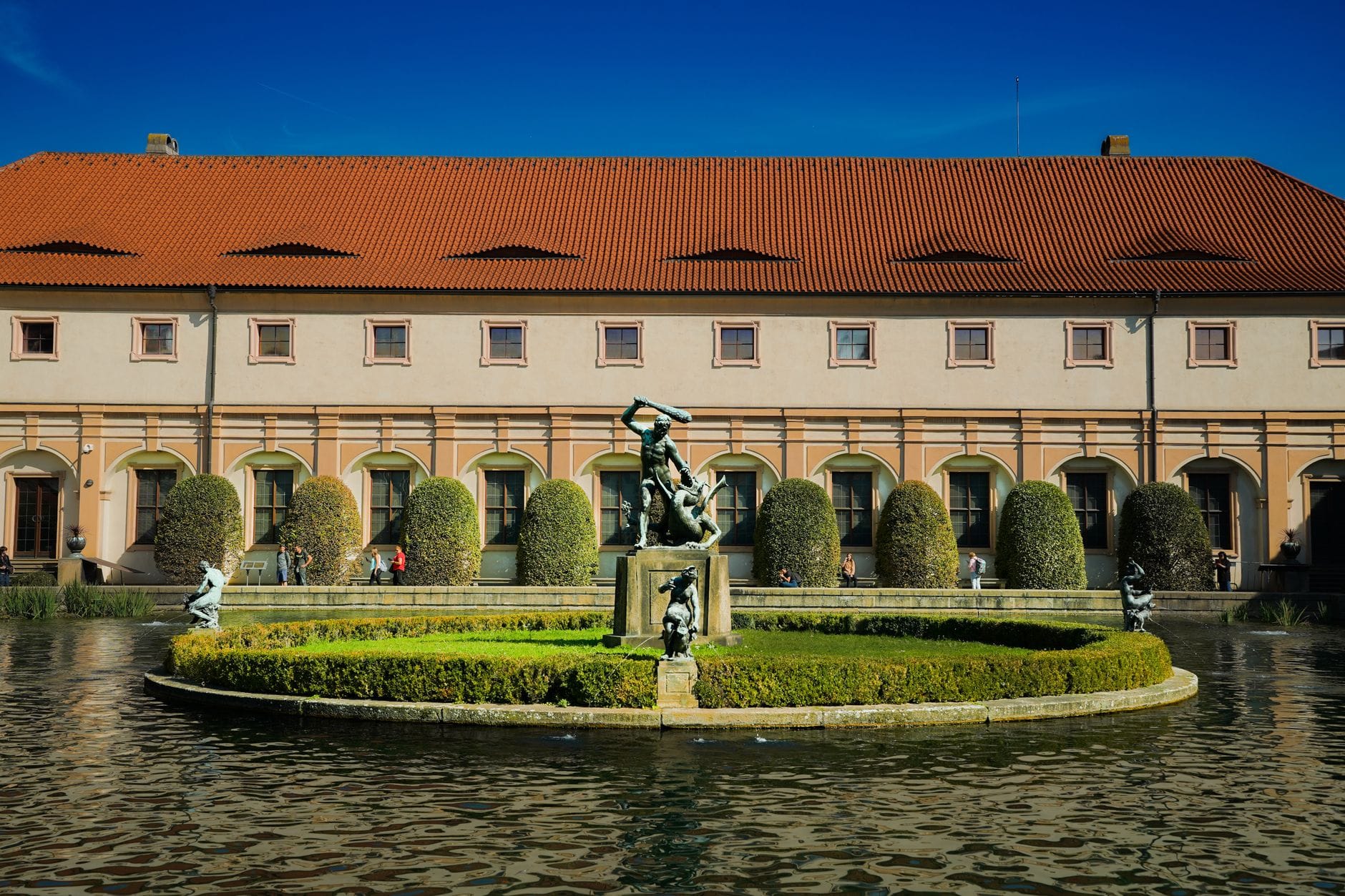
Wallenstein Garden (Czech: Valdštejnská zahrada) is a formal Baroque garden attached to Wallenstein Palace in the Malá Strana quarter of Prague. It was commissioned by Albrecht von Wallenstein, the powerful Bohemian military commander, and built between 1623 and 1629 — making it one of the earliest Baroque gardens in the city. Covering approximately 1.7 hectares, it remains among the largest palace gardens in Prague's city centre and, remarkably, it costs nothing to enter.
Today the palace serves as the seat of the Czech Senate, and the garden is administered accordingly. That institutional ownership has kept it largely free of commercial clutter. There are no souvenir stalls, no food trucks, no ticket kiosks. You walk in through a gate on Letenská street, and the city noise drops away almost immediately.
ℹ️ Good to know
The garden is open seasonally from approximately April to October. Typical hours: Monday–Friday 7:00–19:00; Saturday, Sunday and public holidays 9:00–19:00. Verify current hours with the Senate of the Czech Republic before visiting, as schedules can shift.
The Layout: What You Actually See
The garden follows a strict axial design typical of early 17th-century Italian-influenced Baroque style. A long central gravel avenue bisects the space, flanked by precisely clipped hedges that form geometric compartments. Fountains mark key intersections along the axis, and the sound of water is one of the first things you notice after entering.
The most architecturally striking feature is the sala terrena, a triple-arched loggia at the northern end of the garden. Its interior ceiling is decorated with elaborate fresco paintings depicting mythological and heroic scenes. The loggia is open at the front, so you can step inside and examine the ceiling at close range — a level of access unusual for a space of this age and quality.
Ranged along the main terrace wall is a series of bronze statues. The sculptures you see today are copies; the originals were taken by Swedish troops during the Thirty Years' War in 1648 and remain in Sweden to this day. Even as copies, they're worth examining: the figures depict mythological subjects and are positioned at intervals that reward slow walking rather than a quick pass-through.
At the eastern edge of the garden sits a large pond populated by koi, and peacocks wander the grounds freely. The peacocks are not staged for photographs — they roost, display, and occasionally create noise in ways that feel genuinely incongruous against the formal geometry of the hedges. Children find them reliably entertaining. If you're visiting with younger travelers, see also our notes on exploring Prague with kids, where the garden features as a recommended stop.
Tickets & tours
Hand-picked options from our booking partner. Prices are indicative; availability and final rates are confirmed when you complete your booking.
Must-sees of Prague guided tour with Wallenstein Palace Gardens
From 26 €Instant confirmationFree cancellationPrague Renaissance and Baroque gardens tour with a friendly historian
From 43 €Instant confirmationSelf guided tour with interactive city game of Prague
From 5 €Instant confirmationFree cancellationPrague by night city tour
From 27 €Instant confirmationFree cancellation
How the Garden Changes by Time of Day
Early weekday mornings, from around 7:00 to 9:00, the garden is at its quietest. The gravel paths are still damp, the peacocks are active before the heat builds, and the light angles sharply across the sala terrena's arches. This is when the garden most resembles what it might have looked like in the 17th century — still, ordered, slightly austere.
By mid-morning on weekends, visitor numbers pick up noticeably. Families arrive with children, and small groups of tourists pause at the bronze sculptures or the fountain. Even at its busiest, the garden rarely feels overwhelmed, partly because the formal layout channels people along predictable routes, and partly because 1.7 hectares is enough space to absorb a moderate crowd without losing atmosphere.
Late afternoon in summer brings warm, low light that makes the fresco colours inside the sala terrena appear richer. If you are photographing the loggia interior, come between 16:00 and 18:00 when the sun is lower and direct glare is reduced. In spring, the clipped hedges are at their freshest green, and the fountain basins reflect the sky with unusual clarity.
💡 Local tip
Weekday mornings are significantly quieter than weekend afternoons. If you are coming primarily for photography or simply want the space to yourself, arrive on a Tuesday or Wednesday before 9:00.
Historical Context: Albrecht von Wallenstein and His Garden
Albrecht von Wallenstein (1583–1634) was one of the most powerful figures in Central Europe during the early 17th century. Commander of the Imperial Army during the Thirty Years' War, he amassed extraordinary wealth and used it in part to create a palace complex in Malá Strana that was intended to rival Prague Castle itself. The palace and garden were built with considerable speed between 1623 and 1629, requiring the demolition of around two dozen houses and three gardens to clear the necessary land.
The garden was designed in the Italian Baroque manner, almost certainly with input from Italian architects and designers working in Prague at the time. The sala terrena in particular draws on northern Italian precedents and would have functioned as an outdoor reception space for theatrical and musical performances — a kind of open-air extension of the palace's formal rooms.
Wallenstein was assassinated in 1634, but the palace and garden survived largely intact through the centuries. The complex's fate under different owners eventually brought it into state hands after 1945, and it became the home of the Czech Senate following the dissolution of Czechoslovakia. This political history is woven into the character of Malá Strana as a district, where palaces that once served Baroque aristocrats now house government ministries and embassies.
Getting There and Practical Walkthrough
The most direct route from central Prague is Metro Line A (green line) to Malostranská station. From the station exit, Letenská street runs southwest and the garden's main entrance gate is a three-minute walk. Trams also stop at Malostranská, making this one of the easier attractions in the city to reach without walking a significant hill.
There are multiple entry points: the main gate on Letenská, a secondary entrance near the Malostranská metro exit, and access from the Wallenstein Palace courtyard. If you are approaching from Charles Bridge and walking up through Malá Strana, the Letenská entrance is the most natural. The paths inside are level gravel and compacted earth, broadly accessible to pushchairs and likely navigable for many wheelchair users, though the Senate's official accessibility information is limited and anyone with specific mobility requirements should contact them directly before visiting.
Wallenstein Garden pairs naturally with other sites in the immediate area. Vrtba Garden is a steeper, more intimate Baroque garden a short walk south, and the two together give a useful comparison of how the style evolved across different scales and budgets. If you are exploring the wider neighbourhood, our Prague walking tour guide covers a route through Malá Strana that passes both.
⚠️ What to skip
The garden is closed from roughly November through March. There is no winter access. If you are visiting Prague in the off-season, plan accordingly — the exterior walls give little indication of what lies inside, and you will find the gate locked.
Photography and What to Bring
The sala terrena is the single most photogenic element in the garden. A wide-angle lens or the equivalent setting on a phone camera is useful here, because the full span of three arches is difficult to capture from close range. The ceiling frescoes are best viewed in ambient daylight rather than direct sun; overcast days actually produce more even illumination inside the loggia.
The bronze statue row along the terrace wall photographs well in the morning when the light hits the sculptures from the east. The central fountain makes for a natural compositional anchor if you are shooting along the main axis. Bring comfortable shoes with grip — gravel paths after rain become slightly loose underfoot. No special clothing is required.
For a broader perspective on Prague's garden and rooftop landscapes, the best viewpoints in Prague guide covers elevated spots across the city that complement a ground-level visit to Wallenstein.
Is It Worth Your Time? An Honest Assessment
For a free attraction that takes under an hour to see thoroughly, Wallenstein Garden delivers an unusually high return. The sala terrena alone is architecturally significant and would cost money to access in most comparable European cities. The combination of Baroque geometry, working fountains, quality sculpture, and freely roaming peacocks in a setting less than ten minutes from Charles Bridge is genuinely difficult to find elsewhere.
That said, if you are pressed for time and have to choose between Wallenstein and the paid Baroque gardens on the southern slopes of Prague Castle, those offer more dramatic views and a greater sense of occasion. Wallenstein Garden is more understated — a place for quiet appreciation rather than spectacle. Visitors expecting a public park with benches, shade, and open lawn may find the formal layout more restrictive than expected. The hedges are tall and the design is disciplined; it is not a garden for sprawling on the grass.
If your visit to Prague has more than two days, this garden fits naturally into a Malá Strana afternoon alongside St Nicholas Church and a walk up toward Petřín Hill. For a focused itinerary, see our 3 days in Prague guide.
Insider Tips
- The garden occasionally hosts open-air classical music concerts in summer, usually in the evenings near the sala terrena. Check the Senate's events page before your visit — these events are often free or low-cost and the loggia makes an exceptional acoustic backdrop.
- The Senate holds regular 'open door days' when the Wallenstein Palace interior is also accessible to the public at no charge. These days are announced on the Senate website and are worth timing your visit around if architecture interests you.
- Peacock activity peaks in the early morning. If you want the birds in frame without crowds of other visitors doing the same, arrive shortly after the gate opens on a weekday.
- The secondary entrance near Malostranská metro is less used than the Letenská gate and often has no queue at all, even when the main entrance has a small cluster of arriving visitors.
- The Swedish Army removed the original bronze sculptures in 1648; the replacements you see are period-accurate copies installed later. If you mention this to other visitors, you will almost certainly be the only person there who knows it.
Who Is Wallenstein Garden For?
- Travelers who want a genuine Baroque garden experience without paying admission
- Architecture and art history enthusiasts drawn to the sala terrena's frescoed ceiling
- Families looking for an outdoor space where children can move freely and spot peacocks
- Photographers seeking early-morning light on geometric formal gardens and historic sculpture
- Anyone building a full Malá Strana itinerary who wants a quiet counterpoint to the busier streets
Nearby Attractions
Other things to see while in Malá Strana (Lesser Town):
- Charles Bridge
Charles Bridge is Prague's most recognizable landmark, a 516-metre medieval stone arch bridge lined with 30 Baroque statues linking the Old Town to Malá Strana. Free to cross at any hour, its experience shifts dramatically depending on when you arrive.
- Church of Our Lady Victorious (Infant Jesus of Prague)
Tucked along Karmelitská street in Malá Strana, the Church of Our Lady Victorious is one of Prague's most visited pilgrimage sites. It houses a 16th-century wax-coated wooden statue of the Infant Jesus that draws Catholic pilgrims from across the world, alongside curious visitors exploring Prague's Baroque heritage. Entry is free, and the attached museum adds unexpected depth to the visit.
- Church of St. Nicholas (Malá Strana)
The Church of St. Nicholas in Malá Strana is the most ambitious Baroque building in Prague, rising above the Lesser Town with a copper-green dome that defines the city's skyline. Built between 1704 and 1755, it rewards visitors with extraordinary ceiling frescoes, a soaring interior nearly 60 metres high, and a separate bell tower offering rooftop views across the red-tiled district below.
- Franz Kafka Museum
The Franz Kafka Museum occupies a converted 19th-century brickworks on the Malá Strana riverbank, a short walk from Charles Bridge. It holds original manuscripts, correspondence, photographs, and first editions that illuminate the life and literary world of one of the 20th century's most influential writers. The experience is deliberately unsettling, and that is precisely the point.