Church of Our Lady Victorious: The Shrine of the Infant Jesus of Prague
Tucked along Karmelitská street in Malá Strana, the Church of Our Lady Victorious is one of Prague's most visited pilgrimage sites. It houses a 16th-century wax-coated wooden statue of the Infant Jesus that draws Catholic pilgrims from across the world, alongside curious visitors exploring Prague's Baroque heritage. Entry is free, and the attached museum adds unexpected depth to the visit.
Quick Facts
- Location
- Karmelitská 9, Malá Strana, Prague 1
- Getting There
- Trams 12, 15, 20, 22, 23 – stop at Hellichova, directly next to the church
- Time Needed
- 30–60 minutes for church and museum
- Cost
- Church and museum entry free (sightseeing not permitted during Mass)
- Best for
- Pilgrims, Baroque architecture enthusiasts, quiet reflection, cultural curiosity
- Official website
- pragjesu.cz/en/home
What the Church of Our Lady Victorious Actually Is
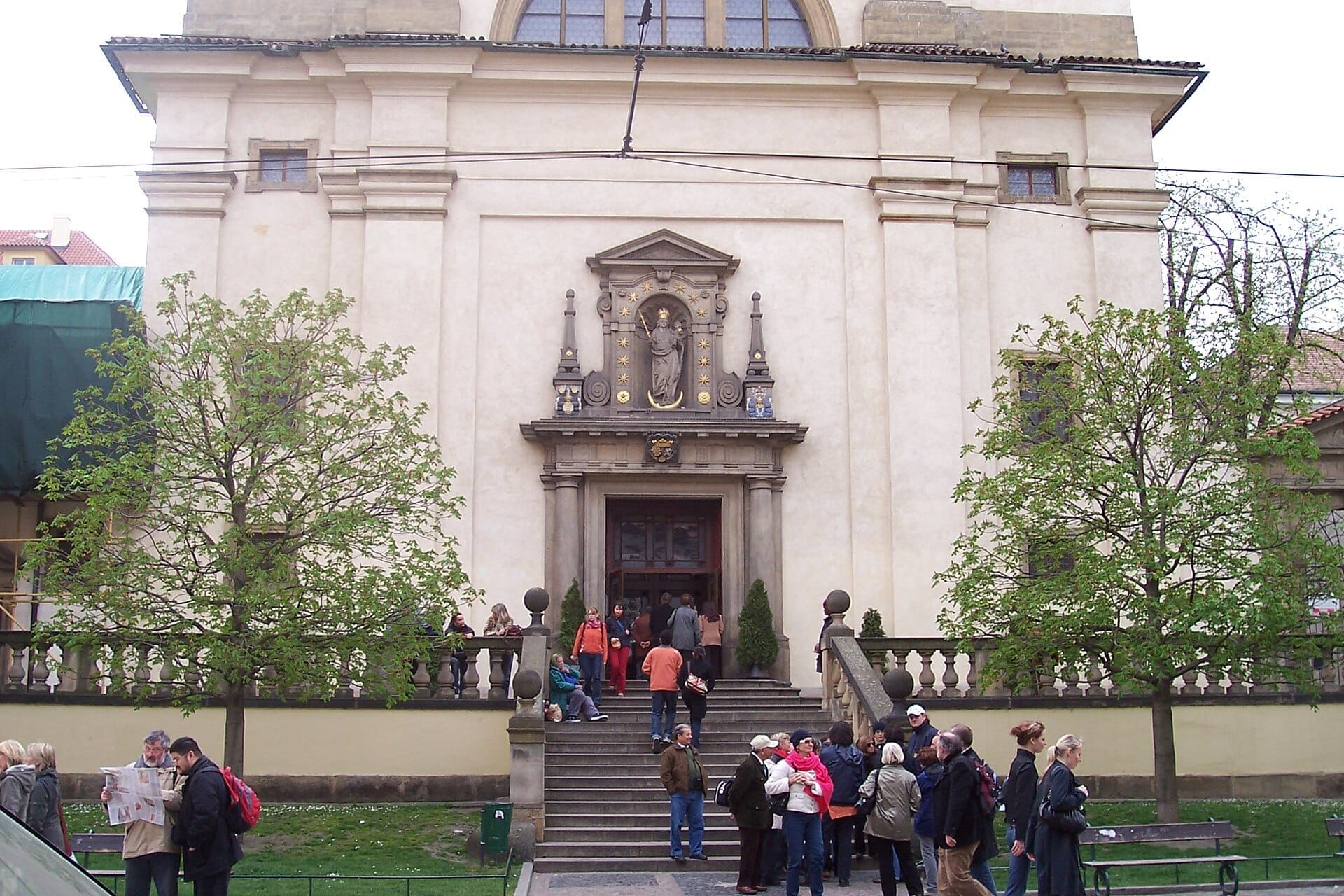
The Church of Our Lady Victorious (Czech: Kostel Panny Marie Vítězné) stands on Karmelitská street in Malá Strana, Prague's Baroque quarter on the west bank of the Vltava. From the outside, its cream-and-ochre facade is modest by the standards of this neighborhood, and easy to walk past if you don't know what's inside. What draws visitors here is not the architecture alone but a single object: the Infant Jesus of Prague, a 16th-century wax-coated wooden statue of Spanish origin that has become one of the most venerated Catholic devotional objects in the world.
This is an active parish church and an international pilgrimage site. On any given weekday morning, you may find a handful of elderly Czech women at prayer in the front pews, a tour group speaking Korean or Portuguese filing quietly down the side aisle, and a solo traveler photographing the gilded altar. The combination is unusual and oddly moving. The church handles this mix with practiced grace — it is genuinely welcoming to everyone, regardless of faith.
A Brief History: From Lutheran Chapel to Catholic Shrine
The church was built between 1611 and 1613 by Prague's German Lutheran community, making it the first Baroque church in Prague. Its original congregation did not last long. Following the Battle of White Mountain in 1620 — the decisive early engagement of the Thirty Years' War that ended Protestant power in Bohemia — the church was transferred to Catholic hands. In 1624, it was given to the Discalced Carmelites, who have administered it ever since.
The statue of the Infant Jesus arrived in the church in 1628, donated by Polyxena of Lobkowicz, a Czech noblewoman who had received it from her Spanish mother. The statue gained a reputation for miraculous intercessions, particularly during the plague and the hardships of the Thirty Years' War. Its fame spread throughout the Catholic world via the Carmelite network, and today replicas of the Infant Jesus of Prague can be found in churches across Europe, Latin America, the Philippines, and beyond.
For a deeper understanding of Prague's religious and historical landscape, the Prague history guide provides useful context on how the Counter-Reformation shaped the city's Baroque character.
Tickets & tours
Hand-picked options from our booking partner. Prices are indicative; availability and final rates are confirmed when you complete your booking.
Self guided tour with interactive city game of Prague
From 5 €Instant confirmationFree cancellationPrague by night city tour
From 27 €Instant confirmationFree cancellationPrague city tour with Vltava River cruise
From 38 €Instant confirmationFree cancellationPrague 6-Hour tour with river boat cruise and lunch
From 89 €Instant confirmationFree cancellation
Inside the Church: What You See and Where to Look
The interior follows a single-nave Baroque plan with side chapels and a relatively compact floor plan. The light inside tends to be warm and slightly dim, filtered through stained glass, which gives the space a contemplative quality at most hours. The smell is the familiar one of old stone, candlewax, and a trace of incense — heavier on mornings when Mass has recently ended.
The focus of the church is the main altar at the far end, where the statue of the Infant Jesus stands in a glass case on a raised throne. The figure is small — about 47 centimetres tall — but its elaborate vestments make it visually arresting. The statue wears one of dozens of outfits that change according to the liturgical calendar; these are crafted from silk, velvet, and embroidered fabric, and the collection spans several centuries of donations from royal courts, religious orders, and individual devotees across the world. The colors follow the Catholic liturgical cycle: red, white, green, purple, and gold.
Look also at the side altars and the painted ceiling. The Baroque decorative program is not as overwhelming as in some of Prague's larger churches, which is actually part of the appeal — there is enough to reward careful attention without the visual overload you might feel at, for instance, the nearby Church of St. Nicholas on Malostranské náměstí.
💡 Local tip
If the church is quiet, walk slowly along the left side aisle where several historic votive paintings hang — these are small devotional works offered by the faithful over the centuries in gratitude for prayers answered, and they are more historically interesting than they first appear.
The Museum of the Infant Jesus of Prague
Accessed from inside the church, the museum occupies rooms on an upper floor and displays the statue's complete collection of vestments alongside artifacts documenting the global reach of the Infant Jesus devotion. It is a small museum — ten to fifteen minutes is enough for most visitors — but the vestment collection is genuinely extraordinary. Several pieces date to the 17th and 18th centuries and were donated by Habsburg royalty and aristocratic families.
Museum opening hours differ from the church: Monday through Saturday 09:30 to 17:00, and Sunday 13:00 to 18:00. Admission to the museum is free; the church itself (excluding the museum) is also free to enter.
ℹ️ Good to know
Church hours: Monday to Saturday 08:30–18:00, Sunday 08:30–19:00. The church is open every day of the year, though hours may shift slightly on major religious holidays.
When to Visit and How the Experience Changes by Time of Day
Mornings are the most atmospheric time to visit. Between 09:00 and 10:30, the church draws mainly local worshippers attending Mass, and the atmosphere is genuinely devotional rather than touristic. The light through the windows is cooler and more directional at this hour, which is also the best time for photography of the interior without harsh flash from other visitors.
Midday brings the highest volume of tour groups, especially in summer between June and August. If you arrive between 11:30 and 14:00 on a weekday in peak season, the church can feel crowded for its size, and the sound of multiple tour guide whispers creates a constant background murmur. This is manageable — the church is not enormous, and groups tend to move through quickly — but it is the least peaceful window of the day.
Late afternoon, from around 15:30 onward, sees visitor numbers thin out again. The low sun at certain times of year enters from the west-facing windows and hits the altar in a way that is worth catching. Evening visits (available until 18:00 on weekdays, 19:00 on Sundays) are possible but the museum will be closed by then.
💡 Local tip
Shoulder seasons — May, September, and October — offer the best balance of good light, manageable crowds, and comfortable walking temperatures in Malá Strana. July and August are the peak months for pilgrimage groups, particularly from Asia and Latin America.
Getting There and the Surrounding Neighborhood
The church sits on Karmelitská street, one of the main arteries running through Malá Strana. Trams 12, 15, 20, 22, and 23 all stop at the Hellichova stop next to the church — this is one of the easiest significant sites in Prague to reach by public transport. From the Old Town side, the most direct walking route crosses Charles Bridge and continues straight through Malostranské náměstí, a walk of roughly eight to ten minutes.
Malá Strana is one of Prague's most rewarding areas on foot. The streets around the church are lined with Baroque palaces, embassies, and small shops. A short walk south along Karmelitská brings you to the Vrtba Garden, one of the finest formal Baroque gardens in Central Europe, and worth combining into the same visit.
To the north, Malostranské náměstí leads to the Church of St. Nicholas in Malá Strana, the most visually spectacular Baroque church in Prague. These two churches make a natural pairing — the intimate scale and devotional intensity of Our Lady Victorious contrasts sharply with the theatrical grandeur of St. Nicholas.
For visitors planning a broader exploration of the area, the Malá Strana neighborhood guide covers the quarter's key sites, gardens, and practical orientation.
Photography and Practical Notes
Photography is generally permitted inside the church, including of the statue. Use available light where possible — the warm ambient lighting of the interior is actually quite photogenic without flash, and flash photography can disturb worshippers. The statue in its glass case can produce reflections; a slight angle to the left or right of center usually eliminates the worst glare.
Dress modestly, as is standard for active churches throughout Central Europe. Shoulders and knees covered is the practical baseline. There is no enforced dress code and no attendant at the door policing this, but it is a matter of basic respect given that Mass is celebrated here daily.
Visitors with mobility needs should contact the parish in advance at +420 257 533 646. Specific wheelchair access details are not reliably documented in public sources, so a direct call is advisable before planning a visit around accessibility requirements.
Is It Worth Your Time? An Honest Assessment
The Church of Our Lady Victorious is not a spectacle in the way that Prague Castle or the Astronomical Clock is. If you are visiting Prague primarily for architectural drama or panoramic views, this will not be the highlight of your trip. What it offers instead is intimacy, historical depth, and genuine religious atmosphere — qualities that are increasingly rare in the heavily trafficked core of the old city.
For travelers with an interest in Catholic devotional culture, Baroque art, or the history of Counter-Reformation Bohemia, it is one of the most rewarding stops in Malá Strana. Even secular visitors often find the layered history — a Lutheran chapel turned pilgrimage site, a tiny Spanish statue that became a global Catholic icon — more compelling than they expected. The combination of free entry and a short time commitment means the risk of disappointment is low.
If you are planning a full day in the area, consider pairing this visit with a walk across Charles Bridge and a stop at the John Lennon Wall, which is just a few minutes' walk south of the church along Karmelitská and Velkopřevorské náměstí.
Insider Tips
- Visit on a weekday morning to experience the church during or just after Mass — the atmosphere is entirely different from the midday tourist window, quieter and more contemplative.
- The vestment collection in the museum is worth a visit if you have any interest in textile history or ecclesiastical art. Several pieces are 17th-century originals from Central European royal courts and are rarely mentioned in mainstream travel coverage.
- The souvenir shop near the entrance sells small replicas of the Infant Jesus statue, medals, and devotional items. These are popular purchases among pilgrims and make for more distinctive souvenirs than most of what is sold on nearby tourist streets.
- The tram stop directly next to the church (Hellichova) connects you straight to the Malostranské náměstí square in one stop on tram 22 and to the National Theatre in the other direction — making this an easy anchor point for a tram-based tour of central Prague.
- If you arrive to find a large pilgrimage group inside, wait ten minutes. Groups are typically led on a structured circuit and clear the main altar area relatively quickly, after which the space opens up again.
Who Is Church of Our Lady Victorious (Infant Jesus of Prague) For?
- Catholic pilgrims and devotional travelers seeking the Infant Jesus of Prague
- Architecture and history visitors interested in early Baroque Prague and the Counter-Reformation
- Travelers looking for a quiet, free, and meaningful stop in an otherwise busy sightseeing day
- Photography enthusiasts interested in Baroque interior light and devotional art
- Families with older children curious about religious iconography and European history
Nearby Attractions
Other things to see while in Malá Strana (Lesser Town):
- Charles Bridge
Charles Bridge is Prague's most recognizable landmark, a 516-metre medieval stone arch bridge lined with 30 Baroque statues linking the Old Town to Malá Strana. Free to cross at any hour, its experience shifts dramatically depending on when you arrive.
- Church of St. Nicholas (Malá Strana)
The Church of St. Nicholas in Malá Strana is the most ambitious Baroque building in Prague, rising above the Lesser Town with a copper-green dome that defines the city's skyline. Built between 1704 and 1755, it rewards visitors with extraordinary ceiling frescoes, a soaring interior nearly 60 metres high, and a separate bell tower offering rooftop views across the red-tiled district below.
- Franz Kafka Museum
The Franz Kafka Museum occupies a converted 19th-century brickworks on the Malá Strana riverbank, a short walk from Charles Bridge. It holds original manuscripts, correspondence, photographs, and first editions that illuminate the life and literary world of one of the 20th century's most influential writers. The experience is deliberately unsettling, and that is precisely the point.
- John Lennon Wall
The John Lennon Wall in Malá Strana is a free, ever-changing outdoor graffiti wall with roots in Cold War resistance. Official visiting hours are generally listed as 10:00–19:00, it costs nothing to see, and it sits just a short walk from Charles Bridge, rewarding those who understand its history as much as its color.