Kampa Island: Prague's Riverside Escape in Malá Strana
Kampa Island is a small, flat park island in the Vltava River, separated from Malá Strana by the narrow Čertovka millstream. Free to enter at any hour, it offers riverside calm, Baroque architecture, public sculpture, and the excellent Museum Kampa — all within walking distance of Charles Bridge.
Quick Facts
- Location
- U Sovových mlýnů 418/5, 118 00 Praha 1 — Malá Strana, at the foot of Charles Bridge
- Getting There
- Tram: Újezd (lines 9, 12, 20, 22) or Hellichova (lines 12, 20, 22). Metro: Malostranská (Line A), ~7–10-min walk
- Time Needed
- 45 minutes for the park; 2–3 hours if visiting Museum Kampa
- Cost
- Free (park access). Museum Kampa charges separate admission — verify current prices before visiting
- Best for
- Riverside walks, contemporary art, photography, quiet afternoons away from the tourist core
What Kampa Island Actually Is
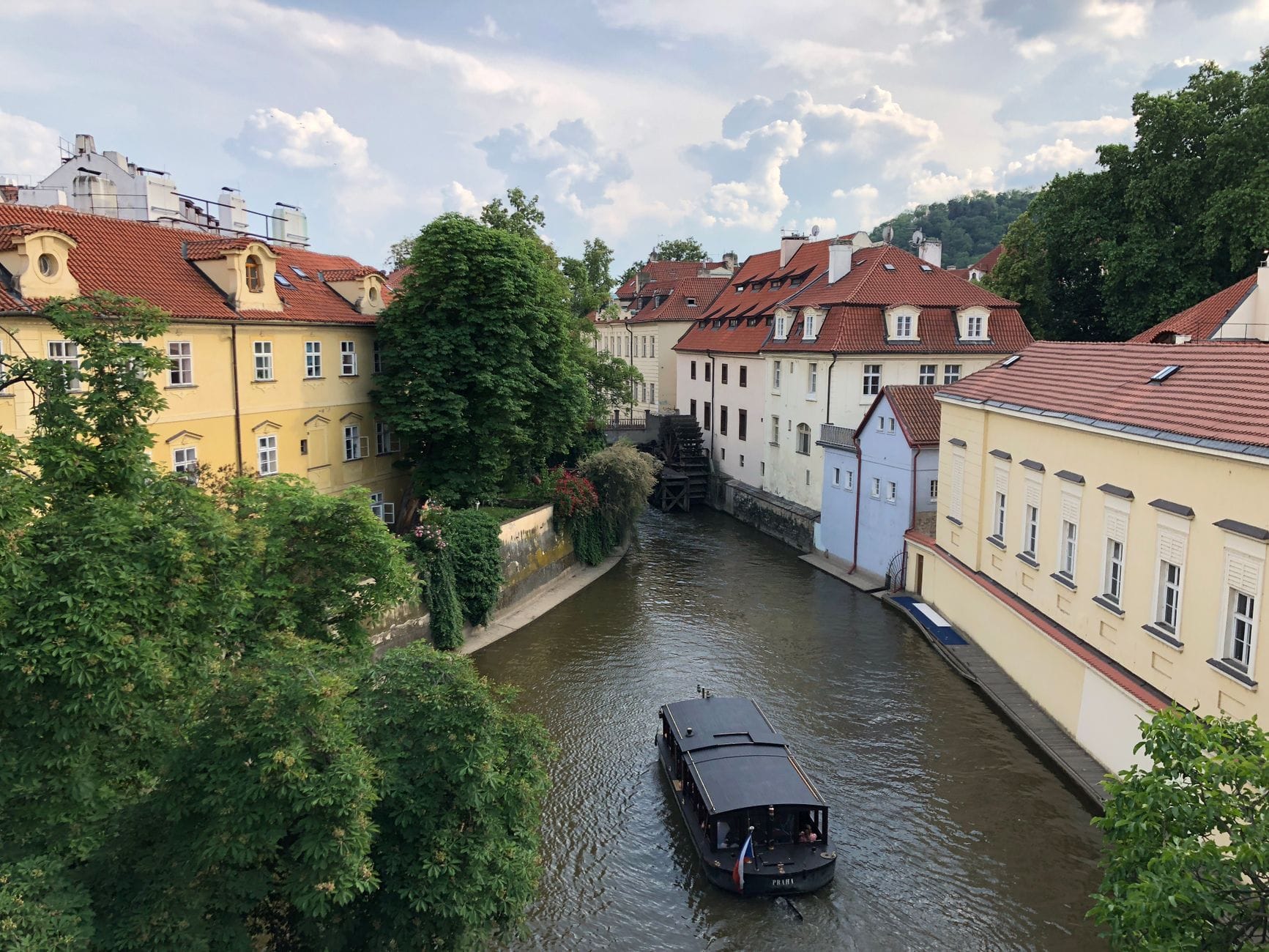
Kampa Island is not quite a natural island. It is an artificial strip of land in the Vltava River, separated from the Malá Strana mainland by the Čertovka, a narrow mill race sometimes called the Devil's Channel. This slender waterway once powered a row of mills; today it reflects the backs of Baroque townhouses and the occasional duck. The result is a small, enclosed world — part park, part neighbourhood, part open-air gallery — that feels genuinely removed from the tourist density of Old Town, even though it sits only a few minutes' walk from Charles Bridge.
References to Kampa appear in written records as far back as 1169, indicating an early documented presence in the city. Its current character took shape after the great fire of 1541, which devastated much of Malá Strana and led to widespread rebuilding in Renaissance and later Baroque styles. Today the island's northern end is anchored by Na Kampě Square, a cobbled open space edged by painted townhouses, while the southern portion opens into a wide grassy park stretching to the water's edge.
ℹ️ Good to know
Kampa Island is a public park open 24 hours a day, every day of the year. There is no entrance fee and no ticket required. Museum Kampa, which occupies the former Sova Mill on the southern end of the island, operates on its own schedule with separate admission pricing — check current hours and rates before your visit.
Arriving on the Island: The Approach Matters
Most visitors reach Kampa from Charles Bridge, descending a staircase near the Malá Strana bridge tower that deposits you directly onto Na Kampě Square. This is a deliberate descent — you step off one of Prague's most photographed monuments and land in a courtyard that, at the right hour, feels almost private. The stairs themselves are uneven stone, and the handrail is not always reliable, so take care in wet weather.
If you are arriving by tram, the Újezd stop is the most practical. From there, follow the Čertovka upstream along its southern bank — this path runs between the channel and the backs of riverside buildings, giving you a ground-level view of the mill race that most visitors never see. The walk to Na Kampě Square from Újezd takes under ten minutes. For step-free access, this route along the Malá Strana streets and riverside paths is preferable to the bridge stairs.
⚠️ What to skip
The access stairs from Charles Bridge are steep and have no lift alternative. Visitors with prams, wheelchairs, or limited mobility should approach via Malá Strana's ground-level streets instead, which connect to the island without steps.
Tickets & tours
Hand-picked options from our booking partner. Prices are indicative; availability and final rates are confirmed when you complete your booking.
Self guided tour with interactive city game of Prague
From 5 €Instant confirmationFree cancellationPrague by night city tour
From 27 €Instant confirmationFree cancellationPrague city tour with Vltava River cruise
From 38 €Instant confirmationFree cancellationPrague Castle online audio guide
From 5 €Instant confirmationFree cancellation
The Island at Different Times of Day
Early morning is when Kampa shows its best side. Before 9am, Na Kampě Square is nearly empty. The Čertovka reflects the Baroque façades in olive-green water, pigeons shuffle across the cobblestones, and the only sounds are the river, distant tram bells, and the occasional bicycle. The light at this hour, particularly in spring and autumn, hits the painted house fronts at a low angle that photographers work hard to find.
By late morning the island fills with a mixed crowd: tourists descending from Charles Bridge, locals cutting through on their way to Malá Strana, art-school students heading to Museum Kampa, and children from nearby streets playing on the park grass. The southern lawn becomes a gathering point for picnickers in warm weather, with views across the Vltava toward the National Theatre on the far bank. The atmosphere is relaxed rather than charged — Kampa attracts people who are specifically looking for a slower pace.
At dusk, particularly in summer, the island takes on a different quality. The light on the water turns amber, the Čertovka becomes very still, and the bridge above glows with reflected light from the lamp posts. This is also when the giant bronze babies — David Černý's famous crawling infant sculptures, installed near Museum Kampa — cast long shadows across the grass. Couples tend to gather on the southern riverside benches at this hour. Late evening is quiet; the park stays open but the crowds thin considerably.
Museum Kampa: Central European Modern Art
At the island's southern end, the Sova Mill — a converted Renaissance and Baroque building — houses Museum Kampa, one of Prague's strongest collections of 20th-century Central European art. The permanent collection focuses on Czech Cubism and the work of two key figures: František Kupka, a pioneer of abstract painting, and Otto Gutfreund, a sculptor whose work bridges Cubism and social realism. If you have any interest in how Central European modernism diverged from its Western counterparts, this museum makes that case with unusual clarity.
The building itself is worth attention. Parts of the mill structure date to the medieval period, and the conversion preserved exposed stonework, heavy timber beams, and the general sense of industrial weight — a deliberate contrast with the delicate works displayed inside. The terrace at the rear of the museum looks directly onto the Vltava, providing one of the quieter waterfront views in the city. Temporary exhibitions rotate regularly; check the museum's current programme before visiting to see what is on alongside the permanent collection.
💡 Local tip
Museum Kampa is frequently overlooked by visitors doing a quick walk through the island. If you are interested in modern and contemporary art, budget at least 90 minutes here. The permanent collection alone justifies the entry price.
Public Art, the Čertovka, and What to Actually Look At
Scattered across the park are several large bronze sculptures by David Černý, including the oversized crawling babies whose faces bear a disturbing, barcode-like pattern where features should be. These are not subtle works — they are provocative by design, and they sit oddly but memorably in the green space. For more context on Černý's work across the city, the David Černý guide covers the full spread of his installations.
The Čertovka channel itself deserves more attention than most visitors give it. Walk its full length along the southern bank — from the old mill wheel near Museum Kampa up to the point where it rejoins the mainstream near Charles Bridge. The channel is narrow enough that you can almost reach across, and the water moves with a speed that surprises people expecting a still canal. The mill race was operational for centuries; the last mill on Kampa stopped working in the 20th century, and the wooden wheel visible near the museum is a later restoration.
Na Kampě Square at the northern end is technically a square but functions more like a courtyard. The buildings on its eastern side back directly onto the channel, with small wooden bridges crossing to garden gates. This is one of the most architecturally coherent small spaces in Malá Strana — the scale is intimate and the Baroque detailing on the house fronts (painted ochre, cream, and terracotta) is well-preserved. It gets photographed constantly, but even in peak season there are gaps between tour groups.
Practical Walkthrough: Getting the Most from the Island
Kampa sits at the centre of a logical walking route through Malá Strana. A sensible sequence: arrive via Charles Bridge in the morning, descend the stairs to Na Kampě Square, walk the Čertovka south to Museum Kampa, spend 90 minutes in the collection, then exit south along the riverside path toward the Újezd tram stop. From there you can continue to Petřín Hill or cut back through Malá Strana toward the castle district.
The island itself takes less than 20 minutes to walk end to end at a slow pace. The paths are flat and mostly paved or cobbled — comfortable in ordinary shoes, though the cobblestones on Na Kampě Square can be slippery when wet. There are a few benches along the riverside and scattered across the lawn; on warm days these fill up by early afternoon. There are no large food concessions on the island itself, though the square has a couple of small café options.
Photography: the best angles on the Čertovka are from the small wooden bridges crossing the channel, looking toward the mill building. For the Charles Bridge approach shot, position yourself on the eastern bank of the Čertovka looking north in the morning — the bridge arch frames well from this angle. The best views guide for Prague covers additional vantage points in the area.
Weather, Seasons, and When to Visit
Kampa works well across seasons but is genuinely different depending on when you go. In summer (June to August), the southern lawn fills with picnickers and the riverside benches are nearly always occupied by early afternoon; the island has a park atmosphere that is pleasant but not peaceful. May, September, and October offer mild temperatures (roughly 10–18°C), thinner crowds, and more dramatic light. Winter visits — December through February, with temperatures typically near 0°C — are quiet enough that you may have parts of the island almost to yourself, and the bare trees open up views of the Vltava that summer foliage blocks. For broader guidance on timing a Prague trip, the best time to visit Prague breaks down each season in detail.
Heavy rain makes the cobblestones slippery and the riverside paths unpleasant. In periods of very high Vltava water levels, the southern riverside area of the park can flood — this is uncommon but worth checking if you are visiting during a wet spring. The island flooded significantly in 2002 and again during later high-water events; the museum and other buildings have since installed flood protection measures.
Insider Tips
- The small wooden bridges crossing the Čertovka along its southern bank are easy to miss. Cross one to reach the narrow gardens between the channel and the Malá Strana buildings — these passages feel genuinely forgotten.
- Museum Kampa's rear terrace is open to ticket holders and offers a riverside view with no crowds. Bring a coffee from the museum café and use it as a rest stop mid-visit.
- The John Lennon Wall is a 3-minute walk from Na Kampě Square — follow the Čertovka north toward the bridge and look for the turn onto Velkopřevorské náměstí. If you want a photo without tour groups, go before 9am.
- The mill wheel near Museum Kampa is lit at night and reflects in the Čertovka. The island after 9pm in summer is almost empty and the lighting on the water is worth the walk.
- Avoid visiting Na Kampě Square between 10:30am and 2pm in peak season if you want space to take photographs — this is when Charles Bridge tour groups descend to the island and the square becomes congested.
Who Is Kampa Island For?
- Photographers looking for Baroque riverside detail and low-crowd morning light
- Contemporary art visitors wanting to see Czech modernism and David Černý sculptures in context
- Couples or solo travellers who want a slower pace after the intensity of Old Town
- Families with older children who can manage cobblestones and enjoy open green space
- Walkers building a Malá Strana circuit that connects Charles Bridge, Kampa, and Petřín
Nearby Attractions
Other things to see while in Malá Strana (Lesser Town):
- Charles Bridge
Charles Bridge is Prague's most recognizable landmark, a 516-metre medieval stone arch bridge lined with 30 Baroque statues linking the Old Town to Malá Strana. Free to cross at any hour, its experience shifts dramatically depending on when you arrive.
- Church of Our Lady Victorious (Infant Jesus of Prague)
Tucked along Karmelitská street in Malá Strana, the Church of Our Lady Victorious is one of Prague's most visited pilgrimage sites. It houses a 16th-century wax-coated wooden statue of the Infant Jesus that draws Catholic pilgrims from across the world, alongside curious visitors exploring Prague's Baroque heritage. Entry is free, and the attached museum adds unexpected depth to the visit.
- Church of St. Nicholas (Malá Strana)
The Church of St. Nicholas in Malá Strana is the most ambitious Baroque building in Prague, rising above the Lesser Town with a copper-green dome that defines the city's skyline. Built between 1704 and 1755, it rewards visitors with extraordinary ceiling frescoes, a soaring interior nearly 60 metres high, and a separate bell tower offering rooftop views across the red-tiled district below.
- Franz Kafka Museum
The Franz Kafka Museum occupies a converted 19th-century brickworks on the Malá Strana riverbank, a short walk from Charles Bridge. It holds original manuscripts, correspondence, photographs, and first editions that illuminate the life and literary world of one of the 20th century's most influential writers. The experience is deliberately unsettling, and that is precisely the point.