National Gallery Prague – Veletržní Palace: Modern Art in a Functionalist Giant
Veletržní Palace houses the National Gallery Prague's collection of 20th and 21st century art across 13,500 square metres of exhibition space. Built in 1928 as a trade fair hall, this Functionalist landmark in Holešovice is a major destination for modern and contemporary art.
Quick Facts
- Location
- Dukelských hrdinů 47, Praha 7 – Holešovice
- Getting There
- Metro Line C to Vltavská; Trams 6 or 17 to stop Veletržní palác
- Time Needed
- 2.5 to 4 hours for a thorough visit
- Cost
- 250 CZK standard; 140 CZK reduced; 500 CZK 10-day multi-venue pass (verify before visiting)
- Best for
- Modern and contemporary art, Functionalist architecture, serious museum-goers
- Official website
- www.ngprague.cz/en/about/buildings/trade-fair-palace
What Veletržní Palace Actually Is
Veletržní Palace (Trade Fair Palace) is the largest venue in the National Gallery Prague network and the city's primary home for modern and contemporary art. The collection spans from French Impressionism through Czech avant-garde movements to art produced after 1989, with more than 2,000 works displayed across roughly 13,500 square metres of exhibition space on multiple floors.
The building itself is as significant as what hangs inside it. Completed in 1928 to designs by architects Josef Fuchs and Oldřich Tyl, it was at the time of its opening considered the largest building of its kind in the world and the first fully realised Functionalist structure in Prague. It has been listed as an immovable cultural monument since 1958 and has housed the National Gallery's modern collections since 1976.
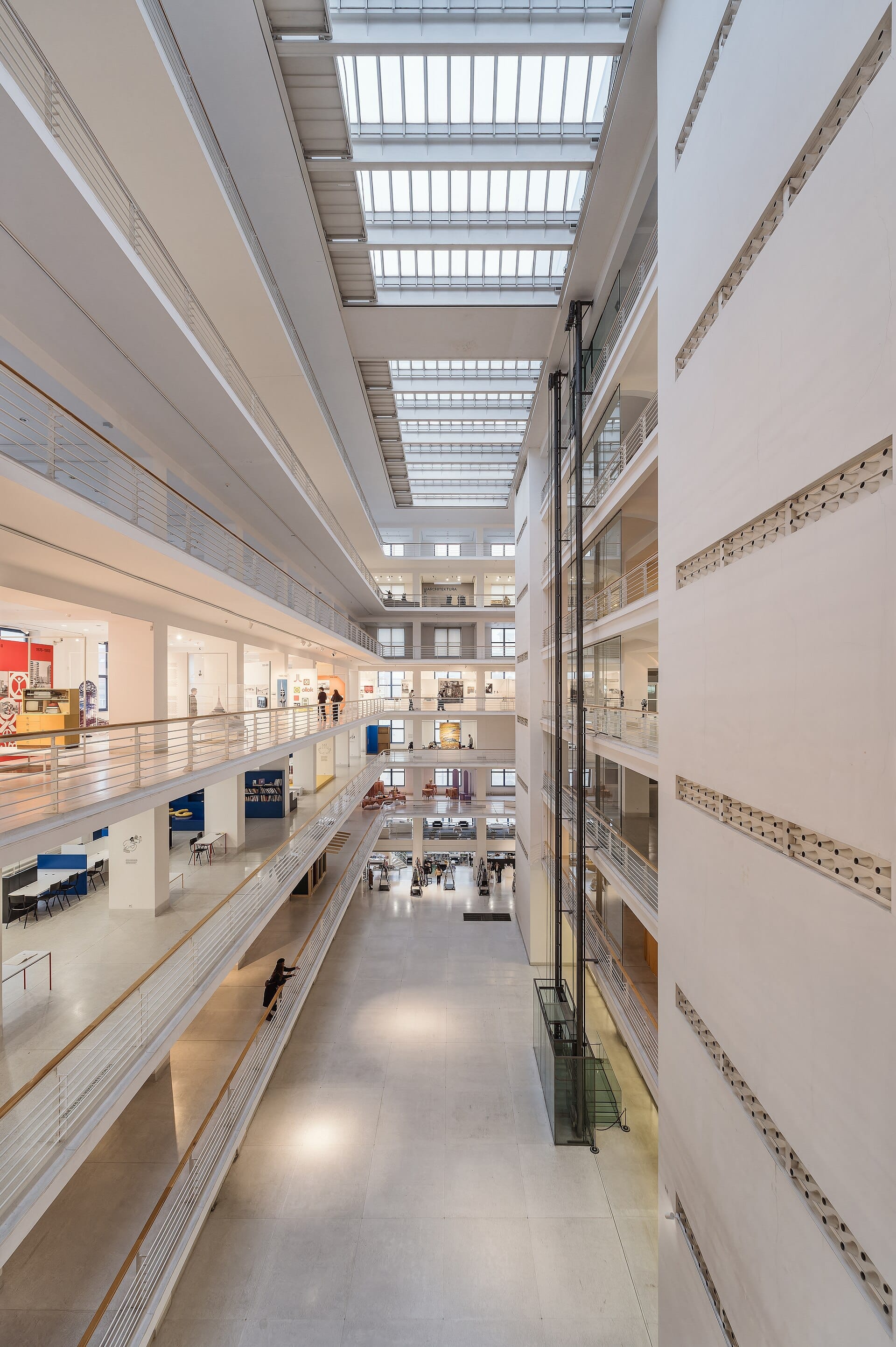
For visitors who have spent time in the historic centre, the shift to Holešovice feels deliberate and clarifying. There is no Baroque ornamentation here, no cobblestone theatrics. The palace stands in the Holešovice district with the blunt confidence of early modernism: reinforced concrete, horizontal strip windows, and a vast glass-roofed atrium that floods the interior with natural light.
ℹ️ Good to know
Opening hours: Tuesday to Sunday, 10:00–18:00. Closed on Mondays year-round. Confirm current hours at ngprague.cz before your visit, as special exhibitions can affect access.
The Architecture: Why the Building Matters
Walking toward the entrance from the tram stop, the sheer scale registers before anything else. The façade stretches across an entire city block, its repeated window bays giving it a rhythm that is industrial in origin but precise in execution. Fuchs and Tyl designed it for the Prague Sample Fair, and the brief demanded maximum floor area, maximum natural light, and the ability to host exhibitions at a scale the city had never seen.
Inside, the central atrium is the spatial centrepiece. It rises through several floors, lit from above through a large glazed roof, and gives the building an openness that conventional gallery spaces rarely achieve. Even on overcast days, this atrium feels luminous. Galleries branch off from the central void at each level, which means you can orientate yourself quickly without a map: go up a level, look across the atrium, reorient.
The palace stands as one of the clearest examples of interwar Functionalism in Central Europe. If you are interested in how Prague's architectural story extends beyond the Gothic and Baroque, the Prague architecture guide covers this period in more detail and puts the building in context alongside other 20th century landmarks in the city.
Tickets & tours
Hand-picked options from our booking partner. Prices are indicative; availability and final rates are confirmed when you complete your booking.
Self guided tour with interactive city game of Prague
From 5 €Instant confirmationFree cancellationPrague by night city tour
From 27 €Instant confirmationFree cancellationPrague city tour with Vltava River cruise
From 38 €Instant confirmationFree cancellationPrague Castle online audio guide
From 5 €Instant confirmationFree cancellation
The Collection: What You Will See
The permanent collection is organised chronologically and thematically across the upper floors. The French 19th century holdings include works by Monet, Cézanne, Gauguin, Picasso and van Gogh, acquired largely during the First Czechoslovak Republic when the country had both the political ambition and the cultural connections to build a serious modern collection. Seeing these works in Prague rather than Paris changes the interpretive frame in a useful way: they arrived here with specific purpose, as models for Czech artists working through their own modernist questions.
The Czech and Central European collections are arguably the stronger reason to visit. Paintings and sculptures from the Czech avant-garde of the 1910s through 1930s, Surrealist works from the 1930s and 1940s, and the complicated, sometimes coded art produced under communist rule form a sequence that does not exist in this depth anywhere else. Some of the most striking rooms contain works that were not publicly exhibited for decades after they were made.
Contemporary works occupy the lower floors and rotate more frequently. Temporary exhibitions run alongside the permanent collection and tend to focus on significant 20th and 21st century figures or thematic surveys. Check the NGP website before visiting because major temporary shows can alter gallery layouts and occasionally close sections of the permanent collection.
💡 Local tip
The 500 CZK multi-venue pass covers all main National Gallery Prague buildings for 10 days, including the Schwarzenberg Palace and Sternberg Palace at the castle. If you plan to visit more than one NGP site, this is significantly better value than single-venue tickets.
How the Experience Changes by Time of Day
Veletržní Palace draws a different crowd than the tourist-dense sites in the old town. Weekday mornings are quiet to the point of genuine solitude in some galleries, with only the soft hum of climate control systems and the occasional footsteps of a school group in a distant wing. This is the best time for the French Impressionist rooms and the early Czech modernist floors, where you can spend real time in front of individual works without managing around other visitors.
Weekend afternoons bring more people, but the building is large enough that crowding rarely feels like a problem. The atrium on a bright afternoon, when light comes down through the roof in angled shafts, is worth experiencing regardless of what is on the walls. Photography is generally permitted in the permanent collection galleries without flash, though this should be confirmed at the entrance desk as policies can vary by exhibition.
Late afternoon visits risk running short on time: the last entry is typically some time before the 18:00 closing, and the upper floors with the permanent collection warrant more time than most visitors initially budget. If you arrive after 15:30, prioritise the floors that matter most to you rather than attempting a complete circuit.
Getting There and Practical Navigation
The most direct route from the city centre is tram 6 or 17 to the stop named Veletržní palác, which deposits you almost at the entrance on Dukelských hrdinů street. From the metro, Line C to Vltavská station puts you roughly a 10-minute walk away. The walk from Vltavská along the river and into Holešovice passes through a neighbourhood that has changed considerably in recent years, with galleries, cafés and offices occupying former industrial buildings.
Holešovice is worth time beyond the palace itself. The district's transformation over the past two decades has produced a concentration of cultural venues in close proximity, including the DOX Centre for Contemporary Art, which focuses on architecture, design and social issues and sits about 10 minutes on foot from Veletržní Palace. Planning a half-day that combines both institutions is practical and genuinely rewarding.
The palace has a coat check near the entrance, which is worth using given the building's size and the inconvenience of carrying a bag through several floors of exhibition space. A café and bookshop are located in the building. Comfortable shoes are advisable: covering all floors involves significant walking and much of it on hard floors.
⚠️ What to skip
Mondays: the palace is closed every Monday without exception. Many visitors arriving after a Sunday-to-Monday travel day make this mistake. Double-check hours on the official NGP website, particularly around Czech public holidays when schedules may change.
Who This Attraction Is and Is Not For
Veletržní Palace rewards visitors who come with some interest in either modern art or architectural history. The collection is substantial and the building is demanding of attention. Casual visitors who spend under an hour will leave with a partial picture of what the institution holds.
Those primarily focused on medieval history, Gothic architecture, or Baroque Prague will find more concentrated satisfaction at St. Vitus Cathedral or the collections at the National Gallery Sternberg Palace. Veletržní Palace is specifically a 20th and 21st century institution, and visitors who do not engage with that period of art history may find the scale of the building more impressive than the contents.
Families with children should note that the permanent collection is text-heavy and the galleries are not designed as interactive spaces. That said, children who are curious about large spaces and architecture often respond to the atrium and the building's industrial scale in ways that more ornate venues do not provoke.
If Veletržní Palace is part of a broader Prague museum itinerary, the best museums in Prague guide provides a structured overview of how it compares to other major collections in the city and how to sequence visits effectively.
Insider Tips
- The French Impressionist rooms on the upper floors are the most visited part of the permanent collection. Go there first, before mid-morning, if seeing the Monet and Picasso holdings without crowds is a priority.
- The 500 CZK multi-venue NGP pass is valid for 10 days across all National Gallery Prague buildings. If you have any intention of visiting the Schwarzenberg Palace or other NGP sites, buy this at entry rather than a single-venue ticket.
- The central atrium is one of the best interior architectural spaces in Prague. Spend a few minutes on each floor looking across it before entering the galleries. The light changes significantly depending on the time of day and weather.
- Temporary exhibitions at Veletržní Palace sometimes require a separate ticket on top of the permanent collection entry. Check the NGP website for current exhibition structure before budgeting.
- The tram stop Strossmayerovo náměstí, served by lines 1, 2, 6, 8, 12, 17, 25 and 26, is an alternative arrival point that puts you at Holešovice's main square, a short walk from the palace and useful for combining the visit with other neighbourhood stops.
Who Is National Gallery – Veletržní Palace For?
- Art enthusiasts with a specific interest in Czech modernism, Surrealism, or post-war Central European art
- Architecture visitors who want to see Prague's best example of interwar Functionalism from the inside
- Travellers who have already covered the historic centre and want to explore a different side of the city
- Serious museum-goers who prefer depth over a quick overview and are happy to spend three or more hours in one venue
- Visitors combining a cultural itinerary across Holešovice, pairing the palace with DOX or the Holesovice Market Halls
Nearby Attractions
Other things to see while in Holešovice:
- DOX Centre for Contemporary Art
Opened in 2008 inside a converted 19th-century factory in Holešovice, DOX Centre for Contemporary Art is a major venue for international contemporary art, architecture, and design. With around 3,000 m² of exhibition space across renovated industrial halls, it stages politically engaged, visually demanding shows that rarely play it safe.
- Holešovice Market Halls (Pražská tržnice)
The Holešovice Market Halls, officially known as Pražská tržnice, The Holešovice Market Halls, officially known as Pražská tržnice, occupy a large heritage complex in Prague 7 that began life as the city's central slaughterhouse in 1895.. Today the red-brick halls host a year-round farmers market, street food vendors, pop-up events, and independent businesses, offering a slice of everyday Prague that most tourists never reach.
- Letná Beer Garden
Perched on the edge of Letná Park above the Vltava River, the Letná Beer Garden is where Prague locals actually drink in summer. No admission charge, plastic cups of cold Pilsner, and a sweeping view across the city's rooftops — it is one of the most genuinely local outdoor experiences in the Czech capital.
- Letná Park
Letná Park occupies a broad plateau above the Vltava in Prague's Holešovice district, offering panoramic views over the Old Town, a famous open-air beer garden, and kilometers of tree-lined paths. Entry is free and the park is open around the clock.