St. Vitus Cathedral: Prague's Gothic Crown Jewel
Standing at the heart of Prague Castle, St. Vitus Cathedral took nearly 600 years to complete and remains the most architecturally significant church in the Czech Republic. Entry to the nave is free, but what's inside — Mucha stained glass, and a soaring 33-metre vault — demands far more than a passing glance.
Quick Facts
- Location
- 3rd Courtyard, Prague Castle, Hradčany — III. nádvoří 48/2, 119 01 Praha 1
- Getting There
- Metro Line A to Malostranská, then tram 22 or 23 to Pražský hrad stop; or walk ~750 m from Hradčanská metro
- Time Needed
- 45 minutes (nave only) to 2+ hours (full castle circuit with tower climb)
- Cost
- Nave entry free; tower and some special areas require a paid Prague Castle circuit ticket (verify current CZK tariffs at hrad.cz)
- Best for
- History enthusiasts, architecture lovers, stained-glass admirers, and anyone doing the full Prague Castle visit
What You're Actually Looking At
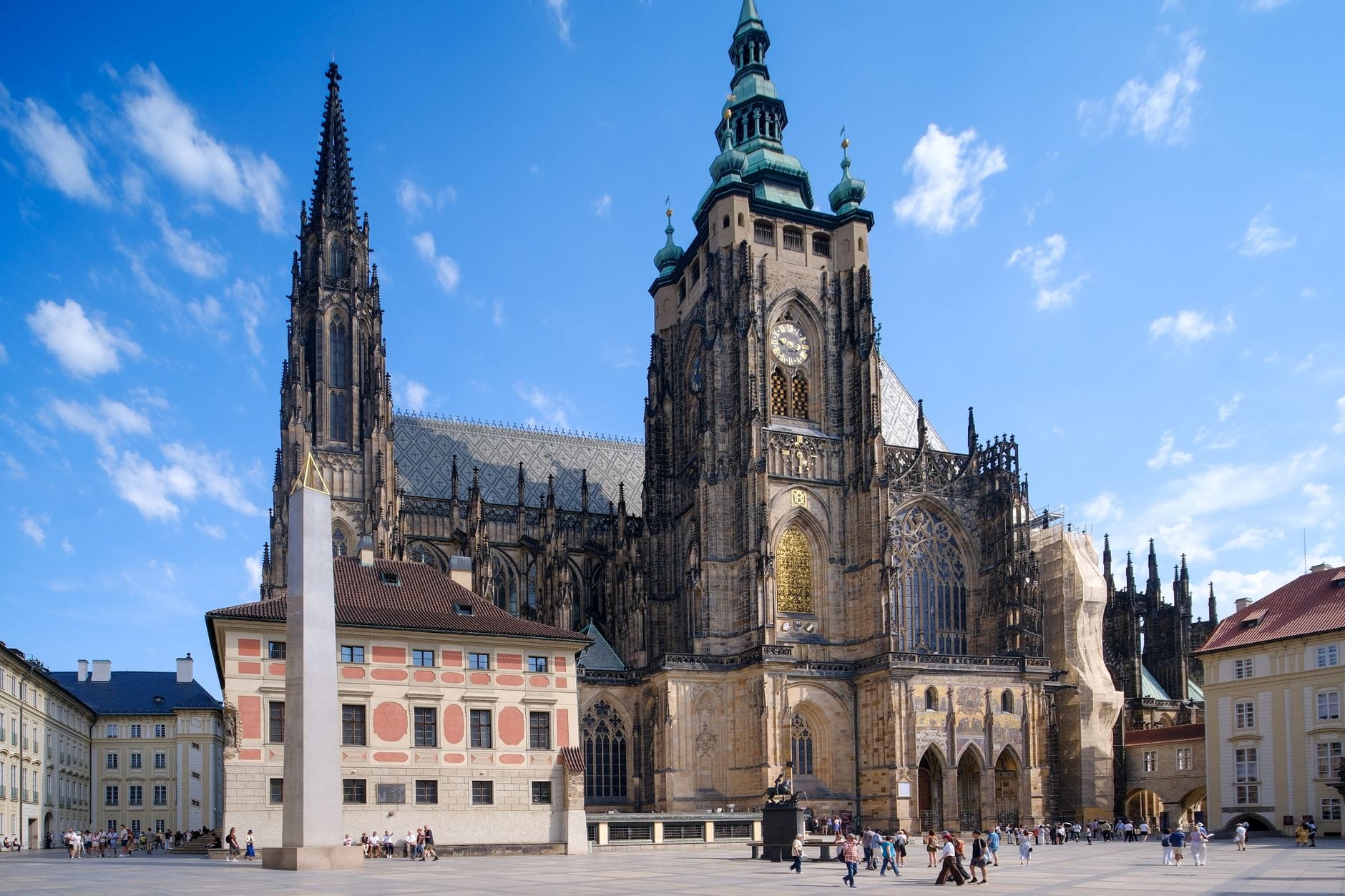
The Metropolitan Cathedral of Saints Vitus, Wenceslaus and Adalbert — known universally as St. Vitus Cathedral — is not just the centrepiece of Prague Castle. It is the physical record of nearly six centuries of Bohemian history, ambition, and craftsmanship compressed into a single building. Founded in 1344 by Emperor Charles IV on the site of a Romanesque rotunda, the cathedral was begun by the French Gothic master Matthias of Arras and continued by Peter Parler, the German architect responsible for its soaring choir and the iconic stone tracery that sets the tone for the entire interior. When Parler died in 1399, construction stalled, resumed fitfully across the centuries, and was only finally completed in 1929 — nearly six centuries after it was founded.
The numbers give a sense of the scale: 124 metres long, 60 metres wide, with a nave vault climbing 33.2 metres overhead. The main south tower reaches 102.8 metres; the twin west facade towers rise to 82 metres. Standing in the Third Courtyard of Prague Castle looking up at the west facade, the sheer vertical ambition of the building is immediately legible — buttresses, pinnacles, and a rose window the diameter of a small house all compressed into a frontage that took the 19th and early 20th centuries to finally finish.
ℹ️ Good to know
Entry to the cathedral nave is free. You do not need a paid Prague Castle ticket just to walk inside and see the main interior. However, access to the bell tower (287 steps, no elevator), the Royal Crypt, and some chapels requires a castle circuit ticket. Check current tariffs at hrad.cz before your visit, as prices and bundle options change.
The Interior: What to Look For
The moment you step through the west doors, your eyes go to the nave vault: a pale stone canopy of ribbed Gothic arches that filters the morning light into something almost abstract. The acoustic is surprisingly alive — whispered conversations carry further than you'd expect, and the low hum of visitors fills the space with a kind of ambient reverb that feels appropriate to the setting.
The stained glass is the interior's true revelation. The windows along the side aisles are largely 20th-century work commissioned as part of the 1929 completion campaign, and several are exceptional. The most photographed is Alfons Mucha's window in the third chapel on the north aisle, depicting the lives of Saints Cyril and Methodius. Mucha created it in 1931 using his characteristic Art Nouveau style — elongated figures, flowing lines, a palette of amber, cobalt, and deep green — and it is technically one of the few large-scale pieces of stained glass he ever produced. It reads differently at different times of day: mid-morning light pushes through it directly, saturating the colours; by afternoon, the light shifts and the window flattens.
The St. Wenceslas Chapel, located at the south transept, is considered the cathedral's most sacred space. Built by Peter Parler in the 14th century over the grave of Bohemia's patron saint, its lower walls are encrusted with more than 1,300 semi-precious stones set into gilded plasterwork — jasper, amethyst, chalcedony — and covered with Gothic frescoes depicting scenes from the Passion. Access is typically limited to the chapel doorway, but even from there the gold-and-gemstone interior is visible in full. The door to the Czech Crown Jewels is in this chapel, secured by seven locks whose keys are held by seven different officials of the Czech state.
For those doing the full Prague Castle circuit, the Royal Crypt below the cathedral contains the tombs of Bohemian kings including Charles IV, Wenceslas IV, and Rudolf II. The crypt is accessed via a separate ticket and is a more subdued, deliberately understated space — low ceilings, bare stone, sarcophagi arranged without theatrical lighting. It rewards visitors who want historical substance over spectacle.
Tickets & tours
Hand-picked options from our booking partner. Prices are indicative; availability and final rates are confirmed when you complete your booking.
Kutna Hora walking tour and St Barbara Cathedral from Prague
From 55 €Instant confirmationFree cancellationKutna Hora with St.Barbara's Cathedral and Bone Church
From 72 €Instant confirmationFree cancellationSelf guided tour with interactive city game of Prague
From 5 €Instant confirmationFree cancellationPrague by night city tour
From 27 €Instant confirmationFree cancellation
How the Experience Changes by Time of Day
The cathedral opens at 09:00 (Monday through Saturday; Sundays from 12:00), and the first thirty minutes after opening are often the calmest. Tour groups from the larger hotels typically arrive between 10:00 and 11:30, and by late morning the nave can feel much busier. The sound level increases markedly, and the natural light from the east windows is at its strongest — good for photography of the choir, but the crush around the St. Wenceslas Chapel can make contemplative viewing difficult.
The early afternoon lull — roughly 13:00 to 14:30 — sees some thinning of crowds as visitors break for lunch in the castle district or head to other parts of the complex. Late afternoon, especially in the summer months when the cathedral closes at 17:00, brings a second wave. The low western light can make the Mucha window look softer and more diffused.
Winter visits (November through February) come with earlier closing times — 16:00 on weekdays — but the cathedral is considerably less crowded, and the stone interior feels appropriately austere. If the Prague Castle district has had overnight snow, the exterior courtyard view of the cathedral's flying buttresses and towers against a white foreground is one of the more dramatic urban sights in Central Europe.
💡 Local tip
Arrive at 09:00 on a weekday for the quietest conditions. Sunday entry doesn't begin until noon, so that day is reliably busier in the afternoon. In summer, dress in layers — the interior stays cool even when temperatures outside exceed 30°C.
The Bell Tower Climb
The Great South Tower is climbable via 287 steps, opening up to a viewing gallery at the upper level with unobstructed sightlines across the castle district, Malá Strana rooftops, and the Vltava bend. The climb is narrow and genuinely steep in sections — the staircase doubles back on itself inside the tower wall. The tower is only open in good weather, which in Prague means it may close without notice during sudden summer thunderstorms. Plan it as a bonus rather than the main event.
The tower is not wheelchair accessible. For panoramic views without the climb, Petřín Lookout Tower offers a comparable — and in some ways wider — city panorama with an elevator option.
Getting There and Practical Logistics
The cathedral sits in the Third Courtyard of Prague Castle, which you reach by passing through the Second Courtyard via the main castle gate. The most direct public transport route is Metro Line A to Malostranská, followed by tram 22 or 23 uphill to the Pražský hrad stop — from there it's a short walk through the castle gate. Alternatively, Hradčanská metro station (also Line A) is about 750 metres away on foot through the Hradčany neighbourhood, passing the Černínský palác and the Loreto Sanctuary area.
Many visitors approach from below via the castle steps from Malá Strana — a steep but straightforward walk that passes the Old Royal Palace and gives a gradual reveal of the castle complex. This uphill approach is not suitable for visitors with mobility limitations; the Hradčanská approach is flatter and preferable. The cathedral itself has barrier-free access at ground level.
Seasonal opening hours shift noticeably: from March through October, the cathedral is open until 17:00; November through February, it closes at 16:00. Sunday entry starts at noon year-round due to morning services. These hours apply to tourist visits and do not affect attendance at regular liturgical services, which continue regardless of visitor access.
⚠️ What to skip
Prague Castle as a whole charges separate entry tickets for different buildings and circuit combinations. The cathedral nave is free, but don't assume that extends to all areas inside. Budget extra time for ticket queues if you plan to visit the Royal Crypt, tower, or exhibition spaces. Verifying current pricing at hrad.cz before arriving saves confusion at the gate.
Photography: What Works and What Doesn't
The interior is dim in areas away from the windows, and most visitors shooting on phones without night mode will find the nave vault underexposed. The best natural light for the Mucha window falls between 09:30 and 11:00 on clear days; for the choir and apse, later morning works better. Tripods are generally not permitted during busy hours. The exterior west facade photographs well from the Third Courtyard, though the courtyard is narrow — a 24mm equivalent lens or wider is useful for capturing the full height. For a longer exterior view, exiting back to the Second Courtyard and looking through the archway gives a compressed but dramatic framing.
If exterior shots of the cathedral from a distance are a priority, the Letná Park terrace and the far bank of the Vltava near the Nusle area offer elevated city profiles that include the cathedral towers on the skyline — though at this distance it reads as part of the wider Prague Castle silhouette rather than a subject in its own right.
Who Might Not Enjoy This
St. Vitus Cathedral is one of the most visited sites in the Czech Republic, and on peak summer days the nave fills with tour groups moving in dense formations. Visitors who are sensitive to crowds, heat, or audio-guide noise from multiple groups speaking simultaneously will find the experience frustrating between roughly 10:30 and 14:00 in July and August. The free nave entry, while an excellent policy, means there is no mechanism to limit interior capacity — you share the space with everyone else regardless of ticket type.
Visitors expecting a quiet, meditative Gothic interior — the kind of experience more typical of less-visited French or German cathedrals — may find the footfall jarring. That said, even in peak season, the St. Wenceslas Chapel threshold area clears periodically, and the upper triforium gallery (where accessible) offers sightlines above the crowd.
Insider Tips
- The Sunday noon opening means that Saturday late afternoon — around 15:30 to 16:30 — is often the least crowded weekend window, as day-trippers begin leaving the castle district.
- Look down, not just up: the mosaic floor tiles throughout the nave are detailed compositions that most visitors walk across without noticing. Near the crossing, the pattern changes markedly between medieval and 20th-century sections.
- The Golden Gate on the south facade — the ornate 14th-century entrance decorated with a mosaic of the Last Judgment — is the original ceremonial entry to the cathedral and is now largely used as an exit during busy periods. It deserves a close look on your way out.
- If you want to attend a liturgical service rather than a tourist visit, check the cathedral's official schedule — Mass is celebrated regularly and the acoustic during sung liturgy is transformative compared to the ambient tourist hum.
- The area immediately outside the west facade in the Third Courtyard is a good orientation point for the whole castle: look east for the Old Royal Palace entrance, north for the garden access, and west back toward the Second Courtyard and the castle gate shops.
Who Is St. Vitus Cathedral For?
- Architecture and art history enthusiasts who want to trace Gothic building techniques across six centuries of construction
- Travellers combining the full Prague Castle circuit — the cathedral anchors the visit and provides context for everything else on the hill
- Stained-glass and decorative arts admirers, particularly those interested in Alfons Mucha's work beyond the Mucha Museum
- History-focused visitors interested in Bohemian royal lineage, the Czech Crown Jewels, and the medieval foundations of the Czech state
- Winter travellers in Prague who want a major indoor cultural experience with significantly thinner crowds than summer
Nearby Attractions
Other things to see while in Prague Castle District (Hradčany):
- Golden Lane
A row of tiny, brightly painted houses tucked against Prague Castle's northern fortification wall, Golden Lane compresses five centuries of city life into roughly 100 metres. Once home to castle guards, goldsmiths, and briefly Franz Kafka, it is one of the most photogenic and historically layered corners of the entire castle complex.
- Loreto Sanctuary (Loreta)
The Loreto Sanctuary is one of the most elaborately decorated Baroque pilgrimage sites in Central Europe, anchored by a 1626 replica of the Holy House from Loreto, Italy. Located on Loretánské náměstí in the Hradčany district, the complex rewards visitors with a carillon that rings every hour, a surprising treasury of religious art, and an atmosphere that stands apart from the crowds near Prague Castle.
- National Gallery – Schwarzenberg Palace
Schwarzenberg Palace stands on Hradčanské náměstí, directly opposite the main entrance to Prague Castle. Built between 1545 and 1567, its sgraffito-covered facade is one of the most technically accomplished examples of Italian Renaissance architecture in Central Europe. Inside, the National Gallery Prague displays its permanent collection of Czech and Central European Baroque art across three floors of period-appropriate grandeur.
- National Gallery – Sternberg Palace
Tucked just off Hradčanské Square, Sternberg Palace is one of the finest High Baroque buildings in Bohemia and home to the National Gallery Prague's permanent Old Masters collection. Here you'll find European paintings and sculpture spanning the 14th to 18th centuries, from Flemish altarpieces to Italian Renaissance panels, in rooms that feel genuinely unhurried compared to the castle crowds outside.