Letná Park (Letenské sady): Prague's Plateau Above the River
Letná Park occupies a broad plateau above the Vltava in Prague's Holešovice district, offering panoramic views over the Old Town, a famous open-air beer garden, and kilometers of tree-lined paths. Entry is free and the park is open around the clock.
Quick Facts
- Location
- Letenská pláň, Prague 7 (Holešovice/Hradčany boundary)
- Getting There
- Tram to Chotkovy sady (south entrance) or Letenské náměstí (north side); 10-min walk from Čech Bridge
- Time Needed
- 1–3 hours depending on pace
- Cost
- Free entry; beer garden purchases in CZK
- Best for
- City views, casual walks, cycling, local atmosphere
- Official website
- prague.eu/en/objevujte/letna-parks-letenske-sady
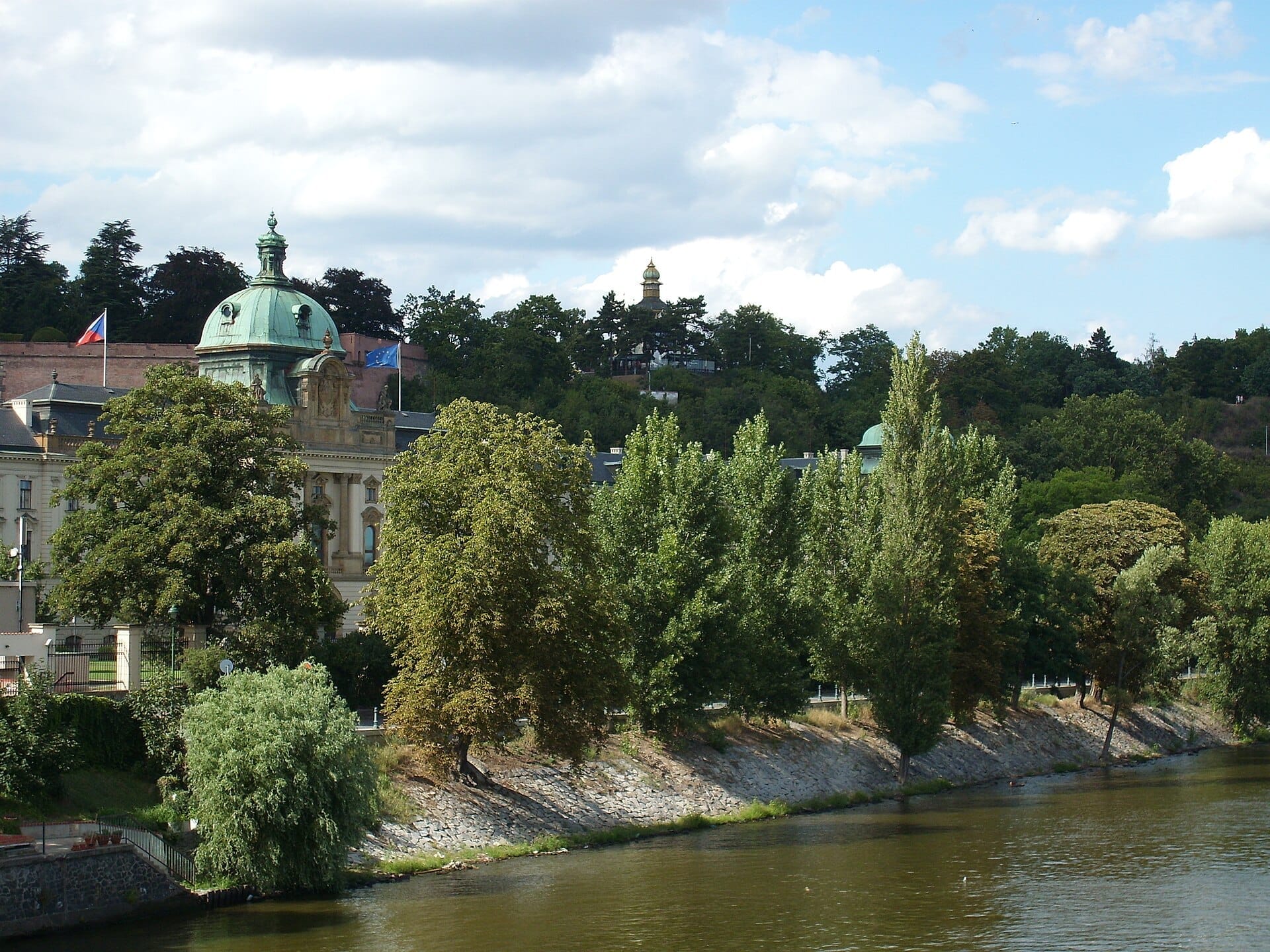
What Letná Park Actually Is
Letná Park, known in Czech as Letenské sady, is a large public green space occupying the Letná hill above the left bank of the Vltava River in Prague 7. The park sits above Prague 7’s Holešovice district on the Letná hill, and covers somewhere between 25 and 52 hectares depending on where you draw the boundary of the broader promontory. Either way, it is one of the largest elevated parks within Prague's inner city.
The terrain is the defining feature. From the Old Town below, Letná appears as a forested bluff. Once you climb up, the plateau opens into a wide, flat expanse of lawns, chestnut and linden avenues, cycling and skating paths, and several facilities including a beer garden and tennis courts. The combination of urban infrastructure and green canopy is what draws the mix of people you see here: joggers at 7am, families with strollers by midday, skateboarders in the afternoon, and groups sharing beer at sunset.
💡 Local tip
The park is free and open 24 hours. Individual facilities inside it, including the beer garden, have their own seasonal hours and are typically closed in winter or during cold snaps.
Getting There: Climbing the Hill
Reaching Letná requires either a short climb or a tram ride that deposits you near the top. The most atmospheric approach is on foot from the Old Town: walk up Pařížská Street, cross Čechův most (Čech Bridge) over the Vltava, and follow the wide staircase that ascends the embankment directly into the southern edge of the park. The climb takes about five minutes and the payoff, a sudden panoramic opening at the top, is immediate.
Tram lines stop at Chotkovy sady on the southern side, placing you close to the park entrance after a short uphill walk. The Korunovační stop serves the north side of the park, useful if you are approaching from deeper in Holešovice. If you have mobility concerns, the underground car park at Podzemní parkoviště Letná allows you to arrive by car and enter the plateau without navigating the steep embankment stairs.
⚠️ What to skip
The embankment stairways from the riverside are steep and uneven in places. Visitors using wheelchairs or pushchairs should access via tram or vehicle to avoid the stairs entirely. Once on the plateau, the main paths are tarmacked and suitable for all.
Letná's accessibility on the plateau makes it practical for cyclists too. It connects naturally to broader cycling routes across Prague, and fits well into a longer exploration of the area. The Holešovice district below offers additional attractions that pair well with a visit.
Tickets & tours
Hand-picked options from our booking partner. Prices are indicative; availability and final rates are confirmed when you complete your booking.
Self guided tour with interactive city game of Prague
From 5 €Instant confirmationFree cancellationPrague by night city tour
From 27 €Instant confirmationFree cancellationPrague city tour with Vltava River cruise
From 38 €Instant confirmationFree cancellationPrague Castle online audio guide
From 5 €Instant confirmationFree cancellation
The View: What You're Actually Looking At
The southern edge of Letná Park delivers one of the most instructive city views in Prague. From the terrace near the old metronome, you look directly down the Vltava as it curves through the city. To the left, the towers of the Old Town and the dome of St. Francis of Assisi Church; to the right, the spires of Prague Castle and St. Vitus Cathedral on the opposing ridge. In between, a sequence of historic bridges crosses the river. It is a genuinely useful view for understanding Prague's geography, not merely a decorative backdrop.
The large red metronome that ticks at this terrace is a deliberate piece of historical commentary. It stands on the plinth where a monumental statue of Joseph Stalin once dominated the cityscape from 1955 until 1962, when it was demolished following Khrushchev's denunciation of the Stalin cult. The metronome was installed in 1991, designed by sculptor Vratislav Novák. It has no official interpretive signage at the site, but the contrast between its ticking rhythm and the blank plinth below repays a few minutes of thought. For deeper context on how communist-era symbols were handled across the city, the Museum of Communism is the most direct resource.
The view changes significantly by time of day. At dawn, the river and rooftops are often wrapped in a low mist that makes the cathedral spires appear to float. By mid-morning the light moves behind you, giving clean visibility across the city. At sunset, the western sky backlights the castle ridge and turns the Vltava copper. The evening view, with city lights reflected in the river, is popular enough that the terrace collects a crowd on warm nights.
History: From Military Parade Ground to Public Park
The plateau now called Letná was historically used as a military camp and parade ground. It was a practical choice: elevated, flat, and overlooking the city in a way that suited both defensive observation and displays of force. Major political gatherings were held here during the communist period, and in November 1989 the site took on entirely different significance when an estimated 750,000 people assembled on Letná Plain during the Velvet Revolution, making it one of the largest political demonstrations in Czech history.
The park itself was formally developed in the 1840s under Karel Chotek, the Burgrave of Prague, who oversaw the planting of approximately 150,000 trees and the purchase of surrounding land. A small chateau was built on the site. For a period in the 19th century the park was renamed Crown Prince Rudolf Park following a visit by the Austrian heir to the throne, though the original name eventually returned. The tree canopy you walk under today is largely the result of that mid-19th century planting program, giving the lime and chestnut avenues a maturity that takes generations to achieve.
Letná sits within a broader arc of significant Prague history. Directly across the river, the Prague Castle complex has dominated the opposing ridge for centuries, and the two elevated positions have always been in visual dialogue across the valley.
The Beer Garden and Daily Life in the Park
The Letná beer garden occupies a terrace close to the viewpoint, with plastic garden furniture arranged on a gravel terrace under trees. It is functional, unpretentious, and well-attended. Czech lager is served in half-litre glasses at prices that remain lower than most Old Town establishments. There is no table service; you order at the counter. The crowd is genuinely mixed: locals, students, tourists who found their way up the hill, and the occasional cyclist taking a break.
The beer garden is seasonal and closes during cold months. Hours shift depending on the season and weather, so treating any specific times published elsewhere as approximate is sensible. On warm weekend evenings in summer, the queue at the counter can be twenty minutes long and the terrace fills completely. Arriving before 6pm on a weekday gives you the best balance of atmosphere and space.
Away from the beer garden, the park's daily rhythms are readable if you spend time there. Early mornings belong to runners using the tree-lined paths as a circuit. The wide central avenue becomes a roller-blade and skateboard corridor by afternoon. Dogs are walked throughout the day. Children use the playgrounds near the park's inner paths. On warm weekends, people spread out on the grass lawns in numbers that make Letná feel genuinely like the city's living room.
For those building a longer day in this part of the city, the Náplavka riverfront below makes a natural complement: start at Letná for the elevated view, then descend to the river level for a different kind of atmosphere.
Photography and Best Times to Visit
Photographers consistently favour the southern terrace in the hour after sunrise and the hour before sunset. The castle ridge catches warm directional light in the morning from this eastern vantage, and the entire river panorama turns gold in the late afternoon. Midday light is flat and tends to wash out the texture of the Old Town roofscape below.
For the park's interior, autumn is the most photogenic season by some distance. The lime and chestnut avenues turn in October and by early November the light filters through yellow and amber canopy in a way that makes even a phone camera produce usable images. Spring brings blossom and a fresh canopy but the tree cover is thinner and less dramatic than autumn.
If you are building a morning visit, pairing Letná with the Letná beer garden at the same terrace makes sense in warmer months, or continuing into Holešovice towards the National Gallery at Veletržní Palace gives a full half-day itinerary in the neighbourhood.
Who May Not Enjoy This
Letná is not a destination attraction in the same sense as a museum or historic monument. If your time in Prague is limited to two days and you are prioritising historic interiors, the park will feel like a pleasant but interchangeable green space. It rewards a slower pace and works best when you have time to sit, walk, and observe rather than tick it off a list.
The climb from the riverside is a genuine physical obstacle for anyone with mobility limitations. While the plateau itself is accessible once you arrive, the most dramatic approach involves stairs, and there is no elevator or ramp on that southern embankment route. Tram access solves this practically, but it removes the element of arrival that makes the view feel earned.
In winter, the park is quiet, grey, and frequently cold. The beer garden closes. The lawns are empty. The view remains, but the atmosphere that makes Letná distinctive in summer is largely absent. Visiting in January or February is fine for a walk but produces a different experience entirely.
Insider Tips
- The metronome terrace is visible from below but the best river photographs are taken from the low wall to the left of the metronome base, not from directly in front of it. That angle includes a second bridge in the frame and gives depth to the composition.
- The park's skating circuit is genuinely good. If you skate or ride, bringing your own board or blades gives you access to several kilometers of smooth tarmac paths with almost no motor traffic.
- Local families use the large grassy areas east of the main path for picnics and informal sports on weekends. Arriving with food from one of the Holešovice market stalls below and eating here is a practical and affordable alternative to a restaurant lunch.
- The Velvet Revolution connection is rarely signed or explained at the site itself. Knowing that you are standing where 750,000 people gathered in 1989 changes how the open plateau reads. The scale of the plain starts to make a different kind of sense.
- If you arrive via Čech Bridge on foot, look back from the top of the stairs before entering the park. The view down the bridge alignment toward the Old Town is one of the most symmetrical urban views in the city and is frequently overlooked because visitors are focused on reaching the terrace.
Who Is Letná Park For?
- Travelers who want an uncrowded city panorama without paying an entrance fee
- Cyclists and skaters looking for smooth, car-free paths in central Prague
- Visitors wanting to understand Prague's geography from a single vantage point
- Locals and long-stay visitors seeking a relaxed afternoon with Czech beer at honest prices
- Photographers targeting the sunset or early-morning light over the Vltava
Nearby Attractions
Other things to see while in Holešovice:
- DOX Centre for Contemporary Art
Opened in 2008 inside a converted 19th-century factory in Holešovice, DOX Centre for Contemporary Art is a major venue for international contemporary art, architecture, and design. With around 3,000 m² of exhibition space across renovated industrial halls, it stages politically engaged, visually demanding shows that rarely play it safe.
- Holešovice Market Halls (Pražská tržnice)
The Holešovice Market Halls, officially known as Pražská tržnice, The Holešovice Market Halls, officially known as Pražská tržnice, occupy a large heritage complex in Prague 7 that began life as the city's central slaughterhouse in 1895.. Today the red-brick halls host a year-round farmers market, street food vendors, pop-up events, and independent businesses, offering a slice of everyday Prague that most tourists never reach.
- Letná Beer Garden
Perched on the edge of Letná Park above the Vltava River, the Letná Beer Garden is where Prague locals actually drink in summer. No admission charge, plastic cups of cold Pilsner, and a sweeping view across the city's rooftops — it is one of the most genuinely local outdoor experiences in the Czech capital.
- National Gallery – Veletržní Palace
Veletržní Palace houses the National Gallery Prague's collection of 20th and 21st century art across 13,500 square metres of exhibition space. Built in 1928 as a trade fair hall, this Functionalist landmark in Holešovice is a major destination for modern and contemporary art.