Náplavka Riverfront: Prague's Living Edge on the Vltava
Náplavka is a riverside promenade running along Rašínovo nábřeží in Prague's New Town, built in two stages between 1870 and 1905. Free to access around the clock, it hosts a beloved Saturday farmers' market for much of the year, moored houseboats turned bars and restaurants, and a cross-section of Prague life that most tourist itineraries miss entirely.
Quick Facts
- Location
- Rašínovo nábřeží, Praha 2 (New Town), along the Vltava River between Palacký Bridge and the Výtoň tram stop
- Getting There
- Metro: Karlovo náměstí (Line B), 5–7 min walk. Tram: Palackého náměstí, Výtoň, or Jiráskovo náměstí (tram 17)
- Time Needed
- 45–90 min for a full walk; longer on Saturday if visiting the farmers' market
- Cost
- Free to enter. Pay only for food, drinks, or event tickets (prices in CZK, set by individual vendors)
- Best for
- Local atmosphere, weekend markets, river walks, casual eating and drinking outdoors
- Official website
- funinprague.eu/en/the-new-season-at-pragues-naplavka-waterfront
What Náplavka Actually Is
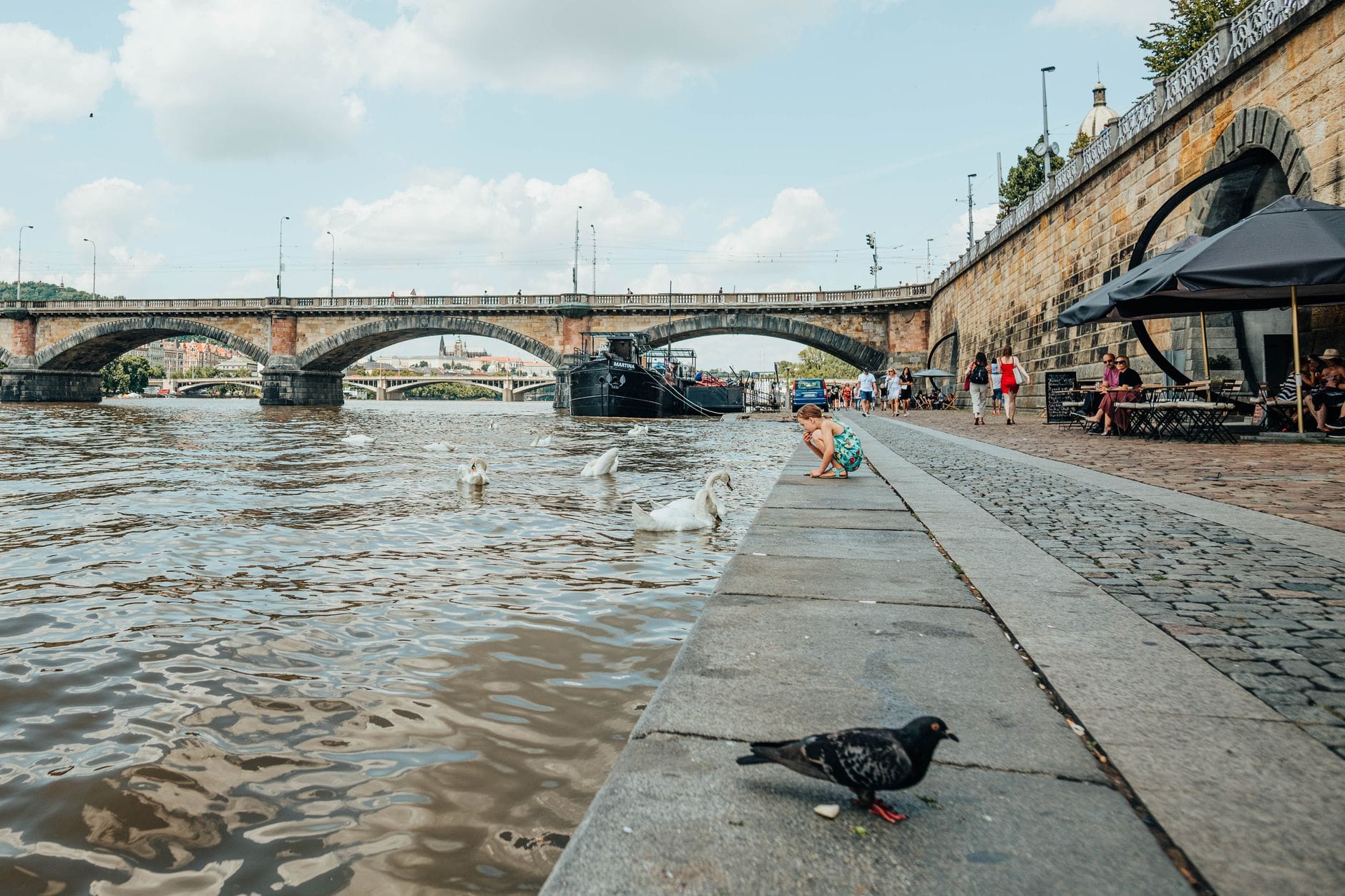
Náplavka is not a park, a market, or a bar district — it is all three at once, and that ambiguity is exactly what makes it work. The name refers to a lower embankment promenade on the right bank of the Vltava River, running for roughly one kilometer between Palacký Bridge (Palackého most) to the north and the Výtoň tram stop to the south. The full address falls under Rašínovo nábřeží, Praha 2, which places it in the New Town (Nové Město) district.
The embankment itself was built in two phases: the first section was completed between 1870 and 1878, and the second followed in 1905. These stone-walled quays were functional infrastructure before they were ever a leisure destination — flood control and river access for commerce came first. Today the stone walls, worn steps down to the waterline, and iron mooring rings are still visible, giving the promenade a texture that newer waterfronts simply cannot replicate.
ℹ️ Good to know
The promenade is open 24 hours a day, every day of the year. There is no entry fee. The Saturday farmers' market runs approximately 8:00–14:00, February–December.
How the Promenade Feels at Different Times of Day
Early weekday mornings are quiet on the lower embankment. Joggers use the flat stone path, dog walkers congregate near the steps, and the river smells faintly of algae and damp stone — not unpleasant, but distinctly riparian. The houseboats moored along the bank are locked up, their windows dark. At this hour you notice the mechanical hum of boat engines idling and the occasional slap of a wave against the hull.
By midday on a weekday, office workers from the surrounding New Town neighborhoods appear with takeaway lunches. The upper embankment path, one level above the water, gets more foot traffic. On sunny days, people sit on the stone walls with their legs dangling over the lower path — an informal practice that has become a visual shorthand for the place.
Summer evenings transform the character entirely. The houseboat bars and riverside kiosks open fully, music carries across the water, and the scent shifts from river damp to grilled food and hops. Light stays in the sky until nearly 9 pm in June and July, and the crowd becomes younger and louder. It is genuinely lively without being aggressive — but if a quiet, meditative riverside walk is what you are after, avoid Friday and Saturday evenings between May and September.
Winter is underrated here. The boats are mostly closed, the crowd thins to almost nothing, and the low angle of afternoon light turns the river surface silver. You can walk the full length in 15 minutes without stopping for a single pedestrian. Bring a warm layer — the river creates wind that cuts through clothing faster than the city streets above.
Tickets & tours
Hand-picked options from our booking partner. Prices are indicative; availability and final rates are confirmed when you complete your booking.
Self guided tour with interactive city game of Prague
From 5 €Instant confirmationFree cancellationPrague by night city tour
From 27 €Instant confirmationFree cancellationPrague city tour with Vltava River cruise
From 38 €Instant confirmationFree cancellationPrague Castle online audio guide
From 5 €Instant confirmationFree cancellation
The Saturday Farmers' Market
The Saturday market at Náplavka is the anchor event that most visitors come specifically for, and it earns its reputation. Stalls set up from around 8:00 and the market runs until 14:00, rain or shine, most Saturdays of the year. The produce is genuinely local: seasonal vegetables, fruit, bread, honey, cheese, and charcuterie dominate, with a small number of prepared food stalls selling items like trdelník (a spiral pastry), klobásy (grilled sausages), and fresh soup. The produce is genuinely local: seasonal vegetables, fruit, bread, honey, cheese, and charcuterie dominate, with a small number of prepared food stalls selling items like trdelník (a spiral pastry), klobásy (grilled sausages), and fresh soup.
Arrive before 10:00 if you want a relaxed browse and first pick of the produce. Between 10:30 and noon the crowd peaks, the lanes between stalls narrow, and reaching the better bread vendors requires patience. The atmosphere is sociable rather than pushy — locals with canvas bags, families with prams, and a fair number of visitors who have done their research. Payment at most stalls is cash in Czech koruna, so arrive with CZK in hand.
💡 Local tip
The stone steps down to the lower embankment level, just south of the main market stalls, are a good spot to eat what you have bought. They face directly over the river and catch morning sun from the east.
Beyond Saturday, the embankment hosts seasonal festivals and pop-up food events throughout the year — summer boat parties, autumn beer markets, and occasional outdoor film screenings. Check the official event listings at funinprague.eu or compare with the broader Prague events calendar before finalising your dates.
The Houseboats: What They Are and What to Expect
A string of permanently moored houseboats lines the lower bank, and several of them operate as bars, cafés, or small restaurants. They are a defining feature of the Náplavka experience — low-ceilinged, slightly swaying on busy days, and offering river views from a perspective you cannot get from the embankment path above. Interiors vary from rough-and-ready wooden panels to more considered bar setups with proper seating.
Individual boats open and close independently, and their operating hours, menus, and names change from season to season. Do not plan your visit around a specific vessel unless you have checked very recently. What you can rely on is that at least a few will be open during summer afternoons and evenings, and that Czech beer (poured from taps, not cans) will be available at prices noticeably lower than the tourist-facing bars around Old Town Square.
Getting There and Getting Around
The most direct metro approach is Karlovo náměstí on Line B (the yellow line). From the station, walk south and downhill toward the river — the embankment path is not immediately visible from the surface level, as it sits one story below the street. Follow the road to the embankment and look for the stairways or ramps leading down to the lower promenade.
Tram line 17 follows the right bank of the Vltava and stops at Palackého náměstí (near the market's northern entrance), Jiráskovo náměstí (close to the Dancing House), and Výtoň at the southern end. If you are walking from the Old Town side, crossing Charles Bridge and following the right bank south is a scenic approach that takes about 20–25 minutes on foot.
The promenade itself is a single elongated path with no loops or branches, so navigation is simple: you walk in one direction and come back the other way. The lower stone level is largely flat and paved, suitable for pushchairs. However, access down from street level requires steps in several places, and some sections of the lower bank are only reachable by stairs, which creates genuine limitations for wheelchair users. Ramps exist at certain entry points but are not consistent throughout.
Placing Náplavka in Prague's New Town
Náplavka sits in the New Town (Nové Město) district, a quarter that Emperor Charles IV laid out in the 14th century as an expansion of the medieval city core. Unlike the preserved Gothic and Baroque streetscape of Old Town, New Town absorbed waves of 19th-century development and has a more mixed architectural character — grand apartment buildings, commercial streets, and public squares that give way to this quieter, more functional riverbank.
The promenade offers a useful orientation point for understanding Prague's topography. Looking across the Vltava from Náplavka, you are facing west toward Smíchov. Looking north up the river, the spires and rooftops of the Old Town and eventually the Prague Castle come into view above the treeline. Downstream to the south, the rocky outcrop of Vyšehrad appears within a 15-minute walk — an easy extension if you have the energy.
If you are building a half-day itinerary around this part of the city, the Dancing House (Tančící dům) is a five-minute walk north along the embankment. The Vyšehrad fortress to the south makes a natural extension — walk along the embankment to Výtoň and climb from there. Together, these three stops form a coherent riverside afternoon without retracing steps.
Weather and Seasonal Considerations
Prague's climate is described as oceanic to humid continental, with cold winters (averaging around -1 to 3°C in December to February) and warm summers (15 to 25°C in June to August). The outdoor nature of Náplavka means the experience is directly shaped by weather in a way that indoor attractions are not.
Summer is the peak season for the houseboats and evening events, but June through August also brings a higher probability of afternoon thunderstorms. These pass quickly but can drench an unprotected embankment in minutes. A compact rain layer takes up no space and changes the calculus entirely. Spring (May) and early autumn (September) offer the best balance of mild temperatures, lower visitor numbers, and reliable weather for the Saturday market.
⚠️ What to skip
In exceptionally wet years, the lower embankment can flood when the Vltava rises. Prague's flood defenses have been significantly upgraded since the major 2002 floods, but check local conditions if you are visiting after heavy rain upstream.
For a broader read on timing your Prague visit, see the best time to visit Prague guide, which covers how seasonal patterns affect different types of attractions across the city.
Insider Tips
- The lower stone steps facing directly over the water, roughly in the middle of the promenade near the market stalls, catch the best morning light and are rarely claimed before 10:00 on Saturdays — ideal for eating market food with an unobstructed river view.
- If you want the Saturday market experience without the crowds, arrive at 8:30. The stalls are fully set up, vendors are in good spirits, and the lanes are walkable. After 10:30, the density of people between stalls makes it harder to actually look at what is on offer.
- The houseboat bars are almost entirely cash operations. ATMs near Karlovo náměstí metro station are the closest option — drawing cash before walking down to the embankment saves an unnecessary trip back up.
- Tram 17 runs along the right bank and stops directly at multiple Náplavka access points. It is a far more scenic approach than the metro if you are starting from the National Theatre or Jiráskovo náměstí area — and it takes roughly the same time.
- Náplavka on a weekday morning in October or November is one of the quietest places in central Prague. If you have been doing intensive tourist sightseeing and want thirty minutes of actual calm near moving water, that is the prescription.
Who Is Náplavka Riverfront For?
- Travelers who want to see how Prague residents actually spend a Saturday morning
- Food-focused visitors looking for local produce, fresh bread, and Czech street food at non-tourist prices
- Walkers building a south-right-bank itinerary that connects the Dancing House and Vyšehrad
- Evening drinkers who prefer an outdoor, river-facing setting over a traditional pub interior
- Anyone visiting in the shoulder seasons (May or September) who wants unhurried outdoor time
Nearby Attractions
Other things to see while in New Town (Nové Město):
- Dancing House (Tančící dům)
Designed by Frank Gehry and Vlado Milunić and completed in 1996, the Dancing House stands on the Vltava embankment as one of Prague's most photographed and debated buildings. Here's what the experience actually looks like from the outside, from the rooftop bar, and from the gallery inside.
- Franciscan Garden
Hidden behind the commercial noise of Wenceslas Square, the Franciscan Garden (Františkánská zahrada) is a free, walled courtyard garden Hidden behind the commercial noise of Wenceslas Square, the Franciscan Garden (Františkánská zahrada) is a free, walled courtyard garden with roots in the 14th century, a Baroque pavilion, and rose beds that offer genuine quiet in the middle of Prague's busiest district. Entry is free, and the contrast with the streets outside is immediate., a Baroque pavilion, and rose beds that offer genuine quiet in the middle of Prague's busiest district. Entry is free, and the contrast with the streets outside is immediate.
- Jerusalem Synagogue
Built in 1904–1906, the Jerusalem Synagogue is the largest synagogue of Prague's Jewish community and one of the most visually arresting religious buildings in the city. Its exterior fuses Moorish Revival arches with Art Nouveau ornament, while the interior overwhelms with color, pattern, and scale.
- Kafka's Rotating Head (Franz Kafka Sculpture)
Standing 11 metres tall outside the Quadrio shopping centre in New Town, the Head of Franz Kafka is a kinetic sculpture of 42 polished stainless steel layers that slowly rotate out of sync, fragmenting and reassembling Kafka's face. It is free to see at any time, though the programmed rotation runs at set intervals between morning and late evening, and it is one of the most photographed modern artworks in the Czech Republic.