Dancing House (Tančící dům): Prague's Most Controversial Building, Explained
Designed by Frank Gehry and Vlado Milunić and completed in 1996, the Dancing House stands on the Vltava embankment as one of Prague's most photographed and debated buildings. Here's what the experience actually looks like from the outside, from the rooftop bar, and from the gallery inside.
Quick Facts
- Location
- Jiráskovo náměstí 1981/6, Praha 2 — on the Rašín Embankment, New Town
- Getting There
- Tram 2, 3, 10, 17 to Jiráskovo náměstí (stop directly outside); or Metro Line B to Karlovo náměstí, then 10-min walk east
- Time Needed
- 20–30 min for exterior and rooftop; 1–1.5 hrs if visiting gallery and dining
- Cost
- Gallery approx. 230 CZK — verify before visiting
- Best for
- Architecture enthusiasts, photography, couples, a riverside drink with a view
- Official website
- www.dancinghouse.cz/en
What Is the Dancing House, and Why Does It Matter?
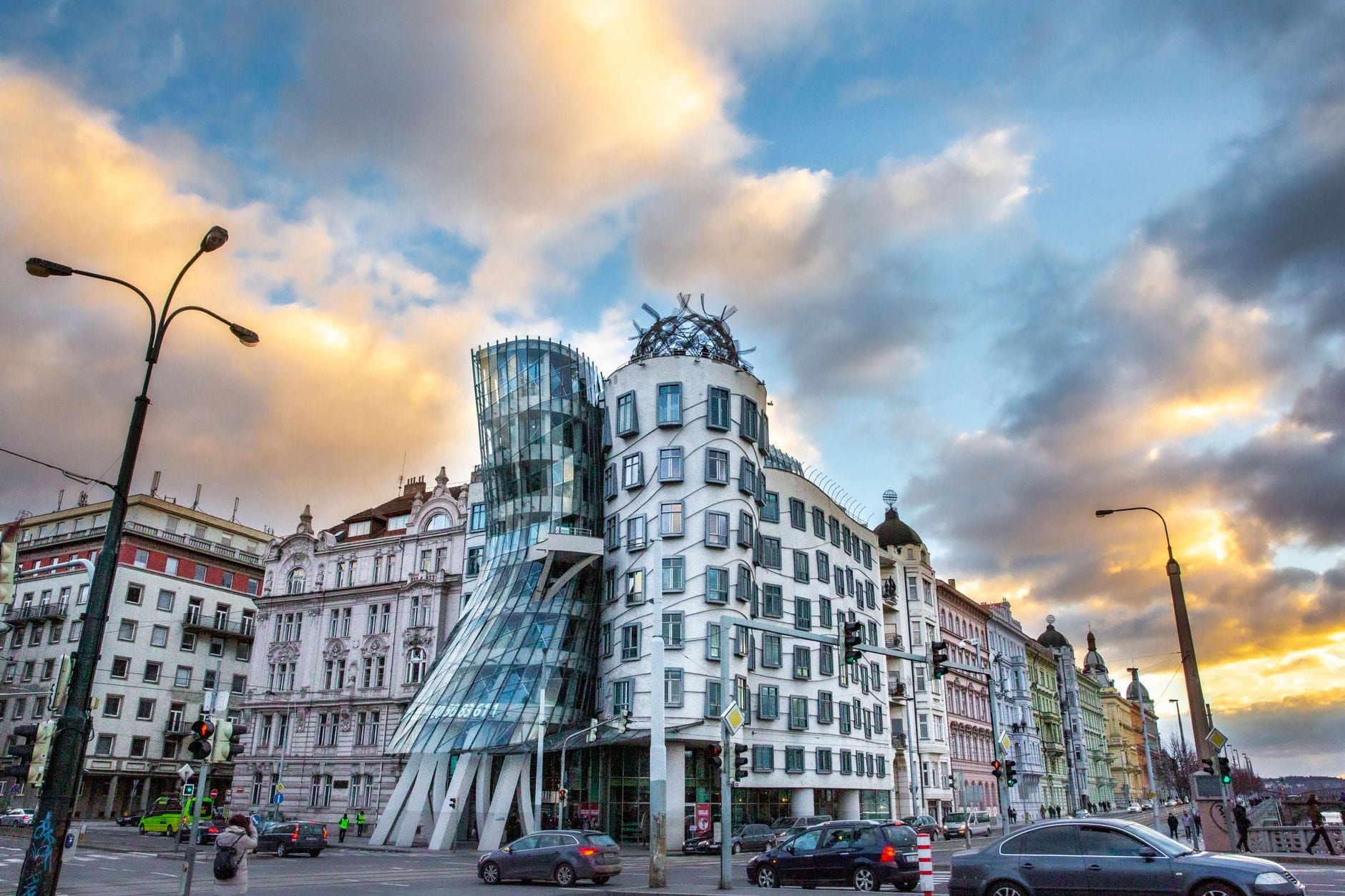
The Dancing House, known in Czech as Tančící dům, is a deconstructivist office and mixed-use building at Jiráskovo náměstí 1981/6 in Prague's New Town district. Its official corporate name is the Nationale-Nederlanden Building, though almost nobody uses that. What people use instead is the nickname 'Fred and Ginger,' a reference to the way its two towers — one curved and glassy, one cylindrical and solid — appear to be a dancing couple caught mid-step.
Designed by Croatian-Czech architect Vlado Milunić and American architect Frank O. Gehry, the building was constructed between 1992 and 1996 on a plot that had sat empty since 14 February 1945, when an Allied air raid destroyed the building that previously stood there. It was controversial when completed — then-President Václav Havel, who lived next door and had championed the project, appreciated it, while some architects and critics argued it clashed with the surrounding 19th-century Neo-Baroque streetscape. That tension is still the most interesting thing about it.
ℹ️ Good to know
Visiting hours (verify before going): Gallery daily 09:00–20:00. Entering the building and riding the lift may be subject to venue conditions.
The Architecture: What You're Actually Looking At
Stand on the pavement at Jiráskovo náměstí and look at the corner of the building where the two towers meet. The 'Ginger' tower — the curved, undulating one clad in concrete and glass — has individually shaped concrete panels; no two are the same size or angle. It pinches at the waist and flares at the top, ending in a metal dome that locals sometimes describe as a hairnet or a crumpled crown. The 'Fred' tower beside it is a conventional cylindrical column with regular windows, solid and upright, providing the visual anchor that makes Ginger's movement readable.
The building occupies a corner position on the Rašín Embankment, and that position is central to how it works as architecture. Gehry and Milunić oriented the building so that its most dynamic face addresses the river and the view from Charles Bridge downstream. From across the Vltava, particularly from the Malá Strana bank, the building reads clearly against the water and the line of 19th-century apartment buildings beside it. The contrast is intentional: this is a building designed to be seen in context, not in isolation.
If you are interested in how this building sits within Prague's broader architectural story, the Prague architecture guide covers the city's full range of styles, from Romanesque to Cubist to late 20th-century deconstructivism.
Tickets & tours
Hand-picked options from our booking partner. Prices are indicative; availability and final rates are confirmed when you complete your booking.
Self guided tour with interactive city game of Prague
From 5 €Instant confirmationFree cancellationPrague by night city tour
From 27 €Instant confirmationFree cancellationPrague city tour with Vltava River cruise
From 38 €Instant confirmationFree cancellationPrague Castle online audio guide
From 5 €Instant confirmationFree cancellation
Visiting at Different Times of Day
The building looks different depending on the light. On overcast mornings, the concrete panels on Ginger's facade take on a flat, almost monolithic grey that emphasises their texture over their shape. In the afternoon, when direct sun hits the southern and western faces, the glass elements catch and scatter the light in ways that shift minute by minute, making the building appear slightly alive in a way that photographs rarely capture. At dusk, the interior lighting of the Glass Bar glows through the curved glass top, and the building becomes readable from across the river in a completely different way.
Morning is the best time to photograph the exterior without crowds. The Jiráskovo náměstí tram stop is active from early, but the tourist foot traffic on the embankment doesn't build until late morning. If you want a clean shot of the facade from the riverbank opposite, arrive before 09:00. By midday on a summer weekend, tour groups cycle through every 15–20 minutes.
💡 Local tip
For the best exterior photograph, cross to the opposite (west) bank of the Vltava. Walk north along the Malá Strana embankment until the building aligns with an open stretch of river — this gives you the full facade with water in the foreground and no foreground clutter.
The Rooftop Glass Bar: Worth It or Overpriced?
Take the lift to the top of the building and you reach the Glass Bar, a curved, bubble-shaped rooftop space with 360-degree views over the Vltava and New Town. The view is genuinely good: upstream toward Charles Bridge and Prague Castle, downstream toward Vyšehrad, and directly east over the rooftops of Vinohrady. On a clear day, the castle is visible as a distinct silhouette several kilometres away.
The bar itself is small, the drinks are priced at a premium, and on busy afternoons it fills quickly. There is no admission charge to access the rooftop — you ride the lift, arrive at the Glass Bar, and are expected to order something if you want to linger. If you arrive, look at the view, and leave without ordering, no one will stop you, but the space is tight enough that standing around without a drink feels uncomfortable when it's busy. Budget accordingly: this is a view that costs the price of a cocktail or a coffee, not a ticket.
If you are comparing rooftop views across Prague, the best views in Prague guide breaks down which viewpoints justify the effort and which are better alternatives depending on your priorities.
The Dancing House Gallery
The Dancing House Gallery occupies several levels inside the building and hosts rotating contemporary art exhibitions. Admission is around 230 CZK per person, though this should be verified close to your visit as prices and exhibitions change. The gallery space is compact, and the quality of the shows varies depending on what is running when you visit. Unlike the permanent collections at the National Gallery or the Mucha Museum, there is no fixed permanent display here — what you find is entirely dependent on the current rotation.
Unless you have a specific reason to see what is currently showing, the gallery is not the main draw. Most visitors find the architecture of the building itself, and the rooftop view, more rewarding than the exhibition space. That said, the gallery admission includes access to parts of the building interior that give you a better sense of how the spaces work structurally — the curved walls and irregular angles are more noticeable from inside than from the street.
Getting There and Getting Around
The easiest approach is by tram. Trams serve Jiráskovo náměstí, near the building. From the Old Town side of Charles Bridge, trams heading south along the river will get you there in around 10 minutes. On foot from Charles Bridge, allow 15–20 minutes walking south along the New Town embankment — it is a pleasant riverside walk with good views of the Malá Strana bank across the water.
From Metro Line B (yellow), exit at Karlovo náměstí and walk east toward the river, then turn south along the embankment. The building is visible from the embankment well before you reach it, so orientation is straightforward.
Accessibility note: the building has a lift that reaches the rooftop bar and gallery levels without charge. Travellers with specific mobility requirements should contact the venue directly for step-free access details, as the original sources do not specify full accessibility specifications.
The Dancing House sits in New Town, which connects easily to Old Town and Malá Strana. For a broader orientation to the area, the New Town Prague neighbourhood guide covers what else is nearby and how the district fits into the city.
The Surrounding Neighbourhood: What's Nearby
The Rašín Embankment is one of the more understated stretches of riverside in Prague. It lacks the heavy tourist density of the Old Town waterfront but has a calm, residential quality that makes it good for walking. The Náplavka riverfront, a popular stretch of riverside terraces and weekend markets, begins a short distance to the south.
Heading north along the embankment takes you toward Jiráskovo náměstí and eventually toward Charles Bridge, passing several 19th-century apartment buildings that provide the context Gehry's building was designed to respond to. Combine the Dancing House with a walk to the Náplavka riverfront for a river-focused half-day in the city.
Wenceslas Square is a walk inland from the Dancing House, making this a natural add-on to a wider New Town itinerary.
Who Should Skip It
If architecture is not a significant interest, the Dancing House is a building you can see adequately in five minutes from the pavement outside. The view from the rooftop bar, while good, is not the highest or the most comprehensive in Prague — Petřín Lookout Tower and the Old Town Hall Tower both offer more expansive panoramas. Visitors on tight itineraries who are already visiting multiple major sites may find this a lower priority than, say, Prague Castle or the Jewish Quarter. The gallery, without a specific exhibition drawing you, is similarly skippable unless you are seeking contemporary art.
For families with young children, the interior does not offer activities or interactive elements. If you are planning a family itinerary, the Prague with kids guide will point you toward attractions better suited to that context.
Insider Tips
- The rooftop Glass Bar is open until midnight, making it one of the few elevated view points in Prague accessible in the evening without a dinner reservation. Arrive after 21:00 on a weekday and it is noticeably quieter than the afternoon rush.
- The building's most photogenic angle from the street is the corner view from the southwest — stand at the Jiráskovo náměstí tram stop and look diagonally at the junction of the two towers. This is the angle that makes the 'dancing couple' metaphor most legible.
- If the Vltava is high after spring rains, the embankment directly in front of the building can be partially flooded. The building itself is unaffected, but the riverside walkway used for exterior photography may be inaccessible.
- The Café on the ground floor opens at 08:00 — earlier than the rooftop bar — and is a reasonable spot for a morning coffee before the rest of the building fills up.
- Combine with a downstream walk to the Náplavka riverfront, which hosts a farmers market on weekends. The two together make a logical riverside loop from New Town back toward the Old Town.
Who Is Dancing House (Tančící dům) For?
- Architecture and design enthusiasts who want to see Gehry's work in a European urban context
- Photographers looking for a riverside shot at an unusual angle, particularly at dusk
- Couples wanting a rooftop drink with a river view without a formal dinner reservation
- Visitors who have already covered the major historical sites and want something from the post-1989 era of Prague's development
- Anyone building a walking itinerary along the Vltava embankment between Charles Bridge and Vyšehrad
Nearby Attractions
Other things to see while in New Town (Nové Město):
- Franciscan Garden
Hidden behind the commercial noise of Wenceslas Square, the Franciscan Garden (Františkánská zahrada) is a free, walled courtyard garden Hidden behind the commercial noise of Wenceslas Square, the Franciscan Garden (Františkánská zahrada) is a free, walled courtyard garden with roots in the 14th century, a Baroque pavilion, and rose beds that offer genuine quiet in the middle of Prague's busiest district. Entry is free, and the contrast with the streets outside is immediate., a Baroque pavilion, and rose beds that offer genuine quiet in the middle of Prague's busiest district. Entry is free, and the contrast with the streets outside is immediate.
- Jerusalem Synagogue
Built in 1904–1906, the Jerusalem Synagogue is the largest synagogue of Prague's Jewish community and one of the most visually arresting religious buildings in the city. Its exterior fuses Moorish Revival arches with Art Nouveau ornament, while the interior overwhelms with color, pattern, and scale.
- Kafka's Rotating Head (Franz Kafka Sculpture)
Standing 11 metres tall outside the Quadrio shopping centre in New Town, the Head of Franz Kafka is a kinetic sculpture of 42 polished stainless steel layers that slowly rotate out of sync, fragmenting and reassembling Kafka's face. It is free to see at any time, though the programmed rotation runs at set intervals between morning and late evening, and it is one of the most photographed modern artworks in the Czech Republic.
- Lucerna Palace
Lucerna Palace (Palác Lucerna) is a landmarked early 20th‑century entertainment and shopping complex in Prague's New Town, built between 1907 and 1921. Its covered arcade connects Štěpánská and Vodičkova streets and contains a cinema, concert hall, bars, and shops — all freely accessible to passersby. Designated a Czech national cultural monument in 2017, it remains one of Prague’s key early multi‑purpose entertainment buildings still in active use.