Lucerna Palace: Prague's Grand Art Nouveau Arcade You Can Walk Through for Free
Lucerna Palace (Palác Lucerna) is a landmarked early 20th‑century entertainment and shopping complex in Prague's New Town, built between 1907 and 1921. Its covered arcade connects Štěpánská and Vodičkova streets and contains a cinema, concert hall, bars, and shops — all freely accessible to passersby. Designated a Czech national cultural monument in 2017, it remains one of Prague’s key early multi‑purpose entertainment buildings still in active use.
Quick Facts
- Location
- Štěpánská 61, New Town (Nové Město), Prague 1
- Getting There
- Tram: Václavské náměstí stop; Metro: Můstek (Lines A & B) or Muzeum (Lines A & C)
- Time Needed
- 30–60 min to explore the arcade; longer for events
- Cost
- Free to enter the arcade; event tickets priced per programme
- Best for
- Architecture lovers, evening entertainment, rainy-day exploring
- Official website
- www.lucerna.cz/en
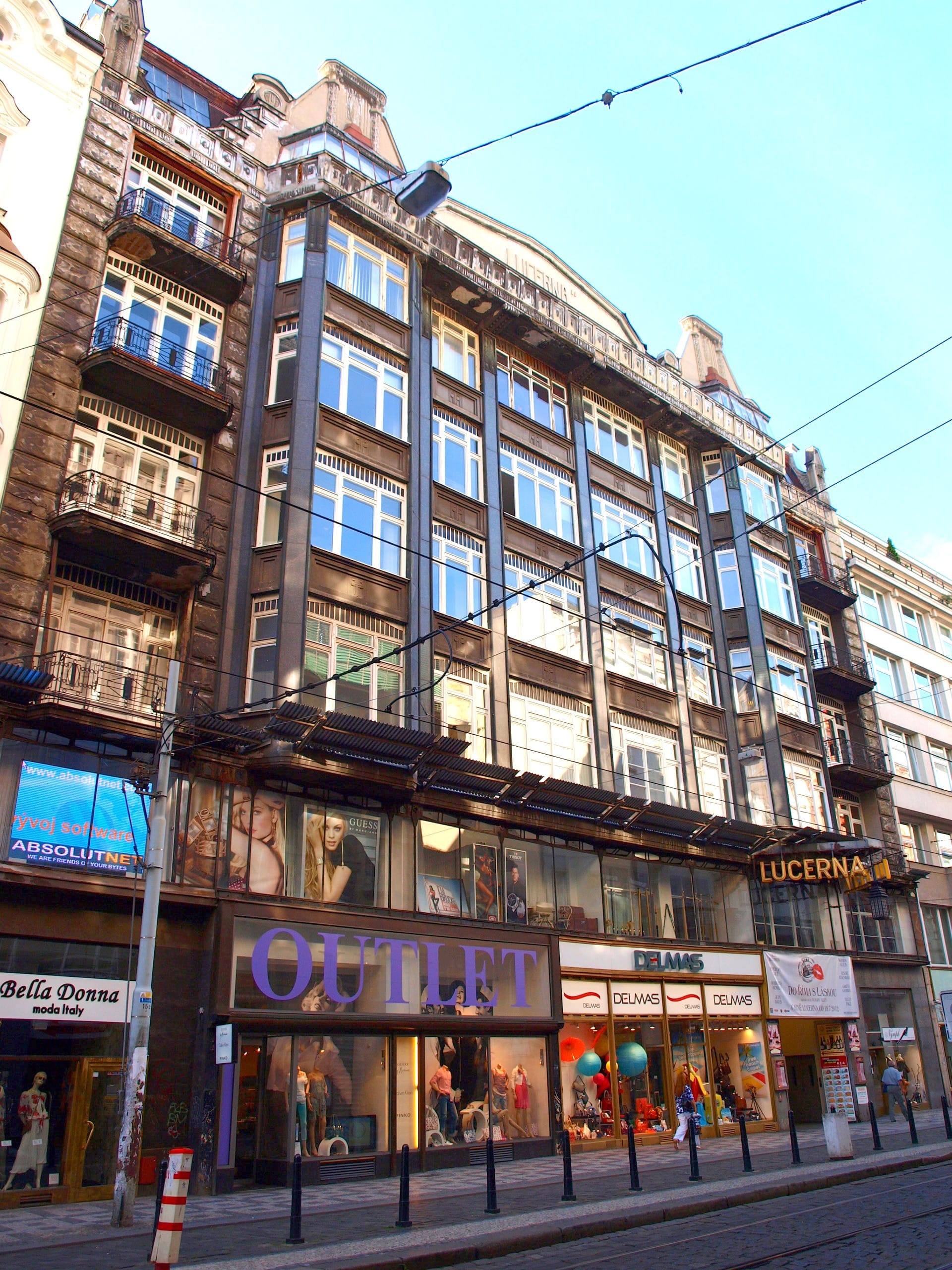
What Lucerna Palace Actually Is
Lucerna Palace is not a palace in the royal sense. It is a sprawling, multi-level entertainment and commercial complex that occupies a substantial plot in Prague's New Town, connecting Štěpánská and Vodičkova streets through a covered arcade. Construction began in 1907 and the complex opened in stages, with the Great Hall completed in 1920 and the full complex officially inaugurated in 1921. It was an early example in the Czech lands of reinforced concrete construction at this scale, and it helped establish the concept of a mixed-use urban entertainment destination in Prague.
The building was designated a Czech national cultural monument in 2017, placing it alongside the country's most significant protected heritage sites. That designation reflects not just the architecture, but the cultural continuity: Lucerna has hosted concerts, balls, film screenings, and public gatherings for over a century, and it continues to do so today.
Lucerna sits at the upper end of Wenceslas Square, one of Prague's main commercial arteries. Walking through the arcade is a natural shortcut between the two parallel streets, and that foot traffic gives the complex its lived-in energy. It never feels like a museum.
The Architecture: Art Nouveau in Concrete
The exterior entrance on Štěpánská is easy to miss if you are moving quickly. Look for the ornate stonework above the passage entrance, where Art Nouveau detailing — flowing curves, floral motifs, and ironwork — frames what is, structurally, a pioneering piece of modern engineering. The building predates most of Prague's famous inter-war functionalist architecture by two decades, and the combination of decorative Art Nouveau surfaces with load-bearing reinforced concrete was genuinely forward-looking for its time.
Inside the arcade, the atmosphere shifts. The passage is wide and covered with a glass-and-iron roof that lets in diffuse daylight during the day and glows warmly at night when the internal lighting takes over. The floors are tiled, the shopfronts are set into arched recesses, and the ceiling height is generous enough that the space never feels cramped, even when it is busy. Several staircases lead off to upper levels and down into the underground sections, including the Great Hall, which lies below street level beneath the arcade.
💡 Local tip
Take a moment to look up at the central atrium area inside the arcade. The ironwork railings on the upper-level balconies are among the most detailed examples of early 20th-century decorative metalwork still intact in central Prague.
If Prague's architectural range interests you more broadly, the Prague architecture guide covers everything from Romanesque crypts to Deconstructivist landmarks, with Lucerna fitting into the Art Nouveau chapter alongside the nearby Municipal House.
Tickets & tours
Hand-picked options from our booking partner. Prices are indicative; availability and final rates are confirmed when you complete your booking.
Self guided tour with interactive city game of Prague
From 5 €Instant confirmationFree cancellationPrague by night city tour
From 27 €Instant confirmationFree cancellationPrague city tour with Vltava River cruise
From 38 €Instant confirmationFree cancellationPrague Castle online audio guide
From 5 €Instant confirmationFree cancellation
The Great Hall: Scale That Still Impresses
The Lucerna Great Hall (Velký sál) is the centrepiece of the complex and one of Prague's most significant concert and events venues. It measures approximately 54 metres long, 25.5 metres wide, and 9 metres high, with a capacity of up to around 2,000 people. The fact that this volume is buried three floors underground, below a functioning commercial arcade, gives a sense of the engineering ambition behind the original construction.
The hall hosts a wide range of events: rock and pop concerts, jazz performances, film festivals, and the famous Lucerna balls, which have been a fixture of Prague's social calendar since the early 20th century. The acoustic character of the space suits amplified music well, and the sightlines from most positions are good given the dimensions. Tickets are sold per event and prices vary considerably depending on the programme. Check the official website (lucerna.cz) for the current schedule before visiting, as events frequently sell out.
The Lucerna Cinema and the Rest of the Complex
The Lucerna Cinema (Kino Lucerna) is one of Prague's oldest operational cinemas and has been screening films in this building for most of the 20th century. The interior retains period details and the programming leans toward art-house, classic, and foreign-language films. It is a genuinely atmospheric place to see a film, and the seating and projection quality are adequate rather than cutting-edge, which some visitors will find charming and others less so.
Beyond the cinema and Great Hall, the complex contains bars, a café, restaurants, and retail spaces across multiple levels. The Lucerna Music Bar in the basement runs club nights and live music on a regular schedule, with a particular reputation for its 1980s and 1990s video parties, which draw a mixed crowd of locals and tourists. The atmosphere at these events is notably more relaxed and unpretentious than at most central-Prague nightlife venues.
ℹ️ Good to know
The café inside the arcade at street level is a reasonable place to sit and observe the foot traffic. It is neither a tourist trap nor a local institution — just a functional café with fair pricing relative to the surrounding area.
How the Experience Changes by Time of Day
The arcade itself is accessible throughout the day and into the evening, functioning as a genuine shortcut and gathering point rather than a ticketed attraction. During the morning, it is quiet: a few regulars, the smell of coffee from the café, the sound of footsteps on tile, and the particular quality of light that comes through the glass ceiling on overcast days, which describes most of Prague's non-summer mornings.
By midday and through the afternoon, foot traffic picks up as shoppers and office workers cut through the passage. This is the most convenient time for photography inside the arcade, since the daylight through the roof is at its strongest and the space is animated without being crowded.
Evenings are when the complex comes fully alive. Concert nights at the Great Hall bring a noticeable shift in energy: the bars fill, the lifts get busy, and the arcade itself serves as a gathering point for people waiting for the venue to open. On nights when the Music Bar is running, you can hear the bass through the floor of the arcade. If you are visiting Prague primarily for its architecture and history, an evening event at Lucerna offers a chance to see the building doing what it was designed to do.
Practical Walkthrough: Getting There and Getting Around
The main entrance on Štěpánská 61 is the easiest to find from Wenceslas Square — walk up the square toward the National Museum end, turn right onto Štěpánská, and the entrance is a short distance along on the right. The Vodičkova entrance is the exit on the parallel street; it is easy to walk through the arcade end-to-end in under five minutes if you are not stopping.
For public transport, the Václavské náměstí tram stop serves multiple lines and is a short walk from the Štěpánská entrance. The Můstek metro station (Lines A and B) is very close by, with Muzeum (Lines A and C) about five minutes on foot from the upper end of Wenceslas Square. Both options are straightforward from any part of central Prague.
The arcade is step-free between the two street entrances, making it accessible for pushchairs and wheelchairs at the ground-floor level. Access to the Great Hall and underground venues involves lifts and stairs; check with the individual venue for current accessibility arrangements. If you are still planning your Prague transport strategy, the getting around Prague guide covers tram, metro, and walking routes across the city.
⚠️ What to skip
Opening hours for specific venues within Lucerna — the cinema, Great Hall, and Music Bar — vary by programme and day. The arcade passage is accessible during normal commercial hours, but do not assume any particular venue is open without checking lucerna.cz first.
Who Should Skip This
If your Prague itinerary is tightly focused on medieval and Baroque history, Lucerna will feel like a detour. The building is early 20th century, and while it is architecturally significant, it does not offer the visual drama of the Old Town or the castle district. Equally, visitors who are not interested in nightlife or cinema may find the complex unremarkable during the day — pleasant to walk through, but not a destination in itself.
Lucerna also does not pretend to be something it is not. Unlike some of Prague's more self-consciously curated attractions, this is a working entertainment venue, not a heritage experience. If you want the full range of what New Town Prague offers architecturally and culturally, Lucerna is worth including. If you are short on time and choosing between this and the major historical sites, those should come first.
Insider Tips
- The Lucerna Music Bar's 80s and 90s video parties (Zlatá Kolekce nights) are a local institution that rarely appears in mainstream tourist guides. They run on Fridays and Saturdays and draw a genuinely mixed crowd. Check the current schedule on the Lucerna website.
- Photography inside the arcade is straightforward and the management does not restrict it for personal use. The best light for photos of the arcade interior is between 11:00 and 14:00 when the glass roof lets in the most daylight.
- If you are attending an event at the Great Hall, arrive 15–20 minutes early. The lift and staircase situation during peak entry periods (when around 2,000 people are arriving simultaneously) creates a bottleneck, and queuing for the lift adds time you may not have budgeted.
- The Vodičkova street entrance is less well-signposted from outside than the Štěpánská one. If you are approaching from the direction of the Franciscan Garden, enter from Vodičkova and walk through the arcade to exit onto Štěpánská — it is a more interesting approach.
- Lucerna Palace is family-owned and has been since its founding. This is not a corporate venue, and that affects how it operates: programming decisions are made with some continuity and institutional memory that larger concert halls lack.
Who Is Lucerna Palace For?
- Architecture enthusiasts interested in early 20th-century Central European design
- Travellers visiting Prague in winter or on rainy days who want an atmospheric indoor destination
- Nightlife seekers looking for a venue with genuine history rather than a purpose-built tourist bar
- Film lovers who appreciate repertory and art-house programming in a period cinema
- Travellers who want to understand Prague beyond its medieval core
Nearby Attractions
Other things to see while in New Town (Nové Město):
- Dancing House (Tančící dům)
Designed by Frank Gehry and Vlado Milunić and completed in 1996, the Dancing House stands on the Vltava embankment as one of Prague's most photographed and debated buildings. Here's what the experience actually looks like from the outside, from the rooftop bar, and from the gallery inside.
- Franciscan Garden
Hidden behind the commercial noise of Wenceslas Square, the Franciscan Garden (Františkánská zahrada) is a free, walled courtyard garden Hidden behind the commercial noise of Wenceslas Square, the Franciscan Garden (Františkánská zahrada) is a free, walled courtyard garden with roots in the 14th century, a Baroque pavilion, and rose beds that offer genuine quiet in the middle of Prague's busiest district. Entry is free, and the contrast with the streets outside is immediate., a Baroque pavilion, and rose beds that offer genuine quiet in the middle of Prague's busiest district. Entry is free, and the contrast with the streets outside is immediate.
- Jerusalem Synagogue
Built in 1904–1906, the Jerusalem Synagogue is the largest synagogue of Prague's Jewish community and one of the most visually arresting religious buildings in the city. Its exterior fuses Moorish Revival arches with Art Nouveau ornament, while the interior overwhelms with color, pattern, and scale.
- Kafka's Rotating Head (Franz Kafka Sculpture)
Standing 11 metres tall outside the Quadrio shopping centre in New Town, the Head of Franz Kafka is a kinetic sculpture of 42 polished stainless steel layers that slowly rotate out of sync, fragmenting and reassembling Kafka's face. It is free to see at any time, though the programmed rotation runs at set intervals between morning and late evening, and it is one of the most photographed modern artworks in the Czech Republic.