Jerusalem Synagogue: Prague's Most Striking Synagogue Interior
Built in 1904–1906, the Jerusalem Synagogue is the largest synagogue of Prague's Jewish community and one of the most visually arresting religious buildings in the city. Its exterior fuses Moorish Revival arches with Art Nouveau ornament, while the interior overwhelms with color, pattern, and scale.
Quick Facts
- Location
- Jeruzalémská 7, New Town (Nové Město), Prague 1 — near the Main Railway Station
- Getting There
- 3–4 min walk from Praha hlavní nádraží (main rail station); also near Jindřišská tram stop
- Time Needed
- 45–75 minutes
- Cost
- Adults 150 CZK (135 CZK online); students/under-15 100 CZK (90 CZK online); under-6 free. Reduced rates with Jewish Town circuit ticket.
- Best for
- Architecture enthusiasts, Jewish heritage travellers, photography, cultural history
- Official website
- www.synagogue.cz/en/jerusalem-synagogue
What Is the Jerusalem Synagogue?
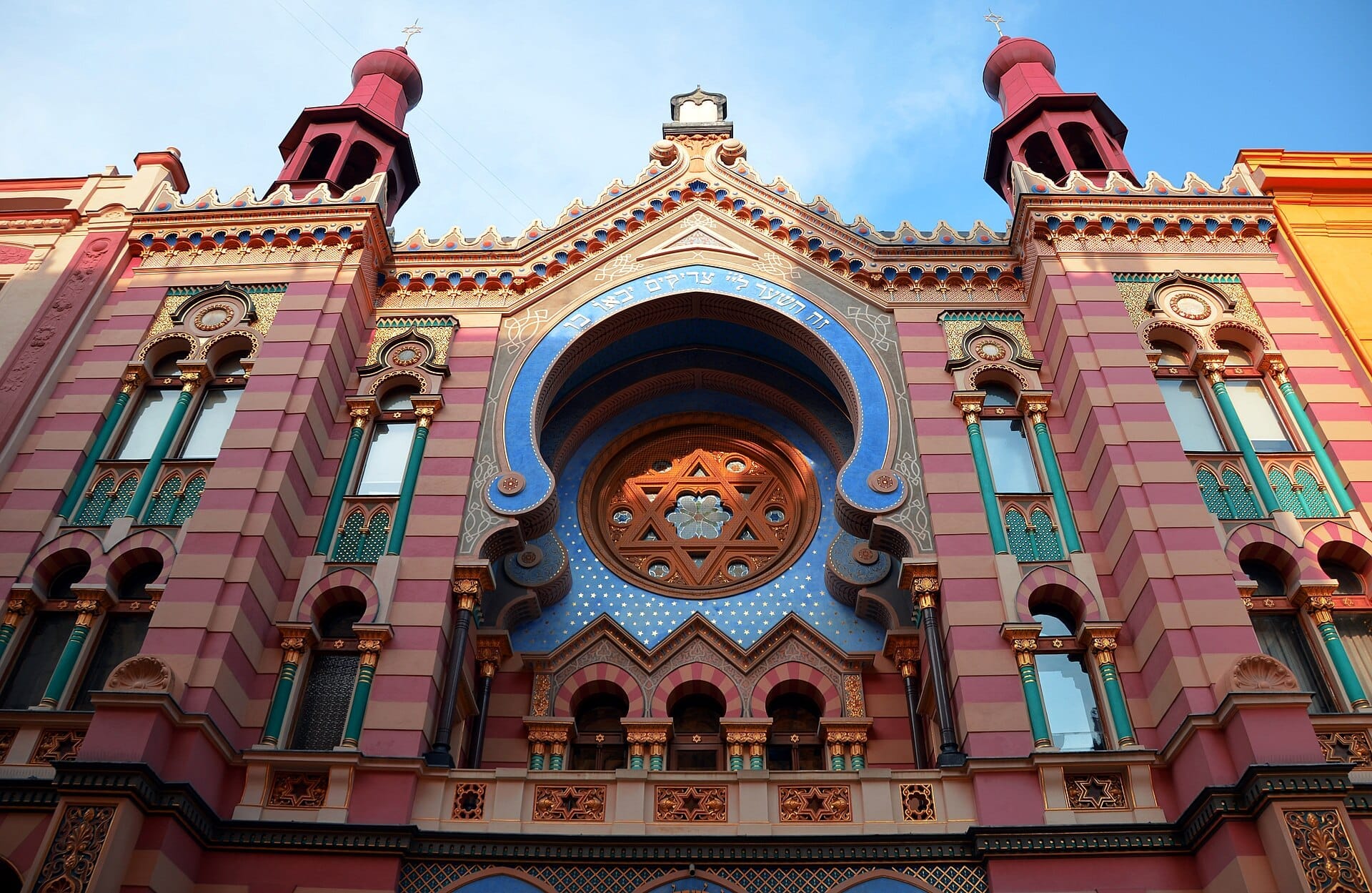
The Jerusalem Synagogue, known in Czech as the Jeruzalémská synagoga and also called the Jubilee Synagogue, stands on a narrow street in Prague's New Town district, roughly three minutes on foot from the main railway station. It is the youngest and largest synagogue belonging to Prague's Jewish community, completed in 1906 after construction between 1904 and 1906 to a design by Viennese architect Wilhelm Stiassny. For a building this significant, it remains surprisingly uncrowded compared to the synagogues inside Josefov, the historic Jewish Quarter.
That separation from the main tourist circuit is part of what makes a visit here feel different. While tour groups pour through the Old-New Synagogue and the Pinkas Synagogue in Josefov, the Jerusalem Synagogue sits just far enough away that many visitors never find it. That is their loss.
💡 Local tip
Buy your ticket online at synagogue.cz to save roughly 15 CZK per adult and skip any queue at the door. The building is open Sunday–Friday, 10:00–17:00 (closed Saturdays and Jewish holidays). In 2026, the season opens on 9 March — check the official site before visiting in late winter or early spring.
The Architecture: Moorish Revival Meets Art Nouveau
Standing on Jeruzalémská street and looking at the facade, the first thing you notice is the sheer confidence of the design. Horseshoe arches, striped stonework in cream and terracotta, and intricate geometric tilework across the upper gable make the building look like it was transplanted from Moorish Andalusia and then dressed with a Viennese finishing coat. The style is often described as Moorish-Secession, a fusion that was fashionable for Central European synagogues around 1900: the Moorish Revival elements signaled the ancient Sephardic roots of Jewish liturgical art, while the Secession (Art Nouveau) detailing placed the building firmly in its contemporary moment.
Stiassny was a specialist in Jewish communal architecture, having designed synagogues across the Austro-Hungarian Empire. The commission for the Jubilee Synagogue, as it was originally named, came from the Prague Jewish community to mark the silver jubilee of Emperor Franz Joseph I's reign. After Czechoslovakia's independence in 1918, the imperial dedication became politically awkward and the building gradually acquired its current name, linking it instead to Jerusalem and religious tradition rather than Habsburg politics.
The exterior reads best in morning light, when the low sun catches the relief work on the upper facade and deepens the color contrast of the striped stonework. By midday the street is in partial shade and the facade looks flatter. If you care about photographing the exterior, arrive before noon.
Tickets & tours
Hand-picked options from our booking partner. Prices are indicative; availability and final rates are confirmed when you complete your booking.
Classical Concert in Spanish Synagogue in Prague
From 39 €Instant confirmationFree cancellationPrague Jewish Quarter guided walking tour with synagogue visits
From 81 €Instant confirmationFree cancellationSelf guided tour with interactive city game of Prague
From 5 €Instant confirmationFree cancellationPrague by night city tour
From 27 €Instant confirmationFree cancellation
Inside the Synagogue: Color, Scale, and Detail
Nothing about the exterior fully prepares you for the interior. The main hall is vast, with a gallery running around three sides supported by cast-iron columns. Every surface — the vaulted ceiling, the gallery balustrades, the walls between the arched windows — is covered in stenciled geometric patterns in deep blue, green, red, and gold. The effect is not oppressive; the high ceilings and generous window openings keep the space from feeling dark, and the polychrome decoration has a rhythmic quality that rewards close attention.
The central bimah (the raised platform from which the Torah is read) and the ornate Aron Kodesh (the Torah ark at the eastern wall) anchor the space liturgically and visually. Both are carved and decorated with the same layered attention to pattern that characterizes everything else in the building. This is not a synagogue preserved as a museum piece: it is an active Orthodox place of worship, and the arrangement of seating, the prayer books on the benches, and the general atmosphere of careful maintenance all reflect that. Visitors are guests in a working religious space.
ℹ️ Good to know
Photography is permitted inside the synagogue. Tripods and flash photography may be restricted during services or special events. Men should cover their heads; kippot (skullcaps) are typically available at the entrance for visitors who do not have their own.
The gallery level, accessible via a staircase, offers a closer view of the ceiling vaulting and a different perspective on the proportions of the hall. It also brings you nearer to some of the stained glass windows, which filter afternoon light into warm amber and ochre tones across the upper walls. If you visit mid-afternoon, the light quality inside is noticeably richer than in the morning.
Historical Context: Prague's Jewish Community Beyond Josefov
Most visitors associate Prague's Jewish heritage almost exclusively with Josefov, the former ghetto. The Jerusalem Synagogue complicates that picture usefully. By the time it was built in 1905–1906, Prague's Jewish population had long since dispersed beyond the ghetto boundaries following legal emancipation in the mid-19th century. The New Town location reflects that dispersal: this was a synagogue built for a community moving outward into the broader city, not one confined to a historic enclave.
That broader story of Czech Jewish life, its emancipation, its integration, and its destruction during the Nazi occupation, is told with particular power in the Pinkas Synagogue and the Old Jewish Cemetery in Josefov. The Jerusalem Synagogue does not duplicate that commemorative function; it offers instead a vivid portrait of Jewish communal ambition and aesthetic confidence at the turn of the 20th century.
For context on Prague's wider Jewish heritage sites, the Prague Jewish Quarter guide covers the full circuit of synagogues and how to plan time across all of them efficiently.
Getting There and Practical Walkthrough
The synagogue is at Jeruzalémská 7/1310 in Prague's New Town. The single easiest approach is from Praha hlavní nádraží, the main railway station, which is approximately three to four minutes away on foot heading south-west. If you are coming by tram, the Jindřišská stop on several New Town tram lines puts you about the same walking distance away. There is no dedicated metro stop directly outside, but the New Town is walkable from Muzeum (Line A or C) in under ten minutes.
The entrance is on Jeruzalémská street. The door is not always immediately obvious from a distance; look for the ticket desk just inside. Opening hours are Sunday through Friday, 10:00 to 17:00. The building closes on Saturdays for Shabbat and on Jewish holidays. The season typically runs March through December; in 2026 the season opened on 9 March. Always check the official website before a winter or early spring visit.
Ticket prices (as of 2025–2026): adults pay 150 CZK at the door or 135 CZK for an e-ticket purchased online. Children under 15 and students pay 100 CZK at the door or 90 CZK online. Children under 6 enter free. If you hold a valid Jewish Town circuit ticket from the Jewish Museum in Prague, reduced rates apply; check the exact discounts on the official website. Prices are in Czech koruna; verify current rates at synagogue.cz before your visit.
⚠️ What to skip
The synagogue is an active place of worship. If a service is in progress when you arrive, entry for tourists may be delayed or restricted. Friday afternoon services ahead of Shabbat make late-Friday visits unreliable. Plan to visit Sunday through Thursday if flexibility allows.
Accessibility, What to Wear, and Photography
Specific accessibility information regarding wheelchair access, step-free entry, or adapted facilities is not detailed on the official website or in major tourism sources. Visitors with mobility needs should contact the synagogue directly before visiting at the contact details listed on synagogue.cz.
Dress modestly as you would in any active place of worship: covered shoulders and knees are appropriate. Men are expected to cover their heads inside the main hall; disposable kippot are typically available at the entrance. Photography with a handheld camera is generally permitted. The interior lighting is best in the mid-afternoon when sunlight enters the stained glass windows, making that window roughly 13:00–15:00 the most photogenic time to visit, especially in summer when the sun angle is higher.
Is It Worth the Visit?
For anyone with a serious interest in architecture, Jewish heritage, or early 20th-century decorative arts, the Jerusalem Synagogue is genuinely one of Prague's most rewarding interiors. The quality of the decoration is exceptional, the crowds are thin compared to the Josefov circuit, and the admission price is modest. Spend 45 minutes to an hour and you will have seen one of the most elaborate interiors in the New Town.
If you are already planning a day in New Town, the synagogue pairs well with a walk along Wenceslas Square and the Municipal House, both within comfortable walking distance and also showcasing the richness of Prague's early 20th-century architectural ambitions.
Who might want to skip it: travellers with very limited time who have not yet seen the core Josefov synagogues should prioritize those first, as the Pinkas Synagogue and Old-New Synagogue carry greater historical weight for a short visit. The Jerusalem Synagogue is the right follow-on for visitors who want to go deeper, not a replacement for the Josefov circuit.
Insider Tips
- Buy e-tickets at synagogue.cz before you go: the online price is about 10% cheaper than the door price and you avoid any wait, which matters during the narrow 10:00–17:00 window.
- Visit mid-afternoon on a weekday: the stained glass windows face in a direction that channels warm afternoon light into the hall, dramatically improving the quality of interior photographs and the general atmosphere.
- If you hold a Jewish Museum Prague ticket (covering the Josefov circuit), check whether your ticket version qualifies for the reduced-rate entry at the Jerusalem Synagogue — it can bring the adult price down from 150 to 100 CZK.
- The exterior is best photographed from the opposite side of the narrow street in morning light. Back up as far as the pavement allows to capture the full height of the facade including the upper gable decoration.
- Avoid Friday afternoons: the synagogue is used for Shabbat preparations and services, and visitor access is uncertain. Sunday mornings are typically the calmest time for an unhurried visit.
Who Is Jerusalem Synagogue For?
- Architecture enthusiasts drawn to Art Nouveau and Moorish Revival design
- Travellers exploring Prague's Jewish heritage beyond the Josefov circuit
- Photographers wanting elaborate interiors without large tour-group crowds
- Cultural history visitors interested in the Austro-Hungarian period in Prague
- Repeat visitors to Prague looking for a site that most first-timers miss
Nearby Attractions
Other things to see while in New Town (Nové Město):
- Dancing House (Tančící dům)
Designed by Frank Gehry and Vlado Milunić and completed in 1996, the Dancing House stands on the Vltava embankment as one of Prague's most photographed and debated buildings. Here's what the experience actually looks like from the outside, from the rooftop bar, and from the gallery inside.
- Franciscan Garden
Hidden behind the commercial noise of Wenceslas Square, the Franciscan Garden (Františkánská zahrada) is a free, walled courtyard garden Hidden behind the commercial noise of Wenceslas Square, the Franciscan Garden (Františkánská zahrada) is a free, walled courtyard garden with roots in the 14th century, a Baroque pavilion, and rose beds that offer genuine quiet in the middle of Prague's busiest district. Entry is free, and the contrast with the streets outside is immediate., a Baroque pavilion, and rose beds that offer genuine quiet in the middle of Prague's busiest district. Entry is free, and the contrast with the streets outside is immediate.
- Kafka's Rotating Head (Franz Kafka Sculpture)
Standing 11 metres tall outside the Quadrio shopping centre in New Town, the Head of Franz Kafka is a kinetic sculpture of 42 polished stainless steel layers that slowly rotate out of sync, fragmenting and reassembling Kafka's face. It is free to see at any time, though the programmed rotation runs at set intervals between morning and late evening, and it is one of the most photographed modern artworks in the Czech Republic.
- Lucerna Palace
Lucerna Palace (Palác Lucerna) is a landmarked early 20th‑century entertainment and shopping complex in Prague's New Town, built between 1907 and 1921. Its covered arcade connects Štěpánská and Vodičkova streets and contains a cinema, concert hall, bars, and shops — all freely accessible to passersby. Designated a Czech national cultural monument in 2017, it remains one of Prague’s key early multi‑purpose entertainment buildings still in active use.