Kafka's Rotating Head: Prague's Most Unsettling Public Artwork
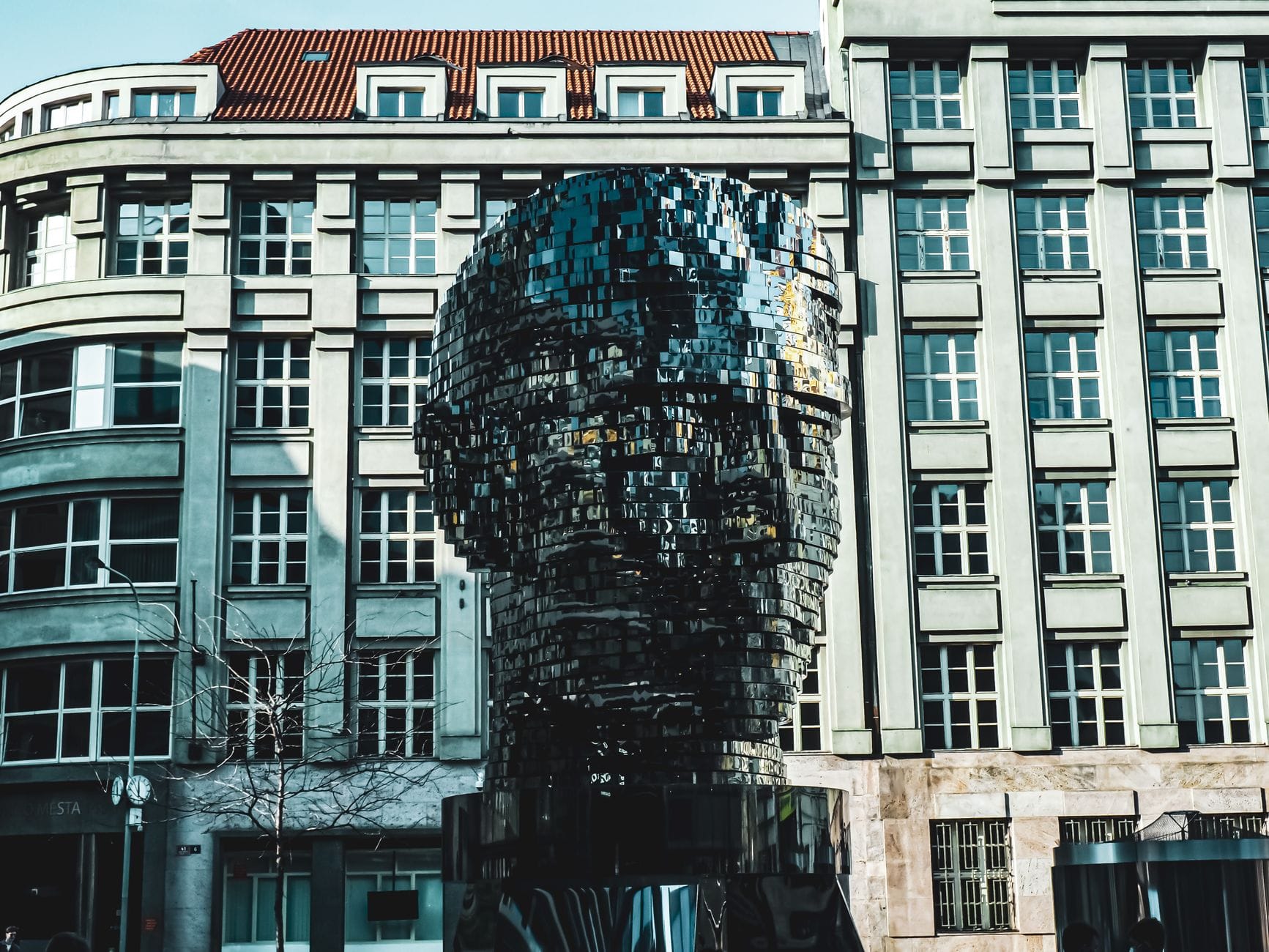
Standing 11 metres tall outside the Quadrio shopping centre in New Town, the Head of Franz Kafka is a kinetic sculpture of 42 polished stainless steel layers that slowly rotate out of sync, fragmenting and reassembling Kafka's face. It is free to see at any time, though the programmed rotation runs at set intervals between morning and late evening, and it is one of the most photographed modern artworks in the Czech Republic.
Quick Facts
- Location
- Spálená 22, Nové Město, Prague 1 — plaza in front of Quadrio shopping centre
- Getting There
- Národní třída (Metro Line B, yellow) — the sculpture is directly above the station exit
- Time Needed
- 15–30 minutes to watch a full rotation cycle and photograph it properly
- Cost
- Free — no ticket required, accessible at all hours as an outdoor public artwork, with rotations on a regular daily schedule
- Best for
- Architecture enthusiasts, Kafka literary pilgrims, photography, modern art
- Official website
- www.quadrio.cz/en/franz-kafka-statue
What You Are Looking At
The Head of Franz Kafka, known in Czech as Hlava Franze Kafky, is a monumental kinetic sculpture installed in 2014 on the public plaza in front of the Quadrio shopping centre in New Town Prague. Created by Czech sculptor David Černý, it stands 11 metres high, weighs approximately 39 tonnes, and is built from 42 independent horizontal layers of polished stainless steel. Each layer rotates on its own axis at its own pace. When aligned, they form a recognisable portrait of the writer. Most of the time, they do not align, leaving visitors watching a shimmering, fragmented chrome mass that occasionally and briefly coheres into something resembling a face before dissolving again.
That tension between clarity and disintegration is, as most observers quickly note, the entire point. Kafka spent much of his adult life in Prague, writing fiction about bureaucratic labyrinths, identity under pressure, and the impossibility of being truly known. A portrait of him that can never hold still is not accidental.
💡 Local tip
The rotation cycle is scheduled at set intervals rather than running continuously. If the sculpture is stationary when you arrive, wait for the next full hour: the programmed sequence runs for about 15 minutes at the start of each hour during the main operating period.
The Artist Behind It: David Černý
The Head of Franz Kafka is one of the most technically ambitious works by David Černý, the Prague sculptor known internationally for provocative, large-scale public pieces. You may already know his work from the Žižkov Television Tower, where giant crawling babies scale the concrete shaft, or from the rotating figure of a man hanging by one hand from a beam in Old Town. Černý consistently uses scale, motion, and recognisable subjects to create discomfort rather than decoration.
The Kafka sculpture required engineering collaboration to realise. Each of the 42 polished stainless steel layers is independently motorised and controlled by a programme that drives the rotation sequence. The result is less a static monument than a mechanical performance that plays out in public whether anyone is watching or not.
If you want deeper context on Černý's presence across Prague, the Prague David Černý guide maps out his major installations across the city and explains the cultural friction his work often generates.
Tickets & tours
Hand-picked options from our booking partner. Prices are indicative; availability and final rates are confirmed when you complete your booking.
Kafka Museum entrance ticket
From 12 €Instant confirmationFree cancellationPrague 2.5-hour tour through the eyes of Franz Kafka
From 28 €Instant confirmationFree cancellationFranz Kafka exploration game and tour in Prague
From 7 €Instant confirmationFree cancellationSelf guided tour with interactive city game of Prague
From 5 €Instant confirmationFree cancellation
Kafka's Relationship with Prague
Franz Kafka was born in Prague in 1883 into a German-speaking Jewish family in what was then the Austro-Hungarian Empire. He lived in the city for almost his entire life, working as a bureaucrat at an insurance company while writing stories and novels in his spare time. He died in 1924, aged 40, having published very little. His executor Max Brod defied Kafka's instructions to burn his manuscripts and instead published them, giving the world The Trial, The Castle, and The Metamorphosis.
Prague treats Kafka as one of its most significant cultural exports, though the relationship is complicated. The city he wrote about was largely German-speaking and Jewish, a world erased by the 20th century. The Franz Kafka Museum in Malá Strana addresses this biographical and historical complexity directly, and is worth pairing with a visit to the rotating sculpture if you want more than an Instagram stop.
Visiting: What to Expect at Different Times of Day
The plaza outside Quadrio is a transit corridor for office workers and shoppers during the day. In the morning, from around 8 to 10, the area sees a steady stream of commuters passing through from the Národní třída metro exit, most without stopping. The sculpture performs regardless. The chrome surface catches direct eastern light in the morning and reflects the surrounding buildings in cool silver tones.
Midday brings the most foot traffic. Office workers on lunch breaks tend to pause briefly, take a phone photo, and move on. This is the least atmospheric time to visit, but it is useful if you want to observe people reacting to the piece in real time. The rotation sequence continues through the lunch hour, and the reflections shift as the sun crosses overhead.
Early evening, roughly 5 to 7pm, is when the piece becomes genuinely striking. As daylight fades, the plaza empties of commuter traffic and the sculpture is lit from below. The polished steel panels glow against the darkening sky. The slow rotation becomes more hypnotic when you are not competing with crowds. If you care about photography, this is your window.
At night the plaza is quiet and the sculpture continues to turn under artificial lighting. The effect is somewhere between meditative and unsettling. The faint mechanical sound of the motors becomes audible up close. There are fewer tourists at this hour than at almost any major Prague attraction.
💡 Local tip
For photography, bring a slightly longer lens if you have one. Shooting from the far edge of the plaza at 50–85mm equivalent gives you a cleaner composition without wide-angle distortion. Dusk lighting makes the chrome glow without harsh reflections.
Getting There and Practical Notes
The sculpture sits directly above Národní třída metro station on Line B (the yellow line). From the main station exit, you emerge into the Quadrio plaza and the sculpture is immediately visible. There is no need to navigate or search. From Old Town Square, it is roughly a 15-minute walk south across the Národní třída axis.
The surrounding area of New Town Prague is commercially dense and not primarily a tourist district. This is useful context: unlike the Old Town astronomical clock or Charles Bridge, there is no souvenir economy surrounding this sculpture. The plaza is functional rather than scenic, bordered by the Quadrio mall and a busy tram corridor on Spálená street.
The sculpture is fully accessible as an outdoor, at-grade public artwork. There are no steps, barriers, or admission points. Wheelchair users and families with pushchairs can approach from any direction across the open plaza.
⚠️ What to skip
In wet weather the polished plaza surface becomes slippery. The sculpture itself is not affected by rain and may actually look better in overcast conditions, with softer reflections on the steel. Just watch your footing.
Is It Worth Your Time?
Honestly, it depends on what you are looking for. If you approach the Head of Franz Kafka as a checkbox on a highlights list, a 15-minute detour on the way between Wenceslas Square and the National Theatre area, the experience will feel thin. A chrome column rotating slowly in front of a shopping centre does not explain itself.
If you arrive knowing the context, understanding who Kafka was, what Černý does, and what the mechanism is actually designed to represent, the piece earns its weight. Watching a fragmented face assemble and dissolve, recognisable for only a few seconds before falling apart again, is a genuinely thoughtful visual metaphor. It is not a conventional monument.
Visitors who find contemporary public art self-indulgent, or who are primarily interested in Prague's medieval and Baroque heritage, will likely find this less rewarding than the Old Town Square or Charles Bridge. That is a reasonable preference, not a criticism.
Insider Tips
- The rotation programme runs in cycles, not continuously. If the layers are stationary when you arrive, wait for the next full hour; the display typically runs for around 15 minutes rather than just a brief spin.
- The best view of the coherent face forming is not from directly in front, but from a slight angle and at eye level with the middle section of the sculpture, roughly the 4th to 6th metre up. Stand back about 8 to 10 metres for the proportions to read correctly.
- Early evening on weekdays, after commuter rush hour clears around 7pm, gives you the sculpture almost entirely to yourself with good ambient light. Weekend evenings also work well.
- The Quadrio shopping centre directly behind the sculpture has a basement food court and ground-floor cafes if you want somewhere to sit and observe the piece over a longer period without standing in the open.
- Combine this with the Franz Kafka Museum in Malá Strana for a more complete picture of Kafka's life and legacy in Prague. The two sites together take about two to three hours and make a coherent half-day.
Who Is Kafka's Rotating Head (Franz Kafka Sculpture) For?
- Architecture and contemporary design enthusiasts who want to see Prague's modern artistic output alongside its historic landmarks
- Literary travellers with an interest in Kafka's work and his complicated relationship with Prague
- Photographers looking for a technically interesting subject with strong abstract and portrait potential
- Visitors who have already covered the major historic sites and want something structurally different
- Anyone interested in David Černý's broader practice as one of the Czech Republic's most prominent living artists
Nearby Attractions
Other things to see while in New Town (Nové Město):
- Dancing House (Tančící dům)
Designed by Frank Gehry and Vlado Milunić and completed in 1996, the Dancing House stands on the Vltava embankment as one of Prague's most photographed and debated buildings. Here's what the experience actually looks like from the outside, from the rooftop bar, and from the gallery inside.
- Franciscan Garden
Hidden behind the commercial noise of Wenceslas Square, the Franciscan Garden (Františkánská zahrada) is a free, walled courtyard garden Hidden behind the commercial noise of Wenceslas Square, the Franciscan Garden (Františkánská zahrada) is a free, walled courtyard garden with roots in the 14th century, a Baroque pavilion, and rose beds that offer genuine quiet in the middle of Prague's busiest district. Entry is free, and the contrast with the streets outside is immediate., a Baroque pavilion, and rose beds that offer genuine quiet in the middle of Prague's busiest district. Entry is free, and the contrast with the streets outside is immediate.
- Jerusalem Synagogue
Built in 1904–1906, the Jerusalem Synagogue is the largest synagogue of Prague's Jewish community and one of the most visually arresting religious buildings in the city. Its exterior fuses Moorish Revival arches with Art Nouveau ornament, while the interior overwhelms with color, pattern, and scale.
- Lucerna Palace
Lucerna Palace (Palác Lucerna) is a landmarked early 20th‑century entertainment and shopping complex in Prague's New Town, built between 1907 and 1921. Its covered arcade connects Štěpánská and Vodičkova streets and contains a cinema, concert hall, bars, and shops — all freely accessible to passersby. Designated a Czech national cultural monument in 2017, it remains one of Prague’s key early multi‑purpose entertainment buildings still in active use.