Old Jewish Cemetery Prague: What to Expect Inside One of Europe's Most Significant Burial Grounds
The Old Jewish Cemetery in Prague's Josefov quarter contains over 12,000 visible tombstones layered up to ten deep across roughly one hectare. In use from 1439 to 1787, it stands as one of the best-preserved medieval Jewish cemeteries in the world and is part of the Jewish Museum in Prague complex.
Quick Facts
- Location
- Široká 3, Josefov, Prague 1 (Jewish Quarter)
- Getting There
- Staroměstská metro station (Line A), approx. 5-minute walk
- Time Needed
- 45–90 minutes for the cemetery alone; allow several hours for the full Jewish Museum circuit
- Cost
- Included in Jewish Museum in Prague ticket: 600 CZK adult, 400 CZK student under 26, 200 CZK child 6–15 (verify current prices at jewishmuseum.cz)
- Best for
- History, Jewish heritage, reflective solo travel, architecture
- Official website
- www.jewishmuseum.cz/en/explore/sites/old-jewish-cemetery
What the Old Jewish Cemetery Actually Is
The Old Jewish Cemetery (Czech: Starý židovský hřbitov) is one of the largest and best-preserved medieval Jewish burial grounds in existence. Located in the Josefov quarter of Prague's Old Town, it covers roughly one hectare and holds more than 12,000 visible tombstones. Beneath those stones, researchers estimate that as many as 100,000 individuals were buried across as many as ten or more stratified layers, the result of the community burying new arrivals directly over older graves for nearly 350 years.
The cemetery was in active use from 1439, when the oldest surviving gravestone was inscribed on 23 April of that year, until 1787, when Emperor Joseph II issued a decree prohibiting burials within city limits. For most of that period, Prague's Jewish community had no alternative: they were confined to the ghetto and barred from expanding the cemetery's footprint. The density of layered burials is not a peculiarity but a direct consequence of that restriction.
Today the cemetery is administered by the Jewish Museum in Prague and visited as part of a combined museum circuit that also includes the Old-New Synagogue, the Pinkas Synagogue, and several other historic sites within Josefov. A single combined ticket covers all of them.
What You See When You Enter
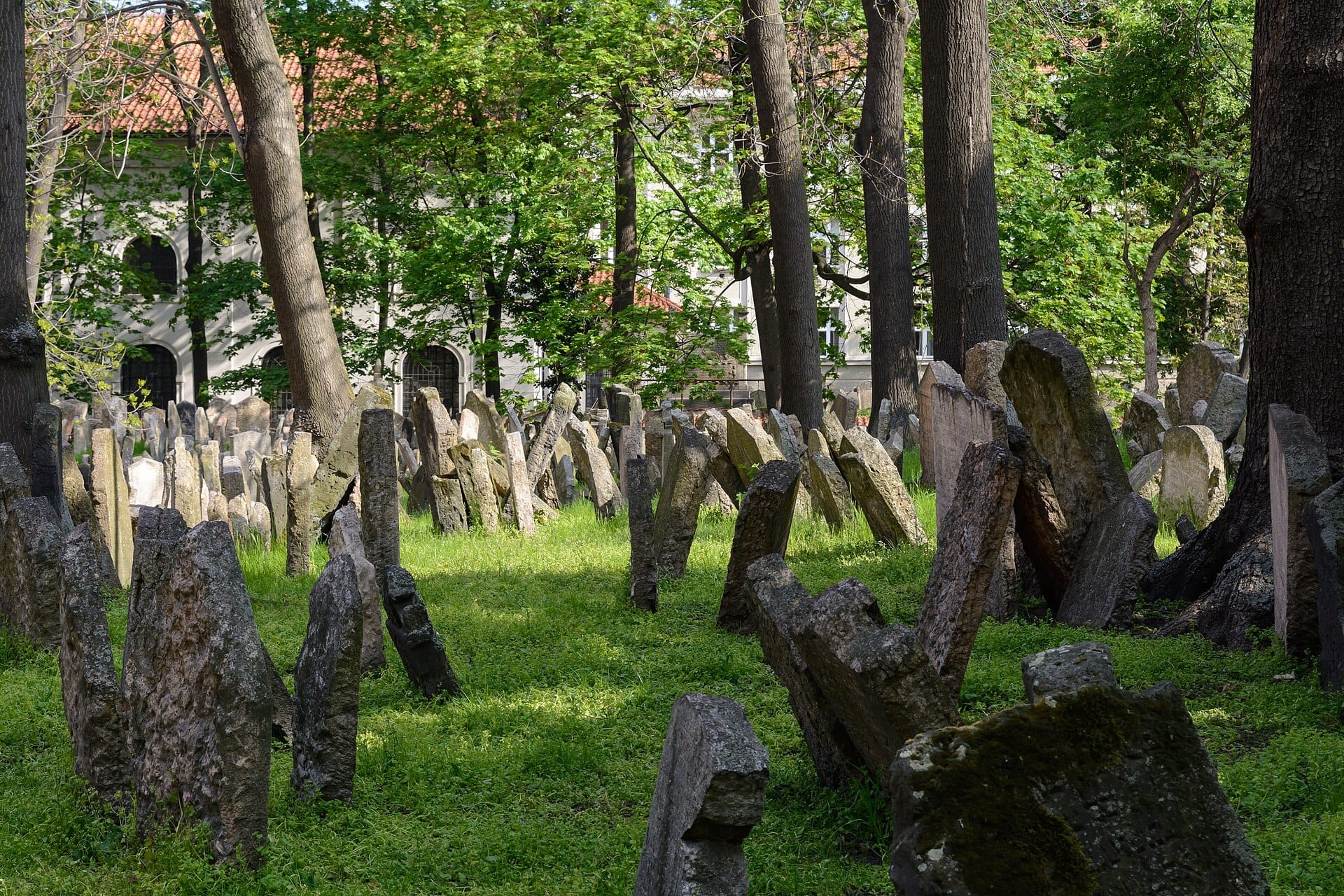
The entrance is on Široká street, and the transition from the surrounding city happens fast. Within a few steps, the street noise drops and the visual landscape shifts entirely: hundreds of pale limestone and sandstone tombstones crowd together at odd angles, tilted by the soil shifting beneath them over centuries. Elder trees spread overhead, their roots threading between burial layers. In summer, the canopy creates dense patches of shade; in winter, the bare branches give the space a starker, more exposed quality.
The tombstones themselves are carved with symbols that carry specific meaning: a pair of hands with fingers spread indicates a member of the Kohanim priestly lineage; a pitcher or jug marks a Levite; a lion or eagle often signifies the family name of the deceased. Many stones are weathered to near-illegibility, but the carving quality on the more prominent monuments, particularly those dating from the 16th and 17th centuries, remains clearly visible.
The most visited grave belongs to Rabbi Judah Loew ben Bezalel, known as the Maharal of Prague, who died in 1609 and is credited in legend with creating the Golem. His tomb, marked by an elaborately carved stone, is typically surrounded by small pebbles and paper notes left by visitors, a Jewish mourning tradition. It is located near the cemetery's western section and is usually identifiable by the quiet cluster of people gathered around it.
💡 Local tip
Arrive at opening time (9:00) to experience the cemetery with fewer visitors. By mid-morning in peak season, the entrance queue can grow along Široká street and the pathways inside become congested. The cemetery is closed on Saturdays and Jewish holidays — check the museum's official calendar before you go.
Tickets & tours
Hand-picked options from our booking partner. Prices are indicative; availability and final rates are confirmed when you complete your booking.
Prague Castle and Orloj with National Museum or Jewish Quarter
From 60 €Instant confirmationFree cancellationHistorical tour of the psychiatric hospital and its abandoned cemetery
From 26 €Instant confirmationFree cancellationPrague Old and Jewish Town: guided tour with entrance tickets, coffee and cake
From 48 €Instant confirmationFree cancellationPrague Jewish Quarter online audio guide
From 8 €Instant confirmationFree cancellation
How the Space Changes by Time of Day
Early morning, particularly in spring and autumn, is when the cemetery is most legible. The low-angle light picks out the texture of carved stone reliefs more sharply than midday sun, and the temperature is cool enough that you can stand and read inscriptions without discomfort. The smell of damp earth and old stone is strongest in the morning hours before foot traffic increases.
By 11:00 in summer, the site is at capacity with guided tour groups moving in loose columns along the narrow gravel paths. The paths are genuinely narrow: two people can pass each other, but not comfortably. Audio guides and tour leaders speaking multiple languages overlap in the enclosed space. If you want quiet contemplation, the early slot is the practical choice, not a preference.
In winter, the cemetery sees significantly fewer visitors, and the reduced opening hours (closing at 16:30) mean the light is already failing by mid-afternoon. The stone takes on grey tones without foliage, and the layered tombstones become visually starker. For a visit focused on architecture and inscription, winter is underrated. For visitors interested in the emotional weight of the place, the stripped-back winter version is often described as more affecting than the lush summer crowds.
Historical and Cultural Context
Josefov, the former Jewish ghetto, was one of the most densely populated areas in medieval Prague. The Jewish community in Prague dates to at least the 10th century, and the ghetto's boundaries were repeatedly legislated by civic and church authorities to restrict Jewish residents to a defined area. The Old Jewish Cemetery grew within those constraints: there was no question of purchasing adjacent land or relocating burials to a suburban site. The community buried their dead in successive layers, adding soil on top of older graves to create new burial space.
In 1893, the city of Prague demolished most of the ghetto's medieval buildings and replaced them with the Art Nouveau residential blocks visible in Josefov today. The cemetery, several of the quarter's synagogues, and the Jewish Town Hall were preserved. The decision to preserve the cemetery was partly practical, partly political, and partly driven by the Jewish community's own advocacy. What remained became the nucleus of what is now the Jewish Museum in Prague, established formally in 1906.
The museum complex as it exists today is shaped significantly by events during the Second World War. The Pinkas Synagogue, adjacent to the cemetery, was converted after the war into a memorial inscribed with the names of 77,297 Bohemian and Moravian Jewish victims of the Holocaust. Visiting the cemetery and the Pinkas Synagogue together, in sequence, is the experience most visitors describe as the most sobering of their time in Prague.
Practical Walkthrough: Getting In and Around
The cemetery entrance on Široká 3 is where you collect or present your Jewish Museum ticket. Tickets cover multiple sites within the museum circuit and can be purchased at the entrance or in advance online through the museum's official website. Given queue lengths in peak season, advance purchase is worth considering.
The internal paths are gravel and compacted earth over uneven ground. The terrain is not flat: stones lean at angles, roots interrupt the surface, and some sections require stepping around obstacles. Visitors using wheelchairs or with significant mobility limitations should be aware that the site's historic layout makes full independent access difficult. Contact the Jewish Museum directly before visiting for current accessibility information.
Photography is permitted within the cemetery. The low light under the tree canopy in summer means cameras with good low-light performance will produce sharper images than smartphones in shade. Flash photography is generally frowned upon in the context of active memorial sites. Tripods are not practical given the path width.
ℹ️ Good to know
The Jewish Museum circuit includes the Pinkas Synagogue, Maisel Synagogue, Spanish Synagogue, Ceremonial Hall, and Old-New Synagogue, in addition to the cemetery. Allocate a full half-day if you intend to visit all sites seriously. The combined ticket is valid for a single entry per site, so plan your route before you start.
Who Should and Should Not Visit
The Old Jewish Cemetery rewards visitors who approach it with some background knowledge. Reading a brief account of Prague's Jewish community, or visiting the Pinkas Synagogue first to absorb its historical context, transforms the cemetery from an unusual landscape into a coherent narrative. Without that context, even attentive visitors may leave uncertain about what they have seen.
Travelers primarily interested in scenic photography or architectural spectacle may find the cemetery less immediately rewarding than other Prague sites. If you are building an itinerary around visual highlights, the Prague Castle complex or the Old Town Square offer more overtly dramatic spaces. The cemetery's significance is historical and layered rather than immediately photogenic.
Visitors with very young children should be aware that the site's narrow, uneven paths make it difficult to navigate with a stroller, and the emotional weight of the adjacent Pinkas Synagogue may require some preparation for family visits. That said, older children interested in history often find the visual density of tombstones and the puzzle of the layered burials genuinely engaging.
For anyone building a broader itinerary around Jewish Prague or the history of Central European Jewish communities, the cemetery fits naturally alongside the Prague Jewish Quarter guide, which covers the full scope of sites in Josefov. For historical context beyond the Jewish Quarter, the Prague history guide provides a useful framework for the city's broader past.
Insider Tips
- Buy your Jewish Museum ticket online the day before to skip the Široká street queue, which forms before the gates open on summer mornings.
- Visit the Pinkas Synagogue immediately before or after the cemetery. The juxtaposition of the 77,297 names inscribed on its walls with the anonymous density of the cemetery's burial layers is the most powerful sequence available in the museum circuit.
- The grave of the Maharal (Rabbi Loew) is in the western section of the cemetery, closer to the Pinkas Synagogue exit than the main entrance. If you enter from Široká, you will reach it roughly two-thirds of the way through your walk.
- Wear flat, closed-toe shoes. The gravel and root-interrupted earth paths are slippery after rain, and the tombstones themselves create low obstacles at ankle height throughout.
- The cemetery is closed on Saturdays and all Jewish holidays. These closures are not always reflected in generic travel booking platforms. Check the official Jewish Museum calendar at jewishmuseum.cz before finalising your visit date.
Who Is Old Jewish Cemetery For?
- Travelers with an interest in Jewish history and Central European heritage
- Those visiting Prague for more than two days who want depth beyond the standard sightseeing circuit
- History readers who have encountered the Maharal, the Golem legend, or Prague's ghetto in literature
- Reflective or solo travelers who value quiet, contemplative spaces over visual spectacle
- Students and educators focused on Holocaust history and Jewish memorial culture
Nearby Attractions
Other things to see while in Josefov (Jewish Quarter):
- Maisel Synagogue
Built between 1590 and 1592 for the wealthiest man in Bohemia's Jewish community, the Maisel Synagogue stands at the heart of Josefov as both an architectural landmark and a gateway to ten centuries of Jewish life in Bohemia and Moravia. Today it houses one of the Jewish Museum in Prague's most important permanent exhibitions.
- Museum of Decorative Arts
Housed in a French Neo-Renaissance building completed in 1899 and sitting directly opposite the Rudolfinum in Josefov, the Museum of Decorative Arts in Prague (UPM) is one of Central Europe's most underrated design collections. From Bohemian glass to Art Nouveau furniture and historical textiles, the permanent collection spans centuries of applied craft — all in a building that is itself worth the entry price.
- Old-New Synagogue
Built around 1270, the Old-New Synagogue in Josefov is not only the oldest surviving medieval twin-nave synagogue in Europe but also a continuously functioning house of worship. Its Gothic brick gables, centuries-old interior, and remarkable survival through Prague's turbulent history make it one of the most significant religious buildings on the continent.
- Pinkas Synagogue
Built in 1535 and transformed into a memorial after World War II, Pinkas Synagogue bears the hand-written names of nearly 80,000 Jewish victims from Bohemia and Moravia on its interior walls. It is one of the most quietly devastating memorials in Central Europe, and no amount of preparation fully readies you for what you see inside.