Old-New Synagogue: Europe's Oldest Active Synagogue in Prague's Jewish Quarter
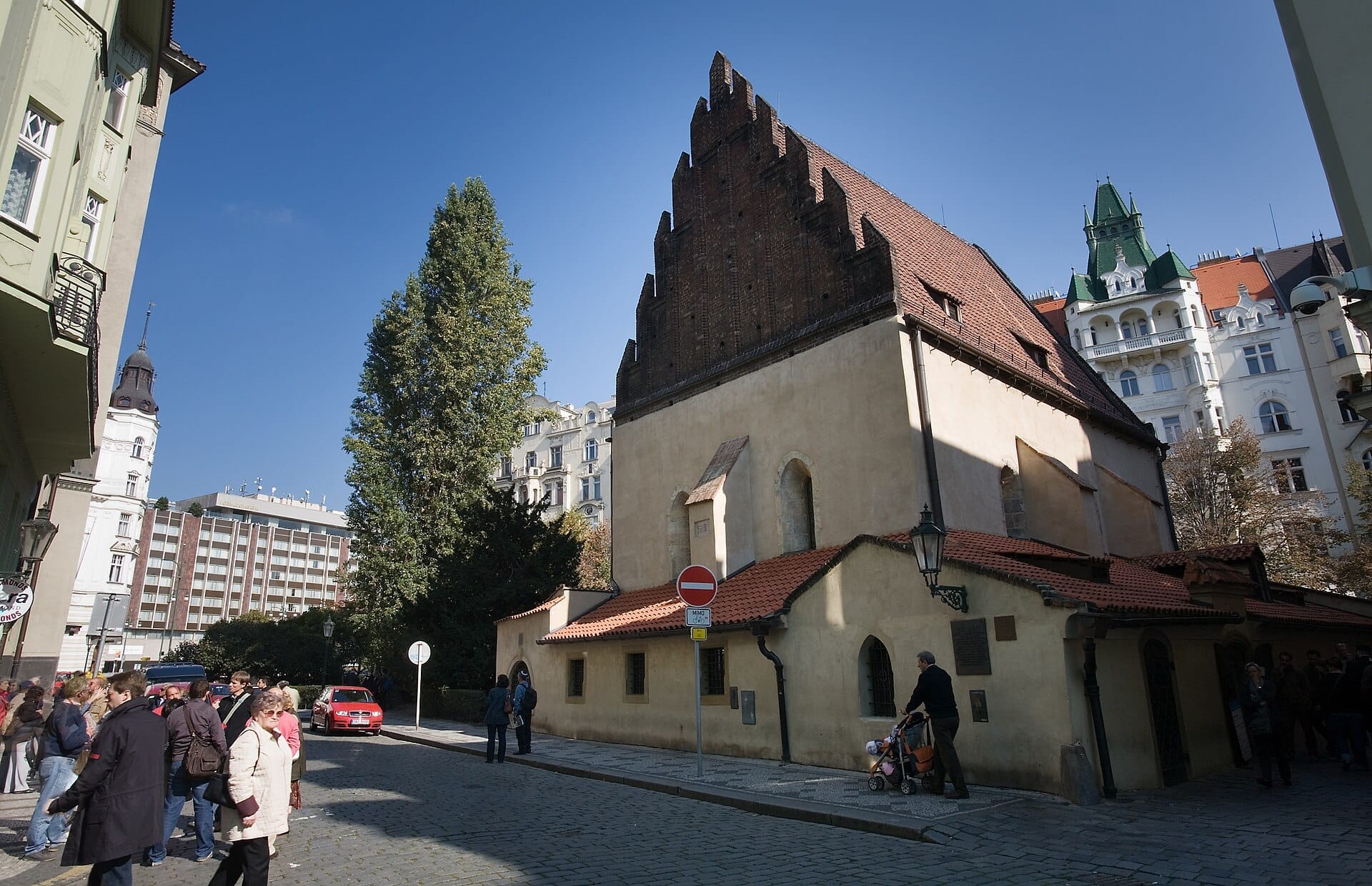
Built around 1270, the Old-New Synagogue in Josefov is not only the oldest surviving medieval twin-nave synagogue in Europe but also a continuously functioning house of worship. Its Gothic brick gables, centuries-old interior, and remarkable survival through Prague's turbulent history make it one of the most significant religious buildings on the continent.
Quick Facts
- Location
- Červená, Josefov (Prague 1) — Prague's historic Jewish Quarter
- Getting There
- Metro Line A to Staroměstská (5‑min walk); Tram 17 to Právnická fakulta or Staroměstská, Tram 18 to Staroměstská
- Time Needed
- 30–60 minutes inside; 2–3 hours if combining with the full Jewish Quarter circuit
- Cost
- Included in the Jewish Town circuit ticket: 600 CZK adults / 400 CZK students under 26 / 200 CZK children 6–15 (as of January 2024). No separate admission sold.
- Best for
- History enthusiasts, architecture lovers, Jewish heritage travellers, cultural explorers
- Official website
- www.synagogue.cz/en/old-new-synagogue
What the Old-New Synagogue Actually Is
The Old-New Synagogue (Staronová synagoga in Czech) is a functioning Gothic synagogue completed around 1270, making it the oldest surviving active synagogue in Europe and the oldest medieval twin-nave synagogue on the continent. It sits in Josefov, Prague's former Jewish Quarter, on a plot that has hosted Jewish worship for over 750 years. This is not a museum dressed up as a place of worship: regular religious services still take place here, and the building is administered by the Jewish Community in Prague.
The name itself carries history. When the synagogue was first built, it was simply called the New or Great Synagogue. As other synagogues rose around the quarter in the late 16th century, it became known as the Old-New Synagogue, a linguistic oddity that has since become one of the most recognisable names in Central European Jewish heritage.
ℹ️ Good to know
Since 1 January 2024, you cannot buy a standalone ticket for the Old-New Synagogue. Entry is only possible as part of the Jewish Town circuit ticket, sold by the Jewish Museum in Prague. The adult price is 600 CZK, the student price (under 26 years) is 400 CZK, and the child price (aged 6–15) is 200 CZK. Children under 6 enter free.
The Architecture: What to Look For Before You Even Enter
Approach from Maiselova Street and the synagogue announces itself through its distinctive crow-stepped brick gables, a silhouette unlike anything else in the neighbourhood. These serrated, staircase-like gable edges are an architectural signature of the building and one of the clearest indicators of its medieval origins. The exterior is austere by Gothic standards: no ornate portal sculptures, no soaring spires. The stone is dark with age, worn smooth in some places, and the proportions feel deliberate and grounded rather than aspirational.
What makes the structure genuinely rare is the interior arrangement: a Gothic double-nave plan with two parallel aisles separated by two octagonal pillars, supporting an unusual five-ribbed vaulting system. Six bays of vaulting cover the main prayer hall. The fifth rib on each vault is considered by scholars to be a deliberate deviation from the standard four-rib Gothic cross-vault, though the precise reason has been debated for centuries. Some architectural historians connect it to the Jewish prohibition on using a cross form in religious buildings; others treat it as a practical structural solution. Either way, standing beneath it and looking up, the vaulting feels more complex than the building's modest exterior suggests.
The synagogue sits comfortably within the context of the wider Josefov quarter, where centuries of Jewish life are visible across multiple synagogues within walking distance. The contrast between the Old-New Synagogue's medieval brick and the Moorish Revival architecture of the nearby Spanish Synagogue makes for a striking architectural survey of Prague's Jewish heritage.
Tickets & tours
Hand-picked options from our booking partner. Prices are indicative; availability and final rates are confirmed when you complete your booking.
Classical Concert in Spanish Synagogue in Prague
From 39 €Instant confirmationFree cancellationPrague Jewish Quarter guided walking tour with synagogue visits
From 81 €Instant confirmationFree cancellationSelf guided tour with interactive city game of Prague
From 5 €Instant confirmationFree cancellationPrague by night city tour
From 27 €Instant confirmationFree cancellation
Inside the Synagogue: The Experience of the Space
Visitors enter through a low, narrow vestibule that opens into the main prayer hall. The shift in scale is immediate: the space feels both intimate and weighty, the stone walls thick, the light entering through narrow windows at an angle that varies considerably with the time of day. In the morning, light enters from the east-facing windows and illuminates the central bimah, the raised platform used for Torah reading, which sits beneath a distinctive iron grille. By afternoon the light flattens and the interior takes on a more uniform, dimmer quality.
The Torah ark on the eastern wall is the visual centrepiece: framed by pointed Gothic arches and decorated with grapevine motifs. A red banner hangs nearby, a copy of the flag granted to Prague's Jewish community by Emperor Charles IV in 1357, bearing the Star of David, one of its earliest documented uses on a Jewish communal symbol. The original flag and the congregation's long history of royal privileges are part of what gives this space its layered, document-weight sense of history.
Along the walls, medieval stone benches line the perimeter. Worn smooth and slightly uneven underfoot, the stone floor gives the impression of a place that has been in continuous use, which it has. The atmosphere is quiet but not hushed in the theatrical sense: it is simply old, with the kind of stillness that comes from a space that has served a specific, consistent purpose for seven and a half centuries.
💡 Local tip
Photography policies inside the Old-New Synagogue are strict and may change. Check the current rules when purchasing your ticket. Even where photography is permitted, flash and tripods are generally not allowed, and the narrow, low-light interior makes handheld photography challenging.
Opening Hours and When to Visit
Hours vary by season. From May through August, the synagogue is open Sunday to Friday from 9:00 to 19:00. In April and September, closing time moves to 18:00. From October through March, the closing time is 17:00. On Fridays, the synagogue closes one hour before the start of Shabbat, which means the effective closing time shifts earlier throughout the year as daylight hours change. The synagogue is closed on Saturdays and on Jewish holidays.
For practical purposes, plan your visit for a weekday morning between 9:00 and 11:00 if you want the quietest conditions. By late morning, tourist groups from nearby Old Town Square begin filtering through Josefov, and the narrow streets and compact synagogue interior can feel crowded. Sunday mornings are also relatively quiet early, but volume builds quickly after 10:00.
If you are combining the synagogue with other sites, the Jewish Quarter circuit ticket also covers the Old Jewish Cemetery, the Pinkas Synagogue, and the Maisel Synagogue, among others. Allocate at least half a day for the full circuit.
Historical Context: Why This Building Survived
Prague's Jewish community traces its presence in the city back to at least the 10th century, and Josefov was the physical centre of that community for most of its history. The Old-New Synagogue was built at a time when the Jewish population was legally confined to this quarter, subject to periodic pogroms, expulsions, and the shifting politics of the Holy Roman Empire. That the building survived largely intact through those centuries, through the clearing of much of Josefov at the end of the 19th century, through the Nazi occupation of Czechoslovakia, and through the communist period is a remarkable fact of architectural and communal history.
During World War II, Prague's Jewish community was devastated. The city's Jewish population of around 120,000 before the war was reduced to a fraction by deportation and murder in the Holocaust. The synagogue was not destroyed, in part because the Nazi administration reportedly had plans to preserve Jewish artefacts and sites as a record of a community they intended to eliminate. The survival of the building is therefore bound up with a profoundly dark history, not just a fortunate one.
Understanding that history is essential to visiting Josefov honestly. The Pinkas Synagogue nearby functions as a memorial, its walls inscribed with the names of 77,297 Czech and Moravian Jewish Holocaust victims. Pairing that visit with the Old-New Synagogue gives the quarter's history the weight it deserves.
Practical Walkthrough: Getting There and What to Expect
From Staroměstská metro station on Line A, walk north along Valentinská Street, then turn left onto Maiselova. The synagogue is visible within a few minutes, set back slightly from the street with a small forecourt. Trams 17 and 18 also stop at Staroměstská on the embankment, adding a slightly longer but scenic approach along the river.
Buy your Jewish Town circuit ticket before joining any queue for the synagogue itself. Tickets are available at the Jewish Museum in Prague ticket offices across the quarter. Queues at the synagogue entrance can develop quickly in peak season, particularly between 11:00 and 15:00 from May to September. If the entrance line is long, start your circuit at another included site and return to the synagogue later in the afternoon.
Dress modestly: shoulders and knees should be covered as a matter of respect for an active place of worship. Head coverings (kippot) are available at the entrance for male visitors who need one. The interior has uneven stone floors and some steps, and accessibility for wheelchair users is limited given the medieval construction. Visitors with mobility concerns should contact the Jewish Community in Prague directly before their visit to discuss current access arrangements.
⚠️ What to skip
The synagogue is closed on Saturdays, Jewish holidays, and on Fridays from approximately one hour before Shabbat begins. The Friday closing time changes throughout the year. Check the official site at synagogue.cz before your visit, especially if visiting between October and March when Shabbat begins in the late afternoon.
Honest Assessment: Who This Suits and Who Might Not Connect
The Old-New Synagogue is a serious historical site, not a showpiece attraction calibrated for broad tourist entertainment. The interior is small, relatively sparse, and deliberately preserved rather than dramatised. Visitors expecting elaborate displays, multimedia exhibits, or grand Gothic interiors on the scale of St. Vitus Cathedral will find it modest. That modesty is precisely the point: the building's power comes from age, continuity, and what it represents, not from visual spectacle.
For travellers focused primarily on sweeping views or lively squares, time may be better spent at Old Town Square or along Charles Bridge. But for anyone with a serious interest in European Jewish history, medieval architecture, or the remarkable persistence of a religious community across eight centuries, the Old-New Synagogue is one of the most genuinely affecting sites in Prague.
Insider Tips
- The Jewish Town circuit ticket is managed by the Jewish Museum in Prague, not the synagogue itself. Buy your ticket at any of the Museum's ticket points across Josefov rather than waiting at the synagogue entrance, where there is no separate ticketing desk.
- Friday afternoon visits carry risk: Shabbat closing varies week by week. In December, the synagogue may close as early as 15:30 on Fridays. Check the specific closing time for your visit date on the official synagogue.cz site.
- The exterior crow-stepped gables photograph best in the morning from Červená Street, when the light falls on the brick face rather than behind it. By midday the angle makes the facade flat and overexposed.
- If the main entrance queue is long, note that the interior is genuinely small. Queues tend to clear faster than they look because the turnover of visitors inside is quick. Waiting 15–20 minutes is usually enough.
- Pair the synagogue with the Old Jewish Cemetery, which is included in the same circuit ticket and is a 3-minute walk away. The layered gravestones there, with around 12,000 visible stones marking far more burials beneath, provide a direct visual connection to the community that worshipped at the Old-New Synagogue for centuries.
Who Is Old-New Synagogue For?
- Travellers with a specific interest in European Jewish history and heritage
- Architecture enthusiasts focused on medieval Gothic construction and rare structural forms
- Visitors spending a dedicated half-day or full day exploring the Jewish Quarter circuit
- Culturally minded travellers who appreciate active places of worship and lived religious heritage rather than purely museum settings
- Those researching the history of Central European Jewish communities before and after the Holocaust
Nearby Attractions
Other things to see while in Josefov (Jewish Quarter):
- Maisel Synagogue
Built between 1590 and 1592 for the wealthiest man in Bohemia's Jewish community, the Maisel Synagogue stands at the heart of Josefov as both an architectural landmark and a gateway to ten centuries of Jewish life in Bohemia and Moravia. Today it houses one of the Jewish Museum in Prague's most important permanent exhibitions.
- Museum of Decorative Arts
Housed in a French Neo-Renaissance building completed in 1899 and sitting directly opposite the Rudolfinum in Josefov, the Museum of Decorative Arts in Prague (UPM) is one of Central Europe's most underrated design collections. From Bohemian glass to Art Nouveau furniture and historical textiles, the permanent collection spans centuries of applied craft — all in a building that is itself worth the entry price.
- Old Jewish Cemetery
The Old Jewish Cemetery in Prague's Josefov quarter contains over 12,000 visible tombstones layered up to ten deep across roughly one hectare. In use from 1439 to 1787, it stands as one of the best-preserved medieval Jewish cemeteries in the world and is part of the Jewish Museum in Prague complex.
- Pinkas Synagogue
Built in 1535 and transformed into a memorial after World War II, Pinkas Synagogue bears the hand-written names of nearly 80,000 Jewish victims from Bohemia and Moravia on its interior walls. It is one of the most quietly devastating memorials in Central Europe, and no amount of preparation fully readies you for what you see inside.