Museum of Communism Prague: What to Expect Before You Go
Housed in the Old Customs House near Republic Square, Prague's Museum of Communism walks visitors through four decades of Czechoslovak life under a totalitarian regime, from the 1948 coup to the 1989 Velvet Revolution. It is a compact but densely layered exhibition covering propaganda, surveillance, everyday shortages, and the human cost of the era.
Quick Facts
- Location
- V Celnici 1031/4, Nové Město, Prague 1 (Old Customs House, near Republic Square)
- Getting There
- Metro Line B – Náměstí Republiky; Trams 6, 8, 15, 26 – Náměstí Republiky stop
- Time Needed
- 1.5 to 2.5 hours for most visitors
- Cost
- Adults 390 CZK, Seniors 340 CZK, Students 310 CZK, Reduced 310 CZK, Family 820 CZK (verify before visiting)
- Best for
- History enthusiasts, those with personal or family connections to Soviet-era Central Europe, curious independent travelers
- Official website
- muzeumkomunismu.cz
What the Museum of Communism Actually Is
The Museum of Communism (Czech: Muzeum komunismu) is a privately operated exhibition dedicated to life in Czechoslovakia under communist rule, spanning the period from the February 1948 coup to the Velvet Revolution of 1989. It opened in 2001 and relocated to its current address in the Old Customs House in August 2017, giving it significantly more space and a more coherent layout than its previous incarnation.
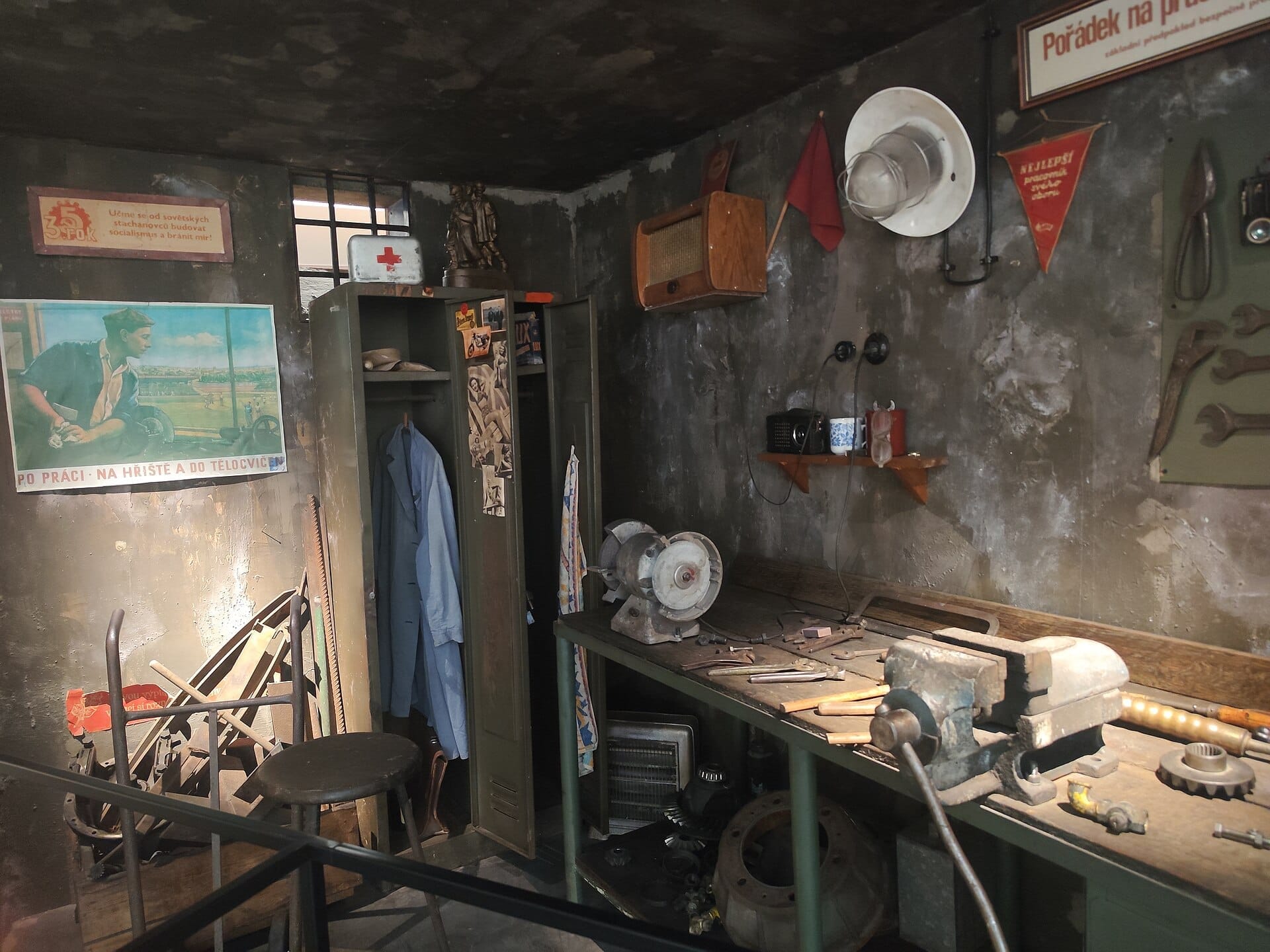
The exhibition covers roughly 500 square metres across multiple themed sections, often characterised as The Dream, The Reality, and The Nightmare. That framework is not accidental. The museum explicitly takes an interpretive position: communism in Czechoslovakia was not an ideological experiment that simply failed, it was a system that caused identifiable suffering to identifiable people. The exhibition makes that argument through original artefacts, period photographs, propaganda posters, audio-visual material, and reconstructed spaces.
ℹ️ Good to know
The ticket office closes 30 minutes before the 20:00 closing time. The museum is open daily year-round except 24 December, from 09:00 to 20:00.
The Building and Getting Inside
The Old Customs House (Stará celnice) is a solid early 20th-century building at the corner of V Celnici and náměstí Republiky. The museum entrance is not immediately obvious from the street. Visitors enter from V Celnici into an internal courtyard, then proceed upstairs to the exhibition floor. The walk from Náměstí Republiky metro station takes about five minutes.
The surrounding neighbourhood is New Town (Nové Město), the 14th-century extension of the historic city that today functions as its commercial backbone. Republic Square itself anchors a cluster of significant architecture: the Municipal House is directly adjacent, and the Powder Tower stands at the square's eastern edge. If you are planning a half-day in this area, combining all three is straightforward on foot.
⚠️ What to skip
The museum is on an upper floor of a historic building. Step-free access may be limited. Visitors with mobility impairments should contact the museum directly before visiting to confirm current provisions.
Tickets & tours
Hand-picked options from our booking partner. Prices are indicative; availability and final rates are confirmed when you complete your booking.
Communism and World War II walking tour and entrance ticket in Prague
From 37 €Instant confirmationFree cancellationSelf guided tour with interactive city game of Prague
From 5 €Instant confirmationFree cancellationPrague by night city tour
From 27 €Instant confirmationFree cancellationPrague city tour with Vltava River cruise
From 38 €Instant confirmationFree cancellation
What You See Inside: A Room-by-Room Sense
The exhibition opens with the ideological context, presenting the promises of communist ideology as they were sold to a post-war population that had just lived through Nazi occupation. The propaganda posters from this period are striking in their graphic confidence, all bright colour and optimistic workers. The contrast with what comes next is the point.
As you move through the rooms, the exhibition shifts from ideology to institution. You encounter the machinery of control: the StB (Státní bezpečnost, the Czechoslovak secret police), surveillance methods, show trials, and the architecture of censorship. There are reconstructed interrogation room elements that are deliberately uncomfortable to stand in. The air here feels stilled, the lighting low. It is not melodrama. It is an accurate rendering of a bureaucratic system designed to intimidate.
Further sections deal with daily life under the regime: grocery shelves with period packaging showing the kinds of goods that were available and unavailable, a reconstructed school classroom with the mandatory portraits and ideological textbooks, and material on the collective farms. These segments tend to land differently for visitors depending on their own background. For many Western Europeans and North Americans, the classroom is simply interesting. For visitors from the former Eastern Bloc or with family connections to that era, the same room often carries a very different weight.
The Nightmare section covers political repression and the 1968 Warsaw Pact invasion more directly. Footage from the period plays on screens. The exhibition concludes with the Velvet Revolution of November 1989, framing it not as an inevitability but as the result of accumulated resistance over decades.
Crowd Patterns and Best Time to Visit
The museum attracts a steady flow of visitors across most of the day, but mornings between 09:00 and 11:00 are noticeably quieter. The exhibition rooms are not large, and when a school group or tour bus arrives, the narrower corridor sections can become congested. If you are the kind of visitor who wants to read every panel without people shuffling past you, aim for the first two hours after opening or after 17:00 when tourist traffic drops.
The museum is indoors and climate-controlled, which makes it a practical option on rainy days or during Prague's colder months. Summer afternoons between 13:00 and 16:00 tend to be the most crowded period, coinciding with peak tourist circulation across the city centre.
💡 Local tip
The audio guide is available in multiple languages and adds considerable context to artefacts that are not fully explained by the English-language panels alone. Factor in an extra 20-30 minutes if you use it.
Is This Museum Worth Your Time? An Honest Assessment
The Museum of Communism is a commercial museum, not a state institution, and that distinction matters. Its interpretive position is clear and consistent, but it is not a neutral archive. The exhibition is unapologetically critical of the communist regime, which for most visitors is not a problem and arguably reflects the historical reality accurately. However, scholars or visitors seeking a more academically nuanced treatment of the period may find the framing occasionally blunt.
That said, the artefact collection is genuine, the reconstructed spaces are effectively done, and the documentary footage provides context that is difficult to find in such a concentrated form elsewhere in the city. For the average visitor with two or three days in Prague and a genuine interest in 20th-century Central European history, this is one of the more informative hours you can spend.
Visitors who want a broader understanding of Prague's history before or after the communist period should also consider the National Museum on Wenceslas Square, which covers the full arc of Czech history. For the communist period specifically, the Museum of Communism is more focused and more immediately accessible than the National Museum's treatment of the same era.
Visitors who find political history dry or who are traveling with young children under ten should probably weigh their time against other options. The content is sobering, the rooms are text-heavy, and there is no interactive layer designed for younger audiences. The interrogation room reconstruction, in particular, is designed to be unsettling.
Photography and Practical Notes
Photography is generally permitted throughout the exhibition for personal use. The lighting in several rooms is deliberately low, so a phone with a reasonable low-light camera will handle it better than a basic point-and-shoot. The propaganda poster sections are the most visually striking for photography, combining strong graphic design with the strange cognitive dissonance of knowing what the ideology actually produced.
Tickets are available at the door. There is no strong argument for booking in advance in most cases, though the museum may participate in Prague discount card schemes. Check current terms before visiting. If you are combining this with other paid attractions, the Prague on a budget guide covers card options and free entry days across the city's major sites.
The museum has a small gift shop with books on Czech and Central European communist history, as well as the inevitable collection of ironic Soviet-era paraphernalia. The books, particularly those in English on the StB and on the 1968 invasion, are reasonably priced and harder to find elsewhere in Prague.
Insider Tips
- Arrive within the first hour of opening (09:00) on weekdays to have the exhibition rooms largely to yourself. Weekend mornings fill up noticeably faster.
- The courtyard entrance on V Celnici is easy to miss. Look for the signage on the gate rather than expecting a prominent street-facing entrance.
- The documentary footage sections require more time than most visitors budget. Do not rush through the video rooms if the 1968 invasion material is what you came for specifically.
- Combine the visit with the Municipal House next door, which represents the exact opposite aesthetic register: optimistic Art Nouveau from the pre-war period. The visual contrast to the communist-era design inside the museum is genuinely striking.
- The museum's English-language panels are thorough, but the audio guide fills in personal testimony and biographical detail that the static panels cannot accommodate. It is worth the additional cost if the subject interests you.
Who Is Museum of Communism For?
- Travelers with personal or family connections to the former Eastern Bloc or Soviet sphere
- History enthusiasts focused on 20th-century Central European politics and Cold War dynamics
- Visitors who want structured context before exploring other communist-era sites across Prague
- Independent travelers who prefer absorbing a place through its difficult history as well as its architecture
- Rainy-day visitors looking for an indoor option with genuine informational depth
Nearby Attractions
Other things to see while in New Town (Nové Město):
- Dancing House (Tančící dům)
Designed by Frank Gehry and Vlado Milunić and completed in 1996, the Dancing House stands on the Vltava embankment as one of Prague's most photographed and debated buildings. Here's what the experience actually looks like from the outside, from the rooftop bar, and from the gallery inside.
- Franciscan Garden
Hidden behind the commercial noise of Wenceslas Square, the Franciscan Garden (Františkánská zahrada) is a free, walled courtyard garden Hidden behind the commercial noise of Wenceslas Square, the Franciscan Garden (Františkánská zahrada) is a free, walled courtyard garden with roots in the 14th century, a Baroque pavilion, and rose beds that offer genuine quiet in the middle of Prague's busiest district. Entry is free, and the contrast with the streets outside is immediate., a Baroque pavilion, and rose beds that offer genuine quiet in the middle of Prague's busiest district. Entry is free, and the contrast with the streets outside is immediate.
- Jerusalem Synagogue
Built in 1904–1906, the Jerusalem Synagogue is the largest synagogue of Prague's Jewish community and one of the most visually arresting religious buildings in the city. Its exterior fuses Moorish Revival arches with Art Nouveau ornament, while the interior overwhelms with color, pattern, and scale.
- Kafka's Rotating Head (Franz Kafka Sculpture)
Standing 11 metres tall outside the Quadrio shopping centre in New Town, the Head of Franz Kafka is a kinetic sculpture of 42 polished stainless steel layers that slowly rotate out of sync, fragmenting and reassembling Kafka's face. It is free to see at any time, though the programmed rotation runs at set intervals between morning and late evening, and it is one of the most photographed modern artworks in the Czech Republic.