DOX Centre for Contemporary Art: Prague's Industrial Canvas for Bold Ideas
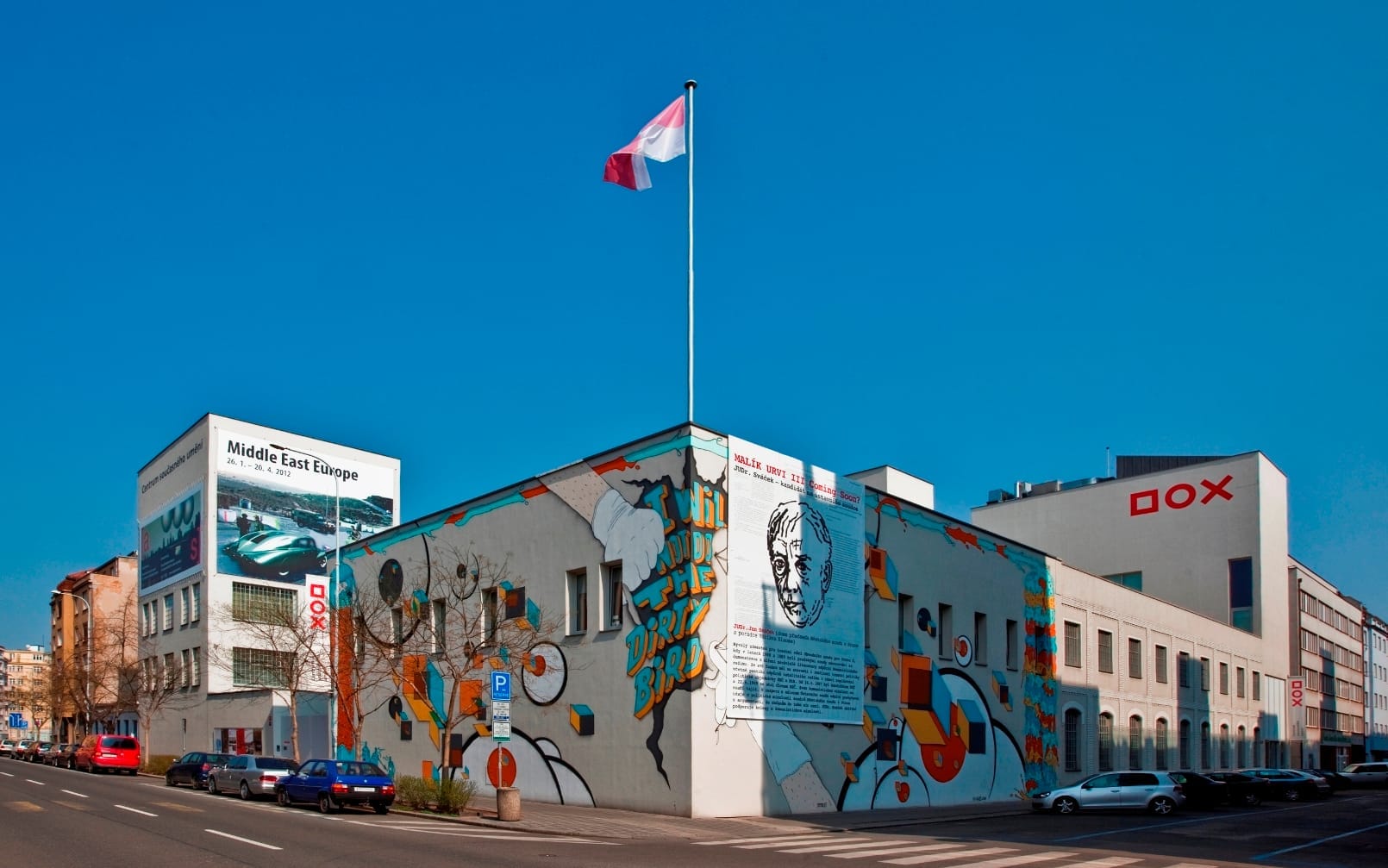
Opened in 2008 inside a converted 19th-century factory in Holešovice, DOX Centre for Contemporary Art is a major venue for international contemporary art, architecture, and design. With around 3,000 m² of exhibition space across renovated industrial halls, it stages politically engaged, visually demanding shows that rarely play it safe.
Quick Facts
- Location
- Poupětova 1, Praha 7 – Holešovice
- Getting There
- Tram to Ortenovo náměstí (lines 6, 12, 17); or Metro Line C to Nádraží Holešovice then ~5-min walk
- Time Needed
- 1.5 to 3 hours depending on exhibitions
- Cost
- 330 CZK standard / 180 CZK reduced / 660 CZK family (verify on official site)
- Best for
- Contemporary art lovers, architecture enthusiasts, curious independent travelers
- Official website
- www.dox.cz
What DOX Actually Is — and Why It Stands Apart
The DOX Centre for Contemporary Art (Czech: Centrum současného umění DOX) is not a conventional museum. It does not display a permanent collection of paintings in chronological order. Instead, it operates as a rotating exhibition space focused on contemporary art, architecture, design, and socially engaged work — often all at once. Since opening in 2008, it has positioned itself as the most internationally ambitious art institution in Prague, bringing in exhibitions that address climate change, political power, surveillance, identity, and migration with a seriousness rarely found in Czech cultural venues.
That ambition is rooted in Holešovice, a district that spent much of the 20th century as a working-class industrial zone before gradually becoming Prague's creative quarter. DOX fits that context precisely: it occupies a converted 19th-century factory, and the bones of that building are still visible inside — exposed brick, steel ceiling structures, and wide loading-bay proportions that give the galleries a raw, unfinished quality no purpose-built museum could replicate. If you want a broader sense of Holešovice's industrial-to-cultural transition, the nearby Holešovice Market Halls tell a parallel story in an even larger footprint.
ℹ️ Good to know
DOX is closed on Mondays. Tuesday through Sunday, it opens at 11:00 and closes at 19:00. Plan to arrive no later than 17:00 if you want unhurried time with the exhibitions.
The Building: Industrial Bones, Considered Intervention
Walking up Poupětova street toward DOX, the building announces itself modestly. The exterior is a mix of red-brick 19th-century factory walls and more recent architectural additions — functional rather than ornamental. There is no grand entrance plaza. You push through a glass door into a reception area where the ceiling immediately opens up, and the scale of the space registers.
The exhibition spaces cover approximately 3,000 m² across interconnected halls, corridors, and a courtyard. The industrial conversion preserved the factory's high ceilings and wide floor plates, which means large-scale installations — video projections, immersive environments, oversized sculptures — fit here in ways they simply cannot in older palaces converted to galleries. Natural light enters selectively; some halls are almost entirely artificially lit to allow precise curatorial control over how work is perceived.
One of DOX's most striking architectural features is the Gulliver airship — a 42-metre wooden zeppelin structure perched on the rooftop that doubles as a reading and community space. It is visible from street level and has become something of a neighborhood landmark. The zeppelin aside, DOX does not rely on architectural spectacle to carry the experience; the buildings serve the art rather than competing with it. For context on how Prague's broader 20th-century architecture evolved, the Prague architecture guide covers the city's full stylistic range from Gothic to Functionalism.
Tickets & tours
Hand-picked options from our booking partner. Prices are indicative; availability and final rates are confirmed when you complete your booking.
Prague Castle and Orloj with National Museum or Jewish Quarter
From 60 €Instant confirmationFree cancellationPrague Jewish Quarter online audio guide
From 8 €Instant confirmationFree cancellation7 best views of Prague e-bike tour
From 74 €Instant confirmationFree cancellationOld Town and Jewish Quarter Tour
From 22 €Instant confirmationFree cancellation
What the Exhibitions Look Like — and How to Read Them
DOX typically runs two to four concurrent exhibitions, each occupying a distinct section of the building. Programming favors work that provokes discussion rather than aesthetic pleasure alone. Past exhibitions have examined Soviet-era propaganda, global refugee movements, the ethics of artificial intelligence, and the history of Czech dissent. The approach is thematic and often research-heavy — wall texts are substantive, and the shows reward time spent reading as much as looking.
This is not a children's playroom or a quick photo-opportunity stop. The work can be confrontational, sometimes deliberately uncomfortable. If you are traveling with young children expecting interactive science-museum energy, this is probably not the right venue. The atmosphere skews toward adults and older teenagers who are genuinely interested in ideas, not just images.
Because the programming rotates, the experience changes significantly from visit to visit. It is worth checking the official website at dox.cz before you go to see what is currently showing. Some exhibitions are visually spectacular; others are more document-and-text heavy. Both approaches appear in the DOX program regularly, and knowing in advance helps set expectations.
💡 Local tip
Photography is generally permitted in exhibitions without flash, but policies vary by show — check the signage at each gallery entrance. Some visiting exhibitions have strict no-photography rules.
Visiting by Time of Day: How the Experience Shifts
DOX is quieter on weekday mornings and early afternoons. Arriving at opening (11:00 on Tuesday through Sunday) typically means small crowds in the first hour — useful if you want to spend unhurried time with dense or emotionally demanding exhibitions. The building's concrete floors and high ceilings carry sound easily, so a full crowd changes the atmosphere noticeably.
Weekend afternoons draw a more social crowd, particularly Saturdays between 14:00 and 17:00. The café fills up, and the gallery spaces become busier. This is not necessarily a drawback — the conversations you overhear between visitors can be part of the experience — but if you want quiet contemplation, a weekday is the clearer choice.
The building is well-heated in winter and cooled in summer, which makes it a practical refuge during Prague's colder months. January and February visits here feel particularly worthwhile: the industrial interior suits gray winter light, the crowds are at their thinnest, and the contrast with the cold outside sharpens your focus inside.
Getting There and the Surrounding Area
The most direct route is tram line 6 or 12 to the Ortenovo náměstí stop, which deposits you about a two-minute walk from the entrance. If you are coming from the city center by Metro, take Line C to Nádraží Holešovice and either walk approximately five minutes south through the residential streets, or pick up a single tram stop. The walk from Nádraží Holešovice is straightforward and passes through the kind of low-key Holešovice streetscape — corner grocery stores, small restaurants, apartment buildings with patchy plaster — that many visitors to Prague's historic center never see.
Holešovice has enough going on to justify a half-day in the area. After DOX, Stromovka Park is a 10-minute walk west for a decompression stroll. The Holešovice neighborhood itself has independent cafés, the Naplavka riverfront embankment, and the National Gallery's trade fair palace about 15 minutes' walk away.
💡 Local tip
There is no large paid parking lot directly at DOX. If driving, street parking in Holešovice can be found in side streets but is limited. Public transport is the more reliable option.
Practical Notes: Tickets, Accessibility, and What to Bring
Admission is 330 CZK for a standard adult ticket, 180 CZK for a reduced ticket (students, seniors, and other eligible categories — confirm current criteria on the official site), and 660 CZK for a family ticket. These prices are in Czech koruna; card payment is accepted. Tickets can be purchased at the door.
The converted factory building has been modernized, and the internal spaces are generally accessible at ground level through the main entrance. However, specific details about elevator availability, step-free access to all exhibition areas, induction loops, and other accessibility features are not fully documented in public sources. Anyone with specific mobility or sensory access requirements should contact DOX directly at dox.cz before visiting.
There is a café on-site, which is a decent stop for coffee or a light lunch. A design bookshop and store is also part of the complex, stocking art and architecture publications, many of which are available in English alongside Czech editions. The bookshop alone is worth ten minutes for anyone interested in Central European contemporary art publishing.
Comfortable shoes are useful: the floor surfaces are largely concrete and stone, and a full visit covers considerable ground. There is no strict dress code. If you are building a broader Prague art itinerary, the best museums in Prague guide covers the full spectrum from historical collections to contemporary spaces, and the National Gallery's Veletržní palác — a functionalist 1920s trade fair building — is the closest institutional peer to DOX in scale and ambition, though it covers a different period.
Is DOX Worth It? An Honest Assessment
DOX is the strongest argument Prague has for contemporary art relevance on a European scale. The programming is genuinely international, the building works extremely well as an exhibition space, and the curatorial approach takes visitors seriously rather than catering to lowest-common-denominator tourism. At 330 CZK, the price is reasonable for what is typically a multi-exhibition visit lasting two hours or more.
The honest caveat: the experience is entirely dependent on what is showing when you visit. An exceptional exhibition makes DOX one of the best things to do in Prague that week. A weaker program — or one that is particularly text-heavy and linguistically demanding for non-Czech speakers — can feel like a long, expensive walk through rooms you do not fully understand. Wall texts are generally available in English, but this is worth confirming for each specific exhibition before you commit the ticket price.
If you are skeptical about contemporary art or primarily interested in Prague's medieval and Baroque heritage, your time is probably better spent in the Prague Castle district or exploring the Old Town Square area. DOX makes no concessions to visitors who are looking for decorative pleasure over intellectual engagement.
Insider Tips
- Check dox.cz in the week before your visit to read the current exhibition descriptions. The quality and type of programming varies substantially between shows, and knowing what is on helps you decide whether to prioritize DOX over other activities on a short trip.
- The Gulliver airship on the rooftop is occasionally accessible for community events and readings. Check the DOX event calendar — these events are often free or low-cost and offer a very different perspective on the building.
- Weekday mornings (Tuesday through Friday, 11:00 to 13:00) are consistently the quietest time to visit. The galleries feel noticeably different when you are one of only a handful of people in a large industrial hall.
- The on-site bookshop stocks a better selection of architecture and contemporary art publications than most general bookstores in Prague. It is worth browsing even if you do not buy — staff can point you toward titles on Czech contemporary art that are difficult to find elsewhere.
- If you are combining DOX with the wider Holešovice area, plan the neighborhood walk first and DOX last — the exhibitions benefit from focused attention, and it is easier to concentrate before you have been on your feet for two hours.
Who Is DOX Centre for Contemporary Art For?
- Travelers with a genuine interest in contemporary art, architecture, or design who want to go beyond Prague's historical sights
- Independent visitors who prefer intellectually engaging experiences and have at least two hours to spend
- Couples or solo travelers on a rainy or cold day looking for a substantive indoor destination in a neighborhood worth exploring
- Art professionals or students seeking context on how Central European institutions approach contemporary programming
- Anyone already spending time in Holešovice who wants to anchor a half-day around a serious cultural venue
Nearby Attractions
Other things to see while in Holešovice:
- Holešovice Market Halls (Pražská tržnice)
The Holešovice Market Halls, officially known as Pražská tržnice, The Holešovice Market Halls, officially known as Pražská tržnice, occupy a large heritage complex in Prague 7 that began life as the city's central slaughterhouse in 1895.. Today the red-brick halls host a year-round farmers market, street food vendors, pop-up events, and independent businesses, offering a slice of everyday Prague that most tourists never reach.
- Letná Beer Garden
Perched on the edge of Letná Park above the Vltava River, the Letná Beer Garden is where Prague locals actually drink in summer. No admission charge, plastic cups of cold Pilsner, and a sweeping view across the city's rooftops — it is one of the most genuinely local outdoor experiences in the Czech capital.
- Letná Park
Letná Park occupies a broad plateau above the Vltava in Prague's Holešovice district, offering panoramic views over the Old Town, a famous open-air beer garden, and kilometers of tree-lined paths. Entry is free and the park is open around the clock.
- National Gallery – Veletržní Palace
Veletržní Palace houses the National Gallery Prague's collection of 20th and 21st century art across 13,500 square metres of exhibition space. Built in 1928 as a trade fair hall, this Functionalist landmark in Holešovice is a major destination for modern and contemporary art.