Old Royal Palace (Starý královský palác): Prague's Most Storied Royal Interior
The Old Royal Palace is the oldest surviving residential building inside Prague Castle, with layers of Romanesque, Gothic, and late-Gothic architecture accumulated over nearly a millennium. Its centerpiece, the vast Vladislav Hall, once hosted jousting tournaments and today stands as one of the most impressive secular interior spaces in Central Europe.
Quick Facts
- Location
- Třetí nádvoří Pražského hradu 48, 119 08 Praha 1-Hradčany (Third Courtyard, Prague Castle)
- Getting There
- Tram 22 to Pražský hrad; or Malostranská metro/tram stop then uphill walk (~15 min)
- Time Needed
- 45–90 minutes for the palace alone; plan 3–4 hours if visiting the full Prague Castle complex
- Cost
- Included in Prague Castle circuit ticket (Tour A approx. 250 CZK for adults; verify current prices at hrad.cz before visiting)
- Best for
- Medieval history, Gothic and late-Gothic architecture, Bohemian royal heritage
What Is the Old Royal Palace?
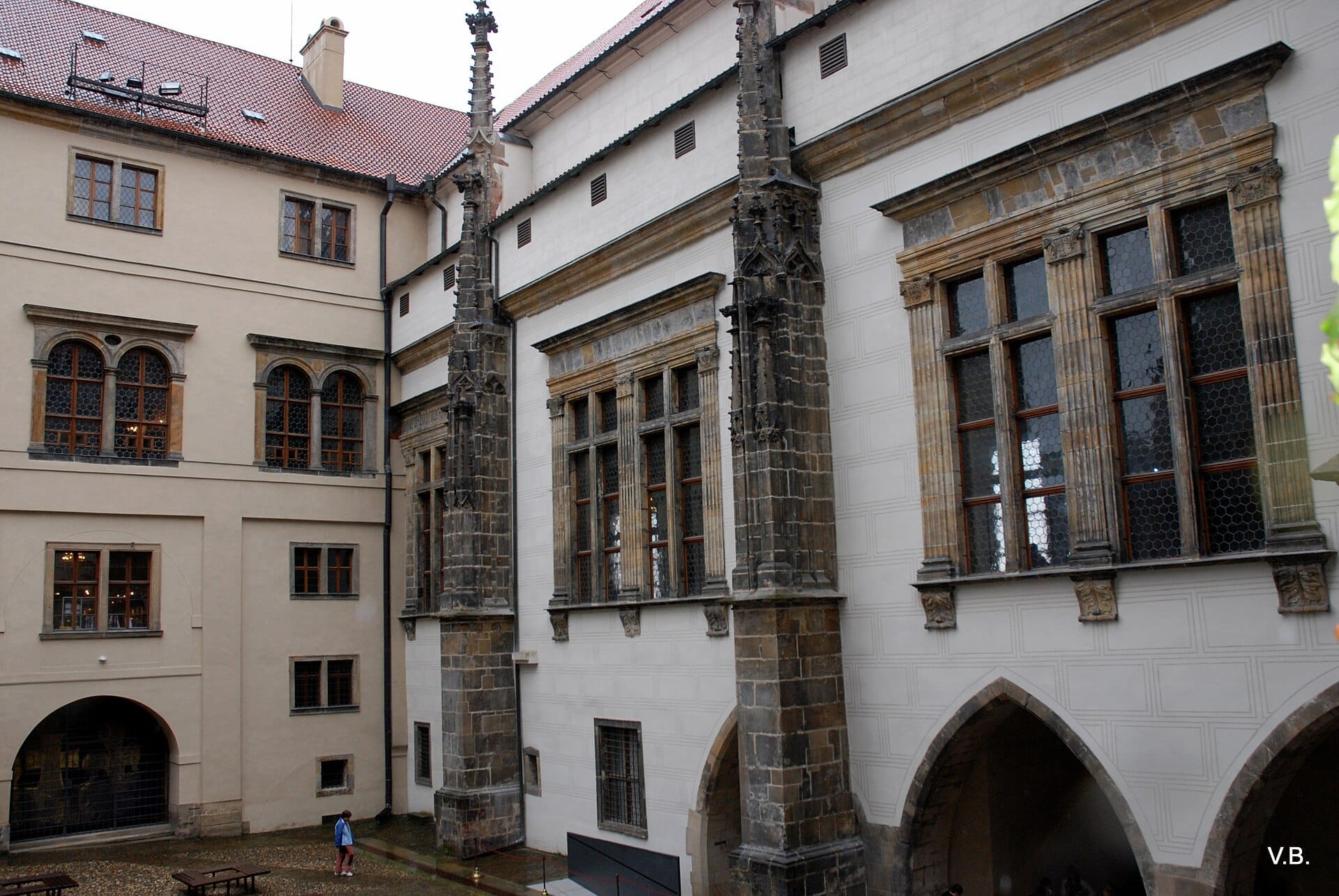
The Old Royal Palace, known in Czech as Starý královský palác, sits within the Third Courtyard of Prague Castle and represents the physical record of nearly a thousand years of Bohemian royal history. Unlike purpose-built royal palaces elsewhere in Europe, this building is essentially a vertical archaeological section: each level belongs to a different era, from Romanesque foundations of the 12th century through Gothic extensions under Charles IV in the 14th century to the spectacular late-Gothic Vladislav Hall completed in 1502.
It is not a reconstructed showcase. The walls, vaults, and staircases are original, and that authenticity is immediately perceptible when you step inside. The air is cool and slightly mineral. Stonework shows the marks of centuries rather than restoration plaster. For anyone seriously interested in medieval European architecture or Bohemian history, this is among the most substantive interiors in the Czech Republic.
ℹ️ Good to know
The Old Royal Palace is open April–October 9:00–17:00 and November–March 9:00–16:00. These hours apply to the full Prague Castle complex; verify current times and ticket prices at hrad.cz before your visit, as they are subject to change.
A Thousand Years of Building: The Historical Layers
The site has been associated with Bohemian rulers since at least the 10th century, when a wooden princely residence stood here. The oldest surviving stone structure dates to the 12th century, when Soběslav I built a Romanesque palace on the site. Those foundations and lower halls are still accessible on the ground floor and give the palace its unusual depth: you are walking through time as much as through space.
Charles IV expanded and elevated the palace in the Gothic style during the 14th century, transforming Prague into one of the most significant cities in the Holy Roman Empire. His son Wenceslas IV continued the work. But the building's most transformative phase came under Vladislav II Jagiellon, who commissioned architect Benedikt Ried to construct the enormous Vladislav Hall between 1490 and 1502. Ried's solution was architecturally daring: he used late-Gothic ribbed vaulting of extraordinary complexity to roof a hall over 60 meters long and 16 meters wide, while inserting Renaissance window frames into the exterior walls, creating one of the earliest examples of Renaissance influence in Bohemian architecture.
The palace ceased to be a royal residence in the late 16th century after a fire damaged much of the complex and the Habsburg court relocated. From the 17th century onward it functioned as an administrative center, housing the Bohemian Diet and various royal offices. That administrative history is itself part of the story: the Diet Hall and the offices of the Bohemian Chancellery are part of the visitor route, and it was from a window of that chancellery that two Catholic governors were thrown during the Second Defenestration of Prague in 1618, an event that triggered the Thirty Years' War.
For a broader understanding of how Prague Castle developed within the city's political and architectural history, the Prague architecture guide provides useful context on the transitions between Romanesque, Gothic, and Renaissance building across the city.
Tickets & tours
Hand-picked options from our booking partner. Prices are indicative; availability and final rates are confirmed when you complete your booking.
Prague Castle and Royal District: Guided Tour with a Historian
From 68 €Instant confirmationFree cancellationSelf guided tour with interactive city game of Prague
From 5 €Instant confirmationFree cancellationPrague by night city tour
From 27 €Instant confirmationFree cancellationPrague city tour with Vltava River cruise
From 38 €Instant confirmationFree cancellation
Vladislav Hall: The Centerpiece
The first thing that registers when you enter Vladislav Hall is the sheer scale. At over 60 meters in length, it dwarfs expectations. The ribbed vaulting overhead forms interlocking geometric patterns that spread across the ceiling like the branches of a stone forest, and the light filtering through the large Renaissance windows creates a clarity that feels almost modern despite the medieval structure beneath it.
In its heyday, the hall served multiple functions simultaneously: a venue for royal coronations, a market for merchants who set up stalls along the walls, and a tournament ground for knights on horseback. That last function explains the wide external staircase, the Riders' Staircase, which horses could actually ascend. The staircase is part of the visitor route and its gently inclined ribbed steps are one of those details that stop you mid-stride: the evidence of a completely different relationship between architecture and daily life.
Today the hall is largely empty of furniture, which is both its weakness and its strength as a visitor experience. Without period furnishings, it can feel austere. But that emptiness also lets the architecture speak without distraction. Morning light hits the south-facing windows most directly, which makes the late-morning hours the most photogenic time to be inside, when the vault ribs cast defined shadows across the floor.
The Rest of the Route: Rooms Worth Not Rushing Past
Most visitors spend the bulk of their time in Vladislav Hall and miss the smaller rooms that branch off it. The Bohemian Chancellery, accessible through a doorway off the hall, is compact but historically charged. A plaque marks the window from which the 1618 defenestration took place. The room itself retains 17th-century furnishings and a quality of preserved stillness that the main hall, with its tour groups, cannot.
The Diet Hall, where the Bohemian parliament met for centuries, has a horseshoe arrangement of benches facing a raised throne and a gallery for observers above. It illustrates the mechanics of medieval governance in a concrete, spatial way that no museum display can fully replicate. Look at the ceiling decoration and the carved details on the benches; they reflect the status consciousness of the institution.
The lower Romanesque and Gothic halls require descending into the base of the building. The atmosphere changes noticeably: the spaces are lower, the stone is rougher, the light is reduced. These rooms date partly to the 12th century and carry a different weight. They are less photographed and less crowded, and for visitors with an interest in the actual physical evidence of medieval architecture rather than the spectacular theatrical spaces above, they can be the most affecting part of the visit.
The Old Royal Palace sits within Prague Castle, which also contains St. Vitus Cathedral, St. George's Basilica, and Golden Lane. Factoring in the full complex is important for planning your time.
Visiting Practically: What to Know Before You Go
Access is through Prague Castle's ticketing system. The Old Royal Palace is included in Tour A, the comprehensive circuit ticket. Individual site tickets are also available; check the official Prague Castle website for current pricing, as rates are updated periodically. Queues at the castle gate are longest between 10:00 and 14:00 on summer weekdays and weekends. Arriving at opening time (9:00) or after 15:00 significantly reduces wait times and gives you a quieter experience inside.
Getting there: Tram 22 is the most direct option, stopping at Pražský hrad and depositing you at the castle's main entrance on Hradčanské náměstí. The alternative is Malostranská metro station on Line A, followed by a walk up the Old Castle Steps or through Malá Strana and up the hill. The walk takes 15–20 minutes but passes through attractive streets and provides a gradual orientation to the castle's hilltop position.
The interior is cool year-round, noticeably so in the Romanesque lower levels. A light layer is worth carrying even in July. The floors are original stone and uneven in places, so footwear with grip and flat soles is more practical than heels or dress shoes. Accessibility within the palace is limited by its historic structure: the Riders' Staircase and several lower-level areas involve steps without lifts. The official Prague Castle website provides current accessibility information.
💡 Local tip
Photography tip: Vladislav Hall is best photographed from the far (west) end, looking back toward the entrance doorway, where the full sweep of the vaulted ceiling is visible in a single frame. Use a wide-angle setting if possible. Tripods are generally not permitted.
If you are planning a multi-day visit to Prague and want to structure your time efficiently across the castle and the rest of the city, the 3-day Prague itinerary suggests a practical sequence that avoids the most congested hours at the castle complex.
Who Gets the Most from This Visit
Visitors with a genuine interest in medieval architecture, Bohemian history, or the mechanics of historical governance will find the Old Royal Palace one of the most rewarding interiors in Prague. The combination of accessible scale, original fabric, and layered historical significance is rare.
Visitors who want a quick scenic photo stop or who are primarily interested in panoramic views will be less well served. The palace has no views of the city; for that, the castle ramparts and the area around St. Vitus Cathedral are more productive. Families with young children may find the interior engaging if the children are old enough to absorb some context, but there is limited interactive provision, and the lower Romanesque halls are not stroller-accessible.
The Old Royal Palace is often treated as a secondary stop after St. Vitus Cathedral on the same castle ticket. That is a reasonable prioritization if time is short, but the palace deserves more attention than it typically receives. The cathedral is more visually immediate; the palace is more historically textured.
Nearby within Prague Castle, St. Vitus Cathedral and Golden Lane are included in Tour A and are natural companions to the Old Royal Palace on the same visit.
Insider Tips
- The Romanesque lower halls are where most tour groups do not linger. If you descend below the Gothic levels and take your time in the 12th-century vaulted rooms, you will often have them nearly to yourself, even in peak season.
- The Riders' Staircase is usually entered from Vladislav Hall toward the end of the route. Pause on the staircase itself and look back up at the vaulting above the doorway: this is one of the finest single architectural details in the palace and is frequently walked past without a second glance.
- The window in the Bohemian Chancellery from which the 1618 defenestration occurred is marked, but the room is small and fills quickly with group tours. Arriving early in the morning means you can spend a few minutes in the room alone, which makes the historical resonance considerably more immediate.
- Prague Castle as a whole has multiple entry points. Entering from the western main gate on Hradčanské náměstí is the most common route; entering from the eastern gate via the Old Castle Steps is quieter and connects naturally to Malostranská metro, useful for the return journey.
- Audio guides for Prague Castle are available at the ticket offices and add significant value in the Old Royal Palace specifically, where the visual experience alone does not fully convey the legislative history of the Diet Hall or the significance of the defenestration window.
Who Is Old Royal Palace For?
- Medieval and late-Gothic architecture enthusiasts
- Visitors with a serious interest in Bohemian and Central European history
- Travelers who want to move beyond the visual highlights of Prague into substantive historical interiors
- Photographers seeking dramatic interior architectural shots, particularly the ribbed vaulting of Vladislav Hall
- Anyone visiting Prague Castle on Tour A who wants to allocate time strategically across the complex
Nearby Attractions
Other things to see while in Prague Castle District (Hradčany):
- Golden Lane
A row of tiny, brightly painted houses tucked against Prague Castle's northern fortification wall, Golden Lane compresses five centuries of city life into roughly 100 metres. Once home to castle guards, goldsmiths, and briefly Franz Kafka, it is one of the most photogenic and historically layered corners of the entire castle complex.
- Loreto Sanctuary (Loreta)
The Loreto Sanctuary is one of the most elaborately decorated Baroque pilgrimage sites in Central Europe, anchored by a 1626 replica of the Holy House from Loreto, Italy. Located on Loretánské náměstí in the Hradčany district, the complex rewards visitors with a carillon that rings every hour, a surprising treasury of religious art, and an atmosphere that stands apart from the crowds near Prague Castle.
- National Gallery – Schwarzenberg Palace
Schwarzenberg Palace stands on Hradčanské náměstí, directly opposite the main entrance to Prague Castle. Built between 1545 and 1567, its sgraffito-covered facade is one of the most technically accomplished examples of Italian Renaissance architecture in Central Europe. Inside, the National Gallery Prague displays its permanent collection of Czech and Central European Baroque art across three floors of period-appropriate grandeur.
- National Gallery – Sternberg Palace
Tucked just off Hradčanské Square, Sternberg Palace is one of the finest High Baroque buildings in Bohemia and home to the National Gallery Prague's permanent Old Masters collection. Here you'll find European paintings and sculpture spanning the 14th to 18th centuries, from Flemish altarpieces to Italian Renaissance panels, in rooms that feel genuinely unhurried compared to the castle crowds outside.