Golden Lane: Prague Castle's Most Storied Street
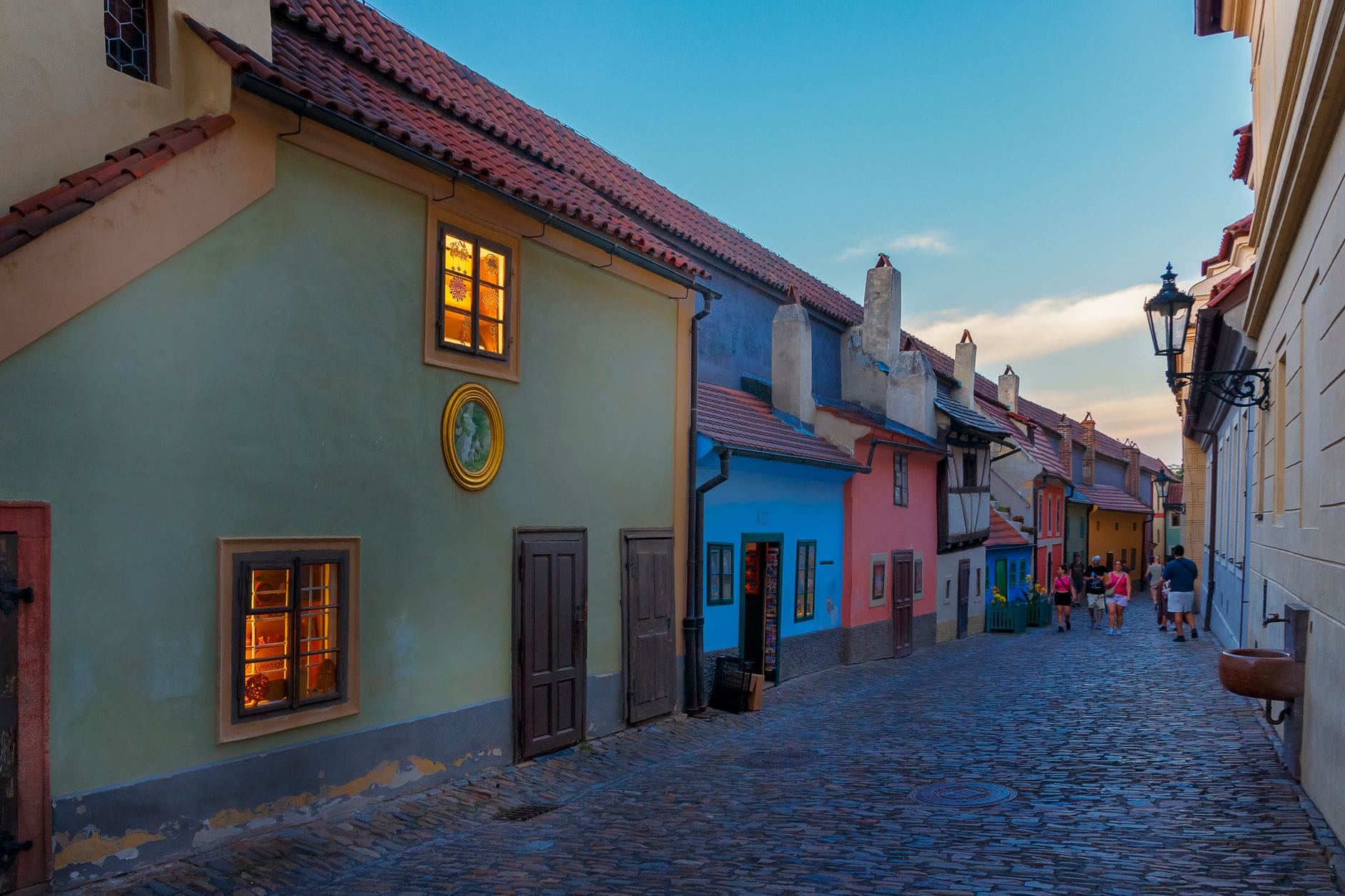
A row of tiny, brightly painted houses tucked against Prague Castle's northern fortification wall, Golden Lane compresses five centuries of city life into roughly 100 metres. Once home to castle guards, goldsmiths, and briefly Franz Kafka, it is one of the most photogenic and historically layered corners of the entire castle complex.
Quick Facts
- Location
- Zlatá ulička u Daliborky, Prague Castle District (Hradčany), Prague 1
- Getting There
- Tram 22 to Pražský hrad stop (castle entrance), or to Malostranská stop then walk up Old Castle Stairs
- Time Needed
- 45–90 minutes, longer if combining with Daliborka Tower
- Cost
- Included in Prague Castle Circuit B; verify current prices at hrad.cz
- Best for
- History lovers, architecture enthusiasts, Kafka fans, families with older children
What Golden Lane Actually Is
Golden Lane (Czech: Zlatá ulička u Daliborky) is a narrow, colour-washed street running along the inside of Prague Castle's northern fortification wall. Golden Lane (Czech: Zlatá ulička u Daliborky) is a narrow, colour-washed street running along the inside of Prague Castle's northern fortification wall. The houses, built in the 16th century to provide housing for castle guards and servants under Emperor Rudolf II, are some of the smallest inhabited structures ever to have stood inside a royal compound in Central Europe.
Today each house functions as a themed exhibit. The lane connects at its eastern end to Daliborka Tower, the castle's 15th-century round keep, which is included in the same ticket circuit.
ℹ️ Good to know
Opening hours: April–October daily 09:00–17:00; November–March daily 09:00–16:00. Entry to the houses requires a Prague Castle ticket (Circuit A or B).
How the Lane Came to Be: A Brief History
The northern fortifications of Prague Castle were extended at the end of the 15th century. The small houses that now define the lane were built into the rampart wall during the 16th century, initially as functional accommodation for the castle's lower-rank guard and support workers. The lane's current name is traditionally linked to goldsmiths who set up workshops here during the 17th century, although popular legend has long preferred a more romantic story linking it to Rudolf II's alchemists supposedly attempting to turn base metal into gold.
The most historically significant resident was Franz Kafka, who rented house No. 22 between 1916 and 1917. He used the tiny space as a writing retreat rather than a permanent address. The house is marked and includes a small display on his time here. Visitors with a serious interest in Kafka's life and work will find the Franz Kafka Museum in Malá Strana considerably more expansive on his biography, but No. 22 carries the particular weight of being a place he actually worked.
The lane's current physical appearance is largely a product of post-war reconstruction completed in the mid-20th century. Before that, the houses had deteriorated considerably and were occupied by impoverished residents well into the 20th century. The reconstruction standardised the bright facade colours that now make the street immediately recognisable in photographs, though it also reduced some of the organic irregularity that a purely medieval streetscape would have had.
Tickets & tours
Hand-picked options from our booking partner. Prices are indicative; availability and final rates are confirmed when you complete your booking.
Self guided tour with interactive city game of Prague
From 5 €Instant confirmationFree cancellationPrague by night city tour
From 27 €Instant confirmationFree cancellationPrague city tour with Vltava River cruise
From 38 €Instant confirmationFree cancellationPrague Castle online audio guide
From 5 €Instant confirmationFree cancellation
The Experience: Walking the Lane at Different Times
At 09:00 when the houses open, the lane is genuinely quiet. Morning light from the east catches the cobblestones and the painted facades in a way that afternoon photographs simply cannot replicate. The air carries the faint mineral coolness of old stone, and with few visitors present you can actually stand in a doorway and look at the carved woodwork or the low ceiling beams without anyone pressing past you.
By 11:00, tour groups begin arriving in force. The lane is narrow enough that two tour groups moving in opposite directions create genuine gridlock. Between roughly 11:00 and 15:00, particularly in summer, the houses become very difficult to move through at your own pace. The sound environment shifts completely: what was quiet stone and birdsong becomes overlapping commentary in a half-dozen languages echoing off the close walls.
Late afternoon, after 15:30, sees a second lull as groups move on to other castle sites or begin descending into the city. If you have flexibility, the combination of early morning or late afternoon timing with the low summer sun makes this one of the most photographable streets in the entire castle complex. Overcast days actually produce cleaner colours from the painted facades than direct sunlight, which creates deep shadow on a street this narrow.
💡 Local tip
Arrive at opening time (09:00) or after 15:30 to avoid the worst congestion. The lane is only a few metres wide at its narrowest point — peak-hour crowds make the interior exhibits frustrating to engage with properly.
Inside the Houses: What the Exhibits Show
The ground-floor exhibits across the houses vary in quality and depth. Some rooms have been thoughtfully dressed with period-accurate tools and furniture to suggest the daily life of their historical occupants. The goldsmith's workshop is one of the more convincing recreations, with actual metalworking tools laid out on a worn bench and small samples of metalwork on display. The alchemist's room leans more theatrical, with bubbling apparatus and dramatic lighting, but it communicates the atmosphere of Rudolf II's court reasonably well.
The upper floor armoury collection is underrated. Running above the lane via internal staircases, it holds a selection of armour, weapons, and military equipment spanning the medieval and early modern periods. The collection includes crossbows, halberds, and full plate armour displayed at close range. For visitors with an interest in military history, this section alone justifies the ticket cost beyond the photogenic street-level experience.
Daliborka Tower at the eastern end of the lane houses exhibits on the tower's history as a prison, including its most famous occupant, the knight Dalibor of Kozojedy, who according to legend learned to play the violin while imprisoned there in the late 15th century. The story later inspired Smetana's opera Dalibor. The tower connects thematically to the broader Prague Castle narrative of medieval justice and royal power.
Practical Walkthrough: Getting There and Moving Through
Tram 22 is the most direct public transport option. Alight at Pražský hrad if you want to enter from the western side of the castle grounds, or at Malostranská to climb the Old Castle Stairs from Malá Strana and approach from below. Golden Lane sits at the eastern end of the castle complex, so if you enter from the main western gate and walk the castle grounds in sequence, you reach Golden Lane toward the end of your visit. Plan accordingly, particularly for ticket circuits. For a broader orientation, the Prague Castle District is worth understanding as a whole before you arrive.
Golden Lane entry is included in Prague Castle Circuit B. Circuit A includes the main castle monuments, while Circuit B includes the Old Royal Palace and Golden Lane. Children under 6 and visitors with limited mobility are reported as exempt from admission charges for Golden Lane specifically; verify this directly with Prague Castle before your visit as policies can change.
Accessibility is limited. The lane runs on uneven cobblestones with gradient changes, and the house interiors involve low doorways, narrow passages, and steep internal stairs to upper floors. The Prague Castle Gardens on the southern slopes offer a more accessible alternative for those who want to experience the castle grounds without the confined interior spaces of Golden Lane.
⚠️ What to skip
The cobblestones are slippery when wet. Wear flat, rubber-soled shoes. Heels are impractical and genuinely uncomfortable on this surface. If you visit during or after rain, the stones become polished and hazardous near the lane's gentle slope.
Who Should Recalibrate Their Expectations
Golden Lane appears in nearly every Prague itinerary, and the gap between expectation and reality can be significant for some visitors. The lane is genuinely short: you can walk end to end in under two minutes. The houses are so small that more than four or five people inside at once makes movement difficult. If you are visiting Prague primarily for architecture or public spaces rather than interior museum exhibits, the St Vitus Cathedral or the castle's exterior courtyards will be more satisfying. Golden Lane rewards visitors who slow down and engage with the exhibits; it frustrates visitors who arrive expecting a photogenic medieval street they can stroll freely.
Very young children often struggle with the low ceilings and tight crowds in peak season. Parents with pushchairs or strollers will find the lane nearly impassable during busy periods. Families with older children who have some patience for small-scale history exhibits will find the armour collection and the reconstructed interiors genuinely engaging.
Visitors with a tightly scheduled single-day visit who are prioritising the castle's major monuments should be aware that Golden Lane takes real time to appreciate properly. For planning, the 3 days in Prague itinerary approach works better for doing the castle complex justice than trying to compress everything into one morning.
Insider Tips
- Buy your Prague Castle ticket online in advance at hrad.cz to skip the queue at the ticket office. During summer peak season, the queue for tickets can itself consume 30–45 minutes.
- House No. 22, Kafka's writing room, is easy to walk past without registering its significance. Look for the small plaque and take a moment inside — the room is roughly the size of a large wardrobe, which gives you a concrete sense of how he worked.
- The upper-floor armoury connecting the houses is far less crowded than the street-level exhibits at almost any time of day. Most visitors drift through the ground floors and move on, leaving the weapons and armour collection relatively uncrowded.
- If you want the classic facade photograph with no people in it, arrive at exactly 09:00 on a weekday in spring or autumn. Within 30 minutes even in shoulder season, the lane fills.
- Daliborka Tower at the end of the lane is included in the same ticket and is worth the short climb. The views from the top over the castle's eastern gardens and out toward Vinohrady are among the less-visited good viewpoints within the castle complex.
Who Is Golden Lane For?
- History enthusiasts who want to engage with the physical texture of medieval castle life
- Kafka readers wanting to see the actual room where he wrote during 1916–1917
- Photographers visiting at opening time or late afternoon for unobstructed facade shots
- Families with children aged 8 and above who can appreciate the armoury and recreated interiors
- Visitors doing a comprehensive Prague Castle circuit and wanting to understand the full complex
Nearby Attractions
Other things to see while in Prague Castle District (Hradčany):
- Loreto Sanctuary (Loreta)
The Loreto Sanctuary is one of the most elaborately decorated Baroque pilgrimage sites in Central Europe, anchored by a 1626 replica of the Holy House from Loreto, Italy. Located on Loretánské náměstí in the Hradčany district, the complex rewards visitors with a carillon that rings every hour, a surprising treasury of religious art, and an atmosphere that stands apart from the crowds near Prague Castle.
- National Gallery – Schwarzenberg Palace
Schwarzenberg Palace stands on Hradčanské náměstí, directly opposite the main entrance to Prague Castle. Built between 1545 and 1567, its sgraffito-covered facade is one of the most technically accomplished examples of Italian Renaissance architecture in Central Europe. Inside, the National Gallery Prague displays its permanent collection of Czech and Central European Baroque art across three floors of period-appropriate grandeur.
- National Gallery – Sternberg Palace
Tucked just off Hradčanské Square, Sternberg Palace is one of the finest High Baroque buildings in Bohemia and home to the National Gallery Prague's permanent Old Masters collection. Here you'll find European paintings and sculpture spanning the 14th to 18th centuries, from Flemish altarpieces to Italian Renaissance panels, in rooms that feel genuinely unhurried compared to the castle crowds outside.
- Nový Svět Quarter
Nový Svět, meaning 'New World,' is a tiny cluster of cobblestone lanes tucked just northwest of Prague Castle in the Hradčany district. Dating to the 14th century and once home to castle servants and later artists, this freely accessible residential quarter offers one of the most atmospheric walks in the city, far removed from the tourist crowds a few minutes away.