Nový Svět Quarter: Prague's Forgotten Medieval Lane
Nový Svět, meaning 'New World,' is a tiny cluster of cobblestone lanes tucked just northwest of Prague Castle in the Hradčany district. Dating to the 14th century and once home to castle servants and later artists, this freely accessible residential quarter offers one of the most atmospheric walks in the city, far removed from the tourist crowds a few minutes away.
Quick Facts
- Location
- Hradčany, Prague 1 (northwest of Prague Castle)
- Getting There
- Tram 22 or 23 to Pohořelec, then 5-min walk downhill
- Time Needed
- 30–60 minutes to walk and absorb the area
- Cost
- Free – public streets, no ticket required
- Best for
- Quiet exploration, photography, escaping castle crowds
- Official website
- prague.eu/en/objevujte/novy-svet-new-world
What Nový Svět Actually Is
Nový Svět, Czech for 'New World,' is a small pocket of medieval streets sitting just northwest of Prague Castle in the Hradčany district. It is not a park, not a museum, and not a formal attraction with a ticket booth. It is a working residential quarter, still inhabited, where a handful of winding lanes preserve the scale and texture of a 16th and 17th century Prague that everywhere else has been swallowed by reconstruction, tourism infrastructure, or both.
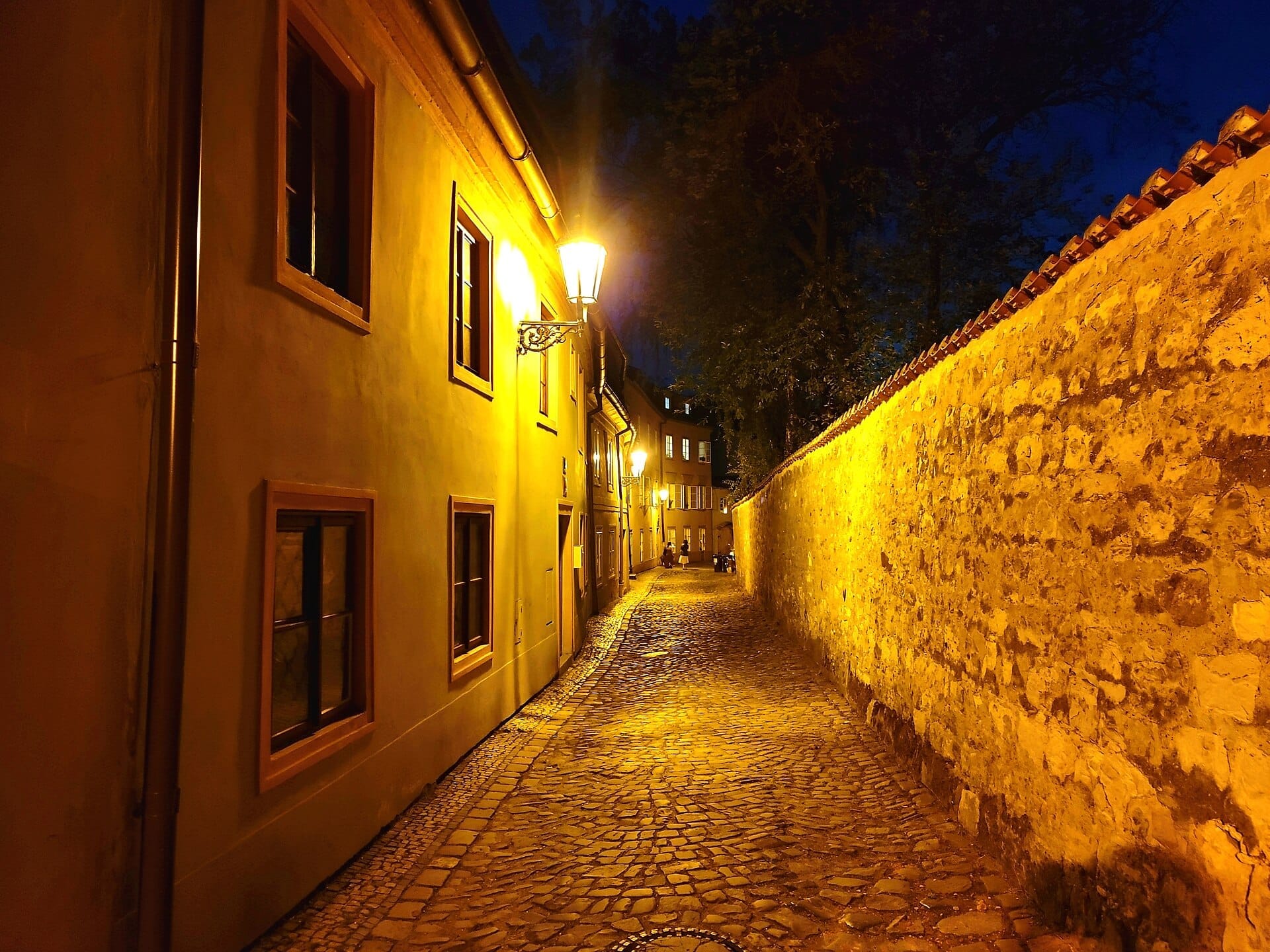
The streets are narrow enough that you can touch both sides with outstretched arms in places. The houses are low, their facades painted in muted yellows, terracottas, and faded blues, most with a tiny front garden or window box. Cats appear frequently on windowsills. There is almost no signage. The whole quarter takes perhaps ten minutes to walk through end to end, yet visitors regularly spend an hour here without noticing.
ℹ️ Good to know
Nový Svět is a residential area. Streets are accessible at all hours, but quiet hours apply from 22:00 to 06:00. Speak at a normal volume and avoid large groups moving through late at night.
A 700-Year-Old Suburb That Survived Intact
Nový Svět began to form around the mid-14th century as a suburb of Hradčany, built to house the people who kept Prague Castle running: servants, craftsmen, stable hands. In 1360, King Charles IV formally affiliated it to Hradčany when new fortifications were extended around the area. Unlike much of Prague, which was periodically transformed by fires, Baroque redevelopment, or 20th-century urban planning, Nový Svět retained its modest medieval street pattern and small-scale housing.
Many of the houses standing today date from the 16th and 17th centuries. They were never grand enough to be demolished and rebuilt as palaces. Their very insignificance is what preserved them. By the 20th century, the quarter had transitioned from housing the urban poor to attracting artists, writers, and filmmakers drawn to its seclusion and visual character.
This layered history, servant quarter to artists' enclave to quietly residential backstreet, gives Nový Svět a different register from the monumental Prague Castle complex visible on the ridge above. If you want the full architectural arc of the Castle District, pairing Nový Svět with a visit to Prague Castle and the Loreto Sanctuary just a few minutes uphill gives you an hour-long loop that covers six centuries of Hradčany in one go.
Tickets & tours
Hand-picked options from our booking partner. Prices are indicative; availability and final rates are confirmed when you complete your booking.
Prague Castle and Orloj with National Museum or Jewish Quarter
From 60 €Instant confirmationFree cancellationPrague Jewish Quarter online audio guide
From 8 €Instant confirmationFree cancellation7 best views of Prague e-bike tour
From 74 €Instant confirmationFree cancellationOld Town and Jewish Quarter Tour
From 22 €Instant confirmationFree cancellation
How the Experience Changes by Time of Day
Early morning is when Nový Svět is most itself. Before 8:00, the lanes are almost empty. The light comes in low and golden from the east, catching the uneven cobblestones and the texture of the old plaster facades. You can hear individual birds. The smell of the quarter in the morning is garden-like, a faint greenness from the small plots and ivy-covered walls, mixed with the stone-and-damp smell common to all of Prague's medieval corners.
By mid-morning, small groups of visitors begin filtering through, usually those who have already done the castle and are following walking tour routes. The quarter can feel noticeably different with even twenty people in it, simply because the lanes are so narrow. By noon on a summer day, the main Nový Svět lane sees a steady trickle of foot traffic, though nothing approaching the queues that form at the Astronomical Clock a kilometre away.
Late afternoon brings the best light for photography. The low sun hits the western-facing facades directly, and the shadows on the cobblestones deepen. In winter, this late-afternoon window arrives earlier, around 14:30 to 15:00, and the lack of leaves on the garden trees opens up views of the rooflines that summer obscures. On a cold clear winter morning, with frost still on the stone, the quarter looks like somewhere that has not changed in three hundred years, because visually it mostly has not.
💡 Local tip
For photography, aim for 07:00–09:00 in summer or 08:00–10:00 in winter. The lanes face a mix of directions, so light conditions shift quickly. Arrive before tour groups and you will have long stretches of empty street to work with.
Walking the Quarter: A Practical Orientation
The most straightforward approach is to arrive via tram 22 or 23 to the Pohořelec stop. From there, walk downhill past the Loreto Sanctuary on your left, continue along Loretánská street, then turn down into the Nový Svět lanes. The descent is noticeable but short. The terrain is hilly and the cobblestones are uneven throughout, so footwear with a firm sole matters more here than in most parts of Prague's centre. Flat-soled shoes or anything with a smooth sole will be uncomfortable and potentially slippery in wet weather.
The quarter is also reachable on foot from Prague Castle itself in about ten minutes, making it a natural extension of a castle visit. From Malostranská metro station on Line A, the walk takes around 20 minutes uphill through Malá Strana, or you can take tram 22 from the same area to Pohořelec and save the climb. From Hradčanská metro station, also Line A, the quarter is approximately 1.6 km and mostly flat once you are on the castle plateau.
The quarter sits within the broader Prague Castle District, and most visitors combine it with the castle, Loreto, and occasionally Strahov Monastery in a single half-day circuit. If you are planning that loop, allow three to four hours total and note that the castle complex itself has separate admission fees and timed entry for some components.
⚠️ What to skip
Nový Svět is not wheelchair accessible. The streets are cobblestone throughout, with no smooth-surface alternatives, and the approach from Pohořelec involves a stepped or steeply inclined descent. Visitors with limited mobility should be aware of this before including it in their itinerary.
What You Actually See Walking Through
The main lane, also called Nový Svět, is the spine of the quarter. It curves gently, which means you never see the full length of it at once. This matters more than it sounds: the curve creates a sense of enclosure and discovery that a straight street would not. Small side alleys branch off, most of them just long enough to frame a doorway or a vine-covered wall before ending.
The houses are predominantly two stories, with steeply pitched roofs. Most have small nameplates or historical markers. One of the best-known structures is a house called 'At the Golden Pear' (U Zlaté hrušky), which now operates as a restaurant and is one of the few commercial establishments in the quarter. Its lantern-lit exterior is a frequent subject of photographs in the evening, when the warm light from the windows contrasts with the dark stone of the lane.
The visual language of Nový Svět is very different from the High Baroque of Malá Strana or the Gothic and Art Nouveau of the Old Town. It is domestic, small-scale, and accidental rather than designed. For context on the architectural range of Prague across its districts, the Prague architecture guide situates Nový Svět within the city's broader building history.
Who Will and Won't Get Much from Nový Svět
Visitors who want interior experiences, exhibitions, or anything explained will be disappointed. There is nothing to enter, no labels on the buildings for general visitors, no audio guide. The quarter rewards people who are comfortable with the experience of looking at a place, attending to texture and light and scale, without a programme. If your trip to Prague is built around specific attractions with content to engage, Nový Svět may feel like an empty detour.
It is also a poor choice in heavy rain. The cobblestones become slick and the drainage is medieval in its ambition. The narrow lanes offer almost no shelter. On a wet grey afternoon, the quarter loses the visual appeal that makes it worth the walk from the castle. If rain is forecast, prioritise it for the beginning or end of a dry spell, or skip it and add time to Prague Castle instead.
For visitors building a castle-district day, Nový Svět fits naturally after the castle complex and before heading back downhill through Malá Strana. The descent from Nový Svět through the back lanes toward Malostranské náměstí takes about 20 minutes on foot and passes through quiet residential streets that see very little tourist traffic.
Insider Tips
- The quarter is most photogenic looking back uphill toward the castle towers. Position yourself at the lower end of the main Nový Svět lane in the late afternoon for a composition that puts the St. Vitus Cathedral silhouette above the rooflines.
- If you visit in the evening, the small cafés and guesthouses provide most of the ambient light on the lane after dark. The warm glow against the stone makes for one of the more atmospheric images in the Castle District, but book ahead if you plan to eat at one of the local restaurants as they are small and fill quickly.
- The back alleys off the main lane are worth exploring. Most dead-end quickly, but a few connect to the Hradčany fortification walls and open onto unexpected views over the city to the north and west.
- Tram 22 runs frequently and stops almost within sight of the quarter's upper entrance at Pohořelec. It is far more practical than walking up from Malostranská metro station on a hot summer day or if you are carrying a bag.
- The surrounding streets between Nový Svět and the Loreto Sanctuary are very quiet and rarely walked by visitors moving between the two on the standard route. Cutting through rather than staying on Loretánská adds only a few minutes but shows a different texture of the neighbourhood.
Who Is Nový Svět Quarter For?
- Photographers looking for empty historic streets with strong architectural character
- Travellers who have finished the castle and want a quiet 30-minute decompression before heading back downhill
- Architecture and history readers interested in pre-Baroque urban form in Central Europe
- Couples wanting a genuinely quiet walk away from the castle crowds
- Return visitors to Prague who have already covered the main sights and want a different register of the city
Nearby Attractions
Other things to see while in Prague Castle District (Hradčany):
- Golden Lane
A row of tiny, brightly painted houses tucked against Prague Castle's northern fortification wall, Golden Lane compresses five centuries of city life into roughly 100 metres. Once home to castle guards, goldsmiths, and briefly Franz Kafka, it is one of the most photogenic and historically layered corners of the entire castle complex.
- Loreto Sanctuary (Loreta)
The Loreto Sanctuary is one of the most elaborately decorated Baroque pilgrimage sites in Central Europe, anchored by a 1626 replica of the Holy House from Loreto, Italy. Located on Loretánské náměstí in the Hradčany district, the complex rewards visitors with a carillon that rings every hour, a surprising treasury of religious art, and an atmosphere that stands apart from the crowds near Prague Castle.
- National Gallery – Schwarzenberg Palace
Schwarzenberg Palace stands on Hradčanské náměstí, directly opposite the main entrance to Prague Castle. Built between 1545 and 1567, its sgraffito-covered facade is one of the most technically accomplished examples of Italian Renaissance architecture in Central Europe. Inside, the National Gallery Prague displays its permanent collection of Czech and Central European Baroque art across three floors of period-appropriate grandeur.
- National Gallery – Sternberg Palace
Tucked just off Hradčanské Square, Sternberg Palace is one of the finest High Baroque buildings in Bohemia and home to the National Gallery Prague's permanent Old Masters collection. Here you'll find European paintings and sculpture spanning the 14th to 18th centuries, from Flemish altarpieces to Italian Renaissance panels, in rooms that feel genuinely unhurried compared to the castle crowds outside.