Basilica of St. Peter and Paul at Vyšehrad: Prague's Neo-Gothic Crown on the Hill
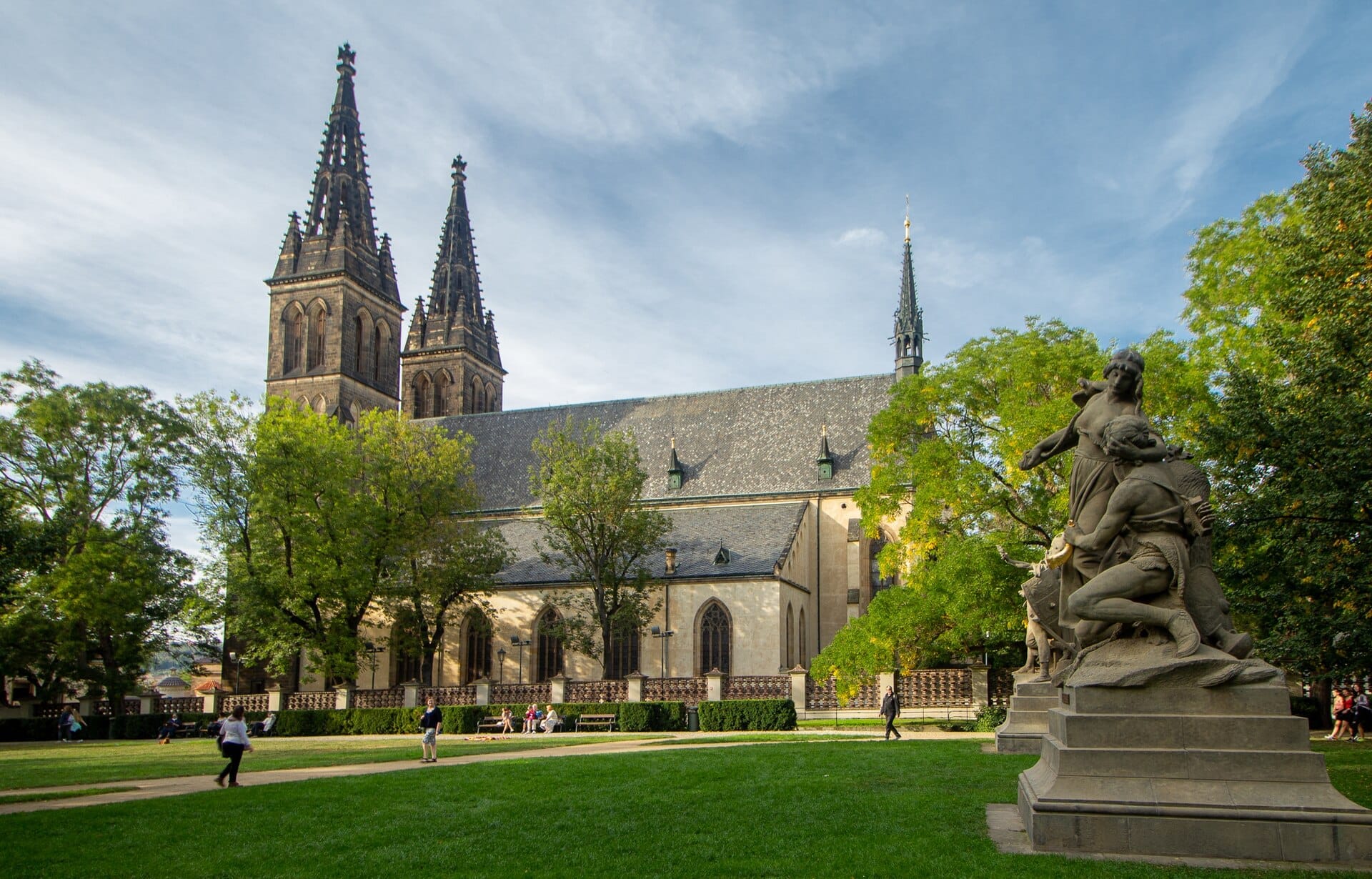
Standing at the heart of the ancient Vyšehrad fortress, the Basilica of St. Peter and Paul is one of Prague's oldest and most architecturally layered sacred sites. Its twin 58-metre neo-Gothic towers define the city's southern skyline, and inside, centuries of Czech history press close. Unlike the crowds of the Old Town, this hilltop church rewards those willing to walk a little further.
Quick Facts
- Location
- Štulcova, Praha 2–Vyšehrad, within the Vyšehrad fortress complex
- Getting There
- Metro Line C, Vyšehrad station – then a 10-minute walk through the fortress gates
- Time Needed
- 45–90 minutes for the basilica alone; allow 2–3 hours if combining with Vyšehrad Cemetery and the fortress ramparts
- Cost
- Approx. 130 CZK full / 70 CZK reduced (verify on site; prices subject to change)
- Best for
- Architecture enthusiasts, history seekers, photography, couples, visitors wanting a quieter alternative to central Prague
- Official website
- www.kkvys.cz/bazilika-sv-petra-a-pavla
What You're Actually Looking At: A Church Built Four Times Over
The Basilica of St. Peter and Paul at Vyšehrad is not one building in any simple sense. What greets you today is the product of nearly a thousand years of construction, demolition, and reinvention on the same rocky promontory above the Vltava River. The earliest structure on this site was a Romanesque basilica founded between 1070 and 1080 by Duke Vratislaus II of Bohemia, making it older than most of what survives in Prague's Old Town. In the 14th century, Charles IV ordered a sweeping Gothic reconstruction that significantly enlarged the church. Fire, war, and neglect came in turns. What stands now is principally the result of a neo-Gothic rebuilding completed between 1885 and 1903, designed by architect Josef Mocker, the same man responsible for much of the restoration work on St. Vitus Cathedral. The visual effect is deliberate and imposing: twin towers rising 58 metres, grey stone that catches differently in morning sun versus afternoon overcast, and a silhouette that reads as medieval even if the hands that built it were Victorian-era Czech.
In 2003, Pope John Paul II elevated the church to the rank of basilica minor, a designation that formalises its spiritual and cultural significance within the Catholic world. That title is not purely ceremonial at Vyšehrad; this is a functioning chapter church of the Royal Collegiate Chapter of St. Peter and Paul, one of the oldest ecclesiastical institutions in Bohemia. Services are held regularly, and the building closes to visitors during ceremonies. Check the chapter's schedule before arriving if your visit is time-sensitive.
💡 Local tip
Opening hours vary by season. November through March: Monday–Saturday 10:00–17:00, Sunday 11:00–17:00. April through October: Monday–Tuesday 10:00–18:00, Wednesday–Friday 10:00–17:30, Saturday 10:00–18:00, Sunday 11:00–18:00. Always confirm hours and check for closures due to services before you visit.
The Approach: Getting Up the Hill and Through the Gates
Take Metro Line C to Vyšehrad station. The exit deposits you at the foot of the modern Nusle Bridge, which spans a dramatic gorge. From there, follow the signposted path up through the Táborská Gate and into the fortress complex. The walk takes roughly 10 minutes at an easy pace, though the path does involve gradients and some cobbled sections. Visitors with limited mobility should be aware that the approach and the surrounding grounds are not flat; there is no cable car or lift to the basilica. Contact the chapter or Vyšehrad Administration directly to confirm current accessibility provisions before planning your visit.
As you walk through the fortress, the basilica's towers appear incrementally over the tree line before the full façade opens up at the western end of the main plateau. The approach from within the fortress is more atmospheric than arriving directly from the street. You pass the rotunda of St. Martin, one of Prague's few surviving Romanesque rotundas, before the basilica itself comes into full view. This sequencing, old stone giving way to older stone, sets the mood well before you reach the entrance.
Vyšehrad sits in Prague's Vyšehrad district, a mostly residential area south of the centre that sees a fraction of the tourist traffic that Old Town absorbs daily. That relative calm is part of the appeal, though it also means fewer cafés and facilities nearby, so plan accordingly.
Tickets & tours
Hand-picked options from our booking partner. Prices are indicative; availability and final rates are confirmed when you complete your booking.
Vysehrad Audio Guide with Optional St. Peter and Paul Basilica Entry
From 5 €Instant confirmationFree cancellationBasilica of St James and Minorite Friary 3-hours tour in Prague
From 48 €Instant confirmationFree cancellationVysehrad Castle and Fortress 2.5-hour guided tour
From 34 €Instant confirmationFree cancellationSelf guided tour with interactive city game of Prague
From 5 €Instant confirmationFree cancellation
Inside the Basilica: Light, Decoration, and the Weight of Devotion
The interior is richly decorated in a manner that surprises visitors expecting restrained neo-Gothic austerity. The walls and vaulted ceilings carry extensive Art Nouveau fresco cycles, the result of early 20th-century commissions. The colour palette is deep: ochres, cobalt blues, and forest greens. On a bright morning, light enters through stained glass on the south side and falls at low angles across the nave, picking out the painted surfaces in a way that changes significantly as the day progresses. By mid-afternoon, the same space feels cooler and more subdued. Both are worth experiencing if your schedule allows.
The main altar is flanked by older sculptural elements that survived earlier phases of the building. Look upward at the rib vaulting, which integrates medieval Gothic structure with the 19th-century restoration. The combination is not seamlessly invisible, but it is honest: you can trace the building's long biography in the fabric of the walls if you know what to look for. The treasury, accessible as part of the visit, holds vestments, reliquaries, and sacred objects spanning several centuries of the chapter's history. It is modest in scale but carefully presented.
ℹ️ Good to know
Photography inside the basilica is generally permitted for personal use, but be respectful of active services. Flash photography and tripods may be restricted. Natural light through the south windows is best for interior shots in the late morning hours.
The Carillon: A Detail Most Visitors Miss
The two towers house a 21-bell carillon that plays several times daily. Most visitors who spend time on the exterior plateau hear it without initially registering what they are listening to. The bells are computer-operated and run through a programme of religious and Czech folk melodies. It is not a performance that requires your full attention, but if you time your visit to be outside the basilica at the top of an hour, the carillon gives the entire Vyšehrad promontory a character that photographs cannot convey. The sound carries across the ramparts, over the cemetery wall, and down toward the river.
The Cemetery Next Door: Context That Matters
Immediately adjacent to the basilica is the Vyšehrad Cemetery, the burial ground for many of the most significant figures in Czech cultural history. Composers Antonín Dvořák and Bedřich Smetana are interred here, as are sculptors, painters, writers, and scientists who shaped modern Czech identity. The cemetery is not an afterthought to the basilica visit; for many who make the journey to Vyšehrad, it is the primary destination, with the basilica as the architectural anchor of the site. Separating the two experiences is somewhat artificial: the church presides over the burials both physically and spiritually, and understanding the basilica's role in Czech national consciousness requires at least a walk through the cemetery grounds.
The broader Vyšehrad fortress complex also includes surviving sections of the Baroque ramparts, gardens with views over the Vltava, and a small museum. Allowing two to three hours for the full site gives you time to engage with all of it without rushing. If your interest is specifically the basilica's architecture and interior, ninety minutes is comfortable.
Time of Day, Weather, and Honest Assessment
The basilica's exterior photographs best in morning light, when the sun hits the west façade directly. By noon, the front is in shade and the towers become harder to render without blowing out the sky. For the interior, late morning on a clear day produces the best light through the southern windows. Overcast days flatten the interior considerably; the frescoes lose depth and the space feels heavier. Summer afternoons bring organised tour groups that can fill the nave, though the numbers are never comparable to the cathedral-level crowds at St. Vitus. September and October offer a useful balance: still-comfortable temperatures, lower visitor numbers than July and August, and autumn light that suits the stone exterior well.
A word of honest calibration: the Basilica of St. Peter and Paul is a significant and genuinely interesting building, but it is not in the same category of scale or interior drama as St. Vitus Cathedral. Visitors who arrive expecting a direct rival to the great Gothic cathedrals of Western Europe may find it compact. Its value is different: it rewards those interested in the layering of Czech history, in the particular brand of national romanticism that drove 19th-century Czech cultural institutions, and in experiencing a sacred site that functions as a real place of worship rather than primarily as a tourist destination.
⚠️ What to skip
The basilica closes during religious services with no set notice to casual visitors. If you are travelling specifically to see the interior, check the Royal Collegiate Chapter's schedule at www.kkvys.cz in advance.
Fitting the Basilica Into a Prague Itinerary
Vyšehrad works well as a half-day excursion from the centre, either on its own or paired with a walk along the Náplavka riverfront below the fortress. From Vyšehrad station, the riverside embankment is accessible on foot, and the contrast between the fortress on the bluff and the informal riverbank culture below is one of the more instructive juxtapositions Prague offers. It is also worth noting that Vyšehrad is far enough from the Old Town core that combining it with a morning at Charles Bridge or Old Town Square makes for a full but manageable day, assuming you are comfortable with public transit.
Those planning a broader Prague stay can find structured itinerary suggestions in the 3 days in Prague guide, which places Vyšehrad appropriately as a half-day rather than a rushed stop. The Prague architecture guide also puts the basilica's neo-Gothic reconstruction in the wider context of Czech national revival-era building.
Who Should Consider Skipping This
Visitors with only a single day in Prague who are prioritising the maximum number of central landmarks may find the journey to Vyšehrad harder to justify. The metro ride is short, but the walk through the fortress adds time, and the basilica itself is not a headline attraction in the way that Prague Castle or the Astronomical Clock are. Travellers with significant mobility limitations should research the terrain carefully before committing; the cobbled paths and gradients on the approach are not trivial. And those who find neo-Gothic 19th-century church architecture less engaging than medieval originals may prefer to spend the equivalent time at St. Agnes Convent or St. Vitus Cathedral instead.
Insider Tips
- Arrive just before 11:00 and position yourself on the plateau outside the basilica's west façade to hear the 21-bell carillon at full effect. The sound is noticeably richer outdoors than inside.
- The views from the southern ramparts of the Vyšehrad fortress, just a two-minute walk from the basilica entrance, look directly down to the Vltava and across to the Nusle valley. They are free, require no ticket, and most visitors walk right past them.
- Tuesday and Wednesday mornings are typically the quietest times at Vyšehrad. Weekend afternoons, especially in summer, bring the most visitors to both the basilica and the cemetery.
- The small park immediately north of the basilica has benches with a partial view of the twin towers. It is a useful rest point that is almost always unoccupied, even when the main plateau has visitors.
- If the basilica is closed for a service when you arrive, use the time in the cemetery or on the ramparts rather than waiting at the door.
Who Is Basilica of St. Peter and Paul (Vyšehrad) For?
- Architecture enthusiasts interested in Czech neo-Gothic and the national revival period
- History travellers exploring Prague beyond the Old Town circuit
- Photographers seeking good tower compositions and interior fresco details in natural light
- Couples looking for a quieter, less crowded alternative to central Prague's main religious sites
- Visitors who want to understand the cultural and spiritual roots of Czech national identity
Nearby Attractions
Other things to see while in Vyšehrad:
- Vyšehrad Cemetery (Slavín)
Established in 1869 on the grounds of Vyšehrad fortress, the Vyšehrad Cemetery is the resting place of many of the most significant figures in Czech cultural history. At its heart stands the Slavín, a monumental shared tomb completed in 1893. Entry is free, the atmosphere is quietly powerful, and the crowds rarely reach city-centre levels.
- Vyšehrad Fortress
Perched on a rocky promontory above the Vltava River, Vyšehrad Fortress is one of Prague's oldest and most historically layered sites. The park grounds and cemetery are free to enter, with paid access to the basilica and casemates. Expect wide river views, Baroque ramparts, and a noticeably calmer atmosphere than the city's more tourist-heavy landmarks.