Vyšehrad Cemetery and Slavín: Prague's Pantheon of Czech Culture
Established in 1869 on the grounds of Vyšehrad fortress, the Vyšehrad Cemetery is the resting place of many of the most significant figures in Czech cultural history. At its heart stands the Slavín, a monumental shared tomb completed in 1893. Entry is free, the atmosphere is quietly powerful, and the crowds rarely reach city-centre levels.
Quick Facts
- Location
- V Pevnosti 159/5b, Praha 2 – Vyšehrad (left of the Basilica of Sts Peter and Paul)
- Getting There
- Metro C: Vyšehrad (10–15-min walk via fortress grounds) or Tram 2/3/7/17 to Výtoň (uphill steps to main entrance)
- Time Needed
- 45–90 minutes for the cemetery; allow half a day to combine with the wider Vyšehrad complex
- Cost
- Free entry
- Best for
- History enthusiasts, architecture admirers, travelers seeking a quieter side of Prague
What Is Vyšehrad Cemetery — and Why Does It Matter?
Vyšehrad Cemetery, known in Czech as Vyšehradský hřbitov a Slavín, is not a standard municipal burial ground. It is a deliberate national statement, founded in 1869 on the rocky promontory of Vyšehrad overlooking the Vltava River. The Czechs created it at a moment of intense national awakening, when the question of cultural identity was inseparable from politics, language, and art. Burying the nation's great figures together in one consecrated place was a way of saying: this is who we are.
Many prominent personalities rest here, almost all of them from the worlds of music, literature, painting, sculpture, and architecture. Composer Antonín Dvořák is here. So is Bedřich Smetana, whose cycle of symphonic poems Má vlast (My Homeland) is still performed at the opening of the Prague Spring music festival each May. The Art Nouveau painter Alfons Mucha is buried steps away. For anyone with even a passing interest in Czech culture, the names on these headstones read like a syllabus.
The cemetery sits within the wider Vyšehrad fortress complex, which means a visit here integrates naturally with the ramparts, the gardens, and the Basilica of Sts Peter and Paul just steps away. If you are planning a broader itinerary, the Vyšehrad neighborhood rewards a slower half-day rather than a hurried stop.
The Slavín: A Tomb Designed to Intimidate (in the Best Way)
The physical centerpiece of the cemetery is the Slavín, a monumental collective tomb built between 1889 and 1893 to the designs of architect Antonín Wiehl. The word 'Slavín' roughly translates as 'hall of fame' or 'place of glory', and the structure lives up to the name. It is a raised sarcophagus platform topped by a large allegorical sculptural group: a winged angel crowning a Czech genius, the figure draped and grave, looking outward over the graves below.
Around 50 individuals are interred within the Slavín itself, chosen for their exceptional contributions to Czech culture. The tomb is positioned as the visual terminus of the cemetery's central axis, so visitors naturally gravitate toward it. Up close, the Czech inscription — Ač zemřeli, ještě mluví (Though they died, they still speak) — is carved across the stone facade. It is a line that earns its gravity in this setting.
💡 Local tip
The Slavín catches the best light in the morning, when the sun hits the sculptural group from the east. If photography matters to you, arrive shortly after the cemetery opens at 08:00.
Architecturally, the Slavín belongs to the Czech National Revival aesthetic: neo-Gothic arches, Historicist detailing, and an emphasis on symbolic imagery over decoration for its own sake. It is worth spending a few minutes reading the individual name plaques embedded in the tomb's base, which list each person interred within.
Tickets & tours
Hand-picked options from our booking partner. Prices are indicative; availability and final rates are confirmed when you complete your booking.
Historical tour of the psychiatric hospital and its abandoned cemetery
From 26 €Instant confirmationFree cancellationVysehrad Audio Guide with Optional St. Peter and Paul Basilica Entry
From 5 €Instant confirmationFree cancellationVysehrad Castle and Fortress 2.5-hour guided tour
From 34 €Instant confirmationFree cancellationSelf guided tour with interactive city game of Prague
From 5 €Instant confirmationFree cancellation
Walking the Cemetery: What You Actually See
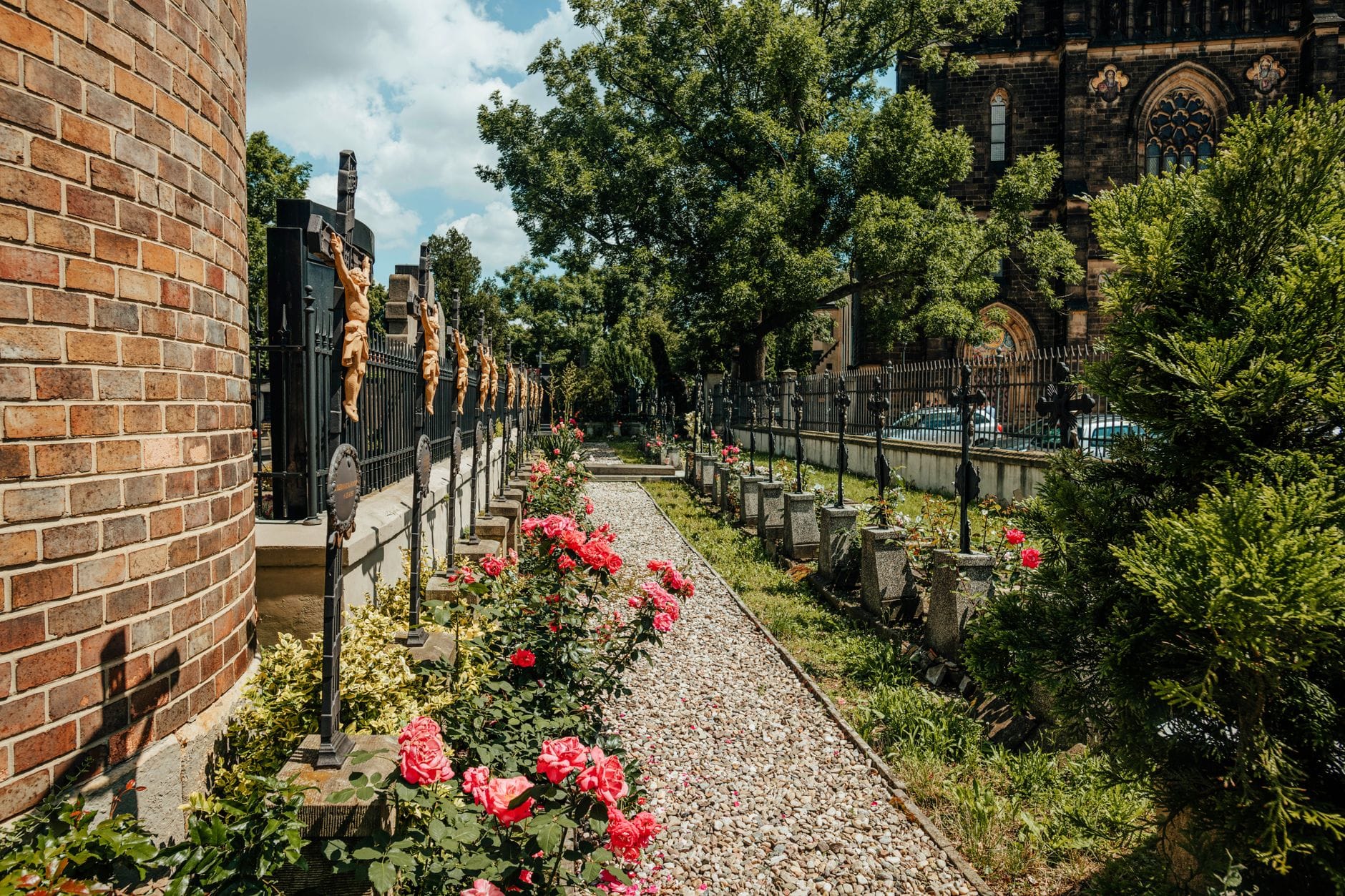
The cemetery is not large. A slow circuit of the main paths takes around 30 to 40 minutes. The layout is formal and symmetrical, with gravel paths lined by tall, closely spaced trees that filter the light into strips and pools. In summer the canopy keeps the temperature noticeably cooler than the surrounding streets. In autumn, fallen leaves collect along the iron railings and the overall effect is appropriately elegiac.
Most of the individual tombs are distinguished pieces of memorial sculpture in their own right. You will see Symbolist bronze reliefs, carved limestone busts, ceramic portrait medallions, and a handful of striking Secessionist-era monuments. The headstones range from modest to elaborate, but even the plainer ones are carefully maintained. Fresh flowers appear regularly at the most visited graves, particularly those of Dvořák and Mucha.
The cemetery is bounded by a low arcade on three sides, a covered walkway with arched openings that houses additional burial niches. Walking the arcade is slightly separate from the main open area and tends to be quieter. The ceramic floor tiles and painted vaulted ceilings in certain sections are worth examining closely — they are period details that most visitors walk past without noticing.
ℹ️ Good to know
Opening hours change seasonally. November–February: 08:00–17:00. March–April and October: 08:00–18:00. May–September: 08:00–19:00. Confirm hours at Praha-vysehrad.cz before visiting, particularly in shoulder months.
Time of Day and Crowd Patterns
The cemetery receives a fraction of the visitor numbers that crowd Charles Bridge or the Old Town Square. Midday on weekdays is calm. Weekend afternoons can bring a modest increase in Czech domestic visitors, particularly in spring and autumn when families often combine a cemetery visit with a walk around the Vyšehrad ramparts. Even at its busiest, the atmosphere remains subdued — the place commands it.
Early mornings, especially in May and September, offer the most rewarding experience. The gates open at 08:00 and in the first hour you will likely have large sections entirely to yourself. The light is cooler and more directional, the birdsong from the surrounding chestnut trees is audible, and there is none of the ambient hum of sightseeing groups. If you are combining this with a visit to the Basilica of Sts Peter and Paul next door, note that the basilica keeps different opening hours.
Visits on or around significant Czech cultural anniversaries — particularly around Dvořák's death date (May 1) or national holidays — may see small gatherings of local visitors paying respects. These moments are unscripted and worth being respectful of.
Getting There: Two Routes, Two Different Experiences
There are two practical approaches. The first is from Vyšehrad metro station on Line C, which deposits you near the northeastern edge of the fortress plateau. From there, a walk of roughly 10 minutes along the fortress grounds brings you to the cemetery's rear entrance. This route passes the Vyšehrad gardens, the old brick ramparts, and several viewpoints over the river, making the walk itself part of the experience. The ground is reasonably flat and accessible.
The second approach is from the Výtoň tram stop, served by lines 2, 3, 7, 17, and others depending on the current PID schedule. From Výtoň you climb a set of stone steps directly up the cliff face of Vyšehrad to the main cemetery entrance, which is located to the left of the Basilica of Sts Peter and Paul. This route is shorter in distance but involves a significant uphill climb on uneven stone steps. It is not suitable for wheelchairs or pushchairs, and challenging for anyone with limited mobility.
⚠️ What to skip
If you have mobility concerns, use the metro approach via Vyšehrad station rather than the Výtoň tram route. The cliff staircase is steep and has no lift alternative.
Historical Context: Why Vyšehrad, and Why 1869?
Vyšehrad has symbolic importance in Czech culture that predates the cemetery by centuries. It was the legendary seat of the earliest Přemyslid rulers, though archaeological evidence suggests its historical role was more complex than the myths imply. By the 19th century, the site had become a powerful emblem of Czech national identity, largely through literature, opera, and romantic historical writing. Smetana's orchestral poem Vyšehrad opens his Má vlast cycle, giving the hill an almost mythological status in the national imagination.
Establishing a national cemetery here in 1869 was a conscious political and cultural act, placing the new in direct continuity with the legendary past. The timing matters: 1869 fell during the period of Czech National Revival, when Czech-language culture, literature, and art were asserting themselves against German cultural dominance in Bohemia. The cemetery was part of the same impulse that built the National Theatre and prompted the large-scale documentation of Czech folk traditions. Understanding this context transforms the cemetery from a curiosity into a document of national history.
For travelers who want to understand the full arc of Czech cultural history, combining a visit here with time at the Mucha Museum in the New Town, or reading about Prague's architecture before arrival using a Prague architecture guide, adds significant depth to what might otherwise feel like a passive cemetery walk.
Practical Details and What to Bring
Entry is free, with no ticketing process or queues at the gate. There is no audio guide facility within the cemetery itself, so doing a little reading beforehand helps considerably. A printed or downloaded map identifying the key graves is worth having, as the on-site signage is sparse and primarily in Czech.
The gravel paths are uneven in places, particularly within the arcade section. Flat, closed-toe shoes are more comfortable than sandals. The site is open to the weather, so in spring and autumn a light layer is useful, especially in the morning when the stone enclosure retains cold air from the night. In summer, the tree canopy provides shade but the afternoon sun can be strong near the Slavín, which sits in an open central position.
Photography is permitted throughout the cemetery. The decorative ironwork, ceramic portrait medallions, and sculptural details on individual tombs photograph well with a close-focus lens. Be aware that this remains an active place of mourning for some visitors, and discretion at graves with fresh flowers or personal mementos is appropriate.
If you are building a broader day around Vyšehrad, the Basilica of St Peter and Paul directly adjoins the cemetery and is worth at least a short visit for its neo-Gothic facade and decorated interior. The Vyšehrad gardens and fortification walls extend the walking circuit considerably and offer views over both banks of the Vltava.
Who Might Not Enjoy This
Travelers with no background interest in Czech cultural history may find the cemetery underwhelming. Without knowing who Dvořák, Smetana, or Mucha were, the names on the headstones carry little weight, and the atmosphere alone — though genuinely distinctive — may not sustain 45 minutes of attention. Children under 10 will typically find little to engage with here, and the solemnity of the environment makes it a difficult space for restless energy. Travelers on a one-day sprint through Prague's headline sights should probably prioritize elsewhere.
Insider Tips
- Download or print a grave map from the Vyšehrad National Cultural Monument website before arriving. The on-site signage is minimal and mostly Czech-language, and navigating to specific graves by name alone is time-consuming.
- The covered arcade on the south and west sides of the cemetery is frequently overlooked. The painted ceiling vaults and period floor tiles in some sections are as detailed as anything in the open-air tombs.
- If you visit in May, check whether the Prague Spring music festival is running — performances of Smetana's Má vlast, which opens with the Vyšehrad poem, take on extra resonance when you have stood at Smetana's grave a few days earlier.
- The Výtoň approach from the tram stop brings you directly to the main cemetery gate, skipping the fortress interior entirely — useful if your sole destination is the cemetery. The metro approach via Vyšehrad station is better if you want the full Vyšehrad experience.
- Fresh flowers at Dvořák's grave are replaced regularly by admirers — often music students and visiting musicians. If you are there on a weekday morning, you may see this exchange firsthand.
Who Is Vyšehrad Cemetery (Slavín) For?
- Classical music enthusiasts wanting to pay respects at the graves of Dvořák and Smetana
- Art history travelers interested in Czech Symbolist and Secessionist funerary sculpture
- Visitors seeking a reflective, crowd-free counterpoint to Prague's busy historic core
- History-focused travelers exploring Czech National Revival culture and identity
- Photographers drawn to atmospheric architectural details and monumental sculpture
Nearby Attractions
Other things to see while in Vyšehrad:
- Basilica of St. Peter and Paul (Vyšehrad)
Standing at the heart of the ancient Vyšehrad fortress, the Basilica of St. Peter and Paul is one of Prague's oldest and most architecturally layered sacred sites. Its twin 58-metre neo-Gothic towers define the city's southern skyline, and inside, centuries of Czech history press close. Unlike the crowds of the Old Town, this hilltop church rewards those willing to walk a little further.
- Vyšehrad Fortress
Perched on a rocky promontory above the Vltava River, Vyšehrad Fortress is one of Prague's oldest and most historically layered sites. The park grounds and cemetery are free to enter, with paid access to the basilica and casemates. Expect wide river views, Baroque ramparts, and a noticeably calmer atmosphere than the city's more tourist-heavy landmarks.