National Theatre Prague (Národní Divadlo): The Soul of Czech Culture on the Vltava
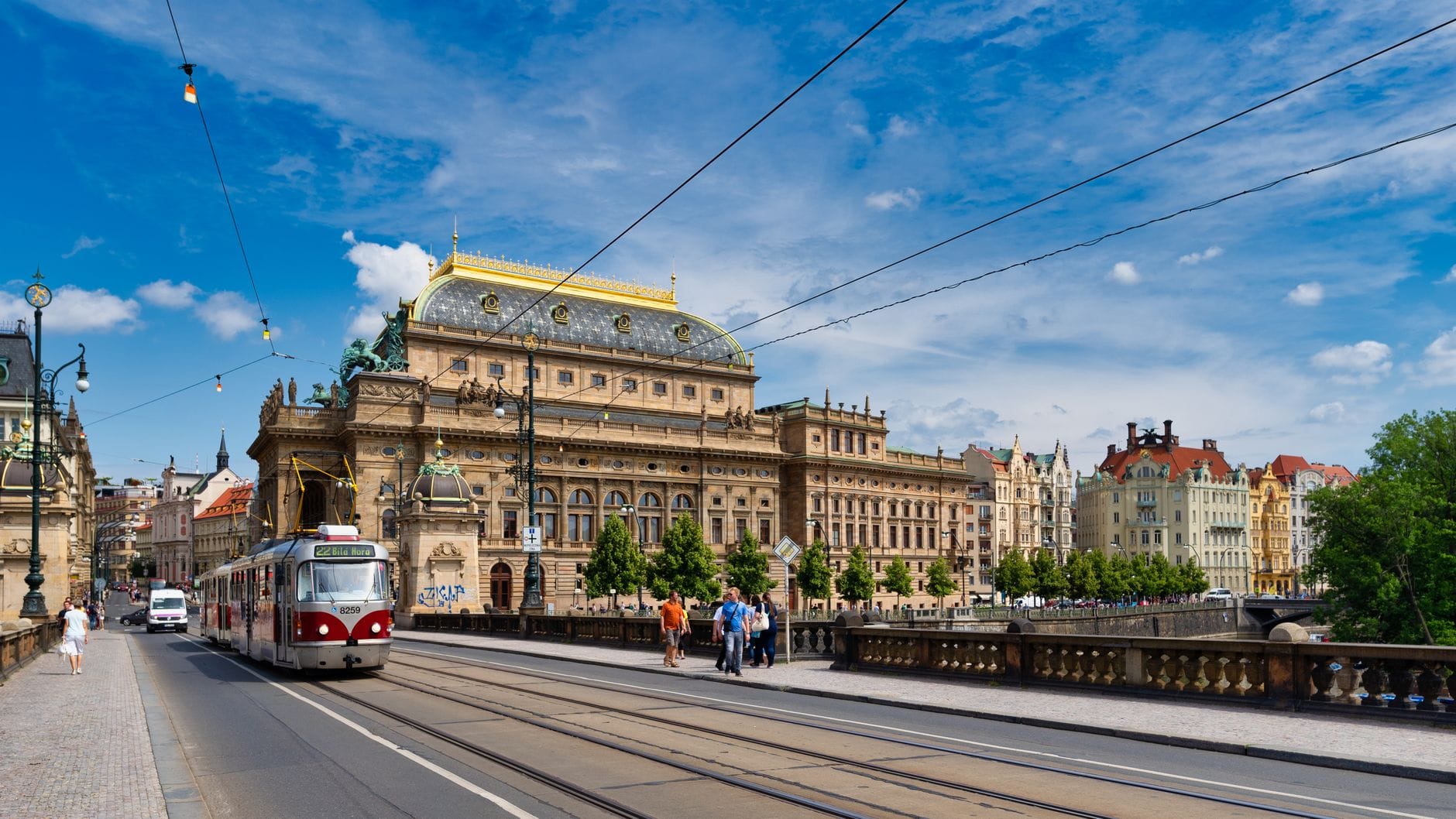
The National Theatre is Prague's most architecturally and culturally significant performance venue, built through a nationwide public collection as a symbol of Czech identity. Standing on the Vltava embankment in New Town, it stages opera, ballet, and drama in a gilded 19th-century interior that rivals any house in Europe.
Quick Facts
- Location
- Národní 2, Praha 1 – Nové Město (New Town), near the Vltava embankment
- Getting There
- Tram 1, 2, 9, 17, 18, 22, 23 to 'Národní divadlo'; or Metro Line B to 'Národní třída', then 5-min walk
- Time Needed
- 30 min for exterior; 2.5–3 hrs for a full evening performance
- Cost
- Ticket prices vary by performance and seating; check narodni-divadlo.cz for current CZK pricing
- Best for
- Opera and ballet lovers, architecture enthusiasts, couples, cultural travellers
- Official website
- www.narodni-divadlo.cz/en/the-national-theatre
What Is the National Theatre and Why Does It Matter?
The National Theatre (Národní divadlo) is more than a performance venue. It is a physical statement of Czech nationhood, built at a time when Czech culture was fighting for recognition within the Austro-Hungarian Empire. Every koruna used to construct it came from voluntary public donations across Bohemia and Moravia during the Czech National Revival movement, making its existence a rare case of a great opera house financed not by a royal court or a wealthy patron, but by an entire people.
The theatre opened in 1881, only to be gutted by fire just weeks later. Rather than abandon the project, the Czechs raised funds again and rebuilt it. It reopened in 1883 with the world premiere of Bedřich Smetana's opera Libuše, a work composed specifically for this moment. That choice of opener was deliberate: Libuše tells the story of a legendary Bohemian princess and prophesies Czech greatness. The symbolism could not have been heavier, and audiences knew it.
Today the National Theatre operates as an institution with multiple stages across Prague, staging opera, ballet, and spoken drama. The historic main building on the Vltava embankment remains the flagship, and understanding its backstory changes how you read the building itself. You can explore how this theatre fits into the broader sweep of the city's identity in our Prague history guide.
The Architecture: Gold, Stone, and National Pride
From the outside, the National Theatre announces itself with a Neo-Renaissance facade of pale stone, topped by a roof finished in gold leaf that catches the Vltava light at dusk with unusual intensity. The roofline carries a row of classical figures, and the main pediment bears inscriptions in Czech. The phrase 'Národ sobě' (The Nation to Itself) is carved above the stage portal inside, summarising the entire project in three words.
The architects Josef Zítek and Josef Schulz oversaw the design, drawing on Italian Renaissance models while incorporating Czech decorative motifs. The interior is where the ambition truly shows: the main auditorium seats approximately 986 people across tiered boxes finished in deep red velvet and gold detailing, with a painted ceiling attributed to the generation of Czech artists later called the 'Generation of the National Theatre.' These painters, including Mikoláš Aleš and František Ženíšek, treated the commission as a cultural mission. The resulting murals, allegorical and dense with Czech mythology, are among the most significant 19th-century decorative painting cycles in Central Europe.
💡 Local tip
If you are visiting for the architecture rather than a performance, the exterior is freely accessible at any time. The best light for photography of the gold roof is in late afternoon, when the sun hits the Vltava-facing facade directly. The embankment walk in front of the building gives you the widest unobstructed view.
The building forms part of a larger architectural sequence along the New Town embankment. For a broader context of how this style sits within Prague's urban fabric, the Prague architecture guide covers Neo-Renaissance and historicist buildings across the city.
Tickets & tours
Hand-picked options from our booking partner. Prices are indicative; availability and final rates are confirmed when you complete your booking.
Prague Black Light Theatre Srnec tickets
From 25 €Instant confirmationFree cancellationBlack light theatre show in Prague Images of Love
From 18 €Instant confirmationFree cancellationSelf guided tour with interactive city game of Prague
From 5 €Instant confirmationFree cancellationPrague by night city tour
From 27 €Instant confirmationFree cancellation
The Experience: Arriving, Inside, and During a Performance
Arriving at the National Theatre by tram, you step off onto a street-level stop directly in front of the main facade. In the hour before evening performances, the surrounding pavements fill with a mix of local regulars in smart attire and tourists who have made the effort to dress up, alongside a minority who arrive in jeans and hiking shoes. The theatre does not enforce a formal dress code, but the interior atmosphere is formal by default, and most of the Prague audience treats an evening here as an occasion.
The main box office is open Monday to Friday 9:00–18:00 and Saturday to Sunday 10:00–18:00. An evening box office opens 45 minutes before each performance, though for popular productions — particularly Smetana operas and full-length Tchaikovsky ballets — seats sell out well in advance. Booking through the official website is the most reliable option; the English-language interface is functional and clearly organised by performance type and date.
Inside, the lobby has the particular smell of old carpet, wood polish, and, faintly, the dry warmth of stage lighting that never entirely dissipates. During interval, the upstairs bar areas open and serve wine and coffee to audience members who spill out into corridors lined with historical photographs and costume sketches. It is worth walking the full circuit of the upper lobbies, even if just for the scale of the decorative programme and the view down into the entrance hall.
The acoustics in the main auditorium are considered excellent for opera and orchestral accompaniment. Sightlines from the side boxes are partially obstructed, as is common in 19th-century horseshoe-plan theatres, so if you are attending for the first time, a stalls or central circle seat gives the most complete view of the stage.
What's On and How the Programming Works
The National Theatre operates three permanent companies under its banner: opera, ballet, and drama. The drama company performs primarily in Czech, making those productions less accessible to non-Czech-speakers without surtitles, though opera and ballet performances are internationally comprehensible regardless of language. Surtitles in Czech and often English are standard for opera.
The repertoire leans toward Czech and European classics. Smetana's cycle of Czech operas features heavily, as do works by Dvořák and Janáček. International opera staples from Verdi, Mozart, and Puccini appear regularly alongside full-length classical and contemporary ballet. The season runs roughly September through June, with a reduced but still active summer schedule.
ℹ️ Good to know
Tickets for standard weeknight performances at mid-range seating are often still available a few days before the show. Opening nights, premieres, and the most popular titles — especially Rusalka, The Bartered Bride, and the Nutcracker in December — book out weeks or months ahead.
For travellers building a Prague itinerary around cultural events, the National Theatre slots naturally alongside other major performance venues. The Estates Theatre in Old Town, where Mozart himself conducted the premiere of Don Giovanni in 1787, offers a useful counterpoint — smaller, older, and with its own distinct atmosphere.
Practical Logistics: Getting There, Parking, and Dress
The most convenient public transport options are trams 1, 2, 9, 17, 18, 22, and 23, all stopping at the 'Národní divadlo' stop directly outside the building. From Metro Line B, exit at 'Národní třída' and walk west along Národní street for about five minutes. The theatre is also within a 15-minute walk of Old Town Square via the embankment, passing Charles Bridge if you approach from the north.
Underground parking is available off Ostrovní Street, adjacent to the theatre complex, which is useful if you are coming from outside the city or combining the evening with dinner in the area. Prague's central tram network is reliable and runs until after midnight on most lines, so returning by tram after a performance is straightforward.
Dress code is not strictly enforced, but smart-casual is the practical minimum if you want to feel comfortable among the regular Prague audience. For opening nights or gala performances, suit jackets and evening dress are common. The venue's own visitor information page notes smart-casual as typical, and advises checking specific event guidelines for special occasions.
⚠️ What to skip
Photography inside the auditorium during performances is not permitted. In the pre-performance period and during interval, photography in the lobbies and from your seat is generally tolerated, but use your judgment and silence your device.
For wheelchair access and specific accessibility requirements, the National Theatre's official website provides detailed current information, including on accessible seating options and lift availability. Given that the building is 19th-century in structure, it is worth checking this before your visit rather than assuming full step-free access throughout.
The Theatre in Its Neighbourhood Context
The National Theatre sits at the western edge of New Town Prague, where Národní street meets the Vltava embankment. The surrounding area rewards a pre-performance walk. The embankment itself runs south toward the Dancing House, the Frank Gehry and Vlado Milunič building from 1996 that stands as one of the most discussed pieces of post-communist architecture in the country. The contrast between the two buildings, separated by about ten minutes on foot, is striking and deliberate.
In the other direction, Národní street leads east toward Wenceslas Square and the commercial centre of New Town. A number of good restaurants and wine bars occupy the side streets between the theatre and Wenceslas Square, making it easy to combine dinner with an evening performance. The Prague restaurant guide covers options across all price points in this part of the city.
Evening performances typically end between 21:30 and 22:30 depending on the production. The neighbourhood is well-lit and regularly trafficked at that hour, and trams and the metro continue to run. It is not an area that empties out after dark.
Who Should Skip This Attraction
If you have no interest in opera, ballet, or formal theatre, the National Theatre offers little beyond its exterior and the surrounding embankment walk. There are no behind-the-scenes tours regularly offered to the public, and the interior is only accessible during performances or specific open-day events. Families with young children may find a full-length opera or ballet (often 2.5 to 3 hours including interval) a difficult ask, particularly in a formal setting where noise is noticed.
Travellers primarily interested in visual art or interactive history would likely get more from the Municipal House, which offers guided tours of its Art Nouveau interiors independently of any performance schedule.
Insider Tips
- Book tickets directly through the official National Theatre website rather than third-party resellers. You will pay the face price in CZK without added booking fees, and the seat map is clearly displayed.
- If you cannot get seats for the main auditorium, the National Theatre also programmes performances at its other Prague stages, including the Estates Theatre and the New Stage (Nová scéna) building attached to the main building. The New Stage hosts a different programme with sometimes more experimental or accessible work.
- The gold roof is illuminated at night and reflects off the Vltava when conditions are clear. The view from the opposite bank, from the Malá Strana embankment side, gives the fullest perspective of the building against the river — better than the view from directly in front.
- Standing tickets are available for some productions at significantly reduced prices. If you are flexible about comfort and mainly want the experience of the auditorium and performance, this is worth checking when booking.
- The embankment promenade between the National Theatre and the Palacký Square area is one of the quieter stretches of central Prague riverfront, particularly on weekday mornings. It makes a useful route to approach from the south without fighting pedestrian traffic on Národní street.
Who Is National Theatre (Národní divadlo) For?
- Opera and ballet enthusiasts looking for a performance in a historically significant European house
- Architecture and design travellers interested in 19th-century Neo-Renaissance interiors and Czech decorative painting
- Couples seeking a formal evening out in a genuinely impressive setting
- Cultural travellers wanting to understand Czech national identity through built form and performing arts
- Travellers already attending multiple Prague cultural venues who want to compare the National Theatre with the Estates Theatre experience
Nearby Attractions
Other things to see while in New Town (Nové Město):
- Dancing House (Tančící dům)
Designed by Frank Gehry and Vlado Milunić and completed in 1996, the Dancing House stands on the Vltava embankment as one of Prague's most photographed and debated buildings. Here's what the experience actually looks like from the outside, from the rooftop bar, and from the gallery inside.
- Franciscan Garden
Hidden behind the commercial noise of Wenceslas Square, the Franciscan Garden (Františkánská zahrada) is a free, walled courtyard garden Hidden behind the commercial noise of Wenceslas Square, the Franciscan Garden (Františkánská zahrada) is a free, walled courtyard garden with roots in the 14th century, a Baroque pavilion, and rose beds that offer genuine quiet in the middle of Prague's busiest district. Entry is free, and the contrast with the streets outside is immediate., a Baroque pavilion, and rose beds that offer genuine quiet in the middle of Prague's busiest district. Entry is free, and the contrast with the streets outside is immediate.
- Jerusalem Synagogue
Built in 1904–1906, the Jerusalem Synagogue is the largest synagogue of Prague's Jewish community and one of the most visually arresting religious buildings in the city. Its exterior fuses Moorish Revival arches with Art Nouveau ornament, while the interior overwhelms with color, pattern, and scale.
- Kafka's Rotating Head (Franz Kafka Sculpture)
Standing 11 metres tall outside the Quadrio shopping centre in New Town, the Head of Franz Kafka is a kinetic sculpture of 42 polished stainless steel layers that slowly rotate out of sync, fragmenting and reassembling Kafka's face. It is free to see at any time, though the programmed rotation runs at set intervals between morning and late evening, and it is one of the most photographed modern artworks in the Czech Republic.