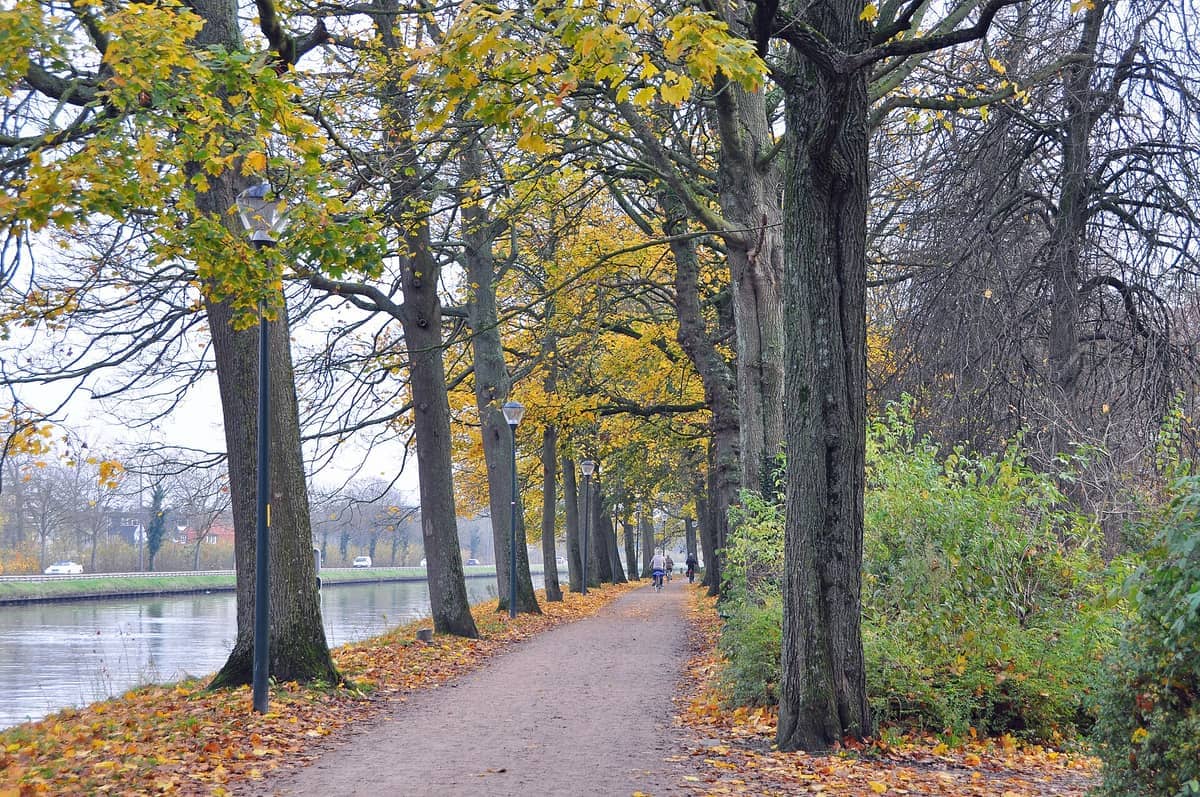
Kruisvest forms part of Bruges' historic city ramparts, a wide green belt of grassy embankments, moats, and four surviving windmills that once defined the city's outer edge. It is one of the few parts of Bruges where you can walk for an hour and feel genuinely alone with the landscape.
Kruisvest is the windmill-lined stretch of Bruges' eastern ramparts, where a broad tree-shaded promenade follows the old city moat past four historic mills standing on the embankment. It sits at the edge of the Sint-Anna quarter and offers a completely different rhythm from the canal-side tourist circuit: open skies, flat green lawns, and the slow creak of wooden sails turning in the coastal wind.
Orientation: Where Kruisvest Fits in Bruges
Bruges (Dutch: Brugge) is encircled by a near-complete ring of medieval ramparts and water, known collectively as De Vesten. This ring road follows the line of the old city walls, and the wide moat that runs alongside it remains in place. Kruisvest is the eastern arc of that ring, running roughly between the Kruispoort gate in the south and the Dampoort gate in the north. If you draw a line straight east from the Markt, you will cross the canal network of the Sint-Anna quarter and arrive at Kruisvest within about fifteen minutes on foot.
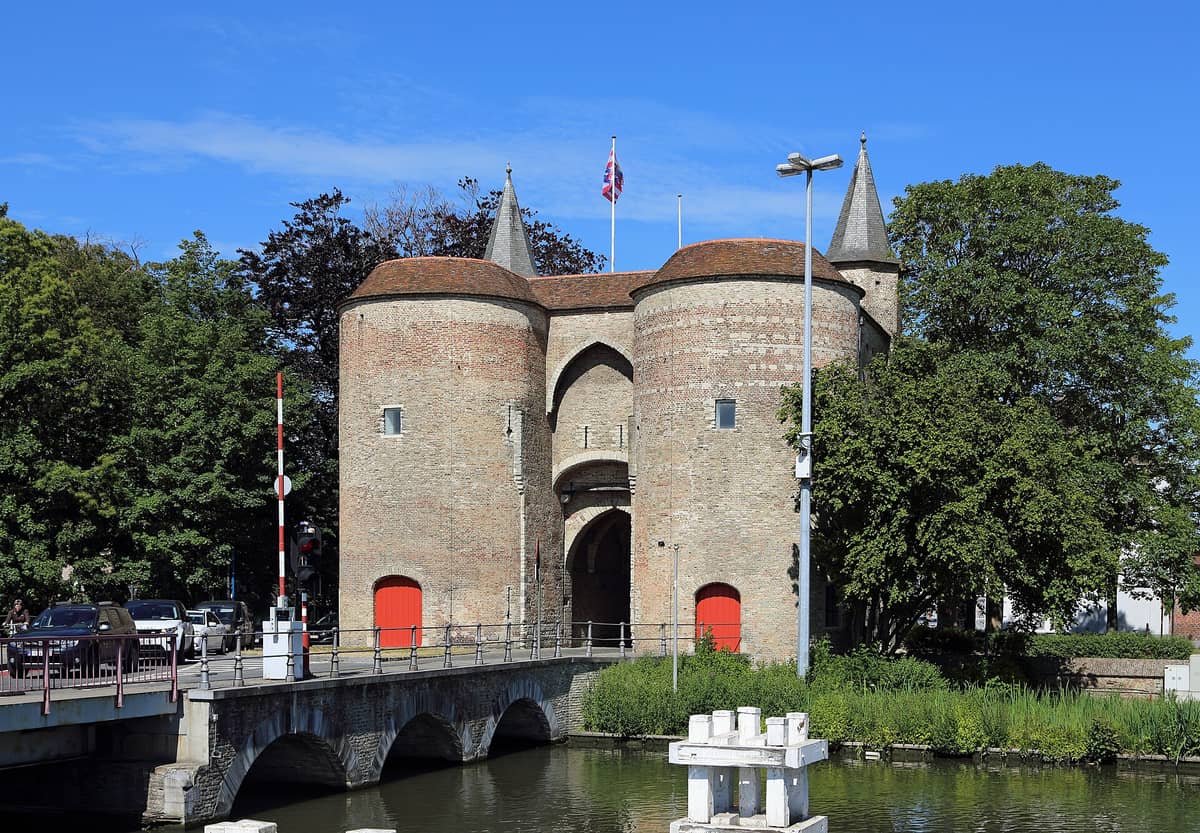
The Kruispoort, a monumental medieval gate, serves as the southern anchor of the area and is one of only four surviving city gates in Bruges. From there, the grassy rampart ridge runs northward along the moat for roughly a kilometre before reaching the Dampoort. This entire stretch sits on the boundary between the historic urban core and the quieter residential streets of Sint-Anna to the west. East of the moat, the city gives way quickly to more modern districts.
The ramparts area is distinct from the canal quarter to the south and from the more densely visited streets around the Markt and Burg. Travellers who have already covered the Bruges historic centre and the Sint-Anna quarter will find Kruisvest a natural extension, adding an outdoor, landscape-focused dimension to their understanding of the city's shape.
Character & Atmosphere: What It Feels Like to Walk Here
Early on a weekday morning, Kruisvest belongs almost entirely to locals. Dog walkers move along the moat path in the grey coastal light, cyclists use the ring road that traces the old wall line, and the windmill sails are still. The air carries a damp earthiness from the moat and the cropped grass of the embankments. There is no market, no street music, no queue. The city feels far away, even though you are technically still inside its medieval boundary.
By mid-morning on weekends and through the summer afternoon, visitors begin arriving, mostly in small groups or couples who have followed a walking route out from the Markt. The mills become the focal point: people climb the embankment ridge and photograph the sails against the sky. But the scale of the open space absorbs these visitors easily. Unlike the Rozenhoedkaai or the Begijnhof, Kruisvest never truly feels congested, even in July. The width of the rampart promenade and the visual sweep of the moat simply do not produce the bottlenecks that narrow canal-side streets create.
In late afternoon, the low westerly light moves across the embankment from behind the city, catching the blades of the mills and turning the water in the moat a dull copper. This is the most photogenic window for the windmill silhouettes, and it requires no planning beyond arriving in the hour before sunset. After dark, the area is quiet and fairly unlit away from the ring road. The moat path is pleasant enough on a warm summer evening but draws few visitors at night, and the mills are not illuminated in any dramatic way.
💡 Local tip
The Sint-Janshuismolen windmill is open to visitors during summer months (generally April through September, subject to weather and staffing). Check Musea Brugge's official website for current opening days before making it the centrepiece of your visit.
What to See & Do
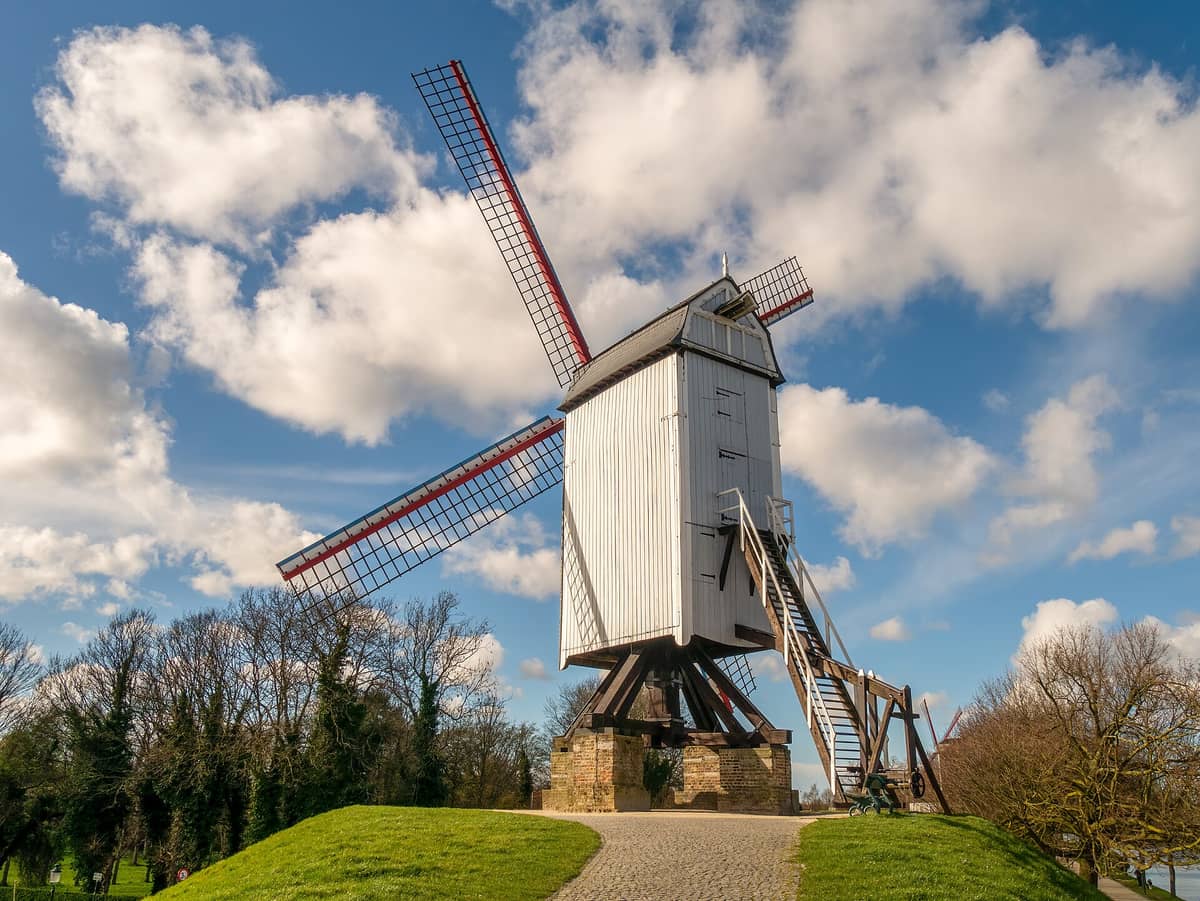
The four windmills on the Kruisvest ramparts are the most visible landmarks in this part of the city. Historically, Bruges had many mills on its ramparts, used to grind grain and pump water. Only four survive today, and all four stand on this eastern stretch. Their arrangement on the elevated embankment ridge, set against an open sky and reflected loosely in the moat below, creates one of the most distinctly Flemish scenes in the whole city.
Sint-Janshuismolen (Sint-Janshuis Mill, Kruisvest 3): built in 1770, this is the only one of the four mills still in its original location and the only one that actively grinds flour. It can be visited during the open season and offers a rare working demonstration of traditional milling.
Koeleweimolen (Koelewei Mill, Kruisvest 1): a wooden corn mill originally from Meulebeke, relocated to Kruisvest near the Dampoort end of the ramparts. It is part of the preserved mill landscape on the ramparts.
Bonne Chiere Mill and De Nieuwe Papegaai Mill: both relocated to the ramparts and part of the four-mill sequence. They stand as part of the landscape rather than as visitor destinations in their own right, but they anchor the visual rhythm of the walk.
Kruispoort gate: the southern entry point to this stretch, one of four remaining medieval city gates in Bruges. The gate itself is a powerful piece of medieval defensive architecture and frames the beginning of the rampart walk.
The moat path (De Vesten walking route): the circular ramparts route allows you to walk the full perimeter of the historic city at ground level, with the moat on your left and the city skyline rising to your right. The Kruisvest section is a scenic arc of this loop.
If you are walking to Kruisvest from the city centre, the route through Sint-Anna passes several quieter attractions including the Jeruzalemkerk, one of the most unusual churches in Flanders, and the Kantcentrum, the city's lace-making centre. Building both into a half-day walk that ends at Kruisvest makes logical geographic sense and adds cultural depth to what would otherwise be a purely landscape outing.
Cyclists will find Kruisvest part of a natural circuit. The ramparts ring is mostly flat and well-signed. For anyone exploring Bruges by bike, cycling the city ramparts is one of the best ways to understand how the medieval boundary related to the city inside it. The full De Vesten circuit takes under an hour at a relaxed pace.
ℹ️ Good to know
The Kruisvest park and the full ramparts walking path are free to access at any time. There is no entry fee to walk along the embankment or to view the mills from the outside. The only paid access is entering Sint-Janshuismolen during its open season.
Eating & Drinking Near Kruisvest
Kruisvest itself has no cafés, restaurants, or market stalls. The rampart corridor is a park, not a commercial street, and this is part of its appeal. If you want to eat before or after walking the ramparts, you need to move into the adjacent neighbourhoods.
The Sint-Anna quarter, immediately west of Kruisvest, has small neighbourhood cafés and bakeries scattered along its residential streets. These are the kind of places that serve coffee to locals on weekday mornings and are not designed around tourist traffic. Prices are lower than anything near the Markt. For a more deliberate meal, the streets running south from Kruispoort toward Sint-Salvator lead into areas with a broader range of restaurants within a ten-minute walk.
Visitors combining Kruisvest with a wider Sint-Anna loop will pass enough small stops to manage a morning or afternoon outing comfortably. For food planning across the city, the Bruges food guide covers the full range of Flemish specialities and where to find them, while the Bruges beer guide is useful for anyone interested in Belgian brewing culture, which is accessible throughout the city.
💡 Local tip
Bring your own food and drink for a picnic on the rampart embankment. The flat grassy areas around the windmills are ideal for sitting in the sun with a bag of supplies from a bakery in Sint-Anna, and the setting is arguably better than any restaurant terrace in this part of the city.
Getting There & Around
Kruisvest is walkable from most parts of the historic centre in 15 to 25 minutes, depending on your starting point. From the Markt, head east through Sint-Anna, roughly following Carmersstraat or Rolweg until the streets open onto the embankment. From the Begijnhof or Minnewater in the south, the route north along the ramparts ring road brings you to Kruispoort and then directly onto the Kruisvest stretch.
From Bruges train station (Station Brugge), the walk to Kruisvest takes approximately 30 minutes on foot, heading northeast through the city centre. Alternatively, De Lijn city buses serve the ring road that traces De Vesten, with stops near both Kruispoort and Dampoort. A single De Lijn ticket costs 3 euros, though fares should be verified before travel as they are subject to revision.
For visitors arriving from Brussels or Ghent by train, the complete transport guide for Bruges covers all arrival options including Brussels Airport (BRU, approximately 100 km away) and Ostend-Bruges Airport (OST, approximately 30 km away). Bruges has no metro system; within the city, walking and cycling are the most practical options for reaching Kruisvest.
Cyclists should note that the ring road running alongside De Vesten carries both cyclists and vehicles. The moat-side walking path is pedestrian-only. The windmill embankment is accessible on foot via short grass slopes; there are no steps or formal access points, just open terrain, which makes it accessible but requires reasonable footwear in wet weather.
Where to Stay: Is Kruisvest the Right Base?
There are no hotels directly on Kruisvest, and the immediate area around the ramparts is largely residential. Staying in the Sint-Anna quarter, which borders Kruisvest to the west, puts you within a 5-minute walk of the mills and the moat path, while keeping you inside the historic centre and within easy reach of the main sights.
Kruisvest suits travellers who want quiet mornings, some distance from the noisiest parts of the city centre, and access to open green space. It does not suit anyone who wants to be within two minutes of the Markt or the main restaurant strips. For a full breakdown of where to sleep across the city, the Bruges accommodation guide covers all the main areas with honest assessments of what each suits.
Who Is Kruisvest For?
Kruisvest is not an area that delivers concentrated sightseeing. There are four windmills, a medieval gate, a pleasant moat, and a long flat walk. If your priority is filling every hour with museums, churches, and canal photography, you can visit Kruisvest in 45 minutes as a detour and move on. But if you want to understand the actual shape of medieval Bruges, how the city wall related to the urban fabric inside it, and what the city looks like from its edge rather than its centre, then Kruisvest is genuinely worth an extended visit.
It works particularly well as part of a wider Sint-Anna circuit. Start at the Jeruzalemkerk, move through the lace quarter, cross into the ramparts at Kruispoort, walk north to the windmills, and loop back through Sint-Anna to the centre. This takes a relaxed half day and covers a completely different side of Bruges from the standard central walking tour routes.
The area is also one of the better choices in Bruges for families with children, who tend to respond well to the open space, the working windmill, and the absence of crowd pressure. There is room to run on the embankments, the moat is visually engaging without being hazardous, and the whole visit can be paced freely without queues or timed entries for most of it.
⚠️ What to skip
The embankment slopes near the moat are unfenced. Take care with young children near the water's edge, particularly after rain when the grass is slippery. The moat is not shallow.
Kruisvest is one of several areas that reward visitors willing to move beyond the central circuit. For more ideas along those lines, the guide to lesser-known Bruges covers a broader selection of overlooked corners, while the free things to do in Bruges guide makes clear just how much of this area costs nothing to explore.
TL;DR
Kruisvest is part of Bruges' medieval ramparts, running between the Kruispoort and Dampoort gates along a grass-covered embankment above the city moat.
Four historic windmills stand on the rampart ridge, including Sint-Janshuismolen (1770), the only one still on its original site that visitors can enter during summer months and the only one still grinding flour.
The area is a free, open public park accessible at any time, with no entry fees, no queues, and significantly fewer visitors than the central canal zone.
Best suited to walkers, cyclists, families with children, and anyone wanting to understand Bruges beyond its postcard centre — it pairs naturally with the Sint-Anna quarter on a half-day circuit.
Not the right choice as a standalone destination if your time in Bruges is very short; combine it with the Sint-Anna quarter and the Jeruzalemkerk to make the visit more complete.
Two days is enough time to cover Bruges properly if you plan well. This itinerary walks you through the city's best sights, neighbourhoods, and experiences in a logical order, with a clear take on what to skip, what to prioritise, and how to avoid the worst of the crowds.
Bruges packs an unusually strong museum scene for a city of its size. From world-class Flemish Primitive paintings at the Groeninge to medieval hospital complexes, immersive history attractions, and specialist museums dedicated to lace, beer, and Belgian fries, the city rewards curious visitors at every turn.
Bruges (Brugge) rewards visitors in every season, but timing your trip well makes a real difference. This guide breaks down weather, crowds, prices, and key events month by month so you can decide when to go based on what actually matters to you.
Bruges (Dutch: Brugge) is a serious beer destination for a city of its size. This guide covers the city's working breweries, museum-style experiences, guided tasting walks, and the bars worth your time, with current pricing, opening hours, and practical advice to help you drink well without wasting money.
Bruges is one of Europe's most photogenic canal cities, and a boat ride through its medieval waterways is one of the best ways to take it all in. This guide covers prices, schedules, the best time to go, what the tour actually involves, and how to avoid the longest queues.
Bruges is one of Europe's most serious chocolate cities, with dozens of artisan chocolatiers, a dedicated chocolate museum, and guided tasting tours winding through the medieval centre. This guide covers everything: Choco-Story ticket prices, the best chocolate walks, how to tell craft shops from tourist traps, and the smartest way to plan your visit.
The Bruges Christmas market is part of the city-wide Winter Glow festival, running from late November through early January across multiple locations in the medieval centre. This guide covers every location, practical logistics, ice skating prices, the free light trail, and the best strategies for making the most of a winter visit to Bruges (Brugge), Belgium.
Bruges preserves some of the finest Gothic architecture in northern Europe, from the soaring Belfry on the Markt to the ornate City Hall on Burg Square. This guide covers every major site, explains what makes each one architecturally significant, and gives you the practical details to plan a focused visit.
Bruges rewards those who wander off the main squares. From a family-built replica of a Jerusalem church to almshouse courtyards that feel frozen in the 17th century, these are the places that reveal a quieter, deeper side of the city.
Bruges in winter is a different city entirely. Crowds thin out, the medieval canals take on a quiet atmosphere, and the city's official Winter Glow program transforms the historic centre from late November through February. This guide covers what's on, what's closed, how to get around, and what most visitors get wrong.
Bruges has been synonymous with handmade bobbin lace for centuries. This guide covers the craft's history, where to watch it being made at the Kantcentrum, how to shop for authentic pieces, and what to skip.
Bruges (Dutch: Brugge) has a reputation as a pricey destination, but the reality is more forgiving. Most iconic sights cost nothing, public transport is straightforward, and a single pass covers nearly every major museum. This guide breaks down exactly what things cost, what's genuinely free, and where it's worth spending a little more.
Bruges is one of Europe's most complete medieval cities, and a single day is enough to see its best. This itinerary gives you a logical, time-aware route through the Markt, the canals, the Belfry, and the quieter corners most visitors miss, with real prices and straightforward planning notes throughout.
From the Saturday market at 't Zand to the weekend antique market along the Dijver canal, Bruges rewards shoppers who know where to look. This guide covers the best shopping streets, market schedules, local specialities, and a clear take on what to buy and what to skip.
Not all Belgian waffles in Bruges are created equal. This guide breaks down the two main styles, names the best spots in the city centre, gives real prices, and tells you which tourist-facing counters to skip.
Bruges (Brugge) packs its most spectacular medieval architecture into a walkable 3–4km historic core. This guide covers the classic self-guided loop from the Markt to Minnewater, with practical notes on timings, entrance fees, crowd patterns, and how to adapt the route for your pace.
Bruges (Brugge) is one of Belgium's most rewarding destinations for families. Compact, walkable, and packed with hands-on museums, canal-side exploration, and chocolate around every corner, the medieval city offers real substance for children and parents alike. This guide covers the best kid-friendly attractions, practical logistics, seasonal timing, and a clear take on where the city delivers and where it falls short for families.
Bruges is one of the most cycle-friendly cities in Europe, with a flat historic centre, expanding bike-priority zones, and nearly 930 km of marked routes in the surrounding Brugse Ommeland. This guide covers rental options and prices, the numbered node network, traffic rules, seasonal considerations, and the best routes for day trips beyond the city walls.
Bruges sits at the center of one of Europe's most connected rail networks. From medieval Ghent to the Belgian coast, these are the best day trips from Bruges, with real train times, honest crowd advice, and exactly what to do when you get there.
Bruges holds one of the world's great concentrations of Flemish Primitive painting. This guide covers the three essential venues, what to look for in each, practical logistics, and how to avoid the most common planning mistakes.
Bruges is one of Europe's most photogenic cities, and a surprising amount of it costs nothing to enjoy. From iconic canal viewpoints and medieval squares to peaceful beguinage courtyards and rampart windmills, this guide covers the best free experiences the city has to offer.
Whether you're arriving by train from Brussels, flying into one of Belgium's two main airports, or planning to cycle the medieval streets, this guide covers every practical transport option for reaching Bruges and navigating the city. Includes real fares, parking rates, and local tips.
Bruges (Dutch: Brugge) is one of Europe's most photographed medieval cities, but does it live up to the hype? This guide cuts through the postcard image to tell you exactly what the city delivers, who it suits best, and how to get the most out of a visit.
Bruges (Dutch: Brugge) is one of Europe's most atmospheric cities for couples, with medieval canals, Gothic architecture, world-class chocolate, and a walkable historic centre that rewards slow exploration. This guide covers the best romantic experiences, practical logistics, and straightforward notes on when to visit and what to skip.
Bruges (Brugge) is a UNESCO World Heritage city in northwest Belgium packed with medieval architecture, Flemish masterpieces, canal tours, and craft beer culture. This guide covers the best things to do in Bruges, with real prices, seasonal tips, and honest takes on what's worth your time.
Bruges is one of Europe's great food cities in miniature. This guide covers everything worth eating, from street-food fries to moules-frites season, plus clear notes on avoiding tourist-trap versions of Belgian classics.
Bruges offers accommodation ranging from canal-side boutique hotels to budget hostels and rural B&Bs. This guide breaks down the best areas to stay, what to expect at each price point, and the practical details most booking sites leave out.