Getting To and Around Bruges: The Complete Transport Guide
Whether you're arriving by train from Brussels, flying into one of Belgium's two main airports, or planning to cycle the medieval streets, this guide covers every practical transport option for reaching Bruges and navigating the city. Includes real fares, parking rates, and local tips.
Plan and book this trip
Tools from our partner Travelpayouts help you compare flights and hotels. If you book through them, we may earn a commission at no extra cost to you.
Flights
Hotels map
TL;DR
- The Brussels to Bruges train takes about 1 hour direct from Brussels-Midi, with frequent departures throughout the day via SNCB/NMBS.
- Bruges station (Brugge) sits about 1.5 km south of the historic centre — walkable in 20 minutes, or a short bus ride.
- Driving into the medieval centre is actively discouraged: above-ground parking is limited to 4 hours and costs up to €18. Use the free Park & Ride sites instead.
- The historic centre is compact enough to cover almost entirely on foot. Cycling is the local favourite for slightly longer distances.
- Bruges does not have its own international airport. The nearest major airport is Brussels Airport (BRU), around 100 km away. See the full seasonal planning guide to time your visit well.
Arriving by Train: The Fastest and Easiest Option
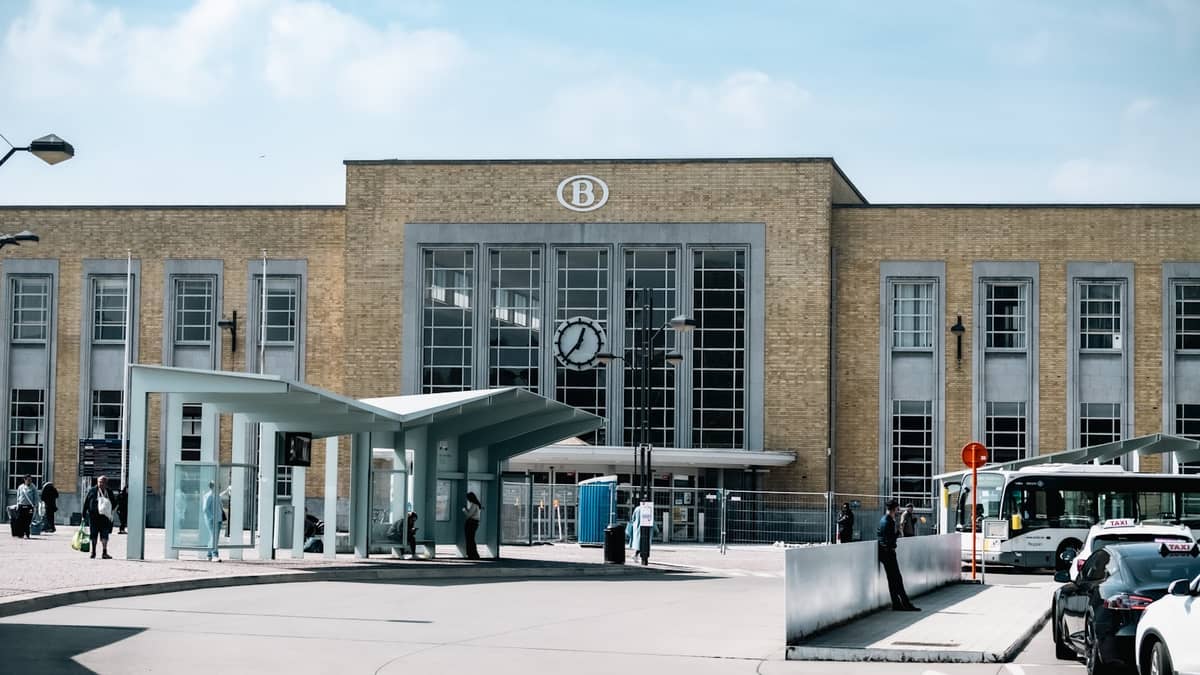
The train is, by a significant margin, the most practical way to reach Bruges from anywhere in Belgium or from neighbouring countries. Belgian national rail (SNCB/NMBS) operates frequent intercity services throughout the day, and the Brussels to Bruges train is the most popular route for visitors. Direct services from Brussels-Midi take approximately 1 hour and 1 minute, making it faster than driving once you factor in parking. Trains also run from Ghent (around 25 minutes), Antwerp (roughly 1 hour 15 minutes with a change), and Brussels Airport (BRU) via Brussels-Central or Brussels-Midi, with a total journey time of around 1 hour 30 minutes.
The station serving the city is officially called Brugge station, located on Stationsplein, about 1.5 km south of the Markt. From the station, you can walk to the historic centre in around 20 minutes along a fairly direct pedestrian route, take bus line 1 or several others toward the centre, or pick up a taxi from the rank outside the main entrance. The tourist office maintains a branch right at the station, which is useful for first-time visitors collecting maps and transport information.
✨ Pro tip
Book SNCB tickets online in advance via the official belgiantrain.be website. Standard second-class fares are fixed-price in Belgium (there is no dynamic pricing like on many European high-speed routes), but buying a return or a multi-journey pass can save money if you're making more than one trip. Weekend return tickets are often discounted.
For travellers arriving from the UK via Eurostar, the standard routing is London St Pancras to Brussels-Midi, then a direct SNCB intercity service to Bruges. Total London-to-Bruges journey time is typically around 3 hours 30 minutes to 4 hours, depending on the Eurostar service and connection. From Paris, the Bruges to Paris train journey requires a change at Brussels-Midi, with total travel time around 2 hours 30 minutes to 3 hours. The Bruges to Amsterdam train similarly requires a change, usually at Antwerp or Brussels, with total journey times of roughly 3 hours.
- Brussels-Midi to Bruges ~1 hour direct, very frequent departures. The core route for most visitors.
- Brussels Airport (BRU) to Bruges ~1 hour 30 minutes with one change. Fare roughly €20–€30 second class (verify current tariffs on belgiantrain.be).
- Ghent to Bruges ~25 minutes direct. Ideal for combining both cities in a single day.
- Paris to Bruges ~2.5–3 hours with a change at Brussels-Midi. Book Thalys/Eurostar leg separately from SNCB leg.
- Amsterdam to Bruges ~3 hours with connections. Check NS (Dutch rail) and SNCB for combined ticketing options.
Getting to Bruges from the Airport
Bruges has no commercial airport of its own. Two airports serve the city, with very different logistics for each.
Brussels Airport (IATA: BRU) in Zaventem is the main international hub, around 100 km from Bruges. The airport has its own rail station directly in the terminal building. To reach Bruges, take a direct or one-change train to Brussels-Midi, then connect onto an intercity service to Bruges. The full journey typically takes 1 hour 30 minutes to 1 hour 45 minutes. There is no non-stop train service from Brussels Airport directly to Bruges without passing through Brussels city. Standard second-class fares for this journey fall roughly in the €20–€30 range, though you should check current pricing on belgiantrain.be before travelling.
Ostend-Bruges International Airport (IATA: OST) sits approximately 30 km from Bruges and is the closer option, though it handles far fewer international routes. From the airport, the most practical approach is a taxi or bus into Ostend city centre, then a train onward to Bruges, which takes around 15 minutes by rail. A direct taxi from OST to Bruges city centre is possible but expensive, with indicative fares in the range of €60–€80 depending on the operator and time of day. Verify current rates with local taxi firms before assuming a price.
⚠️ What to skip
Some visitors consider renting a car at Brussels Airport to drive to Bruges. The drive takes around 1 hour in light traffic, but parking in the Bruges city centre is expensive, limited to 4 hours, and the medieval street layout is not designed for car navigation. Unless you plan to continue into the Belgian countryside afterward, the train is faster door-to-door and considerably less stressful.
Driving and Parking in Bruges
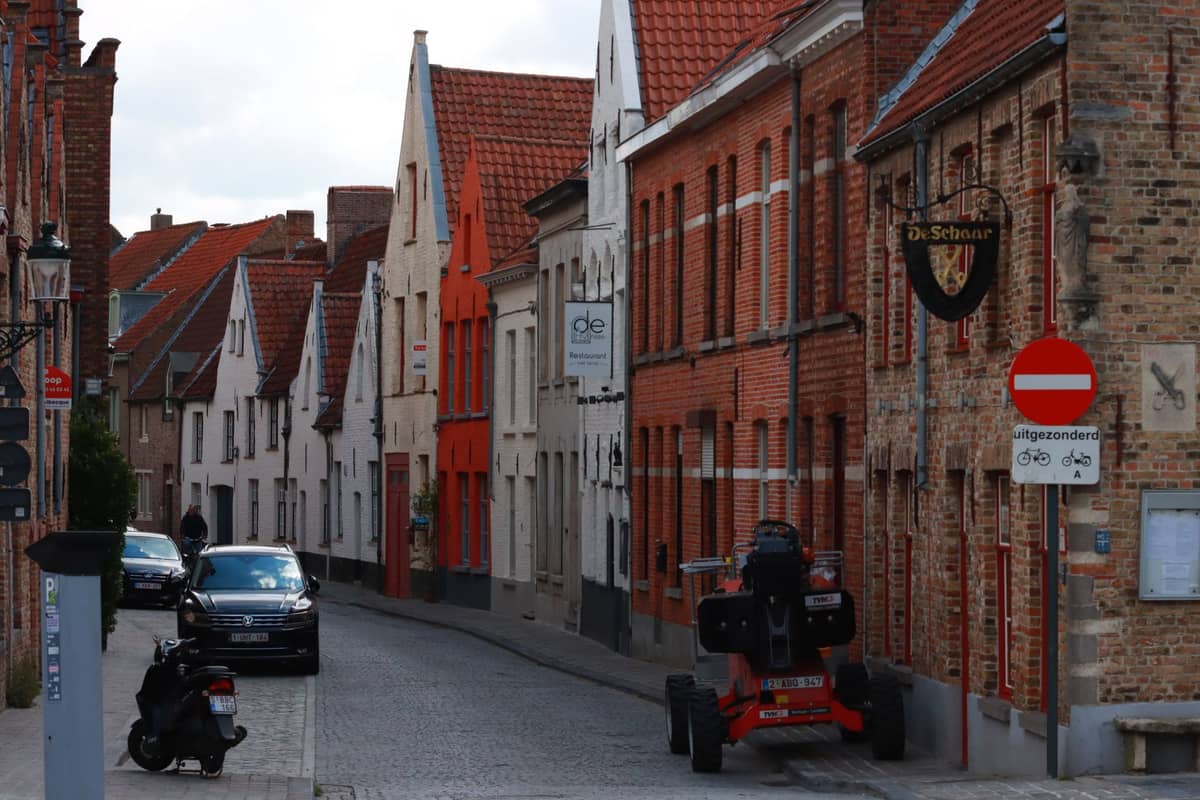
The city of Bruges actively discourages driving into its historic core, and the parking infrastructure reflects that policy clearly. Above-ground parking in the city centre is paid, time-limited to a maximum of 4 hours between 9:00 am and 8:00 pm, and follows a steep progressive rate: €1.00 for 30 minutes, €3.00 for 1 hour, €7.00 for 2 hours, €12.00 for 3 hours, and €18.00 for 4 hours. These rates are intentionally designed to push longer-stay visitors toward peripheral facilities.
The better approach is to use one of the city's free peripheral car parks or Park & Ride (P+R) sites on the edges of the municipality, then continue into the centre on foot, by bike, or by bus. These sites are free to use and well signposted on the approach roads. If you are arriving by car and staying overnight, check whether your hotel provides parking or has a recommended nearby car park, as underground central car parks operate without the 4-hour limit but charge overnight rates.
ℹ️ Good to know
The Centrum-Station car park on Stationsplein is the closest parking facility to the main railway station tourist office. It is a useful reference point if you're arriving by car and need to quickly pick up maps or a city card before heading into the centre on foot or by bus.
Getting Around Bruges: On Foot, By Bike, and By Bus
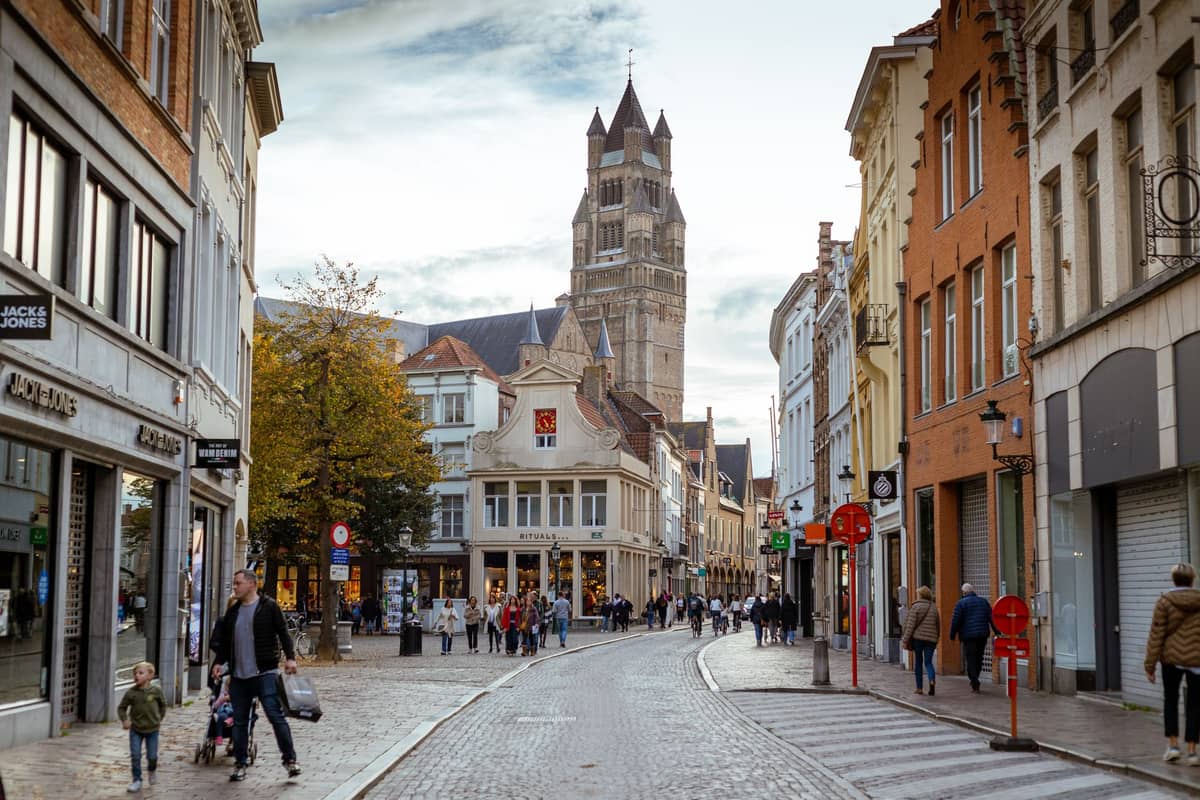
Bruges' historic centre is one of the most walkable in northern Europe. The distance from the Markt to the Begijnhof is roughly 1.2 km; from the Markt to Jan van Eyckplein in the north is under 800 metres. Almost every major attraction sits within a 15-minute walk of the centre. The canal network creates a few natural detours, but the compact layout means getting lost is rarely inconvenient and often accidentally rewarding.
Cycling is the local default for residents and increasingly popular with visitors. Cycling in Bruges covers rental options and suggested routes in detail, but the short version is this: rental bikes are available from several operators near the station and in the centre, prices range from around €10–€15 per day, and the flat terrain makes it accessible for all fitness levels. The main caveat is that some central streets are cobbled, which can be uncomfortable on narrow-tyre road bikes. Opt for a city hybrid or step-through frame.
City buses in Bruges operate under De Lijn, the Flemish public transport authority. A single bus ticket costs around €3 when purchased on board (slightly less if bought via the De Lijn app in advance). Buses are most useful for the journey between the train station and the central Markt area, or for reaching outlying boroughs like Assebroek or Sint-Kruis that fall outside comfortable walking range. There is no metro or tram system in Bruges.
Taxis are available from ranks near the train station and on the Markt. Uber has limited presence in Bruges compared to Brussels; do not rely on app-based ride-hailing as a primary transport option here. Licensed taxis are metered and regulated, but for short in-city journeys, the cost rarely makes sense compared to walking or cycling.
- Walking: the best option for the historic centre. Nearly all major sights are within 20 minutes of each other on foot.
- Cycling: fastest for cross-city movement, great for reaching windmills and canal-side paths. Flat terrain suits all levels.
- De Lijn bus: practical for the station-to-centre run and reaching residential boroughs. Single fare around €3 on board.
- Taxi: useful for late arrivals or airport transfers, but expensive for short distances within the centre.
- Uber: unreliable availability in Bruges. Do not plan itineraries around it without checking current service status.
Practical Basics: Currency, Language, and Electricity
Belgium uses the euro (EUR). Card payments are accepted almost everywhere in Bruges, including small cafés and canal boat ticket booths, though it is worth carrying a small amount of cash for markets and some smaller shops. ATMs are widely available around the Markt and near the train station.
The city sits in the Flemish Region, so the official municipal language is Dutch (specifically the West Flemish dialect). In practice, English is spoken fluently by the vast majority of people working in tourism and hospitality. French is also widely understood. A few words of Dutch are appreciated but by no means required. For more context on navigating the city culturally, the things to do in Bruges guide has useful background on local customs and etiquette.
Belgium uses 230V electricity at 50Hz. Plug types are Type C (two-round-pin Europlug) and Type E (with earth pin). Travellers from the UK will need a plug adapter. Those from North America will need both an adapter and a voltage converter for devices that do not support dual voltage (check the label on your charger; most modern electronics handle 100–240V automatically). Tap water in Bruges meets EU drinking water standards and is safe to drink.
Belgium is a member of the Schengen Area. EU and EEA nationals can enter with a national identity card. Citizens of the US, Canada, Australia, Japan, and a range of other countries can visit visa-free for up to 90 days in any 180-day period. Other nationalities require a Schengen visa obtained in advance. Visa rules change periodically, so always confirm your requirements through official Belgian government or EU sources before travel. The emergency number across Belgium is 112. Belgium's international dialling code is +32.
Neighbourhoods: Where Visitors Spend Their Time
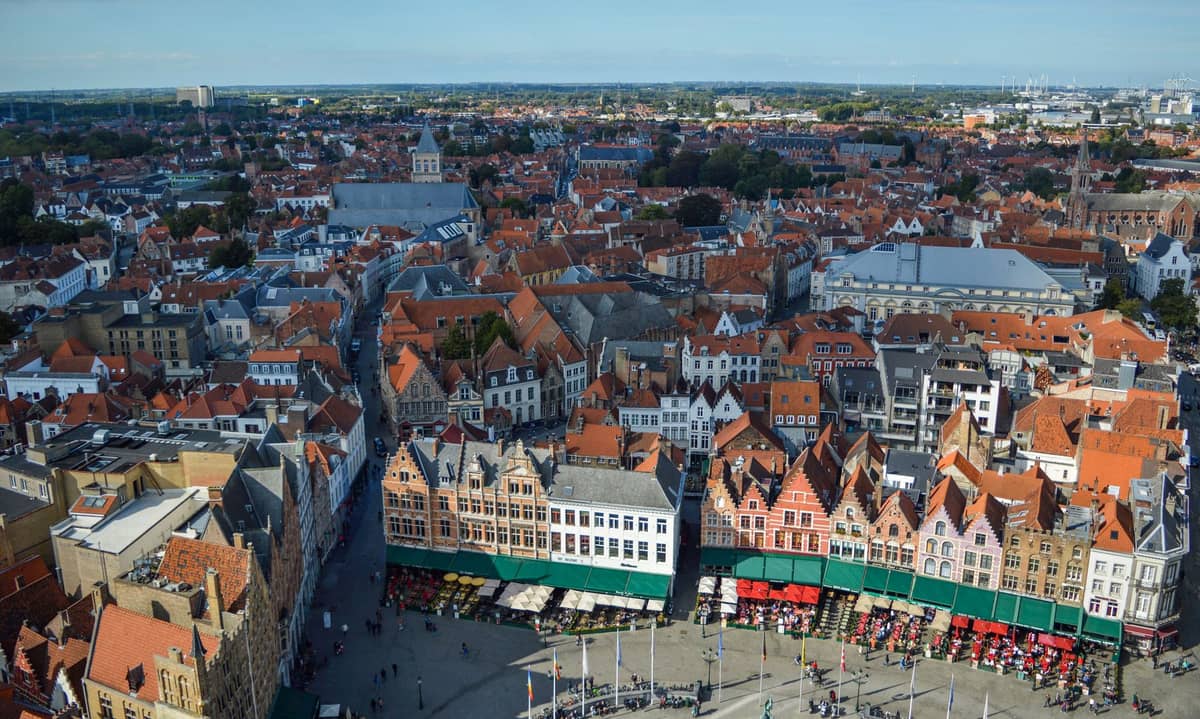
The municipality of Bruges covers 138 km² and contains nine administrative boroughs, but visitors spend nearly all their time in one: the historic core, which is the main area referred to when people say 'Bruges'. Within this centre, the most visitor-relevant zones include the historic centre, the Dijver canal quarter, and the quieter Sint-Anna quarter to the northeast, which tends to have fewer day-trippers.
The Minnewater and Begijnhof area to the south of the centre is a short walk from the station and worth knowing about for orientation. Zeebrugge, the port borough on the North Sea coast around 14 km north of the historic centre, is occasionally of interest to visitors arriving by ferry from the UK or Ireland via other nearby ports, and buses connect the port with Bruges station. For those focused on the medieval city, all the key areas are within a roughly 2 km radius of the Markt.
FAQ
How long does the Brussels to Bruges train take?
Direct intercity trains from Brussels-Midi to Bruges take approximately 1 hour. Services run frequently throughout the day. From Brussels Airport (BRU), allow around 1 hour 30 minutes including the connection at Brussels-Central or Brussels-Midi.
Is there a direct train from Brussels Airport to Bruges?
There is no fully direct non-stop train from Brussels Airport to Bruges. You take a train from the airport's rail station to Brussels-Central or Brussels-Midi, then connect to an intercity service to Bruges. Total journey time is around 1 hour 30 minutes. Book via belgiantrain.be for current timetables and fares.
Can I walk from Bruges train station to the city centre?
Yes. The station is around 1.5 km south of the Markt, a walk of roughly 20 minutes along a direct pedestrian route. Alternatively, several De Lijn bus lines connect the station to the centre in around 5–10 minutes. A single bus ticket costs approximately €3 on board.
Is parking free in Bruges?
No. Parking in the historic centre is paid and limited to a maximum of 4 hours between 9:00 am and 8:00 pm, at rates up to €18 for 4 hours. Free parking is available at peripheral car parks and Park & Ride sites on the outskirts of the municipality. The city's official guidance strongly encourages visitors to use these and travel into the centre on foot, by bike, or by bus.
How do I get to Bruges from Amsterdam or Paris?
From Amsterdam, the most practical route is by train via Antwerp or Brussels, with total journey time around 3 hours. From Paris, take a Thalys or Eurostar service to Brussels-Midi, then connect to an SNCB intercity train to Bruges; total journey time is roughly 2.5 to 3 hours. Direct Bruges-to-Paris or Bruges-to-Amsterdam trains do not exist; all routes require at least one change.