Markt (Market Square): The Heart of Medieval Bruges
The Markt is the vast central square of Bruges, framed by the soaring 13th-century Belfry, neo-Gothic provincial government buildings, and the ornate facades of former guild houses. Free to enter at any hour, it serves as the civic and geographic anchor of the entire historic centre.
Quick Facts
- Location
- Markt, 8000 Brugge, Belgium (historic centre)
- Getting There
- 15-20 min walk from Bruges train station; nearest bus stop Brugge Dijver (De Lijn). Nearby parking: Centrum ’t Zand (around 10 min walk from the square).
- Time Needed
- 30 min to soak in the square; 1-2 hrs if visiting the Belfry
- Cost
- Free to enter. Belfry (Belfort) admission charged separately.
- Best for
- Architecture lovers, first-time visitors to Bruges, photography, Wednesday market
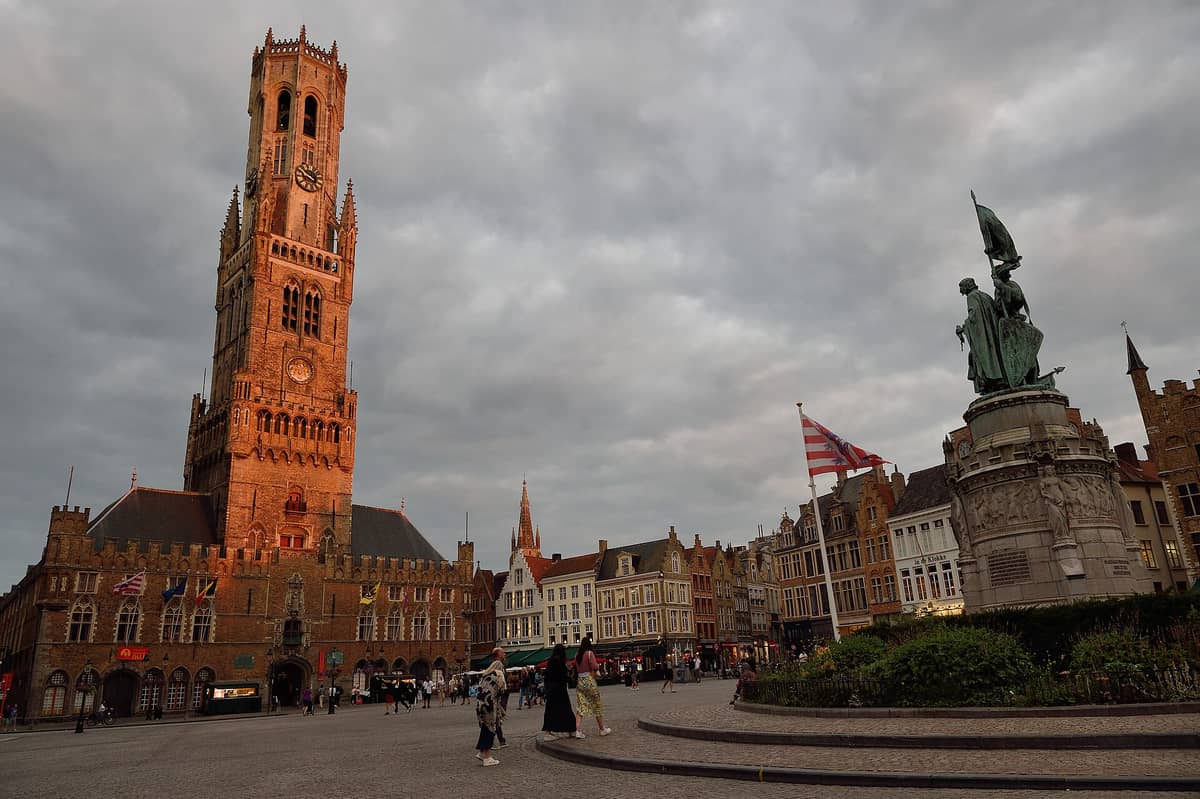
What the Markt Actually Is
The Markt is the central public square of Bruges (Dutch: Brugge), a medieval city in the West Flanders province of northwest Belgium. Covering roughly one hectare, it has served as the commercial and civic core of the city for centuries: a place where grain changed hands, public proclamations were made, and the wealth of Flemish trade was put on permanent architectural display. Today it remains the geographic anchor from which most visitors orientate themselves within the UNESCO-listed historic centre.
Unlike many European city squares that have been pedestrianised, manicured, or sanitised into open-air museums, the Markt retains a genuinely functional character. Horse-drawn carriages line one side. Café terraces fill a large portion of the square. A bronze statue of the Flemish heroes Jan Breydel and Pieter de Coninck, erected in 1887 to commemorate the Battle of the Golden Spurs of 1302, stands at the centre. The square does not feel frozen in time so much as continuously inhabited by it.
💡 Local tip
The Wednesday morning market (approximately 08:00 to 13:00) fills the square with local food and goods stalls. It is one of the most atmospheric ways to experience the Markt away from peak tourist hours.
The Architecture Around the Square
The defining structure is the Belfort van Brugge, the Belfry that rises 83 metres above the southern end of the square. Construction began in the 13th century and the tower was completed and modified through the 15th century, serving as a watchtower, treasury, and symbol of civic independence. The carillon inside contains 47 bells and still rings out across the square at the quarter-hour. The sound carries physically in the open space, especially in the early morning when there is little traffic noise to compete with it.
The eastern flank of the square is occupied by the Provinciaal Hof, a neo-Gothic building completed in 1921 on the site of the old Waterhalle, a covered market hall where goods arrived by canal. Its stepped gable and pointed arches echo medieval Flemish building traditions, though the structure itself is relatively modern. On the northern side, the former guild houses, now converted to restaurants and cafés, display the kind of ornate brick facades that made Bruges one of the wealthiest cities in medieval Europe. For deeper architectural context across the city, the Bruges Gothic architecture guide covers how these styles evolved from the 13th century onward.
The western side of the square is more varied in architectural tone: a mix of 19th-century and early 20th-century buildings, some housing government offices. The overall effect is asymmetric in an interesting way. Standing in the middle and rotating slowly, you get a different visual register on each side, from high medieval to neo-Gothic revival to pragmatic civic architecture, all framing a cobblestone surface that has barely changed in plan since the medieval period.
Tickets & tours
Hand-picked options from our booking partner. Prices are indicative; availability and final rates are confirmed when you complete your booking.
Historium Bruges entrance tickets
From 19 €Instant confirmationFree cancellationBruges food tour with full meal
From 139 €Instant confirmationFree cancellationBruges walking audio guided tour
From 9 €Instant confirmationBruges Family Walking Tour
From 259 €Instant confirmationFree cancellation
How the Square Changes Through the Day
The Markt at 7:30 in the morning is a different place to the Markt at noon. Before the tourist coaches arrive, the square belongs to locals on foot and cyclists cutting across to work, the café staff arranging outdoor furniture, and delivery vehicles restocking the restaurants. The cobblestones glisten after overnight rain, and the Belfry is unobstructed by crowds. This early window is the best time for photography: soft northern light, minimal people, maximum architecture.
By mid-morning, particularly from May through September, tour groups begin arriving and the square fills steadily. By noon, the café terraces are at capacity, horse-drawn carriages queue for fares, and the Belfry entrance has a line. This is not necessarily a negative experience, it is lively and the square is large enough to absorb crowds without feeling claustrophobic. But if you want a contemplative visit, you will not find it between 11:00 and 16:00 in peak season.
Evening brings a gradual shift. After 18:00, the carriage drivers tend to finish for the day, the tour groups thin out, and the square transitions into a place for dinner and drinks. In summer, the long northern European twilight means the facades are still visible in warm natural light well past 21:00. In winter, the square is significantly quieter, and during December the Bruges Christmas market transforms the space entirely with wooden chalets, the smell of mulled wine, and ice skating.
Winter visits deserve more consideration than they typically receive. The guide to Bruges in winter covers why December and January can be among the more rewarding months to visit, including what the Markt specifically offers during the Christmas market period.
Climbing the Belfry: Worth It or Not?
The Belfort van Brugge is accessed from the Markt and requires a separate admission ticket. The climb involves 366 steps on a narrow, winding staircase with no lift. At the top, the view over the canal network, rooftops, and surrounding countryside on a clear day is genuinely exceptional, and the mechanical workings of the carillon are visible close up. However, the staircase is steep, the spaces tight, and the wait at the top limited on busy days. Visitors with mobility concerns, claustrophobia, or vertigo should weigh this carefully before committing.
The Belfry is one of the most popular paid attractions in Bruges and queues during peak season (July to August) can be substantial. Buying tickets in advance online is strongly recommended. Even if you decide not to climb, simply standing in the square and looking up at the tower through a 14mm lens, or just with your eyes, gives you a sense of the medieval ambition that went into its construction.
Getting There and Practical Logistics
Bruges does not have a metro system. The main transport hub is Bruges train station (Brugge), served by Belgian national rail (NMBS/SNCB) with frequent intercity services from Brussels, Ghent, and Ostend. From the station, the Markt is reachable in 15 to 20 minutes on foot via the straightforward pedestrian route through the historic centre. De Lijn buses also serve the area; the nearest stop for the Markt is Brugge Dijver. A single De Lijn bus ticket costs approximately €3, though fares are subject to revision and should be verified before travel.
The nearest car park is Centrum 't Zand, west of the square. Driving into the immediate historic centre is restricted, and signage directing visitors to park-and-walk is clearly marked on approach roads. The cobblestone surface of the Markt and surrounding streets is worth noting for wheelchair users and anyone with limited mobility: it is uneven and in some places quite rough. The square itself is flat and has no steps to enter, but the texture of the surface makes wheeled mobility aids physically demanding to use.
⚠️ What to skip
Cobblestones cover most of the Markt and the surrounding streets. Comfortable, flat-soled shoes are genuinely important, not just a travel cliché. Heels or hard-soled dress shoes will make the visit uncomfortable.
For a broader orientation to movement around the city, including cycling options, the guide to getting to and around Bruges covers train connections from Brussels Airport (approximately 1.5 hours) and Ostend-Bruges Airport (OST, approximately 30 km away), as well as the cycling infrastructure within the city itself.
Around the Square: What to Do Next
The Markt connects naturally to Burg Square, a two-minute walk to the east through a narrow passageway. Burg Square contains the Stadhuis (City Hall), one of the oldest Gothic town halls in the Low Countries, and the Basilica of the Holy Blood. The transition from the Markt to Burg is one of the more quietly dramatic short walks in European urban space: you move from the broad, commercially active main square into a more enclosed, ceremonial civic space.
From the southern edge of the Markt, the Wollestraat leads down toward the canal network and the Rozenhoedkaai, the most photographed canal corner in Bruges. The walk takes five minutes. Canal boat tours depart from the Dijver, a short walk further south. If you are planning a full day in the historic centre, the one-day Bruges itinerary uses the Markt as its natural starting and ending point, which reflects how most visitors actually move through the city.
The restaurant and café terraces on the northern side of the Markt are convenient but priced for tourist footfall. The food is generally adequate rather than exceptional, and you pay significantly for the location. Better-value eating is found one or two streets back from the square, particularly along the side streets toward the Sint-Anna quarter.
Insider Tips
- Visit before 08:30 on any day for near-empty cobblestones and unobstructed views of the Belfry. The quality of morning light, especially in spring and autumn, makes this the best window for photography by a considerable margin.
- The Wednesday morning market (roughly 08:00 to 13:00) is the Markt functioning as it was originally intended: local food producers, seasonal produce, and a genuinely local crowd mixed with tourists. It is far more interesting than the square at midday on a Saturday.
- The café terraces facing the Belfry charge premium prices. If you want a drink with the view, go for it, but know you are paying for geography. A coffee at one of the smaller bars on the side streets off the square costs noticeably less.
- The Belfry carillon plays automated music at quarter-hour intervals and a live carillonneur performs concerts at specific times. Check the schedule via Visit Bruges before your trip if you want to hear the bells played live rather than mechanically.
- At night in summer, the Belfry is illuminated and the square is atmospheric without the daytime crowd density. If you are staying overnight in Bruges rather than day-tripping, a 22:00 walk through the Markt is worth doing.
Who Is The Markt (Market Square) For?
- First-time visitors to Bruges who need a geographic and visual orientation to the city
- Architecture enthusiasts interested in medieval Flemish civic buildings and neo-Gothic revival
- Photographers, particularly those who can visit early morning or in winter light
- Visitors combining a market experience with sightseeing (Wednesday mornings)
- Families with children who want an open, walkable space near multiple major attractions
Nearby Attractions
Other things to see while in Historic Centre:
- Basilica of the Holy Blood
The Basilica of the Holy Blood (Basiliek van het Heilig Bloed) stands on Burg Square in Bruges' historic centre, housing a relic venerated since the Middle Ages. Entry to the basilica is free; the treasury costs €5. With two architecturally distinct chapels stacked on top of each other, it rewards visitors who take time to explore both levels.
- Belfry of Bruges (Belfort)
Standing 83 metres above the Markt, the Belfry of Bruges has dominated the city's skyline since the 13th century. The climb is steep and the staircase narrow, but the rooftop view over the canal network, church spires, and Flemish rooftops rewards the effort. Here is everything you need to know before you go.
- Burg Square
Burg Square, known locally as the Burg or Burgplein, is the political and ceremonial core of Bruges, framed by some of the finest medieval and Renaissance civic architecture in Belgium. Free to enter at any hour, it rewards careful exploration and rewards visitors who stay long enough to watch the light shift across its stone facades.
- Choco-Story Bruges
Choco-Story Bruges traces the story of chocolate from Maya and Aztec cacao rituals to the artisan praline shops lining today's Bruges streets. Located on Wijnzakstraat in the historic centre, it combines genuine cultural history with live chocolate demonstrations that make it one of the more substantive stops on the city's well-worn tourist circuit.