Choco-Story Bruges: Inside the Chocolate Museum
Choco-Story Bruges traces the story of chocolate from Maya and Aztec cacao rituals to the artisan praline shops lining today's Bruges streets. Located on Wijnzakstraat in the historic centre, it combines genuine cultural history with live chocolate demonstrations that make it one of the more substantive stops on the city's well-worn tourist circuit.
Quick Facts
- Location
- Wijnzakstraat 2, 8000 Brugge (Sint-Jansplein), Historic Centre
- Getting There
- Bus stop: Jan Van Eyckplein; Brugge train station ~20–25 min walk
- Time Needed
- 60–90 minutes
- Cost
- Adults approx. €16; students/seniors €14; children 3–11 €10; under 3 free. Combination tickets available.
- Best for
- Families, food history lovers, rainy-day visits, and anyone curious about Belgian chocolate culture
- Official website
- choco-story-brugge.be/en
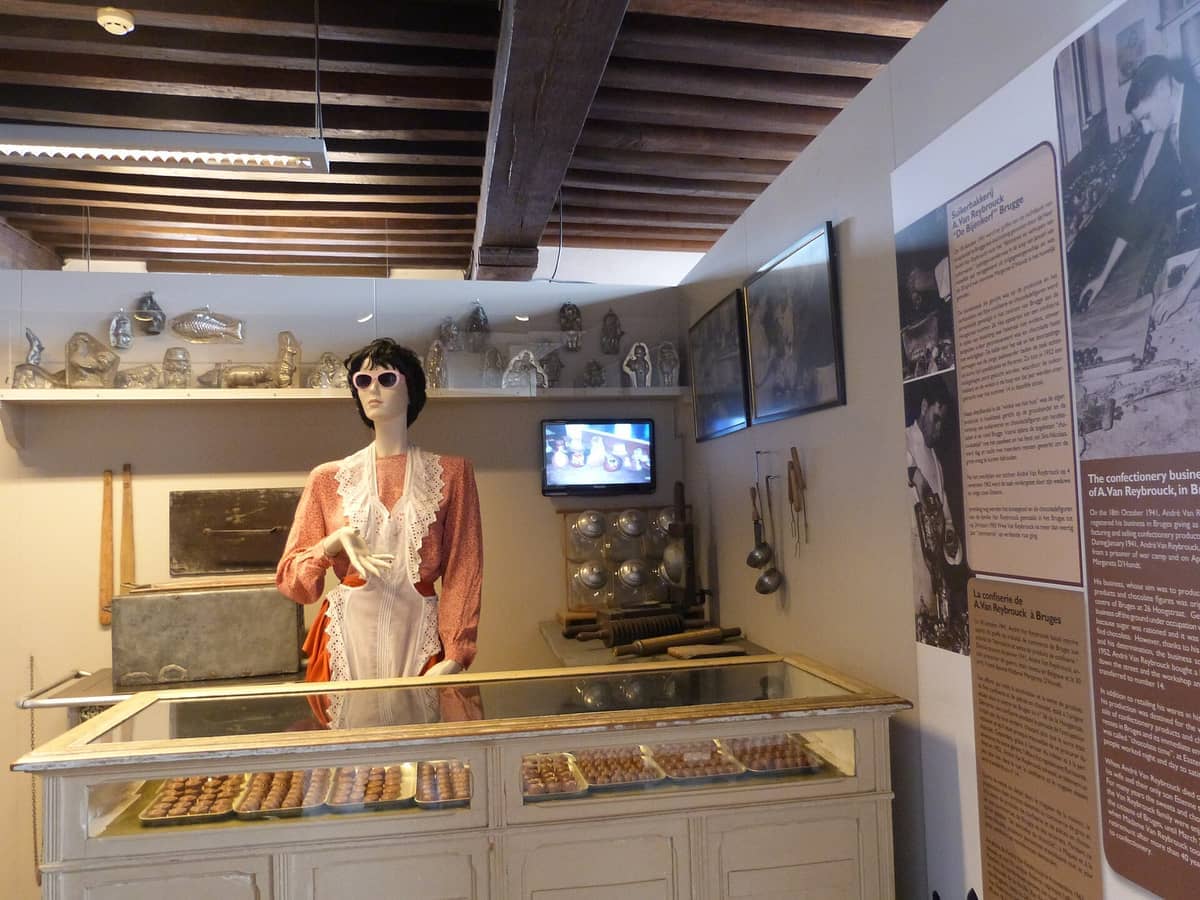
What Choco-Story Bruges Actually Is
Choco-Story Bruges, officially named Choco-Story, Het Chocolademuseum, occupies a handsome step-gabled building on Wijnzakstraat 2, just off Sint-Jansplein in the heart of Bruges's historic centre. It is not a factory tour and not a shop masquerading as a museum. It is a purpose-built educational attraction that follows the story of cacao from the ancient Maya and Aztec civilisations through the Spanish colonial trade routes that brought chocolate to Europe, and on to the emergence of Belgium as one of the world's foremost chocolate-producing nations.
The museum is part of a wider Choco-Story network with outposts in other cities, but the Bruges location has the advantage of its setting: you arrive surrounded by a city that has been selling handmade chocolate since the nineteenth century, which gives the historical narrative a tangible local payoff. When the guided demonstration ends and you taste a freshly made piece, you are doing so in a city where the craft genuinely still lives.
💡 Local tip
Opening hours vary by season. The museum is generally open daily from 10:00 to 18:00, with last tickets sold around 17:00 depending on the period. It closes on 25 December, 1 January, and for a short break in early January, with shorter opening on 24 and 31 December. Verify exact hours on the official website before your visit.
The Collection: From Cacao Pod to Praline
The permanent exhibition is organised chronologically across several rooms. It opens with Pre-Columbian history: ceramic drinking vessels, replica murals, and explanatory panels trace how the Maya prepared a bitter, spiced cacao drink, often mixed with chilli, that bore little resemblance to what most people think of as chocolate today. The artefacts are mostly replicas, but the accompanying context is solid and well-sourced.
Later rooms cover the Spanish conquest, the arrival of cacao in European courts, and the gradual sweetening and solidification of the product across the seventeenth and eighteenth centuries. Display cases hold original chocolate pots, antique packaging, and early advertising material. The collection has real depth here, and visitors who linger will find details that reward attention, including how the Dutch press process changed the texture of chocolate forever, and how Belgian chocolatiers developed the praline form that now defines the country's reputation.
The final section focuses on modern Belgian chocolate production: the roasting and conching process, the tempering technique that gives high-quality chocolate its characteristic snap and gloss, and the difference between couverture and compound chocolate. It is genuinely informative rather than promotional.
Tickets & tours
Hand-picked options from our booking partner. Prices are indicative; availability and final rates are confirmed when you complete your booking.
Choco Story Bruges Entrance tickets
From 14 €Instant confirmationFree cancellationIndividual chocolate workshop and tasting in Bruges
From 38 €Instant confirmationFree cancellationChristmas magic in Bruges private walk and hot chocolate
From 230 €Instant confirmationFree cancellationDiscover the history and mystery of Bruges
From 0 €Instant confirmation
The Live Demonstration: The Real Reason to Come
The highlight for most visitors is the live chocolate-making demonstration held in the demonstration room. A chocolatier shows the tempering and moulding process in real time, explaining why temperature control matters and what distinguishes Belgian-style chocolate from mass-market production. The demonstration runs at scheduled intervals throughout the day, and the room fills quickly, so it is worth timing your arrival to catch it early rather than trying to squeeze it in at the end.
After the demonstration, visitors receive a small piece of freshly made chocolate. It is a modest amount, but the contrast with the industrial product most people eat daily is noticeable: sharper snap, cleaner melt, less residual sweetness. For families with children, this tends to be the moment that cements the whole visit.
💡 Local tip
Arrive at opening time (10:00) to catch the first demonstration with the smallest crowd. Late-morning visits, particularly on weekends and in summer, can mean a packed demonstration room and a queue for the exhibit entrance.
How the Visit Feels at Different Times of Day
In the morning, Wijnzakstraat is quiet. The stepped gable of the building catches the low northern light, and the street smells faintly of chocolate even before you step inside, particularly on days when the demonstration kitchen is already running. The entrance area is compact, with a ticket desk and a small introductory display. The rooms themselves are not large, and the ceiling heights vary; some spaces feel intimate, others slightly cramped when a school group moves through.
By midday in peak season, particularly from June through August, the museum fills considerably. School groups and tour parties tend to cluster around the demonstration area, and the narrower corridor sections can become difficult to navigate at your own pace. If you visit between 12:00 and 14:00, you may spend more time waiting than reading. The late afternoon, in the hour before last admission, tends to be noticeably quieter, though the demonstration may already have run its final session.
On grey autumn or winter days, the museum has a particular logic to it. Bruges in November or February is cool and damp, with around twelve to fifteen rainy days per month, and the warm interior, the scent of cocoa, and the digestible format make this one of the better rainy-day choices in the city. Those visiting during the Christmas market period will find the area around Sint-Jansplein and the broader historic centre especially atmospheric.
For context on visiting Bruges in the cooler months, the guide to Bruges in winter covers what the city looks and feels like between November and February.
Getting There and Practical Logistics
The museum is at Wijnzakstraat 2, reachable on foot from the Markt in around ten minutes by walking north past Sint-Jakobskerk toward Sint-Jansplein. The nearest bus stop is Jan Van Eyckplein, served by De Lijn city routes from the train station. If you are arriving by car, the nearest car park is Parking Langestraat.
Brugge train station is roughly a fifteen-minute walk from the museum, or a short bus ride. For full details on getting around the city, the getting to and around Bruges guide covers rail, bus, and cycling options.
Accessibility is partial. The building has an adapted lift and reserved parking for visitors with disabilities, but the entrance path and adapted toilet are noted as not fully optimised. Wheelchair users should check the detailed accessibility register via the official Visit Bruges accessibility page before visiting. The narrow corridors in some sections of the exhibition can be difficult to navigate with a pushchair during busy periods.
⚠️ What to skip
The museum closes on 25 December and 1 January, has a short multi-day closure in early January, and closes earlier on 24 and 31 December (check the official site for exact dates each year). Plan accordingly if visiting over the winter holiday period.
How It Fits Into a Broader Bruges Visit
Choco-Story sits in the northern part of the historic centre, which makes it a natural pairing with Jan van Eyckplein, the medieval square that once anchored Bruges's role as a commercial hub for northern Europe. The square is a three-minute walk from the museum and provides a very different register of the city's history.
Those with a specific interest in Belgian food culture may also want to visit the Frietmuseum nearby, which applies a similar educational format to the history of the Belgian fry. Combining both in a single afternoon is entirely manageable, and the two together represent a distinct strand of Belgian culinary identity. For a broader take on chocolate's role in the city, the Bruges chocolate guide maps out the best artisan producers and shops in the centre.
If you are building a single day around the museum and its surroundings, the Bruges one-day itinerary suggests a logical sequence of stops across the historic centre that incorporates this area without backtracking.
Is It Worth Your Time?
Choco-Story Bruges earns its admission price for most visitors, but it helps to arrive with calibrated expectations. This is a well-produced, genuinely informative museum, not a sensory spectacle. The rooms are modest in scale, the artefacts are partly replica, and the chocolate you receive at the end is a tasting rather than a meal. Visitors who prefer immersive or technology-driven museum experiences may find the format a little traditional.
For families with children aged roughly five and up, it is one of the stronger options in the city: the subject matter holds attention naturally, the demonstration provides a clear moment of engagement, and the duration of around sixty to ninety minutes matches a child's stamina well. For adults travelling without children, the value depends largely on genuine interest in food history. If the history of cacao and Belgian confectionery genuinely interests you, this is a thoughtful and well-sourced way to spend an hour. If you are primarily looking for a landmark or a spectacular view, this is not that kind of attraction.
The combination ticket with the Frietmuseum or Diamantmuseum offers reasonable value if you plan to visit both. Check current multi-attraction passes and city cards, which sometimes include entry to Choco-Story, if you are visiting several paid attractions across a day or two.
Insider Tips
- Arrive at 10:00 on a weekday to catch the first chocolate demonstration with minimal competition for space. The room fills quickly once tour groups arrive mid-morning.
- Combination tickets with the Frietmuseum are sold at the entrance desk. If you plan to visit both, buying together saves a small amount and avoids a second queue.
- The museum shop near the exit sells chocolate made using techniques explained in the exhibition. It is a more purposeful purchase than the generic praline boxes sold at dozens of shops on the Markt.
- If you are visiting with a pushchair or wheelchair, call ahead or check the Toevla accessibility register linked from the Visit Bruges website. The lift exists, but the entrance path and some corridor widths are not fully optimised.
- Late October to early December is one of the quietest periods to visit. The school-group season has wound down, and Christmas market crowds have not yet peaked, giving you more space to read the exhibits at your own pace.
Who Is Choco-Story Bruges For?
- Families with children aged 5 and up who want an engaging and time-limited indoor activity
- Food history enthusiasts interested in the cultural journey of cacao from Mesoamerica to Belgium
- Rainy-day visitors looking for a substantive indoor experience in the historic centre
- Travellers on a themed chocolate itinerary through Bruges's artisan producers and shops
- Budget-conscious visitors using a multi-attraction city pass or museum card that covers entry alongside several other major sites
Nearby Attractions
Other things to see while in Historic Centre:
- Basilica of the Holy Blood
The Basilica of the Holy Blood (Basiliek van het Heilig Bloed) stands on Burg Square in Bruges' historic centre, housing a relic venerated since the Middle Ages. Entry to the basilica is free; the treasury costs €5. With two architecturally distinct chapels stacked on top of each other, it rewards visitors who take time to explore both levels.
- Belfry of Bruges (Belfort)
Standing 83 metres above the Markt, the Belfry of Bruges has dominated the city's skyline since the 13th century. The climb is steep and the staircase narrow, but the rooftop view over the canal network, church spires, and Flemish rooftops rewards the effort. Here is everything you need to know before you go.
- Burg Square
Burg Square, known locally as the Burg or Burgplein, is the political and ceremonial core of Bruges, framed by some of the finest medieval and Renaissance civic architecture in Belgium. Free to enter at any hour, it rewards careful exploration and rewards visitors who stay long enough to watch the light shift across its stone facades.
- Friet Museum
The Frietmuseum on Vlamingstraat is the world's only museum dedicated to the history and culture of Belgian fries. Housed in one of Bruges's oldest secular buildings, it traces the potato's journey from the Andes to the Belgian frituur, and yes, there are fries at the end.