Burg Square (Burgplein): The Historic Heart of Bruges
Burg Square, known locally as the Burg or Burgplein, is the political and ceremonial core of Bruges, framed by some of the finest medieval and Renaissance civic architecture in Belgium. Free to enter at any hour, it rewards careful exploration and rewards visitors who stay long enough to watch the light shift across its stone facades.
Quick Facts
- Location
- Burg, 8000 Brugge, Belgium — Historic Centre, ~2-minute walk from Markt
- Getting There
- Walk ~15 min from Brugge railway station, or take a De Lijn city bus to the centre and walk
- Time Needed
- 30–45 min for the square itself; 2–3 hours if visiting City Hall and surrounding museums
- Cost
- Free (square access). City Hall/Stadhuis and Liberty of Bruges have separate paid entry
- Best for
- Architecture enthusiasts, history lovers, photographers, and anyone wanting to understand how Bruges was governed for 600 years
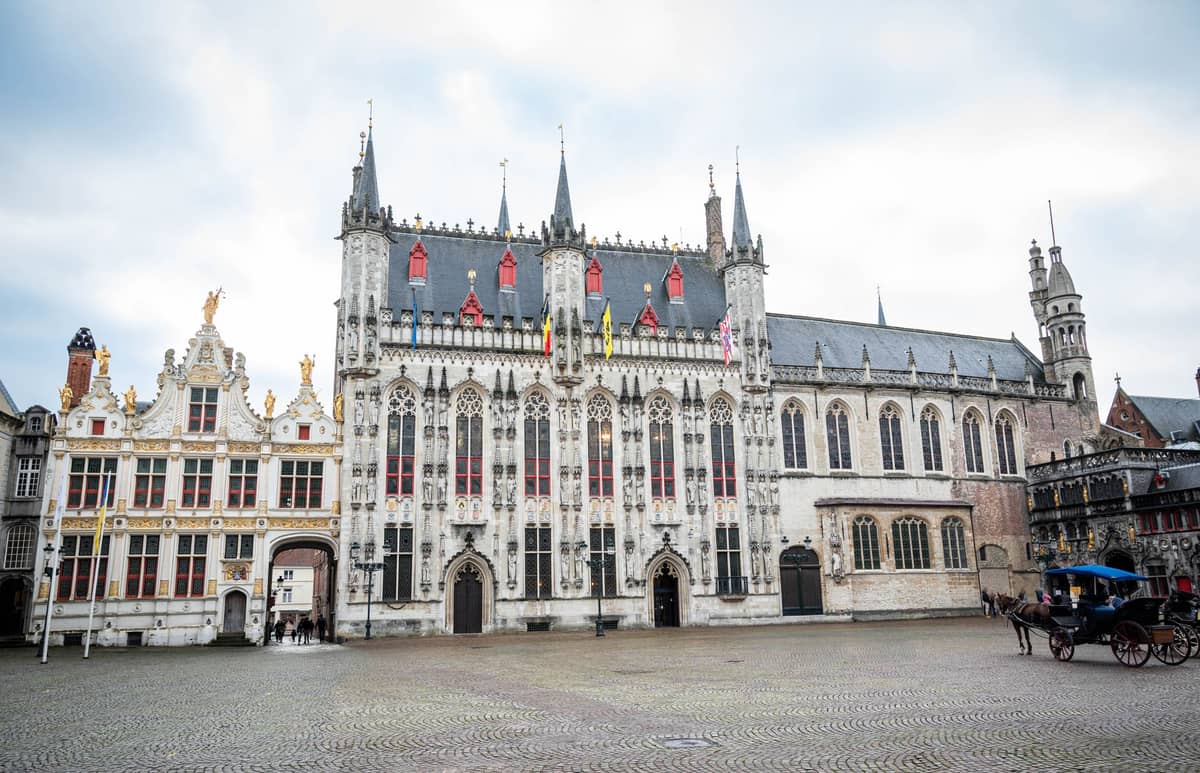
What Burg Square Actually Is
Burg Square, or Burgplein in Dutch, sits roughly one street east of the more famous Markt and is older, quieter, and architecturally far more concentrated. Where the Markt is expansive and commercial, the Burg is compact and institutional: a single square hemmed in by buildings that span seven centuries of civic ambition. The Counts of Flanders established a fortified stronghold here in the 9th century as a defensive position against Viking raids along the coast, and the site has been the administrative and religious nerve centre of Bruges ever since.
Walking into the Burg from the narrow connecting lane off Markt, the spatial shift is immediate. The noise of cafe terraces drops away. The square is paved with flat mosaic cobblestones, and the surrounding facades press in just enough to create a sense of enclosure without feeling claustrophobic. On a clear morning, the Gothic tracery on the City Hall glows a pale cream-gold in the early light. In the afternoon, the same stonework turns grey-green. Neither is a disappointment.
💡 Local tip
The square is open 24 hours a day, year-round, with no admission fee. Come before 9am to have the cobblestones largely to yourself — the coach tour groups typically arrive mid-morning.
The Buildings That Define the Square
The southern flank of the Burg is anchored by the Stadhuis, or City Hall, built between 1376 and 1421. It is one of the oldest Gothic city halls in the Low Countries, and its facade is one of the most painstakingly decorated in the region: three tiers of pointed niches, each originally filled with polychrome statues of the Counts and Countesses of Flanders. The statues visible today are 19th-century replacements — the originals were destroyed during the French Revolutionary period — but the architectural framework is authentic medieval stonework.
Inside the City Hall, the Gothic Hall (Gotische Zaal) on the upper floor is considered one of the finest late-medieval interiors in Belgium, with a painted wooden vault dating from around 1402. Entry is ticketed separately. The Stadhuis van Brugge is well worth the admission if civic Gothic architecture interests you — the ceiling paintings alone justify the climb.
Directly adjacent to the City Hall stands the Basilica of the Holy Blood (Heilig-Bloedbasiliek), a two-layered structure whose lower Romanesque chapel dates from the 12th century and whose upper Flamboyant Gothic chapel was heavily restored in the 19th century. The basilica houses a venerated relic said to contain a cloth with the blood of Christ, brought to Bruges from the Holy Land in the 12th century. The contrast between the spare, low-vaulted Romanesque lower level and the richly gilded upper chapel is genuinely striking.
On the eastern side of the square, the Landhuis van het Brugse Vrije (Liberty of Bruges) presents a Renaissance facade from the early 16th century. This building was the administrative seat of the Liberty of Bruges, a semi-autonomous rural territory surrounding the city. Inside, the main hall contains a remarkable carved oak and black marble chimneypiece from 1529, depicting the Habsburg Emperor Charles V and his ancestors — one of the finest examples of Renaissance decorative art in Belgium. The building now forms part of the civic museum network and requires a separate ticket.
Tickets & tours
Hand-picked options from our booking partner. Prices are indicative; availability and final rates are confirmed when you complete your booking.
Self guided tour with interactive city game of Bruges
From 29 €Instant confirmationFree cancellationHistorium Bruges entrance tickets
From 19 €Instant confirmationFree cancellationBruges food tour with full meal
From 139 €Instant confirmationFree cancellationBruges walking audio guided tour
From 9 €Instant confirmation
The Cathedral That Isn't There
One of the most historically significant absences in Bruges is visible from the Burg: the tree-lined area with benches on the north side of the square marks where St Donatian's Cathedral once stood. For centuries, the cathedral faced the City Hall directly, completing the square's architectural frame. It was demolished during the French Revolutionary period in the late 18th century, and nothing was built in its place. The trees and the low wall are all that mark one of medieval Bruges' most important religious buildings.
Knowing this absence changes how you read the square. The open north side, which can feel like a slightly awkward gap in the composition, was once a solid Gothic mass. The excavated foundations of the cathedral were partially uncovered during works at the current Crowne Plaza hotel on the square's north side, and some remnants are visible in the hotel's lower levels. This history is easy to miss unless you already know to look for it.
ℹ️ Good to know
The foundations of St Donatian's Cathedral, demolished in the late 18th century, can be seen in the basement of the Crowne Plaza hotel on the north side of the square. Ask at the hotel reception if you are interested.
How the Square Changes Through the Day
Early morning, roughly 7–9am, is the most atmospheric time to be here. The cobblestones are damp from the coastal air, the pigeons have the square largely to themselves, and the City Hall facade is lit by low-angle light that emphasises every carved niche and buttress. The silence is not total — bicycle bells, the distant bell of a church, the occasional delivery vehicle — but it is calm enough that the architectural detail registers without distraction.
By 10am, the square begins to fill with visitors on organised tours, many arriving from the Markt. The guided groups tend to congregate in front of the City Hall, which means the Liberty of Bruges and the side passage toward the Basilica are often less crowded even in peak hours. Midday in summer can feel genuinely busy, with the benches occupied and tour leaders raising their voices over each other. The light at this time is flat and not ideal for photography.
Late afternoon, from around 4pm onward, the crowd composition changes: guided tours depart, and the square is left to independent visitors, locals crossing through on bicycles, and people sitting with a drink from one of the cafes on the fringes. The Basilica closes to visitors in the afternoon (check current hours on arrival), but the exterior and the square as a whole remain accessible. On summer evenings, the City Hall is sometimes illuminated, and the square takes on a theatrical quality that is quite different from daytime.
Practical Information for Visitors
The square itself is free to enter at all hours. Individual monuments — the City Hall (Stadhuis), the Liberty of Bruges building, and the Basilica of the Holy Blood — all charge separate admission fees or have specific opening windows. Verify current ticket prices and hours directly with Musea Brugge and the Basilica before your visit, as these change seasonally.
Getting to Burg Square from Brugge railway station takes about 15 minutes on foot, following the straightforward route through the historic centre via 't Zand and the city streets leading northeast. City buses from the station drop passengers in the central area, from where the Burg is a short walk. If you are planning a full day in the centre, a structured one-day itinerary can help you sequence the Burg with the Markt, the canals, and the key museums without doubling back unnecessarily.
Cobblestone surfaces cover the entire square, and while they are flat by Bruges standards, wheelchair users may find the surface uneven in places. There is a lowered footpath near the Crowne Plaza hotel that improves access to the benches on the north side. Some of the surrounding buildings have ramps or other accessibility arrangements — check with Musea Brugge or the Visit Bruges accessibility guide for current arrangements.
Photography is best in the hour after sunrise or the hour before sunset. The City Hall facade faces roughly south, which means morning light catches it obliquely from the east and afternoon light works well from the west side of the square. On overcast days, the diffuse light is actually excellent for architecture photography: no harsh shadows in the carved niches, and the pale limestone reads clearly.
⚠️ What to skip
Bruges has a temperate maritime climate, with roughly 143 rainy days per year. Even in summer, a light waterproof layer is sensible — the cobblestones become slippery when wet, and the square has no overhead cover.
Burg Square in Context: Where It Fits in Bruges
Burg Square is not a standalone visit. It sits at the junction of several important routes through the historic centre and works best as part of a broader walk. The Basilica of the Holy Blood is directly on the square. Two minutes west, the Markt opens up with the Belfort van Brugge and its views across the roofline. A short walk southwest along the Dijver leads to the Groeningemuseum, which houses the city's major collection of Flemish Primitive paintings. The Burg is in many ways the logical starting point for any serious exploration of Bruges.
For visitors interested in the wider architectural and historical context of the square, the Bruges Gothic architecture guide covers the specific styles represented on the Burg alongside comparable buildings elsewhere in the city. Those approaching Bruges primarily through its art history will find that the Burg provides essential civic and ecclesiastical backstory to what is on display in the museums.
One honest caveat: the Burg can feel slightly anticlimactic to visitors who arrive expecting a grand European plaza. It is compact, and on a busy summer afternoon with tour groups and café overflow, it can feel cramped. The square rewards patience and some advance reading. Visitors who understand what each building represents, and who know to look for the ghost of St Donatian's Cathedral in the tree-lined northern edge, consistently get more from the experience than those who pass through in five minutes on the way to the Markt.
Insider Tips
- Enter the square through the narrow passage from Blinde Ezelstraat (Blind Donkey Street) on the south side, rather than coming directly from Markt. The compressed view of the City Hall facade as you emerge from the alley makes for a more dramatic first impression and a much better photograph.
- The Liberty of Bruges building (Landhuis van het Brugse Vrije) is consistently less visited than the City Hall next door, despite containing the Charles V chimneypiece — one of the finest Renaissance carvings in Belgium. Budget 30 minutes here if you want to see it without crowds.
- If you visit during the Feast of the Holy Blood procession (Heilig-Bloedprocessie), held annually on Ascension Day, the Burg is the ceremonial focal point of the entire event. This is one of the most significant religious processions in Belgium and has UNESCO Intangible Cultural Heritage status. Check the date for the relevant year before planning.
- For the best photographs of the City Hall, position yourself near the south-central edge of the square in the first hour after sunrise. The eastern light catches the vertical tracery cleanly, and the square is usually empty enough to shoot without people in frame.
- The hotel on the north side of the square has excavated sections of St Donatian's Cathedral foundations visible in its basement. This is not advertised as a tourist feature, but curious visitors can ask at reception.
Who Is Burg Square For?
- Architecture and art history enthusiasts who want to read a single square as a compressed timeline of medieval to Renaissance civic design
- Photographers looking for dramatic Gothic facades with reliable morning light and manageable crowd windows
- First-time visitors to Bruges who want a geographically and historically central starting point for a full-day walk
- History readers who already know something about the Counts of Flanders, Flemish civic culture, or the Habsburg period and want to stand in the places where that history was made
- Visitors combining the Burg with the Basilica of the Holy Blood and City Hall into a focused half-morning of indoor and outdoor sightseeing
Nearby Attractions
Other things to see while in Historic Centre:
- Basilica of the Holy Blood
The Basilica of the Holy Blood (Basiliek van het Heilig Bloed) stands on Burg Square in Bruges' historic centre, housing a relic venerated since the Middle Ages. Entry to the basilica is free; the treasury costs €5. With two architecturally distinct chapels stacked on top of each other, it rewards visitors who take time to explore both levels.
- Belfry of Bruges (Belfort)
Standing 83 metres above the Markt, the Belfry of Bruges has dominated the city's skyline since the 13th century. The climb is steep and the staircase narrow, but the rooftop view over the canal network, church spires, and Flemish rooftops rewards the effort. Here is everything you need to know before you go.
- Choco-Story Bruges
Choco-Story Bruges traces the story of chocolate from Maya and Aztec cacao rituals to the artisan praline shops lining today's Bruges streets. Located on Wijnzakstraat in the historic centre, it combines genuine cultural history with live chocolate demonstrations that make it one of the more substantive stops on the city's well-worn tourist circuit.
- Friet Museum
The Frietmuseum on Vlamingstraat is the world's only museum dedicated to the history and culture of Belgian fries. Housed in one of Bruges's oldest secular buildings, it traces the potato's journey from the Andes to the Belgian frituur, and yes, there are fries at the end.