Bruges City Hall (Stadhuis): A Gothic Landmark Worth Stepping Inside
Standing on Burg Square since the late 14th century, the Stadhuis van Brugge is one of the oldest and most architecturally significant town halls in the Low Countries. Its ornate Brabantine Gothic facade and restored Gothic Hall make it far more than a photo stop.
Quick Facts
- Location
- Burg 12, 8000 Brugge — Burg Square, Historic Centre
- Getting There
- 2-minute walk from Markt; central bus stops at Markt or Burg within 500m
- Time Needed
- 45–75 minutes
- Cost
- €8 adults (26+), €7 ages 18–25, €4 ages 13–17, free under 13; ticket includes access to the Brugse Vrije
- Best for
- History lovers, architecture enthusiasts, first-time visitors to Bruges
- Official website
- www.museabrugge.be/en/visit/locations/stadhuis
What Is the Stadhuis and Why Does It Matter?
The Stadhuis van Brugge, or Bruges City Hall, is not simply a historic backdrop for holiday photographs. Built between 1376 and 1421 in a late Gothic monumental style, it ranks among the oldest surviving Gothic civic buildings in the Low Countries, and its influence on town hall architecture across Belgium and the Netherlands was considerable. When medieval Bruges was one of the wealthiest trading cities in northern Europe, this building was already here, projecting civic power in carved stone.
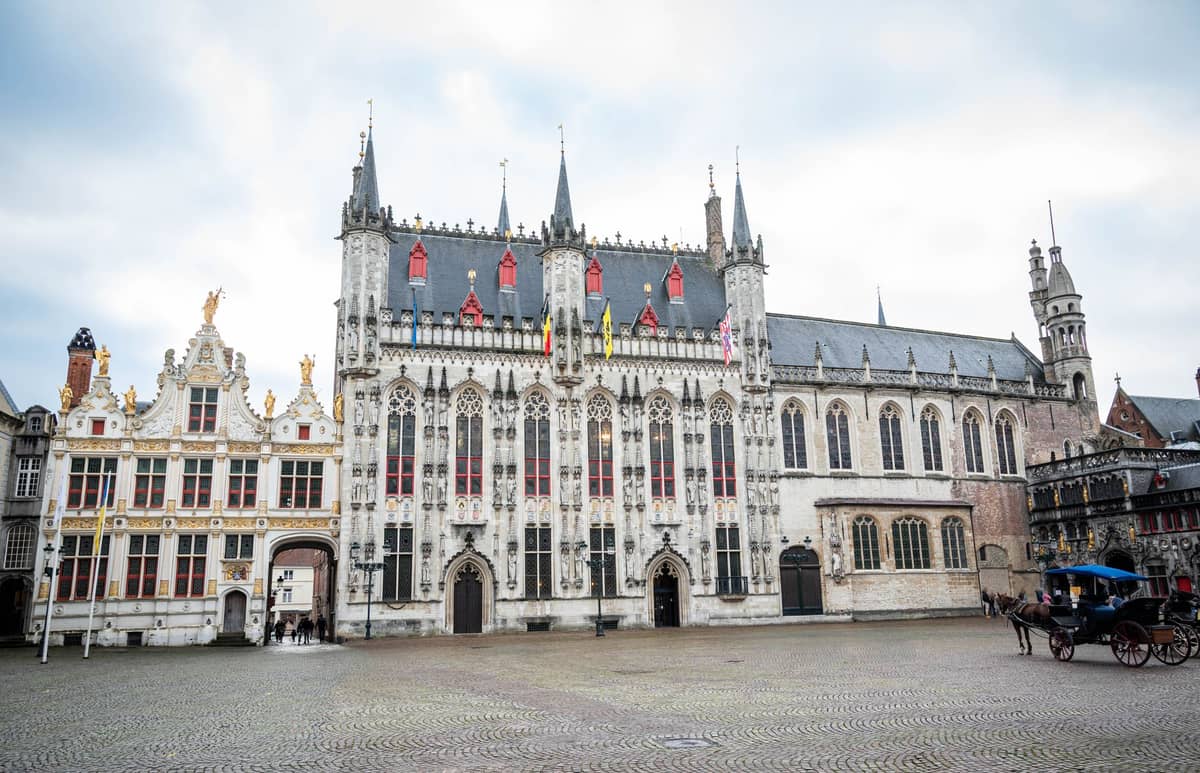
The building sits on Burg Square, a compact plaza that concentrates more architectural history per square metre than almost anywhere in Belgium. The Basilica of the Holy Blood occupies the southern corner, former court buildings flank the north, and the City Hall anchors the west side with a facade of steep pointed gables, delicate tracery, and row upon row of sculpted niches. The current statues are 19th-century replacements for originals destroyed during the French Revolutionary period, but they restore the intended rhythm of the exterior.
The building forms part of the Historic Centre of Bruges, a UNESCO World Heritage Site. If you are building an itinerary around Bruges' medieval core, the Stadhuis pairs naturally with the Basilica of the Holy Blood directly next door and the broader Burg Square ensemble, which together make up one of the most historically layered public spaces in northern Europe.
The Facade: Brabantine Gothic in Detail
Brabantine Gothic is a specific regional style characterised by an abundance of decorative stone carving, slender vertical lines, and an overall effect that is more ornate than French Gothic but more restrained than German Late Gothic. The Stadhuis exemplifies this perfectly. The three gabled bays rise to pointed finials, with corner turrets framing the composition. The stonework is worked in a warm grey-beige limestone that takes on a golden tone in afternoon sun and a cooler, almost silver cast under overcast skies.
Morning light hits the facade directly, which makes the niches and carved foliage cast shadows and read clearly. By midday in summer, the square fills with tour groups and the light becomes flat. For photography, the window between 08:30 and 10:00 is the most rewarding: long shadows, almost no crowds, and the possibility of an unobstructed shot from across the square. In winter, the low northern sun gives dramatic side-light from the east even at noon.
💡 Local tip
For the best facade photographs, position yourself toward the northeast corner of Burg Square. This gives a slight angle that shows the depth of the tracery and avoids the parked bikes that collect near the square's centre during the day.
Tickets & tours
Hand-picked options from our booking partner. Prices are indicative; availability and final rates are confirmed when you complete your booking.
Round-trip shuttle service from Zeebrugge to Bruges
From 49 €Instant confirmationFree cancellationHistorium Bruges entrance tickets
From 19 €Instant confirmationFree cancellationBruges food tour with full meal
From 139 €Instant confirmationFree cancellationBruges walking audio guided tour
From 9 €Instant confirmation
Inside: The Gothic Hall and Its Painted Ceiling
The interior is where many visitors are genuinely surprised. The ground-floor entrance is modest, almost understated, but the Gothic Hall on the upper floor is one of the most striking civic interiors in Belgium. The room is long, with a barrel-vaulted wooden ceiling dating from 1402 that branches into pendant keystones, painted with scenes from the New Testament and the history of Bruges. The colours are rich and warm: deep reds, ochres, and greens applied in a 19th-century restoration, but following documented original schemes.
The walls display large painted maps and allegorical canvases commissioned in the 1890s that depict key moments from Bruges' medieval history, including the city's role in the cloth trade and relations with the Burgundian dukes. They read like a confident piece of civic propaganda, and understanding that context makes them more interesting than they might first appear. The hall also contains carved stone consoles and corbels that survived from the original construction, offering authentic medieval detail amid the 19th-century additions.
The acoustic quality of the Gothic Hall is notable. Even when the room contains a dozen visitors, the scale absorbs sound and keeps the space feeling calm. This is not a noisy, chaotic museum floor. Voices are absorbed by the wooden ceiling, and there is a particular stillness that makes sustained looking easier than in many larger institutions.
Opening Hours, Tickets, and Practical Logistics
The Stadhuis is open daily from 09:30 to 17:00, with last entry around 16:30. Admission is €8 for adults aged 26 and over, €7 for visitors aged 18 to 25, €4 for ages 13 to 17, and free for children under 13; your ticket also includes access to the Brugse Vrije. These prices are current as of mid-2026 but should be confirmed via the official Musea Brugge website before your visit, as prices can change seasonally.
- 24 December: open until 16:00
- 25 December: closed
- 31 December: open until 16:00
- 1 January: closed
- Ascension Day (Hemelvaartsdag): the Stadhuis and O.L.V.-kerk Museum are closed all day
- Last Monday of each month (except July): partial closure due to municipal council meetings; parts of the building are closed to visitors
The building is managed by Musea Brugge, the municipal museum body that also oversees the Groeningemuseum, Gruuthusemuseum, and several other Bruges institutions. If you are planning to visit multiple Musea Brugge sites, a combination ticket can represent reasonable value, particularly for those spending two or more days in the city.
⚠️ What to skip
If your visit falls on the last Monday of a month (except July), check the Musea Brugge website before arrival. A municipal council session means parts of the building are closed and the full experience is not available.
The Stadhuis is at Burg 12, a two-minute walk from the Markt and around 15 minutes on foot from Bruges train station. City buses on the De Lijn network stop at the Markt, which is the practical transit hub for the historic centre. A single De Lijn bus ticket costs approximately €3, though fares are subject to revision.
Accessibility and Visitor Comfort
The entrance level and main gallery areas are step-free, with a lift providing access to the Gothic Hall. Wheelchair users and visitors with reduced mobility can enter via a counter designed for accessibility. Note that some internal doors are heavy and may require staff assistance. The toilets are available within the building but are not fully wheelchair-accessible according to available visitor reports. If this is a concern, contact Musea Brugge directly before your visit.
The building is not large and does not require significant physical effort. An average visit of 45 to 75 minutes covers the facade, the ground-floor historical display, and the Gothic Hall without feeling rushed. If you have a particular interest in medieval civic architecture or the painted ceiling panels, allow closer to 90 minutes.
How the Stadhuis Fits Into a Broader Bruges Visit
Burg Square is a natural starting point for exploring the historic centre, and the Stadhuis combines logically with several nearby attractions. The Basilica of the Holy Blood shares the same square and can be visited in the same morning. A short walk south leads to the Groeningemuseum, home to the city's collection of Flemish Primitive paintings. Anyone with a serious interest in the medieval period can build a dense, satisfying day from this cluster alone.
For a structured overview of how to combine these sites efficiently, the Bruges one-day itinerary routes the Stadhuis as a morning stop before the canal quarter, which works well logistically. Those with more time might explore the broader Gothic architecture of Bruges, which places the Stadhuis in the context of the city's other surviving medieval buildings, from the Belfort to Sint-Salvatorskathedraal.
Is It Worth the Admission?
At €8, the Stadhuis is not the most expensive attraction in Bruges, but it is worth asking whether the interior justifies the price for every type of visitor. The Gothic Hall is genuinely impressive and the painted ceiling is unlike anything else in the city. If you respond to medieval civic architecture and the visible traces of how a 14th-century trading city chose to represent itself, the interior is rewarding. If you are primarily interested in art collections, canal views, or chocolate, the Stadhuis is more of a quick exterior stop than a destination in itself.
The facade is freely visible from the square at any time of day, and the exterior alone makes Burg Square worth visiting. The admission fee specifically buys access to the Gothic Hall, the historical maps and paintings, and the medieval stone detail up close. Visitors who skip the interior and photograph the facade from the square lose relatively little if their focus is on the broader cityscape rather than architectural history.
ℹ️ Good to know
The Stadhuis does not suit visitors who are primarily interested in interactive displays or modern museum experiences. The interior is beautiful but quiet and text-heavy. Children under 13 enter free, but the content is unlikely to engage younger children for more than 20 minutes.
Insider Tips
- Arrive before 10:00 to photograph the facade in raking morning light with minimal foot traffic on Burg Square. By 10:30 in peak season, group tours routinely gather in front of the building.
- Look closely at the ground-floor stonework near the entrance before heading upstairs. Several original medieval corbels and carved details survive at eye level and are easy to miss when visitors rush toward the Gothic Hall.
- The last Monday of each month (except July) brings a municipal council session, which closes parts of the building. Cross-reference your travel dates before planning this as a primary stop.
- Musea Brugge offers a Musea Brugge Card that combines access to multiple city museums. If you intend to visit the Groeningemuseum or Gruuthusemuseum on the same trip, consider this pass when planning your tickets.
- Winter visits have a distinct advantage: the Christmas market occupies the Markt rather than Burg Square itself, so the square in front of the Stadhuis remains relatively uncrowded even in December, and the low winter light is excellent for architectural photography.
Who Is Bruges City Hall (Stadhuis) For?
- First-time visitors to Bruges who want a grounded introduction to the city's medieval history
- Architecture enthusiasts interested in Brabantine Gothic and its influence on civic buildings across the Low Countries
- Travellers on a cultural itinerary combining the Stadhuis with the Groeningemuseum and Basilica of the Holy Blood in a single morning
- Photographers working in morning light who want the most atmospheric conditions on Burg Square
- History-focused travellers who want to understand Bruges' role as a medieval trading and civic centre beyond the canal scenery
Nearby Attractions
Other things to see while in Historic Centre:
- Basilica of the Holy Blood
The Basilica of the Holy Blood (Basiliek van het Heilig Bloed) stands on Burg Square in Bruges' historic centre, housing a relic venerated since the Middle Ages. Entry to the basilica is free; the treasury costs €5. With two architecturally distinct chapels stacked on top of each other, it rewards visitors who take time to explore both levels.
- Belfry of Bruges (Belfort)
Standing 83 metres above the Markt, the Belfry of Bruges has dominated the city's skyline since the 13th century. The climb is steep and the staircase narrow, but the rooftop view over the canal network, church spires, and Flemish rooftops rewards the effort. Here is everything you need to know before you go.
- Burg Square
Burg Square, known locally as the Burg or Burgplein, is the political and ceremonial core of Bruges, framed by some of the finest medieval and Renaissance civic architecture in Belgium. Free to enter at any hour, it rewards careful exploration and rewards visitors who stay long enough to watch the light shift across its stone facades.
- Choco-Story Bruges
Choco-Story Bruges traces the story of chocolate from Maya and Aztec cacao rituals to the artisan praline shops lining today's Bruges streets. Located on Wijnzakstraat in the historic centre, it combines genuine cultural history with live chocolate demonstrations that make it one of the more substantive stops on the city's well-worn tourist circuit.