Belfry of Bruges (Belfort): The Medieval Tower at the Heart of the City
Standing 83 metres above the Markt, the Belfry of Bruges has dominated the city's skyline since the 13th century. The climb is steep and the staircase narrow, but the rooftop view over the canal network, church spires, and Flemish rooftops rewards the effort. Here is everything you need to know before you go.
Quick Facts
- Location
- Markt 7, 8000 Brugge — on the Market Square in the historic centre
- Getting There
- 15–20 min walk from Bruges railway station, or De Lijn city bus to Markt (approx. €3 single fare)
- Time Needed
- 45–90 minutes including the queue, climb, and time at the top
- Cost
- €16 adults in summer, weekends, and Christmas week (€15 on winter weekdays); €14 under 18 in peak season; free under 7. Verify current prices before visiting.
- Best for
- History enthusiasts, photography, anyone wanting the best rooftop view in Bruges
What the Belfry Actually Is
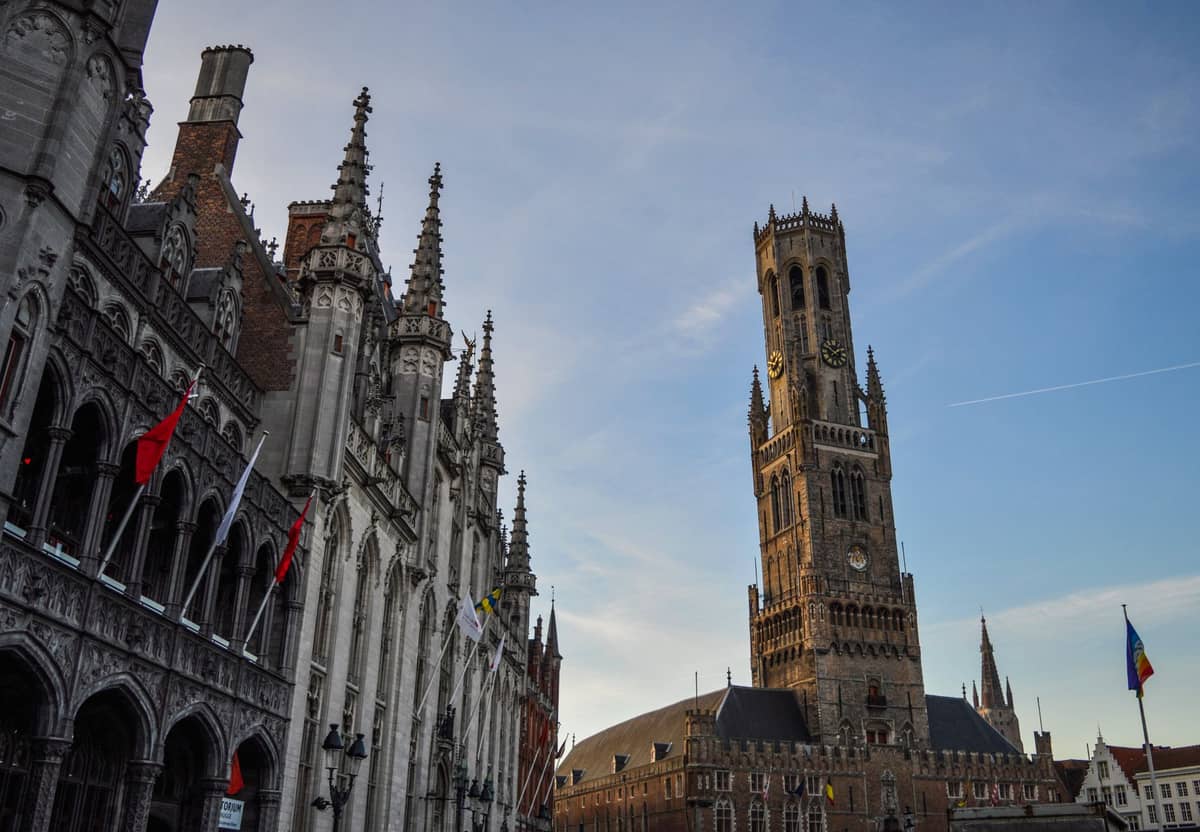
The Belfort van Brugge, known in English as the Belfry of Bruges, is a medieval tower rising 83 metres above the Markt (Market Square) in the heart of Bruges' historic centre. It is one of the most recognisable structures in Belgium, a UNESCO World Heritage Site alongside the belfries of Wallonia and Flanders, and the dominant architectural feature of the city's skyline. But calling it just a tower undersells what it represents: for roughly eight centuries, the Belfry functioned as the administrative and commercial nerve centre of one of medieval Europe's wealthiest cities.
The original structure dates from around 1240, when Bruges was a major trading hub in the North Sea economy, handling cloth and goods from across Europe. The tower formed part of a larger cloth hall complex where merchants weighed and taxed goods. Fires and partial collapses shaped it over successive centuries, and the distinctive octagonal upper section was added in the 15th century. What you see today is the product of layered reconstruction, but the core stonework and the physical presence of the tower are genuinely medieval.
ℹ️ Good to know
The Belfry contains a 47-bell carillon, one of the finest in Belgium. The bells are loud at close range inside the tower — if you time your climb to coincide with a bell performance, expect significant sound.
The Climb: What to Expect on the Way Up
Access to the top requires climbing 366 narrow stone steps. There is no lift. The staircase winds through several chambers, including the treasury room where the city's charters and seal were historically kept under lock, and the carillon mechanism room where you can observe the rotating drum that programs the bell sequences. These intermediate stops break the ascent into stages and give the experience genuine substance beyond the view.
The staircase itself is steep, uneven in places, and in the upper sections, genuinely tight. Two people cannot pass each other comfortably. Most sections are a single-file spiral with a rope guide on the inner wall. Visitors with knee problems or a fear of confined spaces should factor this in before buying a ticket. Children under seven enter free, but the climb is physically demanding and requires adult supervision throughout.
Total climbing time for a reasonably fit adult runs about 15 to 20 minutes at a steady pace, longer with stops at the intermediate levels. Allow at least 20 minutes at the top before the descent.
⚠️ What to skip
The Belfry is not wheelchair accessible and Musea Brugge explicitly notes it is not suitable for visitors with physical or visual impairments. A bronze tactile scale model of the Belfry with Braille information is available on the square outside as an alternative.
Tickets & tours
Hand-picked options from our booking partner. Prices are indicative; availability and final rates are confirmed when you complete your booking.
Round-trip shuttle service from Zeebrugge to Bruges
From 49 €Instant confirmationFree cancellationHistorium Bruges entrance tickets
From 19 €Instant confirmationFree cancellationBruges food tour with full meal
From 139 €Instant confirmationFree cancellationBruges walking audio guided tour
From 9 €Instant confirmation
The View from the Top
The rooftop platform delivers a 360-degree panorama that remains one of the clearest high-level views in northwest Belgium. On the west and south sides, the spires of the Sint-Salvatorskathedraal and the Onze-Lieve-Vrouwekerk break the roofline. To the north and east, the canal network that gave Bruges its medieval name spreads out in thin silver lines through the city's brick fabric. On clear days the view extends well beyond the city boundary toward the flat Flemish polderland.
Mornings offer the clearest light for photography, particularly in the hour after opening. By late morning in summer, the combination of visitors and haze can reduce the sharpness of distant views. Late afternoon in autumn and winter, when the low sun hits the brick facades at a sharp angle, produces arguably the most photogenic conditions, though the shorter opening hours in winter require planning. A wide-angle lens or a smartphone with a panorama mode will capture the sweep, but the tower's iron railings will appear in any forward-facing shot.
The view from the top also makes the urban layout legible in a way that ground-level exploration does not. You can trace the old canal routes, identify the Burg Square directly behind the Belfry's base, and see how the historic centre sits within the ring of canal waterways. For first-time visitors, climbing the Belfry on day one of a trip is a practical orientation exercise as much as a sightseeing experience.
How the Experience Changes by Time of Day
Early morning arrivals, particularly on weekdays outside July and August, encounter shorter queues and quieter conditions on the staircase. The Markt below is still being set up by delivery vehicles at this hour, and the square has not yet filled with tour groups. Opening time in summer is 9:00, and arriving within the first 30 minutes makes a measurable difference to the experience.
Midday is the busiest period. Tour groups from coaches parked near the station arrive in the late morning, and by noon the queue at the base can be 30 to 45 minutes long. The staircase becomes congested, and passing other visitors on the upper section requires patience. If midday is your only option, weekdays are notably calmer than weekends.
Late afternoon visits in summer benefit from lower crowd numbers as day-trippers begin heading back to the station, and the light from the west illuminates the tower's stone facade in warmer tones. In winter, the tower closes at 18:00 on most days (20:00 on Saturdays), so late-afternoon visits in December and January can catch the early dusk settling over the rooflines, with the city lights beginning to appear below.
Opening Hours, Tickets, and Getting There
The Belfry operates on seasonal hours. From 1 April to 2 November, it opens daily from 09:00 to 20:00. From 3 November to 31 March, hours are 10:00 to 18:00 Sunday through Friday, and 09:00 to 20:00 on Saturdays. During the Christmas period from 26 to 30 December, extended hours of 09:00 to 20:00 apply daily. Note that 24 and 31 December the tower closes at 16:00, and 25 December and 1 January it is closed entirely. On Ascension Day, closing time is 12:30.
Admission as of 2026 is €16 for adults in summer, on weekends, and over Christmas week, or €15 on winter weekdays. Visitors under 18 pay a reduced rate (€14 in peak season). Children under 7 enter free. Prices are subject to change; check the Musea Brugge website before visiting. Tickets can be purchased at the entrance on the Markt.
The Belfry is located at Markt 7, directly on the Market Square. From Bruges railway station, the walk takes 15 to 20 minutes through the city centre, passing along Steenstraat toward the Markt. City buses operated by De Lijn connect the station to the Markt area; a single ticket costs approximately €3. If you are planning a full day in the historic centre, consider pairing the Belfry visit with nearby sights such as the Historium on the same square, or the Stadhuis van Brugge a short walk away on Burg Square.
The Broader Context: Why This Tower Mattered
Medieval Bruges was among the wealthiest cities in northern Europe. At its commercial peak in the 13th and 14th centuries, it served as a primary point of exchange between Mediterranean merchants and the textile economies of England and the Low Countries. The Belfry was not an ornamental structure: it was an instrument of civic governance. The treasury room housed documents that defined the rights of citizens and guilds. The bell system announced the opening and closing of markets, fires, attacks, and the hours of the working day. Control of the tower was, in practical terms, control of the city's economic rhythm.
That context is worth holding in mind as you walk through the Markt today. The square still functions as the city's civic heart, though its role is now primarily commercial and touristic. The Markt is surrounded by guild houses and the provincial government building, and the Belfry anchors the entire composition. For a deeper understanding of how Flemish medieval art and commerce intersected in this city, the Groeningemuseum a short walk south along the Dijver canal provides essential visual context.
Practical Notes and a Clear Verdict
The Belfry is Bruges' most visited paid attraction, and the crowds reflect that. In July and August, queues form from mid-morning onward and the staircase can feel claustrophobic when multiple groups are ascending and descending simultaneously. If you are visiting in peak summer and are sensitive to confined spaces or crowding, this is worth weighing against the view. The view is genuinely impressive, but Bruges is a beautiful city at street level too, and several of its lesser-visited attractions offer comparable historical depth without the queuing.
Weather affects the rooftop experience significantly. In rain, the platform can be slippery and the views obscured. Strong winds are common at height in any season, and the platform has no full roof cover. A waterproof layer and sensible footwear are advisable year-round. In summer, sunscreen and water are worth bringing for the wait and the exposed platform.
For travelers following a structured itinerary, the Bruges one-day itinerary builds the Belfry into a logical sequence with nearby attractions. Those with more time should explore the historic centre on foot before or after the climb, as the streets immediately surrounding the Markt contain a high concentration of Gothic architecture and canal views that reward slow exploration.
Insider Tips
- Arrive at opening time on a weekday to avoid the staircase bottleneck. Summer mornings before 10:00 are notably quieter, and the low-angle light is better for photography from the top.
- The carillon mechanism room halfway up is easy to walk past quickly, but worth pausing at. The rotating drum that controls bell sequences is a genuinely remarkable piece of pre-digital engineering, and few visitors spend more than 30 seconds looking at it.
- Buy your ticket at the base rather than arriving with a pre-purchased timed slot if your schedule is flexible. The queue at the door is often shorter than it looks, as it moves in batches controlled by the narrow staircase capacity.
- Wear rubber-soled shoes. The medieval stone steps are worn smooth in the centre and can be slippery on the descent, particularly if the staircase has had wet umbrella traffic from outside.
- The bronze tactile model of the Belfry on the square outside is often overlooked but is a good reference point for understanding the tower's proportions and the relationship between the tower and the cloth hall complex. Worth examining before you go in.
Who Is Belfry of Bruges (Belfort) For?
- First-time visitors to Bruges wanting a geographic and historical orientation to the city layout
- Architecture and medieval history enthusiasts interested in civic Gothic structures
- Photographers seeking elevated panoramic views of Bruges' roofscape and canals
- Travelers with older children (roughly 8 and above) who can manage a sustained physical climb
- Anyone visiting during the Christmas period when the elevated view over the decorated Markt is particularly striking
Nearby Attractions
Other things to see while in Historic Centre:
- Basilica of the Holy Blood
The Basilica of the Holy Blood (Basiliek van het Heilig Bloed) stands on Burg Square in Bruges' historic centre, housing a relic venerated since the Middle Ages. Entry to the basilica is free; the treasury costs €5. With two architecturally distinct chapels stacked on top of each other, it rewards visitors who take time to explore both levels.
- Burg Square
Burg Square, known locally as the Burg or Burgplein, is the political and ceremonial core of Bruges, framed by some of the finest medieval and Renaissance civic architecture in Belgium. Free to enter at any hour, it rewards careful exploration and rewards visitors who stay long enough to watch the light shift across its stone facades.
- Choco-Story Bruges
Choco-Story Bruges traces the story of chocolate from Maya and Aztec cacao rituals to the artisan praline shops lining today's Bruges streets. Located on Wijnzakstraat in the historic centre, it combines genuine cultural history with live chocolate demonstrations that make it one of the more substantive stops on the city's well-worn tourist circuit.
- Friet Museum
The Frietmuseum on Vlamingstraat is the world's only museum dedicated to the history and culture of Belgian fries. Housed in one of Bruges's oldest secular buildings, it traces the potato's journey from the Andes to the Belgian frituur, and yes, there are fries at the end.