Frietmuseum Bruges: Everything You Need to Know About the Belgian Fries Museum
The Frietmuseum on Vlamingstraat is the world's only museum dedicated to the history and culture of Belgian fries. Housed in one of Bruges's oldest secular buildings, it traces the potato's journey from the Andes to the Belgian frituur, and yes, there are fries at the end.
Quick Facts
- Location
- Vlamingstraat 33, 8000 Brugge (Historic Centre)
- Getting There
- Bus: Brugge Stadsschouwburg stop; Train: Station Brugge (~20–25 min walk)
- Time Needed
- About 1 hour
- Cost
- Adults €12 | Students/65+ €10 | Children 3–11 €7 | Under 3 free
- Best for
- Families, food culture enthusiasts, rainy-day visits, curious travellers
- Official website
- frietmuseum.be
What Is the Frietmuseum?
The Frietmuseum, officially known in English as the Belgian Fries Museum, holds the distinction of being the only museum in the world entirely dedicated to the story of the Belgian fry. That sounds like a novelty act, and plenty of visitors arrive expecting something lightweight and tongue-in-cheek. What they find is a genuinely well-researched walk through food history, spanning two floors in one of the most architecturally significant secular buildings in Bruges.
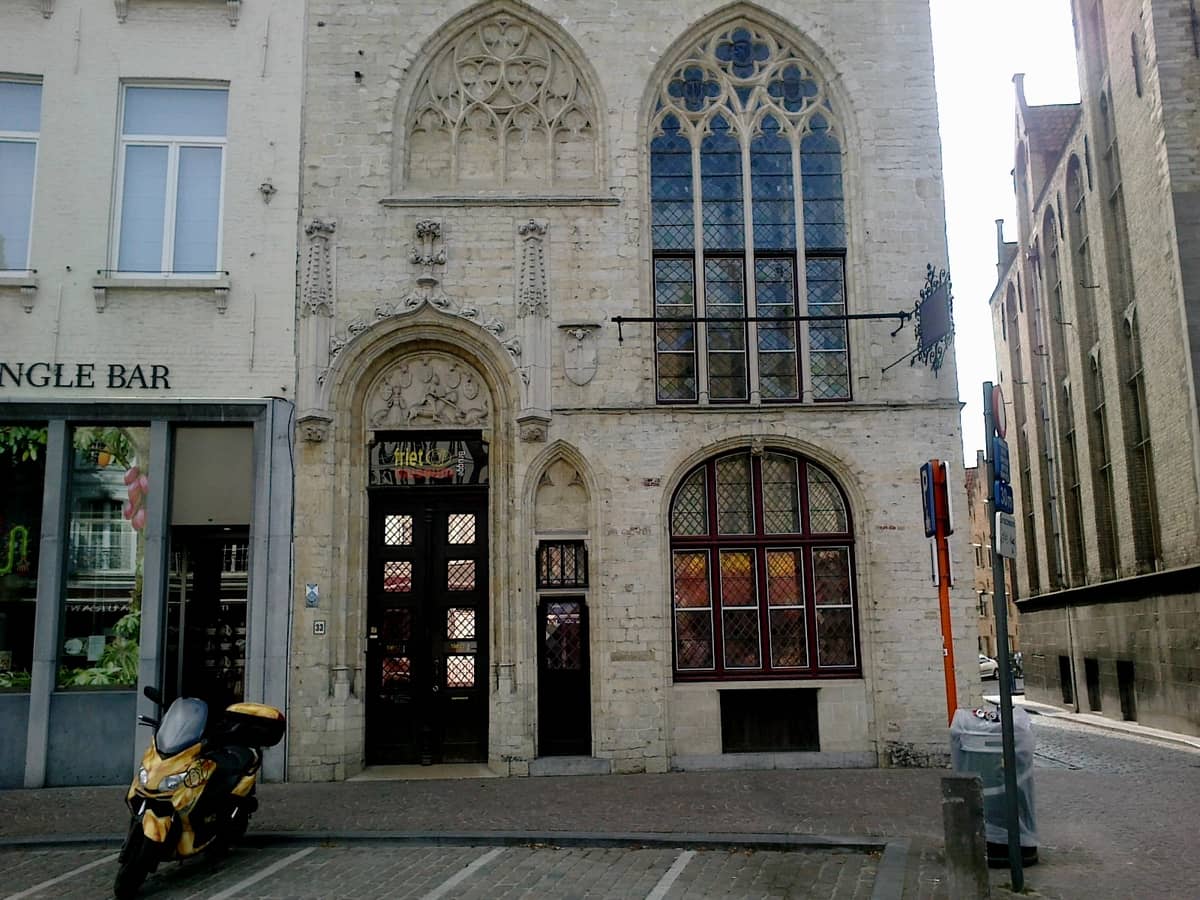
The building itself is worth noting before you even step inside. The Saaihalle on Vlamingstraat 33 dates to the early 14th century and was originally used as a cloth storage hall during Bruges's medieval peak as a trading hub. The façade is a reminder that this street once sat at the commercial heart of one of Northern Europe's wealthiest cities. The museum content and the building's age make for an unlikely but effective pairing.
💡 Local tip
Opening hours are daily 10:00–17:00 (last tickets 16:15). The museum closes on 25 December and 1 January, and closes early at 16:00 on 24 December and 31 December (last entry 15:00). Check the official site for any seasonal closures before visiting.
The Building: A Medieval Backdrop for a Modern Story
The Saaihalle is one of the oldest surviving secular Gothic structures in Bruges. Walking through the entrance, the medieval stonework and vaulted ceilings are immediately apparent, and the contrast with the cheerful, graphic-heavy museum displays inside creates an oddly appealing atmosphere. The building was restored specifically to house the museum, and the renovation preserved much of its original character.
Vlamingstraat itself sits in the heart of the historic centre of Bruges, within easy walking distance of the Markt and several of the city's major museums. If you are already planning a visit to the Groeningemuseum or the Historium Bruges, the Frietmuseum fits naturally into the same afternoon without requiring much extra navigation.
Tickets & tours
Hand-picked options from our booking partner. Prices are indicative; availability and final rates are confirmed when you complete your booking.
Tickets for Frietmuseum in Bruges
From 11 €Instant confirmationFree cancellationHistorium Bruges entrance tickets
From 19 €Instant confirmationFree cancellationBruges food tour with full meal
From 139 €Instant confirmationFree cancellationBruges walking audio guided tour
From 9 €Instant confirmation
What You Actually See Inside
The museum is laid out across two main exhibition floors and moves through the subject chronologically and thematically. The first section covers the origin of the potato, tracing it back to the Andean highlands of South America, where it was cultivated by indigenous peoples for thousands of years before Spanish colonisers brought it to Europe in the 16th century. The displays here use replica artifacts, maps, and explanatory panels, with text in Dutch, French, English, and German.
The second part of the exhibition deals with how the potato spread across Europe and eventually became central to Belgian and broader Flemish food culture. There is considerable attention given to the ongoing debate about who actually invented the fried potato: the Belgians claim the practice originated in the Meuse valley in the late 17th century, when locals fried small fish-shaped potato strips during winter when the river froze and fish were unavailable. The French dispute this. The museum presents the Belgian case with enthusiasm, though it acknowledges the counter-arguments.
The third section is the most tactile and contemporary: it covers the Belgian frituur (fry stand) culture, the specific varieties of potato used, the double-frying technique that produces the characteristic soft interior and crisp exterior, and the dizzying variety of sauces that accompany fries in Belgium. The displays include original frituur equipment, vintage packaging, and advertising materials from the 20th century. This is the section that tends to hold children's attention the longest, largely because it smells exactly like what it is depicting.
ℹ️ Good to know
The museum has a frietkot (fry counter) on the ground floor where you can order a cone of freshly made Belgian fries after your visit. For many people, this is the obvious conclusion to the experience.
Visiting by Time of Day: When to Go
The museum opens at 10:00, and the first hour tends to be the quietest. Groups and school parties typically arrive from mid-morning onward, so if you want a calm, unhurried look at the displays, arriving at opening time is the practical choice. The museum is not large, and the corridors between exhibits can feel narrow when two groups are navigating them at the same time.
Midday to early afternoon is the busiest window, particularly in summer when Bruges draws large numbers of day-trippers from Brussels, Ghent, and across the border from France and the Netherlands. The museum works well as a rainy-day fallback: the interior is entirely covered, climate-controlled, and takes around an hour to move through at a comfortable pace, making it a sensible option when the city's outdoor attractions lose their appeal in wet weather.
Late afternoon visits, arriving around 15:00 or 15:30, usually find the crowds thinning as tour groups move on. The last entry is at 16:00, and the museum closes at 17:00, so arriving after 15:30 gives you enough time to see the exhibits without rushing but may not leave time for the fry counter if it closes earlier.
Practical Walkthrough: Getting There, Accessibility, and What to Bring
The nearest bus stop is Brugge Stadsschouwburg, served by De Lijn city buses. From Bruges train station, the walk takes roughly 15 minutes through the historic centre, passing through the Markt area. If you are arriving from Markt square, the museum is a short walk north along the canal-side streets.
If you are driving, the nearest parking facility is Parking Ezelstraat. Bruges's historic centre has very limited on-street parking, so a dedicated car park is the practical choice. Most visitors arriving by train or bus will find the walk straightforward and well-signposted.
On accessibility: the museum's access paths are described as independently accessible, with an adapted lift available between floors. The entrance itself requires assistance to navigate in a wheelchair. The adapted toilet is noted as not easily accessible, which is worth knowing in advance if this is a consideration for your group.
There is no strict dress code, and the museum is fully indoors, so weather does not affect the visit once you are inside. In winter, Bruges can be cold and damp, and the museum's indoor format makes it a particularly practical choice between November and March.
Is It Worth the Price?
At €12 for adults, the Frietmuseum sits in the mid-range of Bruges museum pricing. It is not the most intellectually demanding museum in the city, and visitors with a strong prior interest in medieval Flemish art or religious history may find the Groeningemuseum or the Sint-Janshospitaal offer more depth per euro. But that is a comparison that misses the point slightly.
The Frietmuseum does what it sets out to do with care and good production values. The historical context is more thorough than most people expect, the building is genuinely impressive, and the experience is well-suited to mixed groups where not everyone shares the same cultural interests. Families with children tend to come away satisfied. Solo travellers or couples who enjoy food history and material culture will find it a worthwhile hour.
If budget is a concern, note that Bruges has a range of no-cost attractions worth prioritising first. The Bruges on a budget guide covers free and low-cost options in detail, which can help you decide where the Frietmuseum sits in your overall itinerary.
⚠️ What to skip
The museum is not ideal for travellers who want significant architectural immersion or large-scale art collections. It is a compact, food-focused attraction. If you have only one day in Bruges and are choosing between this and the major fine art museums, prioritise accordingly.
The Frietmuseum in the Context of Bruges's Food Culture
Bruges takes its food culture seriously, and the Frietmuseum is part of a broader ecosystem of food-focused attractions and experiences in the city. Chocolate, beer, and waffles each have their own dedicated venues and museums nearby. The Choco-Story Bruges chocolate museum is within easy walking distance and covers Belgian chocolate history with similar thoroughness. The De Halve Maan Brewery offers tours focused on Bruges's beer heritage.
For anyone interested in the full picture of Belgian food culture, combining the Frietmuseum with one or two of these other venues makes for a coherent and enjoyable themed day. The Bruges with kids guide includes the Frietmuseum as one of the more child-friendly stops in the city, alongside practical advice on pacing and sequencing a family day.
Insider Tips
- Buy your tickets online in advance during peak summer months. The museum has limited capacity and group bookings can fill the mid-morning slots quickly, particularly on weekends between June and August.
- The fry counter on the ground floor serves freshly made Belgian fries with a choice of sauces. Ordering here after the visit is the logical conclusion, and the fries are made to proper Belgian double-fry standards, not the frozen-product shortcut you find at many tourist venues.
- The medieval building itself is worth a few minutes of attention before you engage with the exhibits. Look up at the vaulted stonework near the entrance, and note the original structural elements visible along the upper floor walls — the restoration work left these deliberately exposed.
- Combination tickets with Choco-Story Bruges are available and represent decent value if you plan to visit both on the same day. Check the official Frietmuseum site for current prices and offers before purchasing individual tickets.
- The multilingual display panels (Dutch, French, English, German) are thorough and clearly written, so you do not need an audio guide to follow the content. Children's trail materials are sometimes available at the entrance desk — worth asking about when you arrive.
Who Is Friet Museum For?
- Families with children aged 5 and up, who will respond to the hands-on displays and the fry counter reward at the end
- Food culture enthusiasts interested in the serious history behind an everyday Belgian staple
- Rainy-day visitors looking for a fully indoor, well-paced hour-long attraction in the historic centre
- Travellers who want a lighter cultural experience alongside the heavier art and religious museums Bruges is known for
- Groups with mixed interests, where a shared food-focused theme provides common ground across different ages and backgrounds
Nearby Attractions
Other things to see while in Historic Centre:
- Basilica of the Holy Blood
The Basilica of the Holy Blood (Basiliek van het Heilig Bloed) stands on Burg Square in Bruges' historic centre, housing a relic venerated since the Middle Ages. Entry to the basilica is free; the treasury costs €5. With two architecturally distinct chapels stacked on top of each other, it rewards visitors who take time to explore both levels.
- Belfry of Bruges (Belfort)
Standing 83 metres above the Markt, the Belfry of Bruges has dominated the city's skyline since the 13th century. The climb is steep and the staircase narrow, but the rooftop view over the canal network, church spires, and Flemish rooftops rewards the effort. Here is everything you need to know before you go.
- Burg Square
Burg Square, known locally as the Burg or Burgplein, is the political and ceremonial core of Bruges, framed by some of the finest medieval and Renaissance civic architecture in Belgium. Free to enter at any hour, it rewards careful exploration and rewards visitors who stay long enough to watch the light shift across its stone facades.
- Choco-Story Bruges
Choco-Story Bruges traces the story of chocolate from Maya and Aztec cacao rituals to the artisan praline shops lining today's Bruges streets. Located on Wijnzakstraat in the historic centre, it combines genuine cultural history with live chocolate demonstrations that make it one of the more substantive stops on the city's well-worn tourist circuit.