Groeningemuseum: Bruges' World-Class Window into Flemish Art
The Groeningemuseum on Dijver holds one of the most concentrated collections of Flemish Primitive painting anywhere in the world, including landmark works by Jan van Eyck and Hans Memling. Compact enough to absorb in two hours, serious enough to reward repeat visits, it anchors Bruges' reputation as a city of medieval artistic genius.
Quick Facts
- Location
- Dijver 12, 8000 Brugge, Belgium (Dijver Canal Quarter)
- Getting There
- Bus stop 'Brugge Dijver' (stop code 502817); Brugge railway station ~15 min walk or short bus ride
- Time Needed
- 1.5 to 2.5 hours for most visitors; allow longer for art enthusiasts
- Cost
- Adults €15, ages 13–25 €13, under 13 free; museumPASSmusées holders free; museum and discount cards may offer additional reductions (prices as of mid-2026, verify before visiting)
- Best for
- Art history lovers, fans of Flemish and Belgian painting, slow travellers, rainy-day culture
- Official website
- www.museabrugge.be/en/visit/locations/groeningemuseum
What the Groeningemuseum Actually Is
The Groeningemuseum is Bruges' primary fine art museum and part of the city-wide Musea Brugge network. Sitting quietly on the Dijver canal, it holds a collection that is unusually rich for its modest square footage: six centuries of Flemish and Belgian painting, from the 15th-century masters who defined European realism to Surrealist canvases from the 20th century. For anyone seriously interested in art history, it is one of the most important small museums on the continent.
The building itself is a 20th-century structure, relatively plain from the outside, which sometimes surprises visitors expecting medieval grandeur. But the understated exterior is part of the museum's appeal: there is no theatrical approach, no monumental staircase. You arrive, pay your admission, and find yourself almost immediately face to face with works you may have studied in books for years.
The museum sits within the Dijver Canal Quarter, one of Bruges' most historically layered neighborhoods, making it easy to combine a visit with a walk along the water or a stop at nearby institutions. If you are planning a focused day of art and medieval history, a visit here pairs naturally with the Gruuthusemuseum directly across the way, and the Memling in Sint-Jan a short walk further into the city.
The Collection: What You Will Actually See
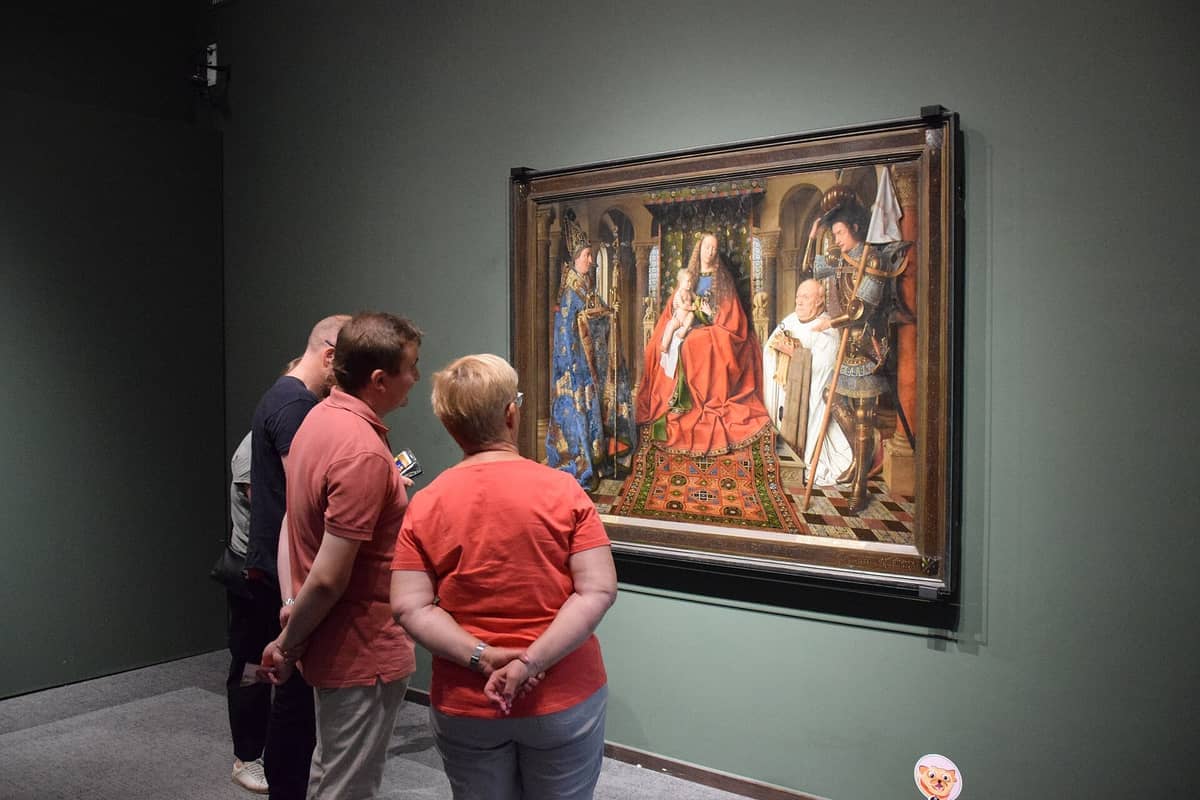
The core of the Groeningemuseum's fame rests on its Flemish Primitives, a term that refers not to crude early work but to the first generation of Northern European painters who mastered oil technique, intense colour, and near-photographic detail in the 15th century. Jan van Eyck's 'Madonna with Canon Joris van der Paele' (1436) is the centrepiece: a large, densely observed devotional painting in which the textures of armour, embroidery, and aging skin are rendered with a precision that still astonishes in person. The sheer scale of detail rewards slow looking; a few minutes in front of it reveals things a reproduction never shows.
Alongside Van Eyck, the museum holds major works by Rogier van der Weyden, Hugo van der Goes, and Gerard David. Hugo van der Goes' 'Death of the Virgin' and Gerard David's disturbing 'Judgement of Cambyses' (two panels depicting a corrupt judge being flayed alive, commissioned for the Bruges town hall as a warning to officials) are among the most viscerally memorable paintings in any Belgian museum. These are not gentle devotional images; they are works made with civic and psychological purpose.
The collection does not stop at the medieval period. Later galleries move through Bruges Renaissance painting, 17th and 18th-century Flemish work, and then into the 19th and 20th centuries, including pieces by Jan Toorop and the Belgian Symbolists. The tonal shift between rooms is marked: the gold-lit devotional panels give way to darker, stranger imagery. Not every traveller comes for the later sections, but for anyone interested in the full arc of Belgian artistic identity, they add genuine depth.
💡 Local tip
Spend at least 30 minutes in the first two rooms before moving on. The Flemish Primitives galleries contain the works most people come for, and the lighting and density of detail reward unhurried attention. Do not let the later galleries rush you past them.
Tickets & tours
Hand-picked options from our booking partner. Prices are indicative; availability and final rates are confirmed when you complete your booking.
Historium Bruges entrance tickets
From 19 €Instant confirmationFree cancellationBruges food tour with full meal
From 139 €Instant confirmationFree cancellationBruges walking audio guided tour
From 9 €Instant confirmationBruges Family Walking Tour
From 259 €Instant confirmationFree cancellation
Visiting in Practice: Layout, Timing, and Crowds
The museum is open Tuesday through Sunday, with seasonal hours: from 1 April to 2 November it opens at 10:00 and closes at 18:00, and from 3 November to 31 March it opens at 09:30 and closes at 17:00, with last admission 30 minutes before closing. It is closed on Mondays and on certain public holidays. Some sources note special holiday hours (for example earlier closing on Christmas Eve and New Year’s Eve and a midday closure on Ascension Day), so checking the official Musea Brugge website before your visit is worth the two minutes it takes.
Weekday mornings, particularly Tuesday through Thursday before 11:00, offer the most comfortable experience. The Flemish Primitives galleries are intimate spaces, and when a school group or a large tour bus arrival coincides with your visit, the atmosphere in front of the Van Eyck panels shifts noticeably. Weekends in summer, especially Saturday afternoons, are the most crowded. If you are visiting in July or August on a weekend, arriving at opening time is the single most effective way to see the collection without being jostled.
The museum layout is sequential and logically arranged by period, so following the route as marked is the most coherent approach. There are no large atrium spaces or dramatic interior architecture; the rooms are gallery-scale and relatively modest, which keeps the focus on the paintings rather than the building. The lighting is calibrated for the works rather than for visitor comfort, so on overcast winter days some rooms feel noticeably dim. This is not a criticism, it is appropriate for preserving the panels, but visitors who find low light a strain may want to visit on a bright day when the skylights in some galleries contribute natural illumination.
ℹ️ Good to know
The museum is wheelchair accessible via an entrance ramp and internal lift. Folding chairs and push wheelchairs are available on request at no additional charge. EnChroma glasses for colourblind visitors and text-format audio tours for hearing-impaired visitors are also available, though availability should be confirmed with staff on the day.
Photography: What's Permitted and What Works
Photography without flash is generally permitted in the permanent collection. The Flemish Primitives panels are behind glass in several cases, which creates reflections depending on your angle and the room's ambient light. A polarising filter is useful if you carry one; failing that, moving to the side of the panel rather than shooting straight on often reduces glare significantly. The works are not large by the standards of Renaissance painting, so a smartphone is adequate for reference shots, though the subtlety of Van Eyck's glazing technique does not compress well into a small image file.
Temporary exhibitions sometimes have different photography rules; check at the entrance desk if you are uncertain about a specific gallery.
Getting There and What to Bring
The museum address is Dijver 12, 8000 Brugge. The closest bus stop is 'Brugge Dijver' (stop code 502817). From Brugge railway station, the walk takes roughly 15 minutes through the historic centre and is pleasant in good weather, passing through the Burg area and along the canal. In rain, the bus is a reasonable option; a single De Lijn ticket costs around €3, though fares are subject to revision.
Bruges has a temperate maritime climate, meaning rain is a realistic possibility at any time of year. The museum makes an excellent wet-weather activity, but bringing a compact umbrella is sensible whenever you are spending time in the city. Coat storage is available at the museum entrance.
If you are planning your day around the museum, read our Bruges one-day itinerary for a route that slots in the Groeningemuseum without doubling back across the city. For those with more time, our guide to the best museums in Bruges covers how the Groeningemuseum compares to the city's other major collections.
Historical and Cultural Context
The collection displayed at the Groeningemuseum represents art made during a period when Bruges was one of the wealthiest trading cities in northern Europe. In the 15th century, the city's merchants, guilds, and religious institutions were among the most significant patrons of painting on the continent. Jan van Eyck himself lived and worked in Bruges from around 1430 until his death in 1441, employed as court painter by Philip the Good, Duke of Burgundy. The 'Madonna with Canon Joris van der Paele' was commissioned by a wealthy Bruges canon for the Church of Saint Donatian, which no longer stands but once occupied what is now the Burg square.
The current museum building on the Dijver replaced earlier display locations used by the city's art collection over the centuries. The 20th-century structure was designed to serve the collection rather than to make an architectural statement, which is part of why it remains largely invisible in photographs of the Dijver canal. What matters is what is inside.
Understanding the art in context is easier if you already know something about the city's medieval trading history and its later decline. Our guide to Flemish art in Bruges provides that background, and if you are interested in the Gothic architecture that surrounded the same patrons who commissioned these works, the Bruges Gothic architecture guide covers the built environment in depth.
Who Should Skip This, and Who Should Not Miss It
If your interest in art is limited to a quick look at a few famous names, the Groeningemuseum will probably feel slow. The works reward attentive looking rather than fast consumption, and unlike larger blockbuster museums there is no single iconic painting that most visitors photograph and leave. The pleasure here is cumulative and specific to those who genuinely enjoy standing in front of paint.
Families with young children can certainly visit, and under-13s enter free, but the collection offers limited interactive elements. Children who are curious and engaged will find plenty to look at; those who need constant activity may find two hours here difficult. The museum is not set up as an educational space for young visitors in the way that some city museums are.
For art history students, serious painters, and anyone who has ever read about the technical innovations of the Flemish Primitives, the Groeningemuseum is an opportunity to see the actual objects rather than reproductions. That experience is difficult to overstate. No reproduction of Van Eyck conveys the physical reality of the panel, the depth of the glazes, or the scale of the ambition. This is one of those rare museums where the works justify the journey independently.
Insider Tips
- Buy your ticket online through the Musea Brugge website in advance. The queue at the door is rarely long, but ticket purchase takes time and cuts into your morning window when the museum is least crowded.
- The audio guide covers only selected works. For deeper context on the Flemish Primitives specifically, reading one focused article about Van Eyck's technique before your visit pays dividends once you are standing in front of 'The Madonna with Canon Joris van der Paele'.
- If you hold a museumPASSmusées card, entry to the Groeningemuseum is free. The pass covers museums across Belgium and pays for itself quickly if you are visiting Bruges and Brussels in the same trip.
- The museum café and shop are small. If you want coffee after your visit, the canal-side streets of the Dijver quarter offer several options within a three-minute walk.
- Combine your visit with the Gruuthusemuseum next door, which shares the same canal setting and covers applied arts and daily life in medieval Bruges. The two museums together take about four hours and create a genuinely rounded picture of the city's history.
Who Is Groeninge Museum For?
- Art history enthusiasts who want to see Flemish Primitive masterworks in person
- Slow travellers spending two or more days in Bruges
- Visitors who want a serious cultural anchor for a day otherwise spent exploring the canals and historic centre
- Rainy-day contingency for any trip to Bruges at any time of year
- Students and researchers interested in Northern European Renaissance painting
Nearby Attractions
Other things to see while in Dijver Canal Quarter:
- Hof Arents
Hof Arents is a free public park in the heart of Bruges, set along the Dijver near the Church of Our Lady and the Gruuthuse domain. Once part of the historic Gruuthuse estate, it offers canal views and a quiet break in the historic centre.
- Boniface Bridge (Bonifaciusbrug)
The Bonifaciusbrug is a small pedestrian bridge over a canal in the heart of Bruges, tucked behind the Church of Our Lady and near the Gruuthusemuseum. Built in 1910 but styled to look centuries older, it offers one of the city's most reproduced canal views. Entry is free and the surrounding garden is open daily.
- Gruuthuse Museum
The Gruuthuse Museum occupies a late medieval city palace on the Dijver canal, tracing Bruges' history from the Middle Ages to the 19th century through furniture, tapestries, weapons, and devotional art. It is one of the few places in Bruges where the building itself is as significant as what it contains.
- Memling in Sint-Jan
Housed inside one of Europe's oldest surviving hospital complexes, Memling in Sint-Jan holds five major works by Hans Memling, the Flemish master who defined 15th-century devotional painting. The setting alone, a working medieval ward turned museum, makes this unlike any conventional art gallery in Bruges.