Memling in Sint-Jan: Hans Memling's Masterpieces in a Medieval Hospital
Housed inside one of Europe's oldest surviving hospital complexes, Memling in Sint-Jan holds five major works by Hans Memling, the Flemish master who defined 15th-century devotional painting. The setting alone, a working medieval ward turned museum, makes this unlike any conventional art gallery in Bruges.
Quick Facts
- Location
- Mariastraat 38, 8000 Bruges (Dijver Canal Quarter)
- Getting There
- Bus stop Brugge O.L.V. Kerk (city buses from Brugge railway station)
- Time Needed
- 1.5 to 2 hours
- Cost
- Adults €15 | Under 26 €13 | Under 18 €7 | Under 13 free
- Best for
- Art lovers, history enthusiasts, and anyone interested in Flemish Primitives
- Official website
- www.museabrugge.be/en/visit/locations/sint-janshospitaal
What Is Memling in Sint-Jan?
Memling in Sint-Jan, officially known as Museum Sint-Janshospitaal (Museum St John's Hospital), is a museum dedicated to the works of Hans Memling, one of the most significant painters of the Flemish Primitive school. It occupies the former wards and chapel of Sint-Janshospitaal, a hospital complex with origins in the 12th century, making it one of the oldest such complexes still standing in Europe. The address is Mariastraat 38, just across the street from the Church of Our Lady.
What distinguishes this museum from most art institutions is context. Four of the five major Memling works on display were commissioned specifically for this hospital and have remained here since the late 15th century. You are not looking at paintings relocated to a purpose-built gallery. You are standing where the patients, nuns, and monks who originally prayed before these altarpieces once stood. That continuity of place is rare anywhere in Europe.
The museum also covers the hospital's medical history, including a restored historic pharmacy. If Flemish painting is your primary interest, pair a visit here with the nearby Groeningemuseum, which holds the broader collection of Flemish Primitive and early Netherlandish art. Together they form the essential art itinerary for Bruges.
The Architecture: A Hospital That Became a Museum
The main hall, the former patient ward, is a long stone nave with heavy timber roof beams dating from the medieval period. The walls are thick, the light filtered through small windows, and the air carries that particular coolness of old stone even in summer. It does not feel like a modern gallery. It feels like a space that has absorbed centuries of use.
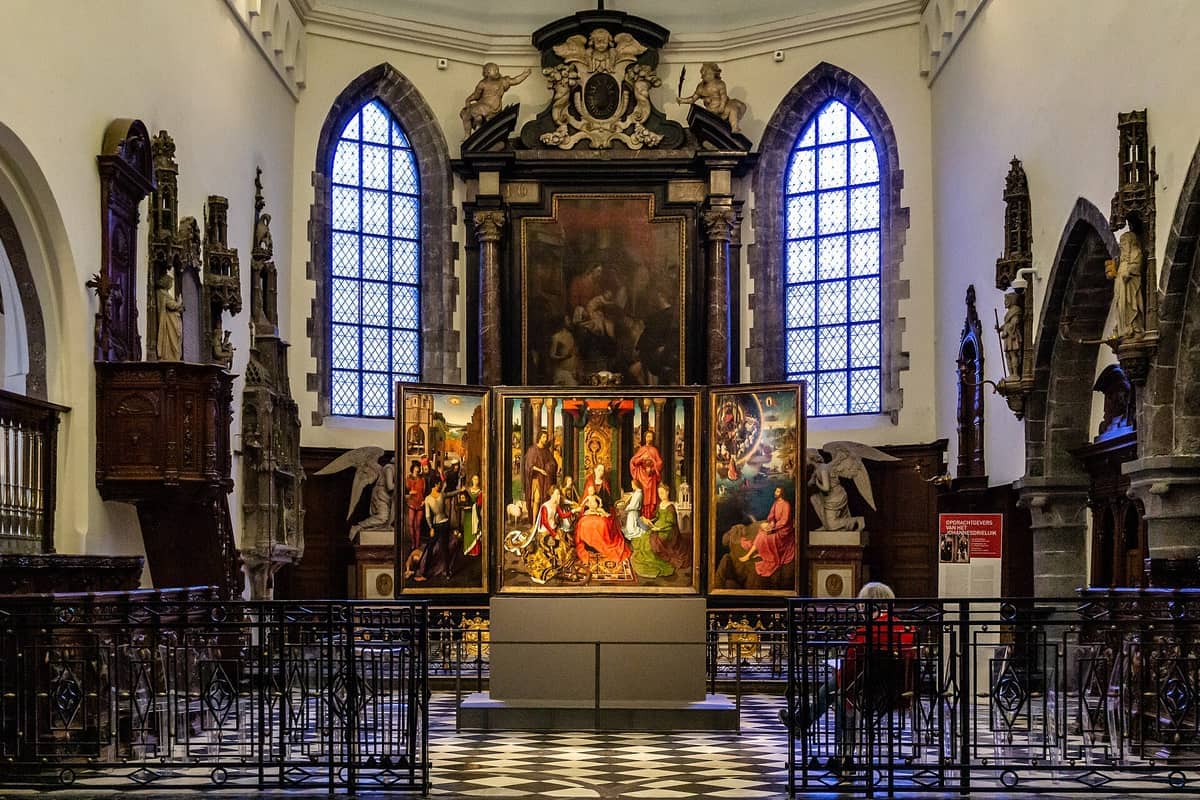
The attached chapel, where several of Memling's key altarpieces were originally installed, still functions as a sacred-feeling space despite its museum status. The proportions are intimate rather than grand. Viewing a triptych here, at roughly the scale it was painted for, gives a sense of dimension that photographs cannot replicate. Reproductions of Memling's work circulate widely, but the actual panels are smaller and more personal than most visitors expect.
The building sits within the broader Dijver Canal Quarter, the southern arc of Bruges' historic center where several of the city's most significant medieval structures cluster together. The Church of Our Lady (Onze-Lieve-Vrouwekerk) stands directly opposite the museum entrance, and the Dijver canal is less than two minutes on foot.
Tickets & tours
Hand-picked options from our booking partner. Prices are indicative; availability and final rates are confirmed when you complete your booking.
Historium Bruges entrance tickets
From 19 €Instant confirmationFree cancellationBruges food tour with full meal
From 139 €Instant confirmationFree cancellationBruges walking audio guided tour
From 9 €Instant confirmationBruges Family Walking Tour
From 259 €Instant confirmationFree cancellation
The Memling Collection: What You Will Actually See
The collection's core works include the Shrine of Saint Ursula, the St John Altarpiece (Mystic Marriage of Saint Catherine), the Diptych of Maarten van Nieuwenhove, Sibylla Sambetha, and the Triptych of Adriaan Reins — four of them painted for this hospital. The shrine and the St John Altarpiece receive the most attention.
The Triptych of the Mystic Marriage of Saint Catherine is Memling's largest surviving work: a three-panel altarpiece running well over two meters wide when open. The central scene depicts the Virgin and Child enthroned, flanked by saints, with portraits of the donors integrated into the side panels with the detail and gravity that defined Flemish portraiture of the period. The color, particularly the crimson and ultramarine used in the figures' robes, has survived remarkably well given its age.
The Reliquary of Saint Ursula is a gilded oak chest, roughly the size of a small suitcase, whose six sides and roof are painted with scenes from the legend of Saint Ursula. The miniature scale of the figures, the precision of the architectural backgrounds, and the storytelling across such a small surface make it one of the most technically complex objects Memling produced. Visitors often spend more time in front of it than any other work in the room.
💡 Local tip
Arrive within the first 30 minutes of opening, ideally on a Tuesday or Wednesday morning. The chapel room holding the Reliquary of Saint Ursula can become crowded by late morning, especially on weekends and in peak summer months. Early entry lets you study the reliquary up close without a group forming behind you.
How the Experience Changes by Time of Day
At 09:30 when the doors open, the museum is quiet enough that you can hear your own footsteps on the stone floor. The natural light in the former ward is soft and cool. By 11:00, guided tour groups from hotels and canal boats begin arriving, and the chapel room in particular fills up. The audio guide pause-and-listen rhythm of larger groups can make it difficult to spend uninterrupted time with the reliquary.
Afternoon visits, particularly from 14:00 to 16:30, see a second wave of visitors but with more turnover. The light in the main ward shifts as the afternoon progresses, which changes how the gilded surfaces of the reliquary and the altarpieces catch illumination. The museum closes at 17:00. On 24 and 31 December the museum closes at 16:00; it is fully closed on 25 December, 1 January, and Mondays throughout the year.
Practical Information for Your Visit
The museum is open Tuesday through Sunday, 09:30 to 17:00. Adult admission is €15, which covers both the Memling galleries and the hospital museum including the historic pharmacy. Visitors aged 13 to 17 pay €7, and children 12 and under enter free. The Musea Brugge Card, which covers entry to several of Bruges' major museums, is worth considering if you plan to visit more than two or three sites.
Getting there from Brugge railway station is straightforward: city buses operated by De Lijn stop at Brugge O.L.V. Kerk, directly adjacent to the museum. The walk from the Markt takes around 10 minutes through the historic center. If arriving by car, the nearest major car park is Centrum 't Zand, from which the museum is a 12 to 15-minute walk.
Accessibility note: Sint-Janshospitaal is a medieval building. Some areas have uneven stone floors and thresholds between sections. Visitors with reduced mobility are advised to check specific access conditions directly with the museum before visiting. Details are available on the official Musea Brugge website. For broader orientation around the neighborhood, the Bruges walking tour guide includes this area and notes path surfaces along the Dijver.
ℹ️ Good to know
Photography policy: non-flash photography for personal use is generally permitted in Belgian public museums, but check current policy at the admissions desk as rules can vary by gallery room or during special installations.
Historical Context: Hans Memling and Bruges in the 15th Century
Hans Memling arrived in Bruges around 1465, likely trained in the workshop of Rogier van der Weyden in Brussels. He settled in the city during the period when Bruges was one of the wealthiest trading centers in northern Europe, a hub for Flemish cloth merchants and Italian banking houses. That commercial wealth translated directly into patronage of the arts, and Memling became the city's most in-demand painter before his death around 1494.
The hospital at Sint-Jan was both a medical institution and a religious community run by Augustinian monks and nuns. Commissions for the chapel were acts of devotion as much as artistic patronage. Memling painted for donors who expected their portraits incorporated into sacred scenes, and the works in this museum show exactly that balance: precise, affectionate likenesses of real 15th-century Flemish faces set within gold-lit theological compositions.
For broader context on Flemish art in Bruges, the guide to Flemish art in Bruges covers the full arc from Jan van Eyck through Memling and beyond, and explains why the city became the center of gravity for this school of painting.
Is It Worth Your Time?
For visitors with genuine interest in late medieval painting, this is one of the most concentrated and authentically situated collections in Europe. The combination of architectural setting and works that have never left their original location gives the museum a gravity that purpose-built galleries rarely achieve.
Visitors who find pre-Renaissance devotional painting less engaging may feel the €15 admission is steep for a collection of five primary works, even given the quality of each. The hospital museum sections that cover medical history are interesting but secondary, and can be moved through quickly. If you are on a tight schedule and primarily interested in sweeping overviews rather than deep focus on individual works, the Groeningemuseum offers broader stylistic range.
Travelers visiting Bruges on a single day should note that Memling in Sint-Jan, the Church of Our Lady (which houses Michelangelo's Madonna and Child), and the Groeningemuseum are all within a few minutes' walk of each other. This cluster is the densest concentration of world-class medieval and early modern art in the city. The Bruges one-day itinerary maps a practical route through all three without doubling back.
⚠️ What to skip
The museum is closed every Monday. This catches many visitors off-guard, particularly those arriving on a Monday day trip from Brussels or Ghent. Double-check the day before planning your visit.
Insider Tips
- Buy your ticket online through Musea Brugge's website in advance, especially for weekend visits in June through August. Walk-up queues at the admissions desk can cost you 15 to 20 minutes during peak hours.
- Stand at a distance from the Triptych of the Mystic Marriage of Saint Catherine before moving in close. The full composition reads very differently at three meters than at arm's length, and most visitors crowd straight to the surface detail without taking in the spatial logic of the whole.
- The historic pharmacy, included in your €15 ticket, is a single room but worth five minutes. The labeled apothecary jars and wooden dispensing furniture are intact 18th-century fittings and give a concrete sense of the hospital's long continuity as a medical institution.
- If you visit in winter, weekday mornings in January or February can be almost empty. The stone interior is cool regardless of season, so a light jacket is useful even in July.
- The Musea Brugge Card (available from participating museums and the tourism office) covers entry to a dozen Bruges museums and monuments including this one. If you plan to visit three or more, it will save money compared to individual tickets.
Who Is Memling in Sint-Jan For?
- Art historians and enthusiasts of Flemish Primitive and early Netherlandish painting
- Travelers interested in medieval European history and the social role of religious hospitals
- Photographers and architecture lovers drawn to authentic medieval interiors
- Visitors who prefer smaller, focused collections over large encyclopedic museums
- Couples or solo travelers seeking a quieter, contemplative alternative to Bruges' busier attractions
Nearby Attractions
Other things to see while in Dijver Canal Quarter:
- Hof Arents
Hof Arents is a free public park in the heart of Bruges, set along the Dijver near the Church of Our Lady and the Gruuthuse domain. Once part of the historic Gruuthuse estate, it offers canal views and a quiet break in the historic centre.
- Boniface Bridge (Bonifaciusbrug)
The Bonifaciusbrug is a small pedestrian bridge over a canal in the heart of Bruges, tucked behind the Church of Our Lady and near the Gruuthusemuseum. Built in 1910 but styled to look centuries older, it offers one of the city's most reproduced canal views. Entry is free and the surrounding garden is open daily.
- Groeninge Museum
The Groeningemuseum on Dijver holds one of the most concentrated collections of Flemish Primitive painting anywhere in the world, including landmark works by Jan van Eyck and Hans Memling. Compact enough to absorb in two hours, serious enough to reward repeat visits, it anchors Bruges' reputation as a city of medieval artistic genius.
- Gruuthuse Museum
The Gruuthuse Museum occupies a late medieval city palace on the Dijver canal, tracing Bruges' history from the Middle Ages to the 19th century through furniture, tapestries, weapons, and devotional art. It is one of the few places in Bruges where the building itself is as significant as what it contains.