Bonifaciusbrug (Boniface Bridge): Bruges' Most Photogenic Canal Crossing
The Bonifaciusbrug is a small pedestrian bridge over a canal in the heart of Bruges, tucked behind the Church of Our Lady and near the Gruuthusemuseum. Built in 1910 but styled to look centuries older, it offers one of the city's most reproduced canal views. Entry is free and the surrounding garden is open daily.
Quick Facts
- Location
- Groeninge 6, 8000 Brugge — behind the Church of Our Lady
- Getting There
- Bus stop Brugge OLv Kerk (stop 502818), served from Bruges Station (Station Brugge)
- Time Needed
- 15 to 30 minutes for the bridge and surrounding garden; longer if you linger for photography
- Cost
- Free — no admission fee, open public bridge
- Best for
- Canal photography, romantic walks, architecture lovers, and anyone connecting the Dijver quarter to the Begijnhof area
What the Bonifaciusbrug Actually Is
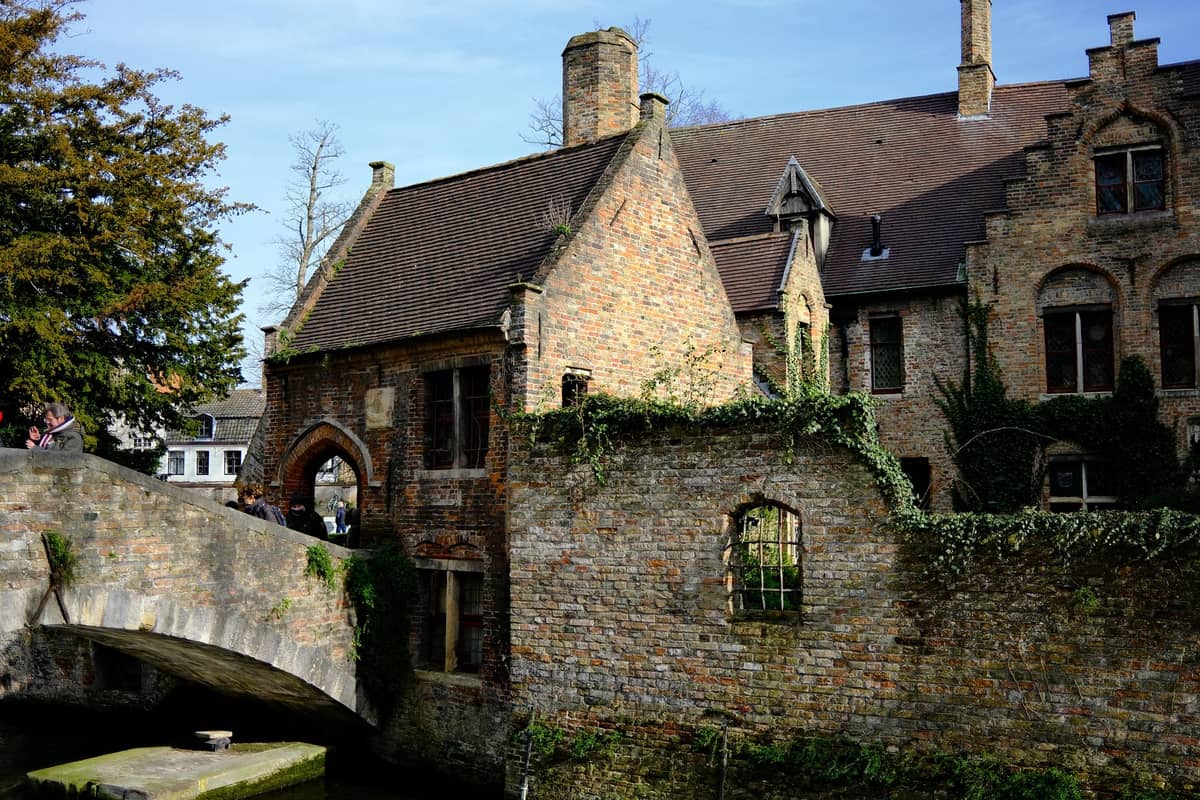
The Bonifaciusbrug is a small stone and brick pedestrian bridge that arches over a narrow branch of the canal in central Bruges. It connects the garden behind the Gruuthusemuseum to the area behind the Church of Our Lady, creating a short passage that most visitors treat as a photo stop rather than a through-route. Despite looking as though it has stood since the Middle Ages, the bridge dates to 1910, making it one of the youngest bridges in the city.
That gap between appearance and reality is the whole story with the Bonifaciusbrug. Its brick arches, worn stone railings, and the Gothic tower of Onze-Lieve-Vrouwekerk rising directly behind it produce a composition that reads as deeply medieval. In practice, early 20th-century civic architects in Bruges were actively building in historical styles to reinforce the city's identity as a preserved medieval landscape. The bridge is a product of that conscious effort, and it works.
ℹ️ Good to know
Access: the bridge and surrounding garden area are generally open daily. There is no admission charge. Hours can vary slightly by season, so check the Visit Bruges official page before an early morning or late evening visit.
The View From the Bridge: What You Actually See
Standing on the Bonifaciusbrug and looking south, the canal stretches ahead between high brick walls draped in ivy and climbing plants. The water is still enough that on calm mornings it mirrors the facades above it almost perfectly. A weeping willow hangs over the right bank. The Church of Our Lady's tower anchors the skyline directly to your north. Few canal views in Bruges frame that tower as cleanly as this one.
Looking in the opposite direction, the canal widens slightly toward the Dijver. The Gruuthusemuseum's Gothic facade appears through gaps in the vegetation, its ochre stonework contrasting with the dark canal water below. The surrounding garden, small and partly enclosed by old walls, adds a sense of compression that makes the bridge feel more intimate than the open Rozenhoedkaai a short walk to the north.
The Bonifaciusbrug sits within easy walking distance of several of the city's most significant cultural sites. The Church of Our Lady is literally adjacent, its entrance on Mariastraat just around the corner. The Gruuthusemuseum borders the garden to the west. Both sites charge admission, but the bridge and garden between them are free to experience.
Tickets & tours
Hand-picked options from our booking partner. Prices are indicative; availability and final rates are confirmed when you complete your booking.
Historium Bruges entrance tickets
From 19 €Instant confirmationFree cancellationBruges food tour with full meal
From 139 €Instant confirmationFree cancellationBruges walking audio guided tour
From 9 €Instant confirmationBruges Family Walking Tour
From 259 €Instant confirmationFree cancellation
How the Experience Changes by Time of Day
Early morning, between 07:00 and 09:00, is when the Bonifaciusbrug is at its most atmospheric and least crowded. The canal surface is glassy, the surrounding lanes are quiet, and the soft northern light makes the stonework glow without producing harsh shadows. At this hour, the bridge often has nobody on it at all for stretches of several minutes, which is genuinely rare for one of Bruges' most photographed corners.
By mid-morning, tour groups and independent walkers start arriving, and the narrow bridge can become briefly congested. The bridge is only wide enough for two people to pass comfortably, so when a group of 10 or 15 arrives for a guided photo stop, the experience shifts from contemplative to logistical.
In winter, the crowds thin considerably. Bruges in December and January can be cold and damp, with daytime temperatures around 2 to 7 degrees Celsius, but the bare willow and mist over the canal create a different kind of visual quality. If you are visiting Bruges in the quieter months, this is one of the spots that rewards the effort of getting up before the city wakes.
💡 Local tip
Photography tip: the best angle for the iconic shot is not from on the bridge but from the canal-side path to the south, looking back north toward the bridge with the Church of Our Lady tower behind it. You will need to step down toward the water slightly. A wide-angle lens or a standard smartphone camera works well here; the scene is compact enough that telephoto compression is not necessary.
The Historical Context: A 20th-Century Bridge in a Medieval City
Bruges spent much of the 19th century in economic decline after its medieval trading supremacy faded with the silting of the Zwin estuary and the rise of Antwerp as the dominant Flemish port. By the late 1800s, the city had become something of a time capsule, its Gothic architecture largely intact simply because there had been little money or motivation to replace it. When prosperity returned through tourism and light industry, local authorities made deliberate choices to maintain and extend that medieval character.
The Bonifaciusbrug, built in 1910, reflects that policy precisely. Rather than constructing a functional modern bridge in iron or early reinforced concrete, the city commissioned a structure in brick and stone that would harmonise with the 15th-century buildings around it. The result is a bridge that many visitors assume is centuries older than it is. There is an argument that this is a form of architectural deception, and there is a counter-argument that the consistency of the urban fabric it produces is exactly what makes the historic centre of Bruges a UNESCO World Heritage Site.
Understanding the bridge in this context makes more sense if you also understand the broader canal quarter it sits within. The Dijver Canal Quarter is the stretch running from the Markt south toward the Minnewater, and it contains the highest concentration of medieval-era civic architecture in the city. The Bonifaciusbrug is one small component of that continuous landscape.
Getting There and Practical Walkthrough
The bridge is not signposted with particular clarity from the main tourist routes, which means some visitors walk past it without realising. From the Markt, head south along Wollestraat toward the Dijver canal, then continue along the canal path past the Groeninge Museum entrance. The lane that leads left between the Gruuthusemuseum wall and the rear garden of the Church of Our Lady brings you directly to the bridge. The walk from the Markt takes around 10 minutes at a comfortable pace.
From the bus stop Brugge OLv Kerk (stop 502818), the bridge is a two-minute walk. If you are arriving by train to Station Brugge, buses depart regularly toward the historic centre, or the walk from the station to the Bonifaciusbrug takes around 15 to 20 minutes through the southern part of the old city.
The bridge itself has steps at both ends and a slightly arched deck made of uneven stone. It is not accessible by wheelchair or pushchair. The surrounding garden paths also include cobblestones and slight changes in level, so visitors with mobility limitations should be aware that the immediate area is not step-free. The view from the canal-side path to the south is accessible without crossing the bridge and offers the best photographic angle in any case.
⚠️ What to skip
The bridge is narrow and has no handrails on the canal side. In wet weather, the stone surface becomes slippery. Wear shoes with grip, and take care with children near the water's edge on the approach paths.
Is It Worth the Stop?
The Bonifaciusbrug is genuinely one of the better free photo spots in Bruges, but it is worth being clear about what it offers and what it does not. It is a small bridge over a narrow canal. The experience of being there lasts 15 to 20 minutes at most before you have seen all of it. It does not have interpretive panels, a visitor centre, or any infrastructure beyond the bridge and a small garden. It is a pause in a walk, not a destination in its own right.
That said, the composition it offers, specifically the canal, the ivy-covered walls, and the tower of the Church of Our Lady, is among the most concentrated and accessible examples of why Bruges looks the way it does in photographs. If your visit to Bruges includes the Gruuthusemuseum or the Church of Our Lady, the bridge is a natural addition that adds almost no time to your day. If you are not in that part of the city, making a special journey for the bridge alone is probably not justified.
Visitors who find the Bonifaciusbrug underwhelming in its scale often respond more strongly to the Rozenhoedkaai, which is a five-minute walk north and offers a wider, more panoramic canal view. The two are complementary rather than interchangeable.
Insider Tips
- Arrive before 09:00 if you want the bridge to yourself. By 10:00, guided tour groups begin arriving in rotation and the narrow deck becomes difficult to photograph without strangers in the frame.
- The best photograph of the bridge is taken from the south bank of the canal, looking north with the Church of Our Lady tower behind it. This angle is not obvious from the bridge itself; you need to walk a few metres past the bridge and turn around.
- The small garden between the Gruuthusemuseum and the Church of Our Lady is itself worth a few minutes. It contains a bronze statue of the Spanish humanist Juan Luis Vives, who lived in Bruges in the early 16th century. A bronze statue of him stands in the garden (he was buried at St. Donatian's Cathedral, later demolished). The statue is easy to miss if you walk straight to the bridge.
- In wet weather, the stone deck of the bridge becomes noticeably slippery. The canal walls on both sides are low. This is not a dangerous bridge, but it is worth paying attention underfoot, particularly if you are carrying camera equipment.
- If you are planning a longer walk along the canal, the Bonifaciusbrug connects naturally to a route south toward the Begijnhof and Minnewater. This southern section of the Dijver quarter is quieter than the stretch toward the Markt and gives a good sense of the residential character of the historic centre.
Who Is Boniface Bridge (Bonifaciusbrug) For?
- Photographers and travellers who want the classic Bruges canal composition in a compact, unhurried setting
- Couples walking the canal quarter who want a quiet moment away from the main tourist flow
- Architecture and urban history enthusiasts interested in how Bruges managed its 20th-century built environment
- Anyone already visiting the Gruuthusemuseum or Church of Our Lady, for whom the bridge is a zero-effort addition
- Winter visitors who want the most atmospheric version of the canal quarter with minimal crowds
Nearby Attractions
Other things to see while in Dijver Canal Quarter:
- Hof Arents
Hof Arents is a free public park in the heart of Bruges, set along the Dijver near the Church of Our Lady and the Gruuthuse domain. Once part of the historic Gruuthuse estate, it offers canal views and a quiet break in the historic centre.
- Groeninge Museum
The Groeningemuseum on Dijver holds one of the most concentrated collections of Flemish Primitive painting anywhere in the world, including landmark works by Jan van Eyck and Hans Memling. Compact enough to absorb in two hours, serious enough to reward repeat visits, it anchors Bruges' reputation as a city of medieval artistic genius.
- Gruuthuse Museum
The Gruuthuse Museum occupies a late medieval city palace on the Dijver canal, tracing Bruges' history from the Middle Ages to the 19th century through furniture, tapestries, weapons, and devotional art. It is one of the few places in Bruges where the building itself is as significant as what it contains.
- Memling in Sint-Jan
Housed inside one of Europe's oldest surviving hospital complexes, Memling in Sint-Jan holds five major works by Hans Memling, the Flemish master who defined 15th-century devotional painting. The setting alone, a working medieval ward turned museum, makes this unlike any conventional art gallery in Bruges.