Church of Our Lady (Onze-Lieve-Vrouwekerk): Bruges' Gothic Giant with a Michelangelo Inside
Rising above the Dijver canal quarter on a 115-metre brick tower, the Church of Our Lady is one of Bruges' most architecturally significant buildings. Beyond the soaring Gothic nave, the museum section holds Michelangelo's marble Madonna and Child and the gilded tombs of Mary of Burgundy and Charles the Bold.
Quick Facts
- Location
- Mariastraat, 8000 Bruges (Dijver canal quarter)
- Getting There
- 20–25 min walk from Brugge railway station, or take a De Lijn city bus to the centre and walk south
- Time Needed
- 45–90 minutes (nave + museum section)
- Cost
- Nave: free. Museum (Madonna, royal tombs): €10 adults, €9 ages 18–25, €5 under 18, free under 13. Pinagsamang tiket kasama ang Gruuthusemuseum: €19
- Best for
- Art history enthusiasts, architecture lovers, anyone with an interest in Burgundian heritage
- Official website
- www.museabrugge.be/en/visit/locations/olv-kerk-museum
What the Church of Our Lady Actually Is
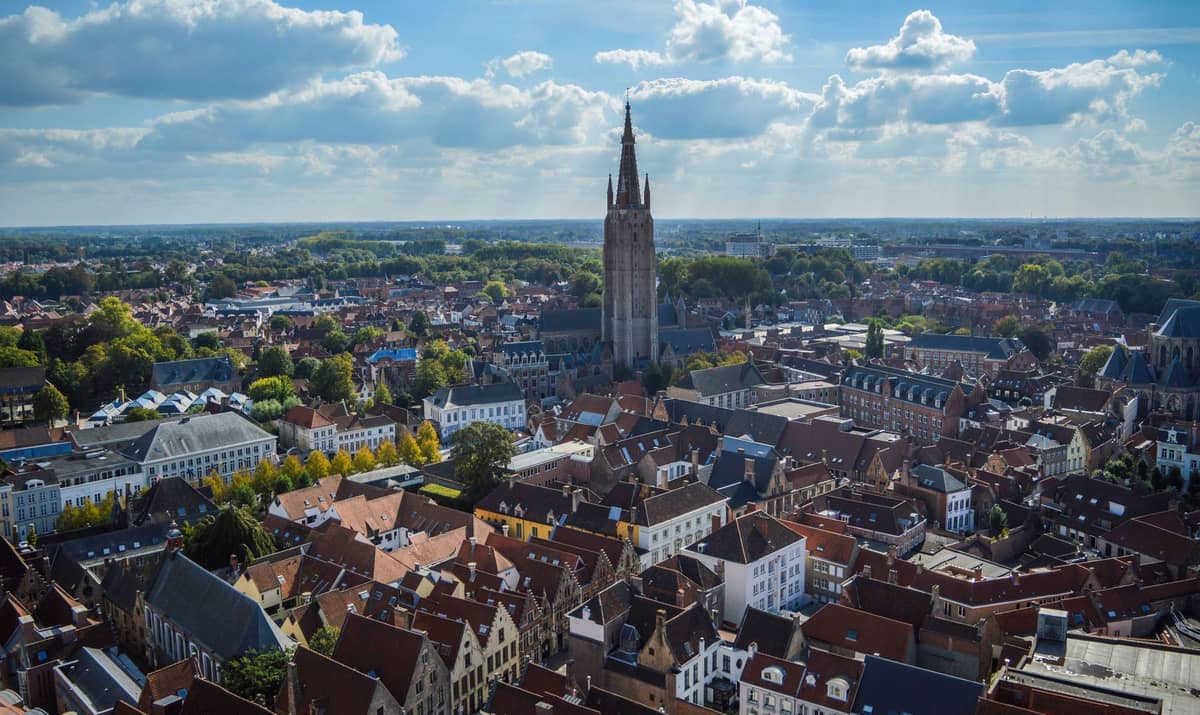
The Church of Our Lady, known locally as the Onze-Lieve-Vrouwekerk, is a Gothic brick church that has dominated the Bruges skyline for centuries. Its tower stands about 115 metres tall depending on the source, placing it among the tallest brick church towers ever constructed. From the Dijver canal and the nearby Rozenhoedkaai, the spire appears almost implausibly tall for a city at sea level.
But the tower is not the main reason serious visitors come here. The church houses one of only a handful of Michelangelo sculptures outside Italy: the marble Madonna and Child, carved around 1503–1505 and acquired by the Mouscron family shortly after, arriving in Bruges around 1506. the gilded bronze tombs of Mary of Burgundy and her father Charles the Bold, two of the most consequential figures in late medieval Flemish history. These are not replicas or facsimiles. They are originals, and they are in a relatively modest room attached to the main nave.
ℹ️ Good to know
The nave is free to enter during opening hours. The museum section, which contains the Michelangelo sculpture and the royal tombs, requires a separate ticket (€10 adults). You can step inside the church and see the Gothic architecture without paying anything.
The Gothic Architecture: What You Are Looking At
Construction on the Church of Our Lady began in the 13th century and continued across several hundred years, which explains why the building is not architecturally uniform. The oldest sections reflect early Scheldt Gothic style; later additions pushed the tower ever higher. The result is a layered structure that rewards close attention.
Inside, the nave is wide and light-filled by Flemish Gothic standards. Stone columns divide the central space from the side aisles, and the clerestory windows allow afternoon light to move across the interior in a way that changes significantly depending on the time of day. Morning visits tend to find the church quiet, the stone floor cool underfoot, and the smell of old timber and stone faintly present. By mid-afternoon, tour groups move through with some frequency, and the acoustic quality of the space means multiple languages overlap near the museum entrance.
For visitors already engaged with Flemish Gothic architecture, the church pairs naturally with the Stadhuis van Brugge and the Basilica of the Holy Blood a short walk north on Burg Square. Together they form the clearest survey of medieval civic and religious architecture in the city.
Tickets & tours
Hand-picked options from our booking partner. Prices are indicative; availability and final rates are confirmed when you complete your booking.
Historium Bruges entrance tickets
From 19 €Instant confirmationFree cancellationBruges food tour with full meal
From 139 €Instant confirmationFree cancellationBruges walking audio guided tour
From 9 €Instant confirmationBruges Family Walking Tour
From 259 €Instant confirmationFree cancellation
The Michelangelo Madonna and Child
This is the centerpiece of the museum section, and it deserves your full attention. The white Carrara marble sculpture depicts the Virgin Mary seated, with the Christ child standing between her knees. Michelangelo carved it between about 1503 and 1505, and it was purchased by the Mouscron family of Bruges merchants, likely as a devotional and status object; it arrived in Bruges around 1506.
The figure is smaller than many visitors expect: about 128 centimetres tall. What strikes most people is the psychological distance between the two figures. The child looks outward, away from his mother, while Mary's gaze is downcast. The relationship between them is rendered with a stillness that feels more emotionally complex than triumphant. The museum display places the sculpture at eye level with minimal obstruction, which is not always the case with major works of this kind.
💡 Local tip
Photography of the Madonna and Child is permitted without flash. The sculpture is displayed in a way that allows you to walk around it, which is worth doing: the treatment of the drapery is best appreciated from the side.
During Napoleon's occupation of Belgium, the sculpture was removed to Paris. It was returned after 1815. The fact that it is here at all, in a regional church rather than a national capital museum, is a quirk of history that distinguishes Bruges from cities that lost their great works permanently.
The Royal Tombs of Mary of Burgundy and Charles the Bold
Adjacent to the Madonna and Child, two elaborate late-medieval tombs occupy a side chapel. The tomb of Mary of Burgundy (1457–1482) is the earlier and more refined of the two. Mary, daughter of Charles the Bold, was the last Duchess of Burgundy and died at age 25 after a riding accident. Her effigy lies in gilded bronze, her features idealized but specific, with heraldic detail across the borders.
The tomb of Charles the Bold (1433–1477), Duke of Burgundy, stands beside hers. His remains were moved here from Nancy long after his death at the Battle of Nancy; the tomb was constructed later, and the two together represent a deliberate statement about Burgundian dynastic continuity. The Dukes of Burgundy controlled much of what is now Belgium and the Netherlands at the height of their power, and Bruges was one of the wealthiest cities in their territory. Standing at these tombs makes the abstract idea of that era feel concrete.
For context on Flemish art from the same period, the Groeningemuseum is a short walk away along the Dijver and holds one of the finest collections of early Flemish painting in the world, including works by Jan van Eyck and Hans Memling.
When to Visit and How the Experience Changes
The museum section opens at 09:30 Monday through Saturday. Arriving in the first hour places you ahead of most organised tours, and the museum section feels genuinely calm: a few individuals circling the Madonna sculpture, the sound of footsteps on stone. By 11:00 on summer days and most weekends, the situation changes. Tour groups with audio guides fill the nave, and the chapel housing the tombs can feel crowded in a way that diminishes the experience.
Sunday opening for the museum section is at 13:30, which limits options for early-morning visits on that day. Catholic holidays generally follow the same 13:30 opening, with the exception of Ascension Day, when the museum remains closed entirely. The museum is also closed December 25 and January 1, and closes at 16:00 on December 24 and 31.
Winter visits have a different quality. Bruges in January or February is cold and sometimes grey, but the church interior is unhurried, and the light through the Gothic windows, low and angled, gives the nave a different atmosphere than summer afternoons. Visitors who find peak-season Bruges too crowded often prefer the city between November and March. The museum section is no less rewarding in those months.
⚠️ What to skip
Opening hours and prices are subject to change. Verify the most current information at museabrugge.be before your visit, particularly around public holidays.
Practical Information: Getting There, Tickets, and Access
The church is on Mariastraat, in the Dijver canal quarter south of the city centre. From the Markt (Market Square), it is roughly a 10-minute walk south along Steenstraat and then Mariastraat. From Brugge railway station, the walk takes around 15 minutes through the historic centre, or you can take a De Lijn city bus to the centre and walk from there. There is no car access or parking immediately adjacent to the church; Bruges' historic core is largely car-restricted.
The nave is free to enter. The museum ticket (€10 for adults, €9 for ages 18–25, €5 for visitors under 18, free for under 13) covers the Michelangelo Madonna, the royal tombs, and the broader collection within the museum section. A combined ticket with the Gruuthusemuseum next door costs €19 and is worth considering if you plan to visit both, since the Gruuthuse collection relates directly to Burgundian Bruges.
The church is listed as accessible for visitors with reduced mobility and is equipped with an induction hearing loop. If you are combining it with the canal quarter's other sites, the Gruuthusemuseum shares a wall with the church and the two are connected at the museum level, which is an architectural detail worth noting in itself.
Modest dress is appropriate, as this is an active place of worship as well as a museum. There is no formal dress code enforcement, but very brief or revealing clothing is out of place. The stone floor can be cold, so comfortable closed shoes are practical, particularly for extended visits.
Who Will Not Enjoy This
Visitors primarily interested in panoramic views or outdoor Bruges will find the church less relevant than the Belfort tower or the canal network. The interior is impressive but not visually overwhelming in the way that Notre-Dame de Paris or Antwerp Cathedral might be; it is a focused rather than a sweeping experience. Families with very young children may find the museum section constraining, since the display cases and sculpture require quiet proximity. Those with no particular interest in medieval art or Flemish history may find €10 steep for a 20-minute experience.
If you are unsure whether this fits your itinerary, the Bruges one-day itinerary guide places the church in the context of a full day in the city and helps you judge whether the museum section warrants a dedicated stop or a free-entry browse.
Insider Tips
- Buy the combined ticket with the Gruuthusemuseum at the Gruuthuse entrance before entering the church museum. The queues there are typically shorter, and the two buildings share internal access at the museum level.
- The church tower is visible from the Rozenhoedkaai canal bend, widely considered the most photographed spot in Bruges. If you want that iconic roofline shot with the tower reflected in the water, go at dawn before foot traffic builds.
- The free nave gives you access to several side altars and decorative elements that most visitors walk past quickly. The painted ceiling sections near the crossing are worth a deliberate stop, independent of the museum ticket.
- Weekday mornings between 09:30 and 10:30 are consistently the quietest window. Tour operators tend to arrive at the church after 10:30, following their Markt and Belfort stops.
- If you are visiting in summer, note that the interior stays noticeably cooler than the street outside. It is a practical midday refuge as well as a cultural site.
Who Is Church of Our Lady (Onze-Lieve-Vrouwekerk) For?
- Art history travellers who want to stand in front of a genuine Michelangelo sculpture outside Italy
- Visitors with an interest in Burgundian history and the late medieval Low Countries
- Architecture enthusiasts studying Gothic brick construction in northern Europe
- Travellers combining a cultural morning with the Groeningemuseum and Gruuthusemuseum in the same canal quarter
- Anyone visiting Bruges in the off-season who wants a substantial indoor experience away from the summer crowds
Nearby Attractions
Other things to see while in Dijver Canal Quarter:
- Hof Arents
Hof Arents is a free public park in the heart of Bruges, set along the Dijver near the Church of Our Lady and the Gruuthuse domain. Once part of the historic Gruuthuse estate, it offers canal views and a quiet break in the historic centre.
- Boniface Bridge (Bonifaciusbrug)
The Bonifaciusbrug is a small pedestrian bridge over a canal in the heart of Bruges, tucked behind the Church of Our Lady and near the Gruuthusemuseum. Built in 1910 but styled to look centuries older, it offers one of the city's most reproduced canal views. Entry is free and the surrounding garden is open daily.
- Groeninge Museum
The Groeningemuseum on Dijver holds one of the most concentrated collections of Flemish Primitive painting anywhere in the world, including landmark works by Jan van Eyck and Hans Memling. Compact enough to absorb in two hours, serious enough to reward repeat visits, it anchors Bruges' reputation as a city of medieval artistic genius.
- Gruuthuse Museum
The Gruuthuse Museum occupies a late medieval city palace on the Dijver canal, tracing Bruges' history from the Middle Ages to the 19th century through furniture, tapestries, weapons, and devotional art. It is one of the few places in Bruges where the building itself is as significant as what it contains.