Hof Arents: Bruges' Quiet Park on the Dijver
Hof Arents is a free public park in the heart of Bruges, set along the Dijver near the Church of Our Lady and the Gruuthuse domain. Once part of the historic Gruuthuse estate, it offers canal views and a quiet break in the historic centre.
Quick Facts
- Location
- Dijver, 8000 Bruges (Dijver canal quarter, near the Church of Our Lady and Gruuthuse domain)
- Getting There
- Walk from Brugge train station; nearest bus stop is Brugge Olv Kerk (De Lijn). Pandreitje car park is close by.
- Time Needed
- 20–40 minutes for the garden alone; combine with Groeningemuseum or Gruuthusemuseum for a half-day
- Cost
- Free. No ticket required.
- Best for
- Canal walks, art lovers, quiet breaks, photographers, families needing outdoor space
What Is the Arentshof?
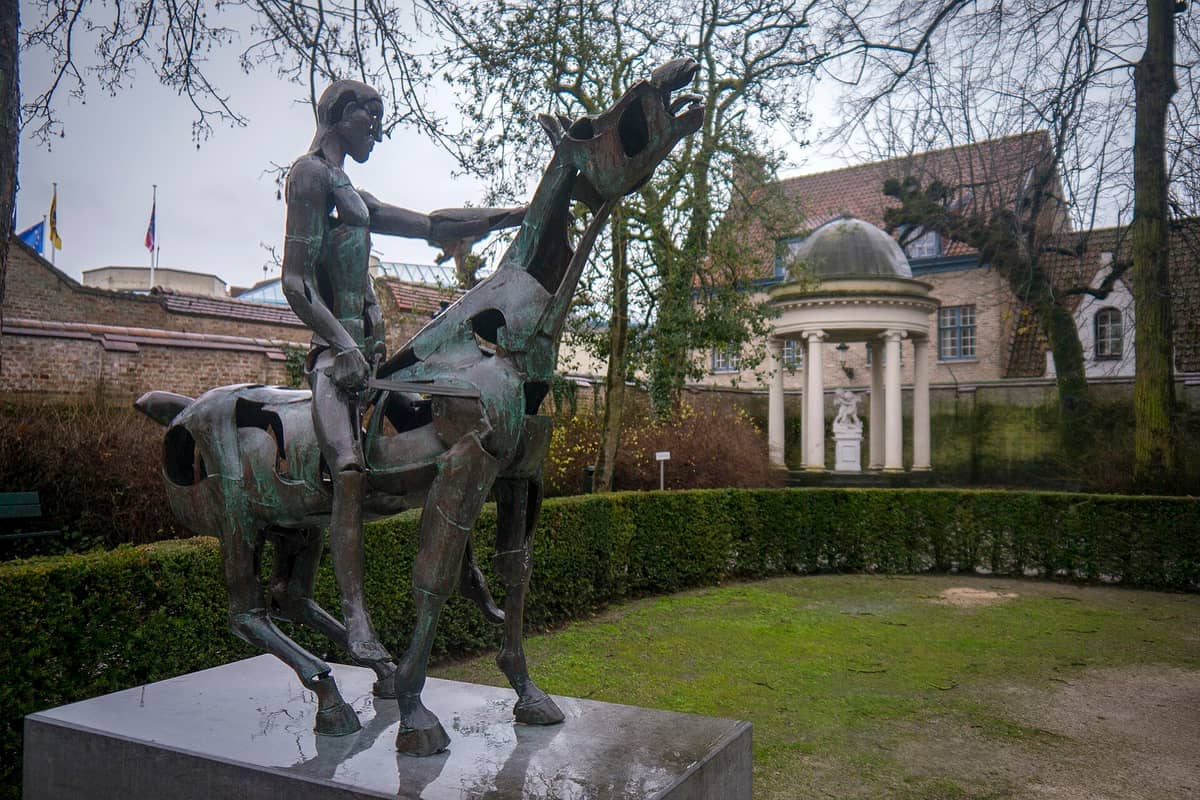
Hof Arents (sometimes written Hof Arents, or referred to in English as the Arentshof Sculpture Garden) is a small public garden occupying a quiet corner of Bruges' most museum-dense street, the Dijver canal quarter. It sits near two of the city's most important cultural institutions: the Groeningemuseum and the Gruuthusemuseum. Entry is free and the space is open at all hours, making it one of the most accessible public outdoor spaces in the historic centre.
The garden is not grand in scale. It won't take 90 minutes of your day. But it earns its place in any itinerary as a genuine counterweight to the crowds on the Markt and Burg Square: a spot where the medieval density of Bruges relaxes briefly into open sky, water glimpses, and open-air sculpture.
💡 Local tip
The garden is free to visit, with no ticket or registration required. Visit early morning (before 9am) or after 6pm in summer to have it almost entirely to yourself.
History: From Gruuthuse Domain to Public Garden
The land that forms the Arentshof was once part of the broader Gruuthuse domain. The Gruuthuse family were among the most powerful in medieval Bruges, controlling the lucrative gruut tax on spiced grain used in beer brewing. Their estate stretched along the Dijver canal and encompassed several adjacent properties, of which this garden formed one part.
The property was expropriated in 1908, and the garden was redesigned in its current form as a public space. The adjacent Arentshuis building, which takes its name from the site, now functions as an exhibition space under the Musea Brugge network. If you want to understand the full historical weight of this stretch of the Dijver, the nearby Gruuthusemuseum provides excellent context, covering the city's domestic history from the 15th century onward.
This part of Bruges belongs to the UNESCO World Heritage-listed historic centre. The Dijver canal quarter as a whole represents some of the densest concentration of medieval and post-medieval heritage in Belgium, and the Arentshof sits at its geographical core.
Tickets & tours
Hand-picked options from our booking partner. Prices are indicative; availability and final rates are confirmed when you complete your booking.
Historium Bruges entrance tickets
From 19 €Instant confirmationFree cancellationBruges food tour with full meal
From 139 €Instant confirmationFree cancellationBruges walking audio guided tour
From 9 €Instant confirmationBruges Family Walking Tour
From 259 €Instant confirmationFree cancellation
What You Actually See: Sculpture, Canal Light, and Narrow Paths
The garden is laid out on gently uneven ground with a mix of paved and unpaved flat paths, mature trees, and low planting. The open-air sculpture collection changes periodically; past installations have included figurative and abstract bronze and stone works placed at intervals along the garden's main axis. The sculptures are not labelled in elaborate detail, so the experience is more ambient than curatorial: you encounter pieces rather than study them.
From certain points in the garden, you can see or sense the Dijver canal nearby, and the rear facades of buildings that form one of the most photographed canal stretches in the city. In spring and summer, the garden fills with a low-level sound of birds and the occasional soft echo of tour boats on the adjacent water. The smell of the nearby canal, especially in warm weather, is mild but present: green, slightly organic, characteristic of Bruges' inner waterways.
Photography here rewards patience over speed. The interplay of stone, greenery, and the soft light that filters through the tree canopy in mid-morning creates conditions that the fully exposed canal front at Rozenhoedkaai does not. The garden is less dramatic but more intimate, and on overcast days, which are common in Bruges given its maritime climate, the diffused light is actually flattering for sculpture photography.
How the Experience Changes by Time of Day
Early mornings, particularly between 7am and 9am, the Arentshof is close to deserted. The surrounding streets are quiet, and the garden feels like a private courtyard. This is when the space is most atmospheric: damp paths, morning bird calls, and the absence of commentary from passing tour groups.
By mid-morning, the Dijver corridor begins to fill with visitors moving between the Groeningemuseum and the Gruuthusemuseum. The garden itself rarely becomes crowded in the way the Markt does, but foot traffic through the connecting paths increases noticeably from around 10:30am. Midday in summer brings the highest density of casual passers-through: visitors using the garden as a shortcut or a lunch stop.
Late afternoon light, especially from April through September, falls at a low angle across the garden from the west, which produces long shadows across the sculpture surfaces and lights up the stone textures. If you plan to photograph the works, 4pm to 6pm on a clear day is the most rewarding window. After museum closing time, the garden quietens again and reverts to local use: dog walkers, residents cutting through, occasional couples on benches.
Practical Walkthrough: Getting In and Moving Around
The main entrance from the Groeninge side involves a small threshold. Once inside, paths are wide and flat, mostly cobblestone or compressed earth. The garden is compact enough that there is no navigational complexity: you can cover the whole space in 10 minutes at a slow walk, or linger as long as you choose.
Wheelchair users should note that while the internal paths are manageable, the entrance threshold and some uneven surfaces may create minor difficulties. If accessibility is a priority, check directly with Musea Brugge before planning a visit that includes the building.
The garden makes a natural pause point on a longer Dijver walk. A practical sequence: arrive from the Groeningemuseum after a morning of Flemish Primitives, spend 20 minutes in the Arentshof, then continue to the Gruuthusemuseum or walk a few minutes south to the Onze-Lieve-Vrouwekerk, which holds Michelangelo's Madonna and Child. This sequence covers the cultural core of Bruges without backtracking.
ℹ️ Good to know
The nearest bus stop (Brugge Olv Kerk, De Lijn) is a short walk away. From Brugge train station, the walk takes about 15 minutes along Mariastraat or through the Begijnhof area. Check current De Lijn fares before travel.
Weather and Seasonal Considerations
Bruges has a temperate maritime climate, which means the Arentshof is generally pleasant from late April through September, with mild spring and summer temperatures. Rain is spread fairly evenly across the year, so carrying a compact umbrella or light waterproof is sensible regardless of season.
In winter, the garden is stripped back and quieter, but still accessible. The bare tree canopy opens up views and the sculpture pieces read differently without leaf cover. If you are visiting Bruges between November and February, the garden is still worth a 15-minute detour on the way between the Dijver museums. For more on what works well in colder months, see the guide to Bruges in winter.
⚠️ What to skip
After heavy rain, some of the unpaved paths in the garden can become muddy. Wear shoes with some grip if visiting in autumn or winter.
Insider Tips
- The garden connects the Groeningemuseum and Gruuthusemuseum at ground level, making it a useful shortcut that also doubles as a breather between two dense museum visits. Most visitors walking this route don't stop, which means the benches are often free even when the surrounding streets are not.
- The Arentshuis building (part of the Musea Brugge network) sits immediately adjacent. Admission to the Arentshuis is listed as free; check the Musea Brugge website for current exhibition status before arriving.
- For the best sculpture photography, visit on an overcast day rather than in harsh midday sun. The even diffused light common in Bruges' climate actually suits stone and bronze surfaces better than direct sunlight.
- The garden is one of the few genuinely free, open-air spaces in the historic centre where you can sit without being expected to order anything. It functions as a quiet rest point in the middle of what can otherwise be an exhausting museum corridor.
- If you enter from the Dijver side, you get a partial view toward the canal from within the garden. Position yourself near the northern boundary in the late afternoon for the best canal-light angles without having to compete for space at the more famous Rozenhoedkaai viewpoint a few minutes away.
Who Is Hof Arents For?
- Museum-goers wanting an outdoor break between the Groeningemuseum and Gruuthusemuseum
- Photographers seeking quieter, less-photographed angles on Bruges' canal quarter
- Families with children who need open space after an indoor cultural stretch
- Visitors on a budget looking for free, quality public space in the city centre
- Anyone whose Bruges itinerary follows the Dijver canal corridor and wants to slow down rather than rush between landmarks
Nearby Attractions
Other things to see while in Dijver Canal Quarter:
- Boniface Bridge (Bonifaciusbrug)
The Bonifaciusbrug is a small pedestrian bridge over a canal in the heart of Bruges, tucked behind the Church of Our Lady and near the Gruuthusemuseum. Built in 1910 but styled to look centuries older, it offers one of the city's most reproduced canal views. Entry is free and the surrounding garden is open daily.
- Groeninge Museum
The Groeningemuseum on Dijver holds one of the most concentrated collections of Flemish Primitive painting anywhere in the world, including landmark works by Jan van Eyck and Hans Memling. Compact enough to absorb in two hours, serious enough to reward repeat visits, it anchors Bruges' reputation as a city of medieval artistic genius.
- Gruuthuse Museum
The Gruuthuse Museum occupies a late medieval city palace on the Dijver canal, tracing Bruges' history from the Middle Ages to the 19th century through furniture, tapestries, weapons, and devotional art. It is one of the few places in Bruges where the building itself is as significant as what it contains.
- Memling in Sint-Jan
Housed inside one of Europe's oldest surviving hospital complexes, Memling in Sint-Jan holds five major works by Hans Memling, the Flemish master who defined 15th-century devotional painting. The setting alone, a working medieval ward turned museum, makes this unlike any conventional art gallery in Bruges.