Rozenhoedkaai (Rosary Quay): Bruges' Most Iconic Canal View
Standing at the bend of the Dijver canal, Rozenhoedkaai frames a view of medieval gabled houses, drooping willows, and distant Gothic spires that has appeared in more travel photographs than perhaps any other spot in Belgium. Free to visit at any hour, it rewards those who time it right.
Quick Facts
- Location
- Rozenhoedkaai, 8000 Brugge (Bruges), Belgium — Dijver Canal Quarter, historic centre
- Getting There
- 10-min walk from Markt (Market Square); nearest bus stop Brugge Dijver; 20-min walk from Bruges main train station
- Time Needed
- 15–30 minutes at the quay itself; allow more if combining with nearby attractions
- Cost
- Free, 24/7, no ticket required. Canal boat tours nearby cost approximately €15 per adult, with reduced rates for children and groups (verify locally)
- Best for
- Photography, architecture lovers, romantic walks, first-time visitors to Bruges
What Is Rozenhoedkaai?
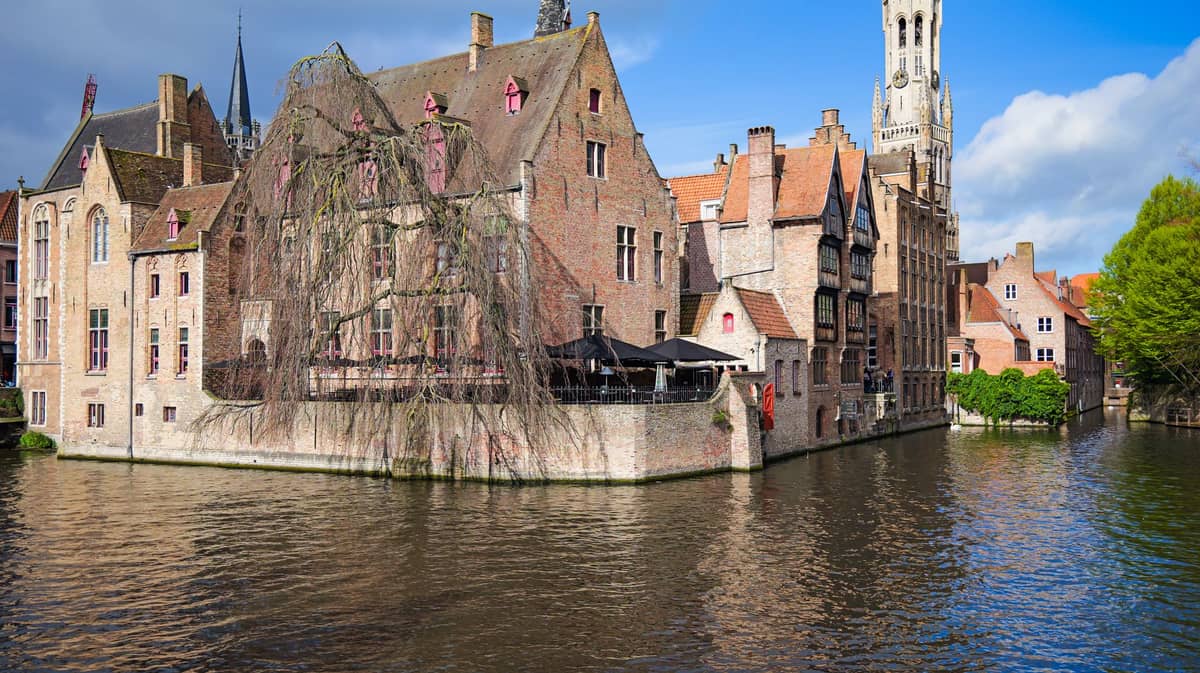
Rozenhoedkaai, Dutch for Rosary Quay, is a short stretch of canal-side walkway along the Dijver in the heart of Bruges' historic centre. It sits at the point where the canal makes a pronounced curve, framed on all sides by step-gabled medieval houses, weeping willows trailing into the water, and, in the distance, the tower of the Belfort and the spire of the Onze-Lieve-Vrouwekerk rising above the rooflines. It is consistently cited as the most photographed location in Bruges, and the view holds up to that reputation.
Despite the reputation, Rozenhoedkaai is simply a public quay. There is no entrance gate, no ticket booth, no guided tour required. You walk up, you look at the canal, and you understand immediately why this corner of a small Flemish city has ended up on so many postcards. The name itself comes from a medieval rose-hat trade once conducted in the area, though today no trace of commerce remains, only the view.
💡 Local tip
Rozenhoedkaai is at its quietest before 9 AM. Arrive early to photograph the canal without crowds of tourists gathered along the bridge. In summer, golden light hits the gabled facades between 7 and 8:30 AM.
The View: What You're Actually Looking At
The canonical view looks south-west along the Dijver canal from the Nepomucenus bridge. The water in the foreground reflects the facades of the buildings lining Steenhouwersdijk, their red-brick gables and cream-coloured stone details mirrored with unusual clarity on calm mornings. The willows at the waterline add a softness that contrasts with the hard geometry of the medieval architecture behind them.
In the middle distance, you will see flat-bottomed canal boats carrying tourists on the Dijver, which adds movement and a sense of scale. Further back, the Belfort tower and the church spires anchor the skyline in a way that makes the entire frame feel deliberately composed. The buildings date from various periods of Bruges' mercantile history, primarily the 15th through 17th centuries, though many facades were restored or rebuilt during the 19th-century Gothic Revival that swept through the city.
For a broader understanding of why Bruges looks this way, the Bruges Gothic architecture guide explains the layers of original medieval construction, 19th-century restoration, and the UNESCO World Heritage designation that now governs what can change.
Tickets & tours
Hand-picked options from our booking partner. Prices are indicative; availability and final rates are confirmed when you complete your booking.
Historium Bruges entrance tickets
From 19 €Instant confirmationFree cancellationBruges food tour with full meal
From 139 €Instant confirmationFree cancellationBruges walking audio guided tour
From 9 €Instant confirmationBruges Family Walking Tour
From 259 €Instant confirmationFree cancellation
How the Experience Changes By Time of Day
Early morning, roughly between 7 and 9 AM, the quay belongs to dog walkers, joggers, and the occasional photographer with a tripod. The light at this hour is low and directional, and because Bruges sits in the flat Flemish coastal plain at near sea level, even slightly overcast conditions produce a soft, diffused quality that renders the red-brick facades in deep, saturated tones. The canal surface is glassy. The reflections are at their sharpest.
By 10 AM, tour groups begin arriving and the bridge over the Nepomucenus becomes congested. Between 11 AM and 4 PM in high season (May through September), the quay is genuinely crowded. Dozens of people compete for the same angles, and the canal boats create continuous movement in the water that disrupts reflections. The experience is not ruined, but it shifts from contemplative to social. If crowds reduce your enjoyment of a place, this is worth knowing in advance.
Evening, particularly in late spring and summer when dusk comes after 9 PM, offers a second window of quality. The tour groups have largely departed by 7 PM, the light turns warm and amber, and the canal takes on a depth of colour that is quite different from the morning. Winter evenings have their own appeal: fog sits on the water more regularly between October and February, the crowds thin substantially, and the medieval streetscape gains an atmospheric quality that the summer sun tends to flatten.
If you are planning a winter trip, the guide to Bruges in winter covers what to expect across the season, including the Christmas market period when the city centre is particularly lively.
⚠️ What to skip
In summer, Rozenhoedkaai between 10 AM and 5 PM is heavily visited. If you are sensitive to crowds or aiming for clean photographs, plan your visit outside these hours. The quay is 24/7 and there is no reason not to go early.
Historical Context: Why This Spot Exists
Bruges reached its commercial peak in the 13th and 14th centuries as one of the most important trading cities in northern Europe. Its canal network was its economic backbone, connecting the city to the sea and, through inland waterways, to the broader Flemish and international trading network. The Dijver canal, along which Rozenhoedkaai sits, was one of the primary arteries of this system. Goods arriving by water were offloaded and traded at points all along the canal.
The name Rozenhoedkaai is believed to refer to the trade in rose-shaped hats or chaplets, the Dutch word rozenhoed meaning a garland or rosary. The quay was one of many specialised trading points that gave Bruges its dense network of trade-named streets and quays. By the 16th century, when the Zwin estuary silted up and the city lost its direct sea access, the commercial traffic declined, but the physical fabric remained largely intact. That intact quality is precisely what draws visitors today.
The canal network extends across the city, and exploring it on foot or by water reveals different perspectives of the medieval layout. The Bruges canal tours guide covers what a boat tour adds to the Rozenhoedkaai experience and where to board.
Getting There and Practical Walkthrough
Rozenhoedkaai is at the address Rozenhoedkaai 3, 8000 Brugge. From the Markt (Market Square), the walk takes roughly 10 minutes heading south on Wollestraat toward the canal, then turning right along the waterside. From Burg Square, the walk is even shorter, under five minutes. Both routes pass through the densest part of the medieval city centre, so the walk itself has visual interest.
From Bruges main train station, allow about 20 minutes on foot heading north-east into the old town, or take the De Lijn bus to the Brugge Dijver stop, which deposits you within a short walk of the quay. A standard single De Lijn bus ticket costs approximately €3, though fares are subject to change and should be verified before travel.
The quay itself is a stretch of paved canal-side walkway. The surface reflects the age of the city: uneven stone and brick paving in places, with the kind of gentle undulation common across the historic centre. Visitors with mobility aids should note that there are no step-free guarantees along the waterfront, and the historic streetscape does not conform to modern accessibility standards at every point. The area is manageable for most visitors on foot, but worth checking in advance for those with specific needs.
Rozenhoedkaai fits naturally into a broader walking itinerary through the city centre. The Bruges walking tour guide suggests a logical sequence that connects the Markt, Burg Square, the canal quarter, and several of the key museums and churches within a half-day.
Photography: Making the Most of the View
The most widely reproduced angle is from the Nepomucenus bridge, looking south-west along the canal. This gives you the curve of the water, the line of facades, the willows, and the spires in the background simultaneously. A wide-angle lens (equivalent to 24–35mm on a full-frame camera) captures the full composition without distortion. Phone cameras on portrait or standard mode work well from this angle.
For less common angles, walk north along the quay toward the Groenerei junction, where the canal branches and the density of overhanging trees increases. From here, the view back toward Rozenhoedkaai puts more green in the frame and less of the crowds. The reflection shots that circulate most widely on travel platforms are taken on completely calm mornings, usually in spring or autumn when wind is less frequent. A light breeze breaks the mirror effect quickly.
ℹ️ Good to know
Bruges has a temperate maritime climate with average summer temperatures of 17–22°C and frequent overcast days. Overcast light is actually flattering for canal photography, reducing harsh contrast and allowing longer exposures for smooth water effects.
What Else Is Within Walking Distance
The Dijver canal quarter is one of the most concentrated areas of cultural attractions in Bruges. Within five minutes of Rozenhoedkaai you can reach the Groeningemuseum, which holds one of the most significant collections of Flemish Primitive painting in the world, including works by Jan van Eyck and Hans Memling.
Equally close is the Gruuthusemuseum, a Gothic palace that houses applied arts and historical artefacts from Bruges' medieval and early modern periods. The canal boat departure points on the Dijver are also seconds away from the quay, making it easy to extend the visit onto the water.
A short walk south brings you to the Begijnhof and the Minnewater, two of the quieter corners of the city that contrast sharply with the busier canal-side zones. Together, the walk from Rozenhoedkaai to the Begijnhof and back via the Bonifaciusbrug takes about 45 minutes at a relaxed pace and covers most of the iconic scenery Bruges is known for.
Insider Tips
- The Nepomucenus bridge offers the classic shot, but it fills with people fast. For a cleaner frame, position yourself slightly further along the quay toward the Groenerei junction, where fewer visitors stand and the water has more green canopy overhead.
- Canal boat tours depart from the Dijver jetty a few steps from Rozenhoedkaai. Tours are officially guaranteed from March through October, usually between 10:00 AM and 6:00 PM, and last about 30 minutes; one jetty also operates daily in winter on a rotation system. Arriving at the jetty shortly before a departure (rather than queuing in peak hours) reduces wait times significantly.
- In fog, which occurs with some regularity between October and February, Rozenhoedkaai becomes a different place entirely. The spires disappear into grey, the reflections turn dark and abstract, and the medieval stone work looks closer to its original atmospheric character. This is not a reason to avoid the city in winter, it is a reason to go.
- The quay is lit at night but not brightly. Bring a phone or camera that handles low light if visiting after dark. Long-exposure shots of the canal at night, with the lamplight reflected on the water, are visually striking and require a stable surface or small tripod.
- Rozenhoedkaai itself has no cafes or vendors directly on the quay. Steenhouwersdijk, running along the opposite bank, has several spots where you can sit with a drink and look across the water at the same view from a different angle, with considerably fewer people around you.
Who Is Rozenhoedkaai For?
- First-time visitors to Bruges who want to understand what makes the city visually distinctive
- Photographers at any level looking for a genuinely rewarding composition, especially in early morning light
- Couples and those on a romantic itinerary through the historic centre
- Architecture and history enthusiasts interested in medieval Flemish urban form
- Visitors combining a canal walk with nearby museums in the Dijver quarter
Nearby Attractions
Other things to see while in Dijver Canal Quarter:
- Hof Arents
Hof Arents is a free public park in the heart of Bruges, set along the Dijver near the Church of Our Lady and the Gruuthuse domain. Once part of the historic Gruuthuse estate, it offers canal views and a quiet break in the historic centre.
- Boniface Bridge (Bonifaciusbrug)
The Bonifaciusbrug is a small pedestrian bridge over a canal in the heart of Bruges, tucked behind the Church of Our Lady and near the Gruuthusemuseum. Built in 1910 but styled to look centuries older, it offers one of the city's most reproduced canal views. Entry is free and the surrounding garden is open daily.
- Groeninge Museum
The Groeningemuseum on Dijver holds one of the most concentrated collections of Flemish Primitive painting anywhere in the world, including landmark works by Jan van Eyck and Hans Memling. Compact enough to absorb in two hours, serious enough to reward repeat visits, it anchors Bruges' reputation as a city of medieval artistic genius.
- Gruuthuse Museum
The Gruuthuse Museum occupies a late medieval city palace on the Dijver canal, tracing Bruges' history from the Middle Ages to the 19th century through furniture, tapestries, weapons, and devotional art. It is one of the few places in Bruges where the building itself is as significant as what it contains.