Princely Beguinage Ten Wijngaerde: Bruges' Most Quietly Powerful Landmark
Founded in 1245 and still inhabited by Benedictine nuns, the Princely Beguinage Ten Wijngaerde is one of the most affecting places in Bruges. Entry is free, the whitewashed courtyard is genuinely tranquil, and it sits steps from the Minnewater lake. Here is everything you need to make the most of a visit.
Quick Facts
- Location
- Begijnhof, 8000 Brugge, Belgium (Minnewater-Begijnhof quarter)
- Getting There
- Bus to Brugge Onze-Lieve-Vrouwekerk stop, or a 15-minute walk south from the Markt. Parking at Katelijne car park nearby.
- Time Needed
- 30 to 60 minutes for the courtyard and small museum; longer if you linger
- Cost
- Free entry to the beguinage grounds (small fee for the museum inside)
- Best for
- History lovers, architecture admirers, anyone seeking a quiet retreat from the crowds
What the Beguinage Actually Is
The Princely Beguinage Ten Wijngaerde (Dutch: Prinselijk Begijnhof Ten Wijngaerde) is a UNESCO World Heritage-listed religious enclosure founded in 1245. It was originally a community for beguines: devout laywomen who lived a semi-religious life of prayer and communal work without taking permanent vows. Unlike nuns, beguines could own property, leave the community, and marry. The movement flourished across the Low Countries during the medieval period, and Bruges was home to one of the largest and most prosperous beguinages in the region.
The beguines of Bruges are gone now. The remaining beguines entered a Benedictine congregation in 1927, and the enclosure has been home to Benedictine nuns ever since. They maintain the site and continue to use its church for daily prayer. The nuns actually live here. That is not a detail to gloss over: this is a functioning religious residence, not a heritage reconstruction. That fact changes how you move through the space, and it explains why the atmosphere feels different from every other landmark in the city.
ℹ️ Good to know
Opening hours: The beguinage is open year-round during daytime, and the gates close between sunset and sunrise (commonly around 6:30am–6:30pm). Hours can change with the seasons; arrive before late afternoon to be safe, especially in winter when darkness falls early. Admission to the grounds is free.
Stepping Through the Gate: First Impressions
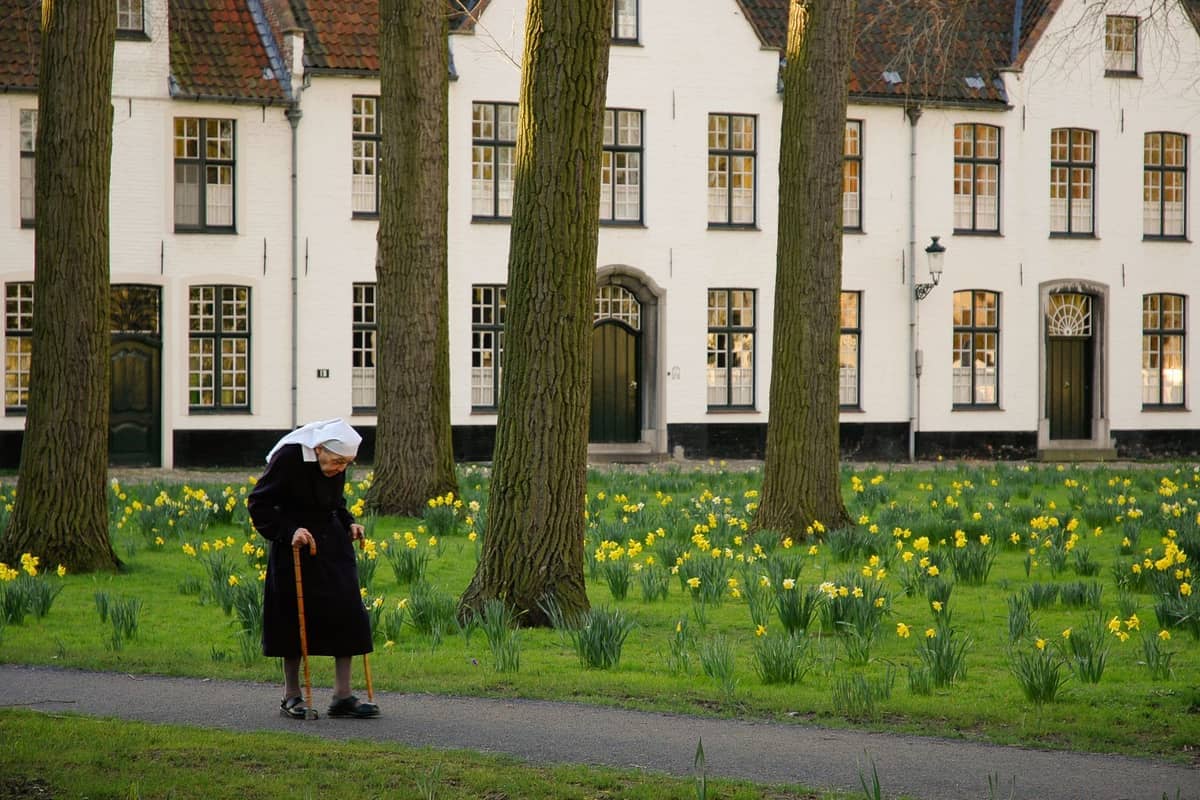
The entrance is a low arched gateway that forces a slight pause. You pass through it from a canal-side street, and the contrast is immediate. Outside, Bruges hums with foot traffic, cycling bells, and the low murmur of canal boats. Inside, the sounds drop away. The courtyard opens in front of you: a large oval of trimmed grass edged by rows of whitewashed houses, their stepped gable facades reflecting whatever light the Belgian sky is offering that day.
In spring, typically from mid-March into April, a carpet of daffodils covers the courtyard grass. It is one of the most-photographed seasonal spectacles in the city, and for good reason. In summer, the green is deep and the white walls almost glow. In winter, the bare trees and grey light give the enclosure a more austere character that some visitors actually prefer. Rain softens the stone, darkens the brickwork, and keeps the crowds away. Do not dismiss a winter visit out of hand.
The beguinage sits at the southern edge of Bruges' historic centre, directly adjacent to the Minnewater lake. Most visitors arrive as part of a southern loop through the city, pairing it with the lake and then walking north toward the Church of Our Lady. That combination makes for one of the most rewarding walking circuits in Bruges.
Tickets & tours
Hand-picked options from our booking partner. Prices are indicative; availability and final rates are confirmed when you complete your booking.
Historium Bruges entrance tickets
From 19 €Instant confirmationFree cancellationBruges food tour with full meal
From 139 €Instant confirmationFree cancellationBruges walking audio guided tour
From 9 €Instant confirmationBruges Family Walking Tour
From 259 €Instant confirmationFree cancellation
The Architecture: Understated and Precise
The houses lining the courtyard date primarily from the 17th century, when earlier structures were rebuilt and reshaped. They follow a consistent pattern: whitewashed facades, modest proportions, and the stepped gables that define Flemish domestic architecture of the period. There is no single showpiece building. The power of the architecture is cumulative, the effect of repetition and coherence rather than individual grandeur.
The beguinage church, dedicated to Our Lady of the Vine (Onze-Lieve-Vrouw van de Wijngaard), stands along the northern edge of the courtyard. Its interior is spare and functional, consistent with beguine tradition, which valued simplicity over ornamentation. The church is still in active religious use, so access may be limited during services. Check before entering.
If you want to understand the broader architectural vocabulary you are seeing here, the guide to Gothic architecture in Bruges provides useful context on how the beguinage fits into the city's built heritage.
The Museum House: A Rare Interior View
One of the courtyard houses has been converted into a small museum displaying furnishings and objects from the period of the beguines. It gives a concrete sense of how these women actually lived: the sleeping quarters, the working room, the personal devotional objects. The rooms are small and the collection modest in scale, but it is one of the few places in Bruges where you can step inside a historic interior at this human scale rather than a palace or a church.
A small admission fee applies to the museum. The amount is subject to change, so check current pricing on arrival or via the official Visit Bruges website before your visit.
How the Experience Changes Through the Day
The beguinage opens during daytime and closes again between sunset and sunrise, which means the experience shifts considerably depending on when you arrive. Early morning, particularly on weekdays, the courtyard is close to empty. The light is low and directional, crossing the white facades at sharp angles. Birdsong is audible. The nuns may be walking between buildings. It is genuinely quiet in a way that few tourist sites anywhere manage.
By mid-morning, and especially between 10am and 1pm in high season, the courtyard fills steadily with visitors arriving from canal tour stops and the Minnewater promenade. Groups with guides congregate near the church entrance. Photography slows movement. The atmosphere does not become unpleasant, but it is noticeably different. If quiet contemplation is your goal, aim for before 9am or after 4pm.
Late afternoon in autumn and winter produces some of the best photographic light: warm and low, raking across the gabled facades. In summer, the courtyard stays open long enough to catch the evening softening of the light, though dusk comes late and the crowds take time to thin.
💡 Local tip
Best time to visit: Arrive at opening or in the hour before closing. Midweek mornings in spring or autumn give you the daffodil carpet or warm light with far fewer people than weekends.
Practical Walkthrough: Getting There and Moving Around
The nearest bus stop is Brugge Onze-Lieve-Vrouwekerk, served by De Lijn city buses. From Bruges train station (Station Brugge), the walk takes about 15 minutes, heading toward the historic centre through the Katelijne quarter. Drivers should use the Katelijne car park, which is the closest paid parking to the beguinage. The walk from the car park to the gate is under five minutes.
The beguinage is most naturally visited in combination with the Minnewater lake immediately to the south, and many visitors extend the walk north to the Gruuthuse Museum or the Church of Our Lady. For a fuller picture of how to structure a day in this part of the city, the Bruges one-day itinerary maps out a logical sequence.
The courtyard is on level ground and accessible on foot without steps at the main entrance, though the cobbled surface within is uneven in places. Those using wheelchairs or mobility aids should be aware of this. No detailed official accessibility statement was available at the time of writing; contact Visit Bruges directly for current information.
⚠️ What to skip
This is a functioning religious residence. The Benedictine community who live here ask for quiet and respectful behavior throughout the site. Loud conversation, music, and intrusive photography near the residential houses are inappropriate. The request for silence is posted at the entrance and is taken seriously.
Is It Worth Your Time?
Yes, with the right expectations. The beguinage is not a grand museum or a dramatic viewpoint. It does not have the architectural shock of the Belfort or the painting collections of the Groeningemuseum. What it offers is something harder to find in a heavily visited medieval city: genuine stillness and a direct material connection to a distinctive form of medieval women's religious life.
The UNESCO designation is deserved. Belgium's surviving beguinages are listed as a group, recognized for their exceptional representation of a social and religious movement unique to the Low Countries. Ten Wijngaerde is one of the best-preserved examples in Flanders.
Travelers who find the central squares too dense with visitors often discover that the beguinage, along with the almshouses scattered across the city, provides a more sustainable experience of Bruges' heritage. For more ideas on seeing the city away from the main crowds, the guide to Bruges' lesser-known sights is worth consulting.
Who should consider skipping it: visitors with very limited time who prioritize art collections or architectural monuments over atmosphere. Also, anyone who finds quiet, unhurried spaces frustrating rather than restorative will get less from this visit than from the Historium or the Belfort. The beguinage rewards slowness. If you are moving at pace, its qualities do not fully register.
Insider Tips
- Come in mid-March to early April for the daffodil bloom across the courtyard grass. It is brief and weather-dependent, but when it coincides with morning light, it is one of the most photographed scenes in all of Belgium.
- The courtyard wall along the canal side has a small gate that offers a view back across the water toward the Minnewater. Most visitors miss it by walking straight to the church. Turn left after entering and follow the perimeter.
- Weekday mornings before 9am are the closest you will get to experiencing the site as its residents do. The nuns are visible going about their routines, the bell may ring, and the atmosphere is entirely different from the mid-morning rush.
- The museum house is small but gives genuine insight. Do not assume the free courtyard visit tells the whole story. The interior details, particularly the sleeping arrangements and devotional objects, add real depth to what you have just walked through.
- If you visit in winter, the bare poplar trees that line the oval courtyard create a skeletal architecture of their own. Paired with low grey light on white walls, it produces photographs that look nothing like the spring images that dominate social media.
Who Is Beguinage Ten Wijngaarde For?
- History and heritage travelers who want context beyond surface-level sightseeing
- Architecture enthusiasts interested in Flemish domestic building traditions
- Photographers, especially in spring (daffodils) or on crisp autumn mornings
- Travelers seeking a genuine pause from the more crowded central squares
- Couples and solo visitors who appreciate contemplative spaces
Nearby Attractions
Other things to see while in Minnewater & Begijnhof:
- De Halve Maan Brewery
Brouwerij De Halve Maan is the last historic family brewery still operating in the historic centre of Bruges, producing the city's signature Brugse Zot beer on the same Walplein site since 1856. The guided tour takes you through copper brew kettles, a rooftop panorama, and a tasting — capped by the story of the world's only beer pipeline running under the city streets.
- Minnewater (Lake of Love)
Minnewater, known as the Lake of Love, is a serene medieval water basin at the southern edge of Bruges' historic centre. Free to visit at any hour, it combines quiet waterside walks, resident swans, and centuries of history in one of the city's most photogenic spots.