Minnewater (Lake of Love): Bruges' Most Romantic Corner
Minnewater, known as the Lake of Love, is a serene medieval water basin at the southern edge of Bruges' historic centre. Free to visit at any hour, it combines quiet waterside walks, resident swans, and centuries of history in one of the city's most photogenic spots.
Quick Facts
- Location
- Minnewater, 8000 Brugge, Belgium (Minnewater-Begijnhof quarter)
- Getting There
- Station Brugge (about a 10-minute walk); bus stop 500041 Brugge Station Perron 1; Centrum-Station car park nearby
- Time Needed
- 30–60 minutes for the lake and park; 90+ minutes if combining with the Begijnhof
- Cost
- Free — no ticket, no booking required. Open at all hours, year-round.
- Best for
- Couples, photographers, solo walkers, families with young children
What Minnewater Actually Is
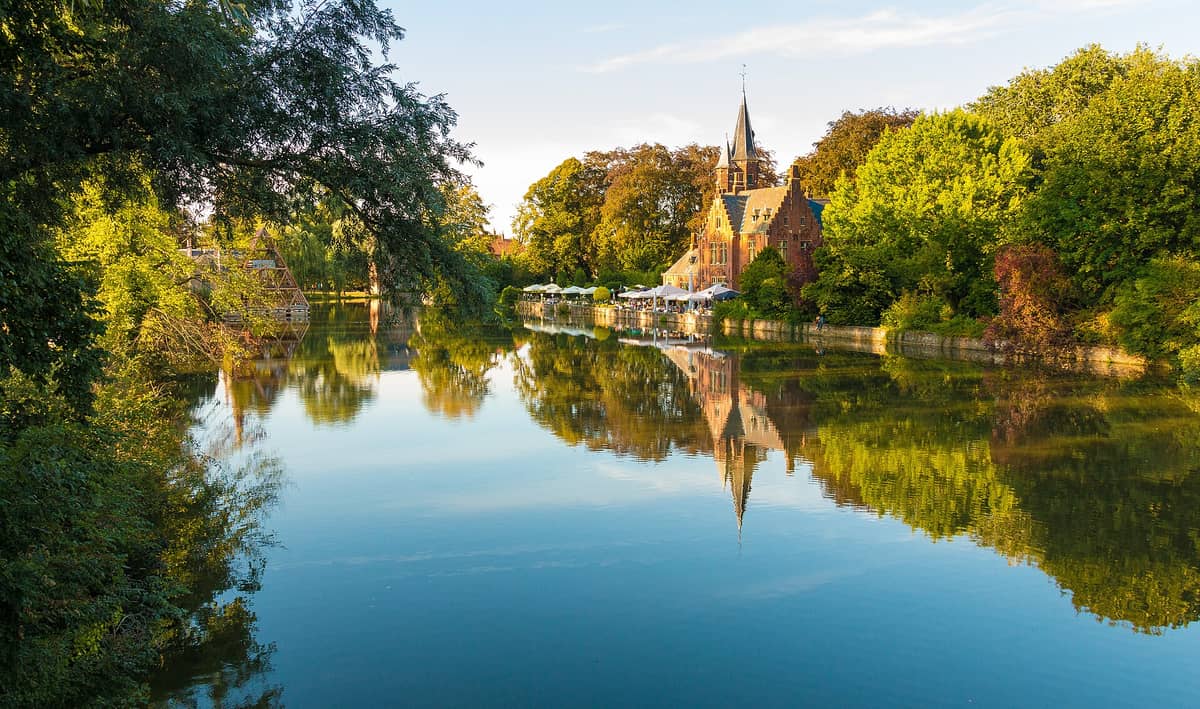
Minnewater is a still, reed-fringed water basin sitting at the southern limit of Bruges' medieval city core. Its popular name, the Lake of Love, sounds like marketing copy, but the place earns a degree of that reputation honestly. The water is wide enough to reflect the willow trees and old brick walls on its banks, the resident swans move across it with complete indifference to tourists, and the surrounding Minnewaterpark offers shaded benches and gravel paths that give the whole area a slower, quieter tempo than the canal quarters closer to the Markt.
What many visitors don't immediately clock is that Minnewater is not a natural lake at all. It's a medieval reservoir, originally constructed to supply water to the city's inner canal network and to control water levels for the port. The 16th-century sluice tower, the Sashuis (built in 1519), stands at the northern end of the basin and is one of Bruges' few surviving examples of medieval hydraulic infrastructure. The tower's stonework is weathered and unpretentious up close, yet it anchors the whole scene with a sense of functional history that the prettier canal bridges in the centre lack.
💡 Local tip
The Sashuis (sluice house) at the north end of the lake is easy to walk past without noticing. Pause on the small stone bridge above it and look down at the lock mechanism — it gives real context to Bruges' medieval water management.
How the Experience Changes by Time of Day
Early morning, roughly 7–9am, is when Minnewater is closest to what people imagine when they see the photographs. The water is glassy, the park is almost empty, and the only sounds are birdsong and the occasional cyclist cutting through on the way to work. The swans are most active at this hour, and the morning light on the south-facing bank gives photographers a soft, low-angle reflection that disappears once the sun climbs.
By mid-morning, tour groups begin arriving from the Begijnhof, which sits just a few minutes' walk to the north-east. Between roughly 10am and 1pm the lakeside path on the eastern bank gets noticeably busier, particularly in summer. This is still far less crowded than the Rozenhoedkaai area or the Markt, and the park's width means you can always find a quiet bench on the western bank. By late afternoon, the crowds thin again, and the golden hour light between 5 and 7pm in summer produces some of the best conditions for photography anywhere in Bruges.
After dark, Minnewater takes on a different character. The park is not heavily lit, and the lake reflects only the ambient glow of the city. It's calm rather than dramatic, and couples do walk the paths in the evening. It's also perfectly safe: the area is a public park within a well-visited part of a small city. That said, if you're visiting in winter, darkness falls by 5pm, and the park feels remote enough that some visitors prefer to stick to the lit towpath along the western bank.
Tickets & tours
Hand-picked options from our booking partner. Prices are indicative; availability and final rates are confirmed when you complete your booking.
Historium Bruges entrance tickets
From 19 €Instant confirmationFree cancellationBruges food tour with full meal
From 139 €Instant confirmationFree cancellationBruges walking audio guided tour
From 9 €Instant confirmationBruges Family Walking Tour
From 259 €Instant confirmationFree cancellation
The Swans: More Than a Picturesque Detail
The large population of white swans on Minnewater is one of Bruges' most distinctive sights, and the birds have been associated with the city for centuries. According to local tradition, Bruges is obligated to maintain swans on its waterways following an edict dating to the late 15th century, connected to the execution of a city treasurer named Pieter Lanchals, whose coat of arms featured a swan. Whether the story is precisely accurate or partly embellished, swans have been a formal part of Bruges' civic life for a very long time, and they are conspicuously well-fed and entirely unafraid of people.
This makes for excellent close observation, but keep children supervised near the water's edge. The birds can be assertive, especially during nesting season in spring, and the lakeside path in places comes quite close to the water without a significant barrier.
⚠️ What to skip
During spring nesting season (roughly March to May), swans near the bank can become territorial. Give nesting birds a wide berth, and keep small children away from the water's edge.
Walking the Park: What to Expect
Minnewaterpark is the formal name for the green area surrounding the lake, and it stretches south and west of the water basin in a layout that combines open lawn with tree-lined paths. The park is well-maintained, with gravel and paved surfaces that are manageable for pushchairs and wheelchairs on the main routes, though some of the informal paths closer to the water's edge are unpaved and can be muddy after rain.
The circuit around the lake itself takes about 20 minutes at a relaxed pace. Most visitors approach from the north along Wijngaardstraat, which connects the Begijnhof entrance to the lake's northern bank. A small stone bridge crosses the sluice at this end, and the southern bank of the lake is where the park opens into a wider green space with benches and mature trees. There is a cafe pavilion in the park that operates seasonally, useful for a rest stop if you're combining the area with a longer walk.
The most photogenic angle on the lake is from the stone bridge at the Sashuis, looking south down the length of the water. For a different perspective, the path running along the western bank offers a quieter vantage point with the Begijnhof's tree canopy visible to the east. If you're planning a broader walking route through this part of Bruges, the Bruges walking tour guide maps a logical path that connects Minnewater with the Begijnhof, Bonifaciusbrug, and the Dijver canal quarter.
Minnewater and the Surrounding Neighbourhood
Minnewater sits at the heart of one of Bruges' most rewarding quarters for aimless exploration. The Begijnhof (Beguinage) is a two-minute walk to the north-east, and the combination of the two forms a natural half-day itinerary. The Begijnhof is enclosed and charges a small entry fee for the church; the surrounding courtyard is free. Together, the two sites give a coherent picture of how this southern edge of the medieval city functioned: the lake as infrastructure, the Beguinage as a community of semi-religious laywomen who produced lace and maintained their independence within Bruges' urban fabric.
A short walk north along the Dijver canal brings you to the city's principal art museum, the Groeningemuseum, and to the Gruuthusemuseum. In the other direction, heading south from Minnewater, you quickly leave the tourist centre behind and enter quieter residential streets, which is useful to know if you simply want to decompress from the crowds.
The area also connects naturally to the Kruisvest ramparts and windmills to the north-east. If you have time, the Kruisvest ramparts quarter offers a walking path along the old city walls with four surviving windmills, and it is reachable from Minnewater in about 20 minutes on foot.
Practical Details: Getting There, Weather, and Photography
Minnewater is a 10-minute walk from Brugge railway station, making it one of the easiest significant attractions in Bruges to reach directly from the train without passing through the main tourist corridor. From the station forecourt, walk north toward the historic centre along Buiten Begijnenvest: the park entrance is clearly signed. Alternatively, bus stop Brugge Station Perron 1 is the nearest stop for De Lijn city buses, and a single bus ticket costs around €3 (verify current fares before travel as prices are subject to revision). The Centrum-Station car park is the closest paid parking if you're arriving by car.
Bruges has a temperate maritime climate with around 143 rainy days per year, and Minnewater's open setting means wind and rain affect the experience more than at the sheltered canal streets closer to the centre. The park is most pleasant from May through September, when average daytime temperatures are in the 17–22°C range and the trees are in full leaf. In winter, the park is stark but not without atmosphere: bare branches, low mist over the water, and almost no other visitors. Carry a waterproof layer at any time of year.
For photography, the single most important variable is light. The lake faces south, which means midday sun creates harsh reflections and flat contrast. Early morning and late afternoon are consistently better. A polarising filter helps cut glare on the water in direct sunlight. The stone bridge over the sluice and the willow trees on the south bank are the two most-photographed elements, but the wider view from the southern end of the park, looking back north toward the Sashuis tower, is less commonly seen and worth seeking out.
ℹ️ Good to know
Minnewater is free and open 24 hours a year-round. No booking, no ticket, no entry formalities. Just walk in. The park's cafe is seasonal, so bring water and a snack if you're combining this with a longer walk.
Insider Tips
- The best light on the lake is in the 45 minutes after sunrise. In summer this means arriving before 6:30am, but you'll have the entire park to yourself and the swans at their most active.
- Most visitors approach from the Begijnhof side (north). Try entering from the south end of the park off Buiten Begijnenvest instead: you get a full-length view down the lake toward the Sashuis tower that the standard approach misses entirely.
- The grassy bank on the western side of the lake has the fewest visitors even at peak hours. It's the better spot for a quiet lunch or a rest, and you get an unobstructed cross-lake view toward the tree line on the east bank.
- In December, Minnewater occasionally hosts a Christmas market event on the park lawns. Dates and formats change annually, so check the Visit Bruges website before your trip if you're planning a winter visit.
- The Sashuis tower is not open to the public inside, but the stonework and the lock mechanism visible from the bridge above are genuinely old and worth five minutes of attention. Bring a 20–35mm lens equivalent if you want to capture both the tower and the water in a single frame.
Who Is Minnewater (Lake of Love) For?
- Couples looking for a quieter, less commercial alternative to the crowded canal viewpoints near the Markt
- Photographers who want soft-light reflections and medieval architecture without competing for the same five spots as every other visitor
- Families with young children who need open green space and flat walking surfaces in the city centre
- Visitors combining a morning walk with the Begijnhof, Groeningemuseum, and the Dijver canal on a half-day south Bruges loop
- Travellers arriving by train who want a significant, rewarding sight within a 10-minute walk of the station
Nearby Attractions
Other things to see while in Minnewater & Begijnhof:
- Beguinage Ten Wijngaarde
Founded in 1245 and still inhabited by Benedictine nuns, the Princely Beguinage Ten Wijngaerde is one of the most affecting places in Bruges. Entry is free, the whitewashed courtyard is genuinely tranquil, and it sits steps from the Minnewater lake. Here is everything you need to make the most of a visit.
- De Halve Maan Brewery
Brouwerij De Halve Maan is the last historic family brewery still operating in the historic centre of Bruges, producing the city's signature Brugse Zot beer on the same Walplein site since 1856. The guided tour takes you through copper brew kettles, a rooftop panorama, and a tasting — capped by the story of the world's only beer pipeline running under the city streets.