Bruges Almshouses (Godshuizen): Living History Behind Quiet Courtyard Gates
Bruges is home to 46 historic almshouse complexes, known locally as Godshuizen, almost all of which remain inhabited today. Free to enter, these medieval charity dwellings offer some of the most atmospheric and unhurried corners in the entire city, tucked behind low walls and wooden gates across the historic centre.
Quick Facts
- Location
- Distributed across Bruges historic centre, with concentrations in the Sint-Anna quarter and near Katelijnestraat
- Getting There
- Station Brugge (rail); on foot from Markt square, most almshouses are within 15-20 minutes
- Time Needed
- 30-45 minutes per almshouse courtyard; allow 2-3 hours to visit several in a self-guided loop
- Cost
- Free of charge; no ticket required
- Best for
- Architecture lovers, slow travellers, photographers, history seekers, and anyone wanting a quieter side of Bruges
- Official website
- www.visitbruges.be/en/things-to-do/godshuizen-almshouses
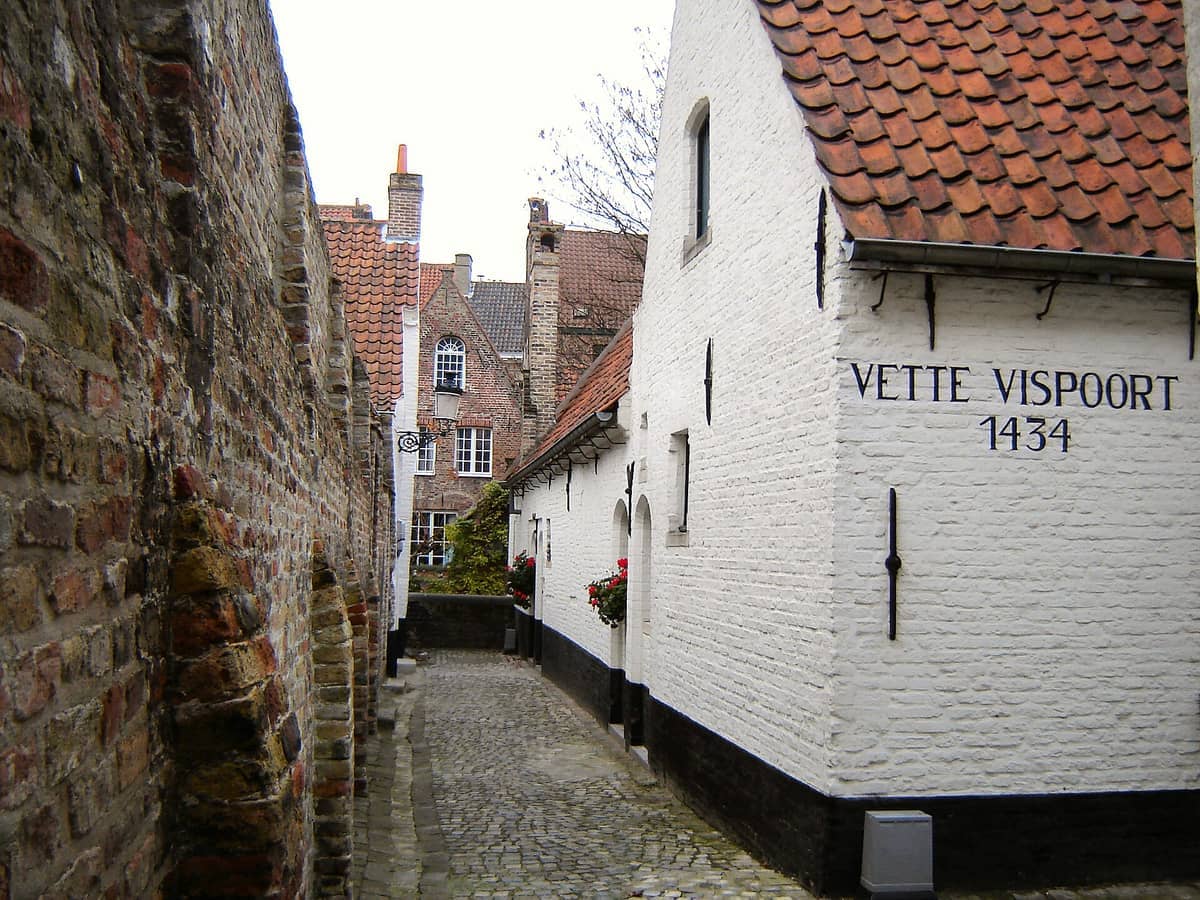
What Are the Godshuizen? A Network, Not a Single Attraction
The Bruges Almshouses, or Godshuizen in Dutch, are not one building but a city-wide network of 46 historic charitable housing complexes. Founded from the 14th century onward and continuing into later centuries by wealthy merchants, guilds, and religious patrons, they were built to house the elderly poor, widows, and those unable to support themselves. Today, 43 of the 46 complexes remain inhabited, with roughly 250 elderly residents still living behind their gates.
This is what sets the Godshuizen apart from most heritage sites: they are not preserved as museums. They are functioning homes, and that distinction shapes everything about how you visit. You are stepping into a place where someone wakes up each morning, tends their small garden patch, and expects their neighbours not to be photographed for a travel blog. The atmosphere of genuine habitation, rare in any medieval city, is precisely what makes them worth seeking out.
The almshouses are scattered across the historic centre of Bruges, with notable clusters in the Sint-Anna quarter, along Katelijnestraat, and in the streets around the Begijnhof. They fit naturally into a broader walk through the city, and several can be combined in a single afternoon loop without backtracking significantly.
💡 Local tip
Access is free, but gates may be closed at any time without notice. If a gate is shut, do not push it open; simply move to another almshouse on your list. Early morning, before 9am, tends to offer the quietest, least-interrupted experience.
The Architecture: Whitewash, Cobblestone, and Controlled Calm
Most Godshuizen follow a recognisable pattern: a row of small whitewashed or brick cottages arranged around a central garden courtyard, often enclosed by a low wall or wooden gate facing the street. The cottages themselves are one-storey or low two-storey structures, scaled for a single occupant or couple. Their proportions are modest to the point of austerity, which makes the carefully tended garden at the centre feel almost theatrical by contrast.
What strikes most visitors is the texture. The cobblestones are uneven underfoot, worn smooth in the paths most frequently walked. The whitewashed walls hold a slight cream tint in afternoon light and turn almost grey under overcast Flemish skies. Window boxes with geraniums or seasonal flowers appear on many cottages, planted by residents, not by a heritage board. These small personal touches give the spaces a warmth that no museum reconstruction can replicate.
Architecturally, the Godshuizen represent a centuries-long tradition of civic philanthropy expressed in built form, a tradition Bruges shared with other Flemish and Dutch cities. For those already interested in Bruges Gothic architecture, the almshouses offer a counterpoint: where the churches and guildhalls reach upward, the Godshuizen settle inward, into the courtyard, into community.
Tickets & tours
Hand-picked options from our booking partner. Prices are indicative; availability and final rates are confirmed when you complete your booking.
Historium Bruges entrance tickets
From 19 €Instant confirmationFree cancellationBruges food tour with full meal
From 139 €Instant confirmationFree cancellationBruges walking audio guided tour
From 9 €Instant confirmationBruges Family Walking Tour
From 259 €Instant confirmationFree cancellation
Notable Almshouse Complexes Worth Finding
Given that there are 46 complexes across the city, a selective approach is sensible. A few stand out for accessibility, condition, and visual impact.
Godshuis Van Campen, at Gloribusstraat 1-5, is a commonly recommended introduction to the typology. Godshuis De Vos on Noordstraat 6-14 and Godshuis O.L.V.-van-Blindekens on Kreupelenstraat 12-16 are both well-preserved examples with accessible garden courtyards. Het Rooms Convent at Katelijnestraat 9-19 sits close to the city's southern heritage corridor and can be paired with a visit to the Begijnhof, which lies a short walk further down Katelijnestraat.
The Begijnhof is not technically a Godshuis, but shares the same spatial DNA: enclosed dwellings around a central garden, inhabited by a community, entered through a gate. Visiting both on the same walk helps clarify what was common architectural thinking across medieval Flemish charitable institutions.
ℹ️ Good to know
Car parking closest to the southern almshouse clusters is at Parking Katelijne, Nieuwe Gentweg 22, 8000 Brugge. From Station Brugge, the historic centre is walkable in around 18–20 minutes; no bus is necessary for most almshouse visits.
How the Experience Changes by Time of Day
Morning visits, particularly before 9am, offer the best chance of quiet. The gates that are open are likely to remain open, fewer tourists are moving through the lanes, and the quality of light on whitewashed walls is at its most flattering. You may hear a resident moving inside a cottage, a radio faintly audible through a window, birdsong from the courtyard garden. The human scale of these spaces becomes most apparent in the absence of crowds.
By midday in peak season, particularly in July and August, the narrow streets leading to the most well-known almshouses will see steady visitor traffic. The courtyards themselves are small, and a group of eight people can fill one completely. If you arrive at a busy moment, it is worth pausing at the gate rather than pushing inside, both out of courtesy to residents and to get a cleaner sense of the space.
Late afternoon light, from around 4pm in summer, casts long shadows across the cobblestones and catches the textures of the old brick and plaster in a way that midday light flattens entirely. For photography, this is arguably the most rewarding window. Autumn and winter visits have their own character: the gardens are bare but the architecture reads more clearly without foliage, and the absence of other visitors makes contemplation easier.
Rules, Etiquette, and What Visitors Often Get Wrong
The Godshuizen are protected monuments and active residences. Visitors are welcome in the courtyard gardens on the condition that they remain quiet, stay on the marked garden paths, and do not photograph residents or their private spaces. This is not a guideline buried in small print; it is the foundational agreement that keeps these spaces open to the public at all.
What visitors often get wrong is treating an open gate as an invitation to linger indefinitely. These are not parks. The appropriate visit is a respectful, attentive walk through the courtyard, taking in the architecture and garden, and then leaving. Speaking in a normal conversational voice is generally acceptable; groups that arrive talking loudly and remain that way are the most common source of friction with residents.
⚠️ What to skip
Some courtyards are visible only from outside over a low wall, and the gate may be locked. Do not attempt to enter a closed almshouse. There is no public right of access when a gate is shut, and residents have the right to close them.
Detailed step-free accessibility information is not published centrally, and the cobblestone courtyard surfaces present real difficulty for wheelchair users or those with mobility limitations. If accessibility is a concern, it is worth checking individual almshouse conditions in advance or opting to view several from street level, where the low walls allow a partial view of the gardens without entering.
Putting the Almshouses in Context: The Broader Sint-Anna Quarter
The Sint-Anna quarter is one of the least commercialised parts of the historic city. Its streets are residential in character, with small brown-cafes, neighbourhood bakeries, and workshops occupying the ground floors of buildings that tourists rarely enter. The almshouses sit within this fabric naturally, neither cordoned off nor over-signed.
A walk through Sint-Anna that takes in two or three Godshuizen can also include the Jeruzalemkerk, a 15th-century private chapel modelled on the Church of the Holy Sepulchre in Jerusalem, and the Kantcentrum, the city's lace-making centre. Together, these sites sketch a portrait of a neighbourhood that operated for centuries around craft, faith, and mutual support, the same impulses that produced the Godshuizen in the first place.
For travellers with more than a day in the city, incorporating the almshouses into a Bruges walking tour rather than treating them as a standalone destination is the most natural approach. The best visits happen when you are already moving slowly through the city and duck through a gate on instinct.
Who This Is and Isn't For
The Godshuizen reward patience and attentiveness. Visitors who want clear narrative content, explanatory panels, or a structured experience will find little here. There are no audio guides, no entrance halls, no gift shops. What you get is architecture, garden, silence, and the faint sense that time has moved at a different pace inside these walls for 600 years.
Travellers on a short itinerary focused on the main sights, Markt, Burg, Belfort, the canal views, may reasonably skip the almshouses without feeling they have missed the essential city. But for anyone with a half-day to spend away from the main tourist corridors, the Godshuizen offer something the headline attractions cannot: an encounter with Bruges that does not feel staged.
Insider Tips
- Map your route before you go using the Visit Bruges website, which lists individual almshouses with addresses. Trying to find them by wandering alone is pleasant but inefficient; several are on streets that do not appear on standard tourist maps.
- The almshouses near Katelijnestraat can be combined with the Begijnhof and Minnewater lake in a single 2-hour southern loop that avoids the busiest tourist streets entirely.
- Overcast days are actually preferable for photography here. Direct sunlight creates harsh contrast between the white walls and dark cobblestones. Flat Flemish light renders the textures more evenly.
- If a courtyard is occupied by residents doing garden work or sitting outside, a quiet nod of acknowledgment goes a long way. These are their homes, and visitors who treat them as such are occasionally rewarded with a brief conversation about the history of the complex.
- The almshouses are free, which makes them an excellent option for travellers watching their budget. Pair them with the free exterior views of the windmills along Kruisvest for a full morning at no cost.
Who Is Bruges Almshouses (Godshuizen) For?
- Architecture and urban history enthusiasts who want to see medieval civic philanthropy in built form
- Photographers seeking textured, human-scale subjects away from the overcrowded canal viewpoints
- Slow travellers and repeat visitors to Bruges who have already covered the main sights
- Travellers on a budget, since admission is free and the experience requires only time and attention
- Anyone interested in how medieval European cities organised welfare and community care
Nearby Attractions
Other things to see while in Sint-Anna Quarter:
- Folklore Museum (Bruggemuseum – Volkskunde)
The Volkskundemuseum, part of the Bruggemuseum network, recreates daily life in Bruges from the 19th and early 20th centuries through immersive period interiors and craft workshops. Housed in a row of restored almshouse buildings on Balstraat, it offers a grounded, unhurried contrast to the city's more crowded heritage sites.
- Guido Gezelle Museum
The Gezellehuis on Rolweg is the birthplace and former home of Guido Gezelle (1830–1899), one of the most celebrated poets in Dutch-language literature. This quiet literary museum in the Sint-Anna quarter preserves his life, manuscripts, and 19th-century world, wrapped around a garden that is open most of the year.
- Jerusalem Church (Jeruzalemkerk)
Built around 1430 by a wealthy Flemish merchant family inspired by Jerusalem, the Jeruzalemkerk is one of the most architecturally unusual churches in Belgium. Still privately owned by the Adornes family after nearly 600 years, this intimate chapel in the Sint-Anna quarter rewards visitors who make the short detour from Bruges' crowded centre.
- Lace Centre (Kantcentrum)
The Kantcentrum on Balstraat brings Bruges' centuries-old lacemaking tradition to life through daily afternoon demonstrations by working lacemakers, a museum tracing the craft's history, and a well-stocked specialist shop. Housed in a former lace school within the historic Adornes estate, it is one of the few places in Europe where the craft is still actively taught and practised in a public setting.