Folklore Museum Bruges (Volkskundemuseum): A Window into Everyday Brugge
The Volkskundemuseum, part of the Bruggemuseum network, recreates daily life in Bruges from the 19th and early 20th centuries through immersive period interiors and craft workshops. Housed in a row of restored almshouse buildings on Balstraat, it offers a grounded, unhurried contrast to the city's more crowded heritage sites.
Quick Facts
- Location
- Balstraat 43, 8000 Brugge — Sint-Anna quarter, east of the historic centre
- Getting There
- De Lijn bus to Kruispoort or Langestraat stop (near Langestraat 187); about 20-minute walk from Markt
- Time Needed
- 1 to 1.5 hours for most visitors; allow 2 hours if you read every panel
- Cost
- Adults €8 | Under 26 €7 | Under 18 €4 | Under 13 free
- Best for
- History lovers, families with older children, travelers who want depth over spectacle
What the Volkskundemuseum Actually Is
The Folklore Museum Bruges, officially the Volkskundemuseum and part of the city-run Bruggemuseum network, sits at Balstraat 43 in the Sint-Anna quarter. It occupies a long row of whitewashed almshouse buildings, originally constructed in the 17th century as housing for poor tailors. The low-ceilinged rooms, worn brick floors, and small windows are not a reconstruction of historic poverty — they are the original fabric of those buildings, adapted over decades into a museum that uses period objects and room reconstructions to show what ordinary Bruges life looked like in the 19th and early 20th centuries.
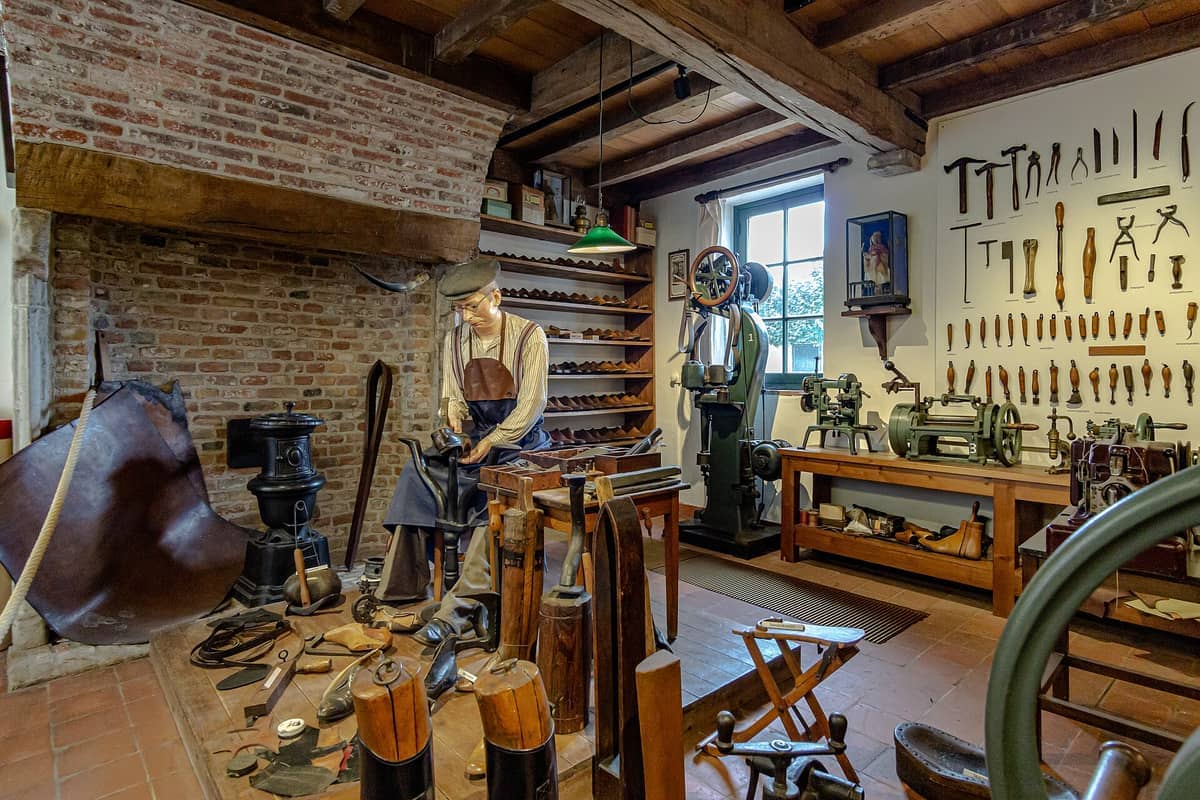
This is not a museum of kings and merchants. There are no gilded altarpieces or Flemish masterworks here. Instead, you move through a confectioner's shop with period packaging still on the shelves, a cobbler's workshop with leather-smelling tools laid out mid-task, a schoolroom with slates and wooden benches, a hat maker's atelier, and a grocery that feels oddly specific. The level of detail in each reconstructed space is high enough that children frequently ask if anyone still lives here.
ℹ️ Good to know
Opening hours vary by season. Summer (1 April to 2 November): open Tuesday to Sunday, 09:30–17:00, closed Mondays. Winter (3 November to 31 March): open Wednesday to Sunday, 09:30–17:00, closed Mondays and Tuesdays. December 24 and 31 close at 16:00; closed December 25 and January 1; Ascension Day closes at 12:30. Always confirm on the official Musea Brugge website before visiting.
The Building and Its Setting
The almshouse complex that holds the museum wraps around a quiet interior courtyard garden. In spring and early summer, the garden is planted with herbs and flowering shrubs that would have been familiar to 19th-century Bruges households. Entering through the gate on Balstraat, the transition from the street is immediate: the noise of the Sint-Anna quarter drops away, and the scale shifts to something domestic and human.
The whitewashed facades and terracotta roof tiles of the buildings are characteristic of the Flemish almshouse tradition, a form of charitable housing patronized by guilds and wealthy families across the Low Countries. Bruges alone has dozens of surviving almshouse complexes, and this one is among the most intact.
The Sint-Anna quarter itself is one of the least tour-group-heavy parts of the historic centre. Arriving from the Jeruzalemkerk or from the Kantcentrum lace centre a few streets away, you'll notice the area has a residential feel that the canal-side zones near Rozenhoedkaai largely lack. The walk here is part of the experience.
Tickets & tours
Hand-picked options from our booking partner. Prices are indicative; availability and final rates are confirmed when you complete your booking.
Historium Bruges entrance tickets
From 19 €Instant confirmationFree cancellationBruges food tour with full meal
From 139 €Instant confirmationFree cancellationBruges walking audio guided tour
From 9 €Instant confirmationBruges Family Walking Tour
From 259 €Instant confirmationFree cancellation
Moving Through the Rooms: What You'll Actually See
The museum is organized around a series of workshop and domestic interiors that follow a loose thematic sequence rather than a strict chronological path. The layout is compact but not cramped, and each room is self-contained enough that you can linger without blocking other visitors.
The confectioner's shop is one of the more sensory spaces: glass jars with period candy labels, a tiled counter, wooden drawer units with spice labels still readable. The smell of old wood and faint traces of dried herbs accumulates across several rooms. The cobbler's workshop has tools arranged with a specificity that suggests actual use rather than decoration. The schoolroom, with its chalk-dusted blackboard and ranked desks, tends to generate the most time from visitors who read the period texts written on the boards.
Beyond the craft workshops, the museum covers domestic interiors across different social classes, a tobacco and pipe workshop, a pharmacy, and displays related to local folk customs and calendar traditions. Object labels are present in Dutch, French, and English, though the depth of commentary in English varies by room. Some spaces are better explained than others, and a few of the smaller display cases feel underlit — bring reading glasses if you need them.
💡 Local tip
The interior courtyard garden is free to enter during museum hours and accessible even to non-paying visitors in some configurations. It's a calm place to pause between rooms and worth a second look in late morning light.
Time of Day and Crowd Dynamics
The Volkskundemuseum draws a fraction of the visitor numbers that flow through the Groeningemuseum or the Belfort. On most weekday mornings in the summer season, the rooms are genuinely quiet — you may share a workshop space with only one or two other people. Weekend afternoons in July and August are busier, particularly when school groups from Belgium and the Netherlands visit, but even then the space rarely feels overcrowded.
Late morning, roughly 10:00 to 12:00, is the most reliably calm window. The early light through the small windows is at its best in the east-facing rooms during this period. Winter visits have a particular atmosphere: the low Flemish light through old glass, the silence of rooms that in summer occasionally fill with school commentary, and the closed courtyard garden create a more austere but equally rewarding experience. Winter closures on Monday and Tuesday mean planning is more important in the off-season.
Historical and Cultural Context
The museum's focus on 19th and early 20th-century life captures Bruges during a period of economic rediscovery. After centuries of relative stagnation following the gradual silting of the Zwin waterway in the late medieval period, Bruges later reinvented itself through tourism, lace production, and the construction of the modern port at Zeebrugge. The craft workshops in the museum — the lacemaker's space, the confectioner, the cobbler — reflect trades that sustained the city's working population during that transition. For broader context on the city's craft heritage, the guide to lace-making in Bruges covers the industry's history and living practitioners in detail.
The almshouse form itself is worth understanding before you visit. These complexes were built by guilds, wealthy individuals, or religious institutions as housing for the deserving poor, typically members of a specific trade or profession. The tailors' almshouse on Balstraat was constructed in the 17th century and represents a philanthropic tradition that shaped much of the physical texture of Bruges outside the main monuments. Walking through these buildings is a reminder that the city's surviving medieval and early modern fabric extends well beyond the churches and civic buildings that appear in most photographs.
If you're building a fuller itinerary around the Sint-Anna quarter, the Guido Gezelle Museum is a short walk away. The Flemish poet Gezelle, born in 1830 in Bruges, lived through precisely the period the Volkskundemuseum depicts, and pairing the two visits gives a more complete picture of 19th-century Bruges than either museum provides alone.
Practical Walkthrough: Getting There, Tickets, and Access
From the Markt, the walk to Balstraat takes around 20 minutes on foot through the Sint-Anna quarter. The route via Sint-Annarei and then east along Rolweg or Carmersstraat is straightforward and passes several points of interest. If you prefer public transport, De Lijn buses stop at Kruispoort and at Langestraat (near Langestraat 187), both within a few minutes’ walk of the museum entrance.
Admission is €8 for adults (the same rate applies to visitors 65 and over), €7 for visitors under 26, €4 for visitors under 18, and free for children under 13. The museum is part of the Musea Brugge network, and combination tickets covering multiple city museums are available — worth calculating if you plan to visit more than two or three sites. Contact the museum directly at +32 50 44 87 43 or musea@brugge.be for accessibility-specific queries before visiting, as the original almshouse architecture means some parts of the complex involve uneven floors and narrow doorways.
⚠️ What to skip
The building's historic structure means it is not uniformly step-free. Visitors with mobility limitations should contact Musea Brugge in advance to clarify which sections are accessible.
Photography is generally permitted in the museum without flash. For those building a half-day route through this part of Bruges, the Sint-Anna quarter has enough to fill three to four hours including the Folklore Museum, the Jeruzalemkerk, the Kantcentrum, and the windmills on the Kruisvest ramparts a short walk to the north.
Is It Worth Your Time?
The Volkskundemuseum is not the most visually striking museum in Bruges. It does not have the painterly drama of the Groeningemuseum or the medieval grandeur of the Gruuthusemuseum. What it has is specificity: the sense that someone has taken pains to show what a tailor's household actually contained, what a Bruges schoolroom looked like in 1890, what the city smelled and felt like before tourism became its primary economy.
Visitors who arrive expecting a major spectacle will leave underwhelmed. Visitors who come ready to look carefully at small things — the grain of a worn wooden counter, the labels on a row of apothecary jars, the tools of a trade that no longer exists — will find the museum unusually rewarding for its size and ticket price. It works especially well as a counterpoint to the more celebrated museums rather than as a standalone half-day destination.
Insider Tips
- The interior courtyard garden is at its best from late April through June, when the plantings are in flower and before summer heat dries them back. Plan your visit for this window if you can.
- The in-house café, De Zwarte Kat (The Black Cat), is a traditional Flemish tavern space within the almshouse complex. It operates on limited hours and is not always open during winter closures, but on a cold afternoon it can be one of the more atmospheric places in Bruges to stop for a beer.
- If you're visiting with children, the reconstructed shop interiors — particularly the confectioner's and the grocery — hold attention in a way that a purely object-based display wouldn't. Ask at the desk about any activity sheets available for younger visitors.
- Winter Tuesdays see the museum closed alongside Mondays; this catches some visitors off guard. Always check the current seasonal hours on the Musea Brugge website rather than relying on third-party listings, which are often out of date.
- The Balstraat entrance is easy to walk past; look for the small gate set into the whitewashed wall rather than a prominent museum facade. There is no large sign visible from the street until you are directly in front of it.
Who Is Folklore Museum (Bruggemuseum – Volkskunde) For?
- History and social history enthusiasts who want to understand Bruges beyond its medieval monuments
- Families with children aged 8 and older who respond well to reconstructed environments
- Repeat visitors to Bruges who have already covered the headline attractions
- Travelers combining a half-day route through the Sint-Anna quarter with the Jeruzalemkerk and Kantcentrum
- Anyone seeking a quiet, unhurried museum experience away from the main tourist flow
Nearby Attractions
Other things to see while in Sint-Anna Quarter:
- Bruges Almshouses (Godshuizen)
Bruges is home to 46 historic almshouse complexes, known locally as Godshuizen, almost all of which remain inhabited today. Free to enter, these medieval charity dwellings offer some of the most atmospheric and unhurried corners in the entire city, tucked behind low walls and wooden gates across the historic centre.
- Guido Gezelle Museum
The Gezellehuis on Rolweg is the birthplace and former home of Guido Gezelle (1830–1899), one of the most celebrated poets in Dutch-language literature. This quiet literary museum in the Sint-Anna quarter preserves his life, manuscripts, and 19th-century world, wrapped around a garden that is open most of the year.
- Jerusalem Church (Jeruzalemkerk)
Built around 1430 by a wealthy Flemish merchant family inspired by Jerusalem, the Jeruzalemkerk is one of the most architecturally unusual churches in Belgium. Still privately owned by the Adornes family after nearly 600 years, this intimate chapel in the Sint-Anna quarter rewards visitors who make the short detour from Bruges' crowded centre.
- Lace Centre (Kantcentrum)
The Kantcentrum on Balstraat brings Bruges' centuries-old lacemaking tradition to life through daily afternoon demonstrations by working lacemakers, a museum tracing the craft's history, and a well-stocked specialist shop. Housed in a former lace school within the historic Adornes estate, it is one of the few places in Europe where the craft is still actively taught and practised in a public setting.