Lace Centre (Kantcentrum): Bruges' Living Tradition of Bobbin Lace
The Kantcentrum on Balstraat brings Bruges' centuries-old lacemaking tradition to life through daily afternoon demonstrations by working lacemakers, a museum tracing the craft's history, and a well-stocked specialist shop. Housed in a former lace school within the historic Adornes estate, it is one of the few places in Europe where the craft is still actively taught and practised in a public setting.
Quick Facts
- Location
- Balstraat 16, Sint-Anna quarter, 8000 Bruges (Brugge), Belgium
- Getting There
- 20–25-min walk from Bruges train station; nearest bus stop is Brugge Molenbrug (De Lijn)
- Time Needed
- 1 to 1.5 hours, longer if you stay for the full afternoon demonstration
- Cost
- Combined museum & lace demonstration ticket €8 (verify current prices before visiting)
- Best for
- Craft and textile enthusiasts, history lovers, and anyone seeking a quieter alternative to Bruges' main museum circuit
- Official website
- www.kantcentrum.eu/en/home
What the Kantcentrum Actually Is
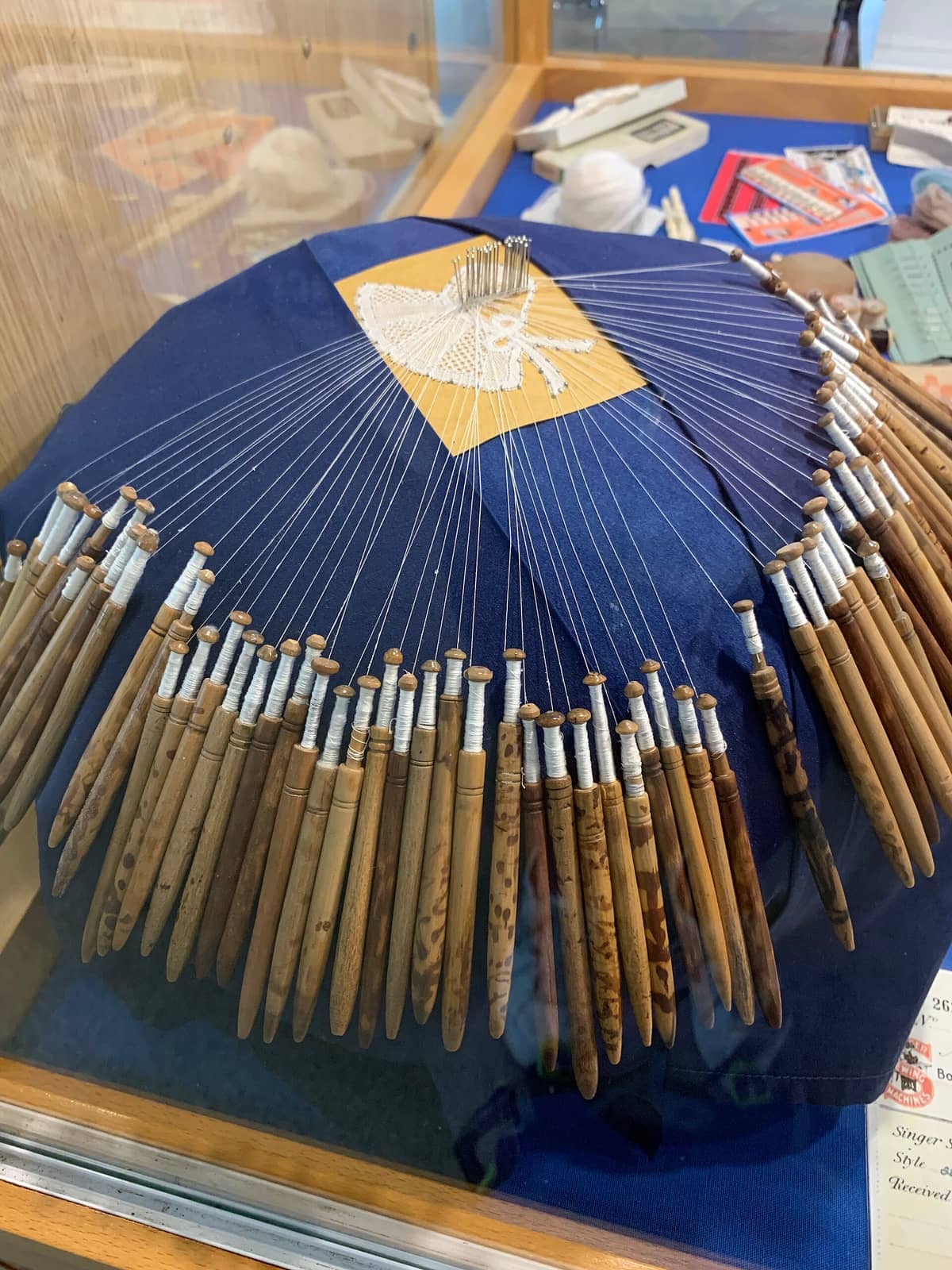
The Lace Centre (Kantcentrum) is both a working craft institution and a small specialist museum dedicated to Bruges bobbin lace, one of the most technically demanding traditional lace techniques in Europe. Unlike a typical heritage display, the Kantcentrum keeps the craft alive: the building is simultaneously a school, a demonstration space, a museum, and a shop. On any weekday afternoon, you can watch lacemakers at work, their fingers moving across boards dense with pins and coloured bobbins in patterns that look improvised but follow centuries-old designs.
The centre is housed in the former lace school of the Apostoline Sisters, part of the historic Adornes estate on Balstraat in the Sint-Anna quarter. The Adornes estate is itself one of Bruges' more remarkable complexes, best known for the Jeruzalemkerk next door. The building's origins as a religious teaching institution give the interior a particular atmosphere: narrow corridors, low-ceilinged workrooms, and the kind of quiet that feels earned rather than staged.
💡 Local tip
Demonstrations run Monday to Saturday, 14:00 to 17:00. If watching lacemakers at work is the main reason for your visit, time your arrival for early afternoon rather than the morning, when the building is quieter but the workrooms are empty.
The History Behind the Craft
Bruges lace has been synonymous with quality since at least the seventeenth century, when Flemish bobbin lace was among the most prized luxury textiles in Europe, worn by aristocrats and clergy across the continent. The city's lace industry grew in parallel with its role as a major trading hub, and fine Bruges lace would eventually be exported to courts from Madrid to St Petersburg. By the nineteenth century, however, industrial machine-made lace had devastated the handmade trade, and what had once employed thousands of Bruges women was reduced to a cottage industry sustained by a handful of dedicated practitioners.
The Kantcentrum was established to prevent the craft from disappearing entirely. Its roots in the Apostoline Sisters' lace school reflect the role the Church played in keeping the tradition alive through the lean decades of the twentieth century, training young women in the technique even when commercial demand had largely collapsed. Today the institution continues that educational mission, running courses alongside its public-facing museum and demonstration programme.
For anyone interested in how this craft fits into Bruges' broader artistic legacy, the Bruges lace guide covers the different lace styles produced in the city, where to buy authentic pieces, and how to distinguish handmade from machine lace.
Tickets & tours
Hand-picked options from our booking partner. Prices are indicative; availability and final rates are confirmed when you complete your booking.
Historium Bruges entrance tickets
From 19 €Instant confirmationFree cancellationBruges food tour with full meal
From 139 €Instant confirmationFree cancellationBruges walking audio guided tour
From 9 €Instant confirmationBruges Family Walking Tour
From 259 €Instant confirmationFree cancellation
The Museum Rooms: What You'll See
The museum section of the Kantcentrum is compact rather than exhaustive, which works in its favour. The displays trace the development of Bruges bobbin lace through historical examples, technical explanations, and period tools. You'll see lace pillows (the cushioned boards on which bobbins are managed), collections of antique bobbins in wood and bone, pattern cards, and finished lace pieces ranging from domestic items to ecclesiastical textiles.
The exhibition does a reasonable job of explaining the technical vocabulary of lace-making to a non-specialist visitor: the difference between torchon, Bruges flower lace, and Bruges guipure is explained with reference to actual samples rather than abstract descriptions. Labels are available in multiple languages. The lighting in the display cases is adequate but not always ideal for appreciating the finest pieces, which is worth knowing if you're a close observer of textile work.
The museum rooms are not large, and most visitors move through them in 30 to 40 minutes. The building's character, with its low wooden ceilings, tiled floors, and the faint smell of aged wood, adds a layer of atmosphere that a purpose-built exhibition space would lack. This is a place that has been used for its stated purpose for a long time, and that continuity is tangible.
The Afternoon Demonstrations: The Real Draw
Between 14:00 and 17:00 on weekdays and Saturdays, working lacemakers gather in one of the ground-floor rooms to demonstrate the craft to visitors. This is not a theatrical performance. These are skilled practitioners, many of them volunteers or students from the centre's own courses, working on actual pieces. The sound in the room is distinctive: the soft clicking of wooden bobbins being crossed and twisted, a rhythmic percussion that becomes hypnotic if you stand and watch for more than a few minutes.
Visitors are welcome to watch closely, and the lacemakers are generally willing to answer questions or explain what they're working on. The informality of the arrangement is one of its strengths. You're not separated from the work by a glass screen or a rope barrier; you can lean in and see exactly how a pattern is built up, pin by pin, across the pillow.
For children, the demonstrations are often the most engaging part of the visit, partly because of the physical dexterity on display and partly because the lacemakers are approachable. That said, the overall pace of the Kantcentrum is slow and contemplative; children who need constant movement may find the experience short.
ℹ️ Good to know
Photography is generally permitted in the demonstration area, but always check with staff on the day. Natural light from the windows is your best asset here; flash photography is disruptive in a working space.
The Shop and What's Worth Buying
The Kantcentrum shop is one of the more reliable places in Bruges to buy authentic handmade lace, as well as lace-making supplies for practitioners: bobbins, pattern books, thread, and pillows. The distinction between handmade and machine-made lace matters significantly in Bruges, where many souvenir shops sell Belgian lace that is in fact produced industrially, often outside Belgium entirely. The Kantcentrum's shop and the lacemakers themselves can explain what you're looking at.
Genuine handmade bobbin lace commands a substantial price premium, and rightly so: a small doily can represent dozens of hours of work. If you're considering a purchase but want broader context on what to look for and where else to shop in Bruges, the Bruges shopping guide covers craft and artisan retail across the city.
Getting There and Practical Logistics
The Kantcentrum is at Balstraat 16 in the Sint-Anna quarter, a residential neighbourhood east of the historic core. From the Markt, the walk takes around 15–20 minutes on foot through the quieter streets of Sint-Anna to the Jeruzalemkerk and Adornes estate complex, which is directly adjacent to the Lace Centre. This part of Bruges sees considerably less tourist traffic than the canal-side areas, and the walk itself is part of the appeal.
The nearest De Lijn bus stop is Brugge Molenbrug. Visitors arriving by car can use Parking Langestraat, a short walk away. The museum and shop are open Monday to Saturday from 09:30 to 17:00, and are closed on Sundays and public holidays. Opening hours can vary seasonally; check the official website before visiting.
The Sint-Anna quarter rewards a slower pace. The Sint-Anna quarter contains several other low-key attractions including the Jeruzalemkerk, the Folklore Museum, and the Guido Gezelle Museum, all within a short walk of the Kantcentrum. Combining two or three of these into a half-day makes good sense.
⚠️ What to skip
The Kantcentrum is closed on Sundays and public holidays. If your visit to Bruges falls over a weekend, plan for Saturday; a Sunday visit to this attraction is not possible unless checking for exceptional openings in advance.
Is It Worth the Time?
For visitors with a genuine interest in craft, textile history, or the cultural specifics of Bruges, yes, without qualification. The combination of a historically situated building, a clear and honest museum, and a live demonstration of a disappearing skill is unusual in any city. The Kantcentrum does not try to be more than it is, which is a form of integrity that more heritage institutions could learn from.
For visitors doing a fast circuit of Bruges' headline attractions in a single day, the Kantcentrum is harder to fit in. It sits geographically and atmospherically apart from the Markt, Burg Square, and the Groeningemuseum cluster, and requires a conscious decision to head east into a quieter part of the city. If you're short on time and prioritising major art collections or canal views, this attraction is likely to fall off your list.
If you're planning your visit and want to see how the Kantcentrum fits into a wider itinerary, the Bruges one-day itinerary and the two-day Bruges guide both suggest how to structure your time across the city's different neighbourhoods.
Insider Tips
- Arrive between 14:00 and 14:30 on a weekday to catch the demonstrations at their fullest, before the lacemakers begin to wind down for the day. Later in the afternoon, the room can thin out and some practitioners may have already finished.
- The Adornes estate and the Jeruzalemkerk are immediately next door. The Jeruzalemkerk is one of the most unusual medieval buildings in Belgium, a private chapel modelled on the Church of the Holy Sepulchre in Jerusalem, and a combined visit to both sites takes well under two hours.
- If you are considering buying handmade lace, bring a magnifying glass or use your phone camera to zoom in. Handmade bobbin lace has slight irregularities in thread tension and pattern repeat that machine lace cannot replicate. The staff at the Kantcentrum shop are knowledgeable and can point out the differences on request.
- The Sint-Anna quarter is one of Bruges' better areas for a quiet late-morning walk before the Kantcentrum opens its demonstration session. The neighbourhood's windmills along the Kruisvest ramparts are a 10–15-minute walk north, and make a logical first stop before arriving at the Lace Centre.
- The Kantcentrum runs lace-making courses for beginners and advanced practitioners. If you're staying in Bruges for more than a day or two and have a serious interest in learning the craft, check the official website for the current course schedule.
Who Is Lace Centre (Kantcentrum) For?
- Textile and craft enthusiasts looking for direct access to a living tradition rather than a static display
- Slow travellers who want to spend time in a quieter part of Bruges away from the main tourist circuits
- Visitors with an interest in Flemish cultural history and medieval trade crafts
- Shoppers looking for verifiably authentic handmade Bruges lace rather than mass-produced souvenirs
- Travellers combining a half-day in the Sint-Anna quarter with the Jeruzalemkerk, Folklore Museum, and Kruisvest windmills
Nearby Attractions
Other things to see while in Sint-Anna Quarter:
- Bruges Almshouses (Godshuizen)
Bruges is home to 46 historic almshouse complexes, known locally as Godshuizen, almost all of which remain inhabited today. Free to enter, these medieval charity dwellings offer some of the most atmospheric and unhurried corners in the entire city, tucked behind low walls and wooden gates across the historic centre.
- Folklore Museum (Bruggemuseum – Volkskunde)
The Volkskundemuseum, part of the Bruggemuseum network, recreates daily life in Bruges from the 19th and early 20th centuries through immersive period interiors and craft workshops. Housed in a row of restored almshouse buildings on Balstraat, it offers a grounded, unhurried contrast to the city's more crowded heritage sites.
- Guido Gezelle Museum
The Gezellehuis on Rolweg is the birthplace and former home of Guido Gezelle (1830–1899), one of the most celebrated poets in Dutch-language literature. This quiet literary museum in the Sint-Anna quarter preserves his life, manuscripts, and 19th-century world, wrapped around a garden that is open most of the year.
- Jerusalem Church (Jeruzalemkerk)
Built around 1430 by a wealthy Flemish merchant family inspired by Jerusalem, the Jeruzalemkerk is one of the most architecturally unusual churches in Belgium. Still privately owned by the Adornes family after nearly 600 years, this intimate chapel in the Sint-Anna quarter rewards visitors who make the short detour from Bruges' crowded centre.