Jerusalem Church (Jeruzalemkerk): Bruges' Medieval Pilgrimage in Stone
Built around 1430 by a wealthy Flemish merchant family inspired by Jerusalem, the Jeruzalemkerk is one of the most architecturally unusual churches in Belgium. Still privately owned by the Adornes family after nearly 600 years, this intimate chapel in the Sint-Anna quarter rewards visitors who make the short detour from Bruges' crowded centre.
Quick Facts
- Location
- Peperstraat 3, Sint-Anna quarter, Bruges (Brugge), Belgium
- Getting There
- Brugge Molenbrug bus stop (De Lijn); 20-minute walk from Brugge railway station
- Time Needed
- 1 to 1.5 hours for chapel, Adornes Museum, and Pieter's Gallery
- Cost
- Adults €11 | Seniors 65+ €9 | Ages 7–25 €7 | Under 6 free | museumPASSmusées free
- Best for
- Medieval history, religious architecture, Flemish cultural heritage, quiet exploration
- Official website
- www.adornes.org/en-home
What the Jerusalem Church Actually Is
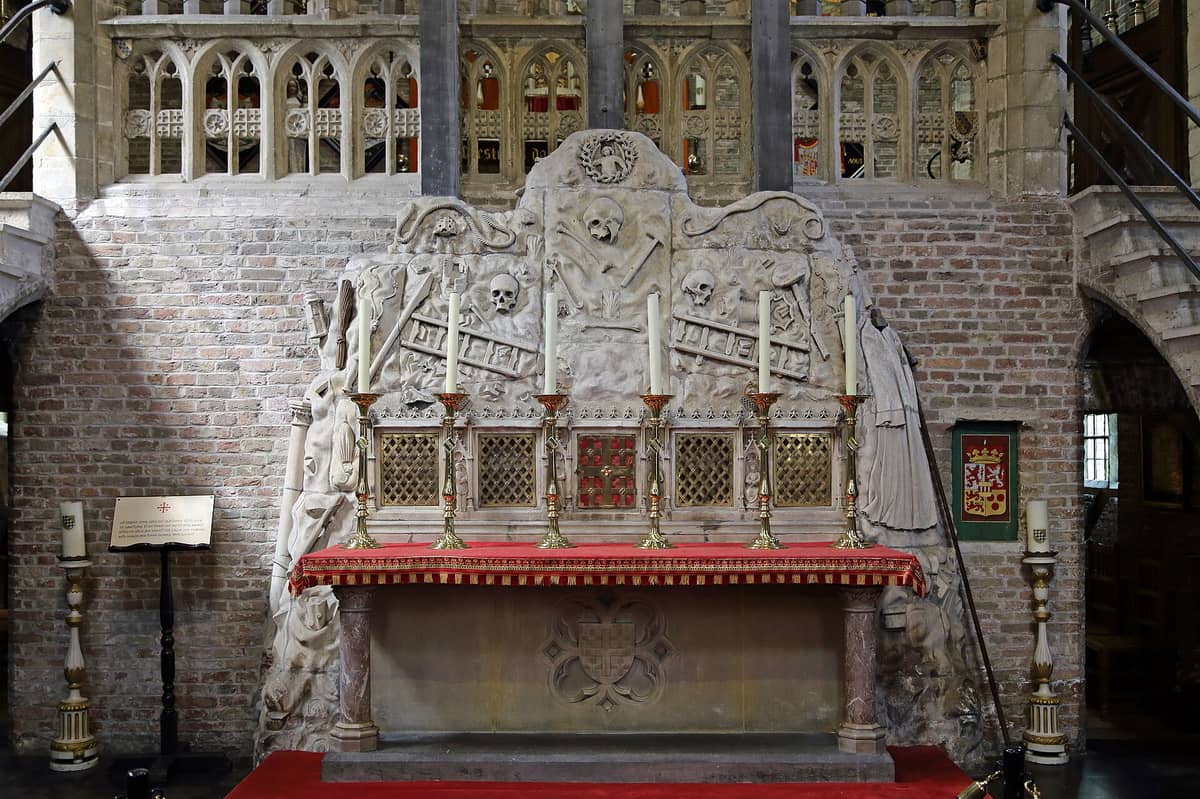
The Jeruzalemkerk is not a parish church in the ordinary sense. It is a private family chapel, commissioned in the early 15th century by the Adornes family, prominent Bruges merchants of Genoese descent, modelled on the Church of the Holy Sepulchre in Jerusalem. The Adornes family had made pilgrimages to the Holy Land and wanted to recreate the experience of that sacred site on their own property in Bruges. The result is a two-storey Gothic structure with an octagonal tower, ornate carved stonework, and a crypt containing a replica of Christ's tomb that visitors can still enter today.
What makes this place genuinely unusual is continuity. The chapel has remained in the hands of the Adornes family for nearly 600 years, making it one of the last privately owned medieval religious monuments in Belgium. The current generation still oversees the estate and the adjacent Adornes Museum. This is not a city-run attraction managed at arm's length from history. The family connection gives the whole complex a personal weight that is hard to manufacture.
ℹ️ Good to know
Opening hours as of 2026: Monday to Saturday 10:00–17:00 (to 18:00 on Saturdays in summer). Closed Sundays and Belgian public holidays. Verify current hours at adornes.org before visiting, as seasonal variations apply.
The Architecture: A Jerusalem Replica in Gothic Brick
The exterior of the Jeruzalemkerk is immediately striking, even by Bruges standards. The tower is based on the rotunda of the Church of the Holy Sepulchre, rendered here in dark Flemish brick and decorated limestone. Standing at the entrance on Peperstraat, the building reads as compressed and vertical compared to the wide Gothic facades of churches like Onze-Lieve-Vrouwekerk. The scale is domestic rather than civic, which makes the interior all the more unexpected.
Inside, the space is divided across two levels. The upper level holds the main chapel with its elaborate altarpiece and the original Jerusalem-inspired decorative programme, including Jerusalem crosses and symbolic stonework referencing Calvary and the tomb. The lower level contains the crypt with the replica tomb itself, a low-ceilinged, candlelit space where the stone sarcophagus reproduces the dimensions recorded by the Adornes family during their pilgrimage. The tomb is small enough that visitors have to step carefully, and the atmosphere is noticeably different from the rest of the building. If you have an interest in how medieval pilgrimage functioned, or in Bruges Gothic architecture more broadly, this is among the most concentrated examples in the city.
The stained glass deserves particular attention. Several panels are original 15th-century glass, depicting portraits of the Adornes family members alongside religious scenes. The quality and survival of these panels across nearly six centuries is remarkable. In morning light, when the sun angles through the eastern windows, the glass projects coloured light across the carved stonework in a way that photographs cannot fully capture.
Tickets & tours
Hand-picked options from our booking partner. Prices are indicative; availability and final rates are confirmed when you complete your booking.
Historium Bruges entrance tickets
From 19 €Instant confirmationFree cancellationBruges food tour with full meal
From 139 €Instant confirmationFree cancellationBruges walking audio guided tour
From 9 €Instant confirmationBruges Family Walking Tour
From 259 €Instant confirmationFree cancellation
How the Visit Works in Practice
Admission covers the Jerusalem Chapel, the Adornes Museum housed in the adjacent almshouses, and Pieter's Gallery. The museum uses a short historical film and interpretive displays to explain the Adornes family history, their trading connections across Flanders and the Mediterranean, and the context of 15th-century Bruges as a major commercial centre. The exhibits are well-curated and reasonably concise. You will not spend hours reading panels.
The almshouses themselves form part of the estate and can be explored from the courtyard. These are small, low-built dwellings originally provided by the Adornes family to house the poor, a practice common among wealthy Bruges merchants as a form of charity and social display. Some almshouses in Bruges still function as residences today, so the courtyard at the Adornes Estate offers a rare combination of lived-in heritage and museum access.
💡 Local tip
Pick up the printed guide available at the entrance desk. It provides floor-by-floor detail on the symbolism of each element of the chapel, which is easy to miss without context, especially in the crypt.
Time of Day and Crowds
The Jeruzalemkerk sits in the Sint-Anna quarter, east of the Markt and away from the main tourist circuit. This means it rarely reaches the saturation levels of the Basilica of the Holy Blood or the Belfry on a summer afternoon. The chapel is small, however, and group visits can fill it quickly. A tour group of twenty people in the crypt is uncomfortable for everyone. For the best experience, arrive shortly after opening, around 10:15, when the light through the east windows is at its most useful and the space is typically quiet.
Saturday afternoons in high season (July and August) can bring more visitors, partly because the estate stays open until 18:00 on Saturdays, giving it a longer window of foot traffic. Weekday mornings in May, June, or September offer the calmest conditions. The chapel is entirely indoors and climate-controlled to a degree, making it a practical choice on rainy days when Bruges' outdoor attractions are less comfortable.
For a broader sense of the neighbourhood, the Sint-Anna quarter rewards time on foot. The Kantcentrum lace centre is a short walk away, as are the windmills along the Kruisvest ramparts. Combining the Jerusalem Church with these stops makes for a coherent half-day itinerary in a part of Bruges that sees significantly fewer visitors than the canal-side centre.
Historical and Cultural Context
The 15th century was Bruges' commercial peak. The city was one of the wealthiest in northern Europe, a hub of the Hanseatic trade network and a centre for Flemish textile and art production. Merchant families like the Adornes accumulated significant wealth and, with it, the resources to commission private religious architecture on a scale normally reserved for civic or ecclesiastical institutions. The Jerusalem Church is a direct product of that moment: a family wealthy enough to build a replica of one of Christianity's holiest sites on their own estate, within a city dense with Gothic stone.
Anselm Adornes himself had a complex end. He spent his later years in Scotland as a diplomat for King James III and was murdered in Linlithgow in 1483. His heart was brought back to Bruges and interred in the Jerusalem Chapel, while his body remained in Scotland. The tomb monument in the chapel, showing Anselm and his wife Margriet van der Banck lying side by side, is carved with considerable precision. It is a genuinely affecting object when you know the circumstances. For visitors interested in the broader story of Flemish merchant culture and its intersection with art and devotion, the Flemish art in Bruges provides essential background.
Photography, Accessibility, and What to Bring
Photography is not permitted inside the Adornes estate (including the chapel). Confirm current house rules on arrival. The interior lighting is low, so a camera that performs reasonably in low light will produce better results than a phone camera alone. The stained glass is best captured in morning light from inside. The exterior tower photographs well in the afternoon when the western light catches the carved limestone detailing.
Accessibility within the complex is limited in certain areas, particularly the crypt staircase, which is narrow and steep. The ticket pricing structure includes a dedicated rate for visitors with disabilities (€7), and the Brugse Ommeland tourism board provides a dedicated accessibility information page for the estate. If mobility is a concern, it is worth contacting the estate directly via the official website before visiting to understand which parts of the complex are accessible.
The chapel interior stays cool even in summer. A light layer is useful. There are no cafes or shops within the estate itself, but the Sint-Anna quarter has several small cafes within a five-minute walk.
⚠️ What to skip
The chapel is closed on Sundays and Belgian public holidays. This catches a significant number of visitors who assume Belgian churches are open on Sunday mornings. Double-check the day before you go.
Who Should Consider Skipping This
The Jeruzalemkerk is not for everyone. If your primary interest in Bruges is canal views, chocolate shops, and an afternoon beer, the time required to walk to the Sint-Anna quarter and pay for a ticket may not feel worthwhile. The complex has limited interactive elements and no cafe on site. Families with young children may find the low ceilings and restricted interior of the crypt difficult to manage. Those with a short itinerary, say a single day in Bruges, might prioritise the Groeningemuseum or the Basilica of the Holy Blood first. The Jerusalem Church rewards visitors who come with some curiosity about medieval religious culture and Flemish history. Without that interest, the €11 admission may feel steep for a 45-minute visit.
Insider Tips
- Arrive within the first 30 minutes of opening on a weekday. The chapel holds perhaps 15 to 20 people comfortably, and a single tour group will change the atmosphere entirely.
- The tomb in the crypt is a tight squeeze. If you are claustrophobic or have difficulty bending low, be aware that viewing the replica sarcophagus requires crouching in a low stone passage.
- The printed guide sold at the entrance includes a family tree of the Adornes lineage spanning nearly 600 years. It is more useful than it sounds for understanding what you are looking at on the tomb monument.
- Combine the visit with the Kantcentrum lace centre two streets away. Both are low-key, high-quality, and in the same quarter. Together they take roughly half a day and cost less than most major Bruges museums combined.
- The almshouse courtyard at the estate is a quiet place to pause between the chapel and the museum rooms. Take a few minutes there rather than rushing between spaces.
Who Is Jerusalem Church (Jeruzalemkerk) For?
- Medieval architecture enthusiasts who want to see something beyond the standard Bruges circuit
- Travellers interested in Flemish merchant history and the private patronage of religious art
- Visitors seeking a quieter alternative to the crowded Burg Square churches
- Photography travellers focused on Gothic stone detail and historic stained glass
- Repeat visitors to Bruges who have already covered the main attractions
Nearby Attractions
Other things to see while in Sint-Anna Quarter:
- Bruges Almshouses (Godshuizen)
Bruges is home to 46 historic almshouse complexes, known locally as Godshuizen, almost all of which remain inhabited today. Free to enter, these medieval charity dwellings offer some of the most atmospheric and unhurried corners in the entire city, tucked behind low walls and wooden gates across the historic centre.
- Folklore Museum (Bruggemuseum – Volkskunde)
The Volkskundemuseum, part of the Bruggemuseum network, recreates daily life in Bruges from the 19th and early 20th centuries through immersive period interiors and craft workshops. Housed in a row of restored almshouse buildings on Balstraat, it offers a grounded, unhurried contrast to the city's more crowded heritage sites.
- Guido Gezelle Museum
The Gezellehuis on Rolweg is the birthplace and former home of Guido Gezelle (1830–1899), one of the most celebrated poets in Dutch-language literature. This quiet literary museum in the Sint-Anna quarter preserves his life, manuscripts, and 19th-century world, wrapped around a garden that is open most of the year.
- Lace Centre (Kantcentrum)
The Kantcentrum on Balstraat brings Bruges' centuries-old lacemaking tradition to life through daily afternoon demonstrations by working lacemakers, a museum tracing the craft's history, and a well-stocked specialist shop. Housed in a former lace school within the historic Adornes estate, it is one of the few places in Europe where the craft is still actively taught and practised in a public setting.