Bruges Windmills at Kruisvest: The City's Last Four Mills
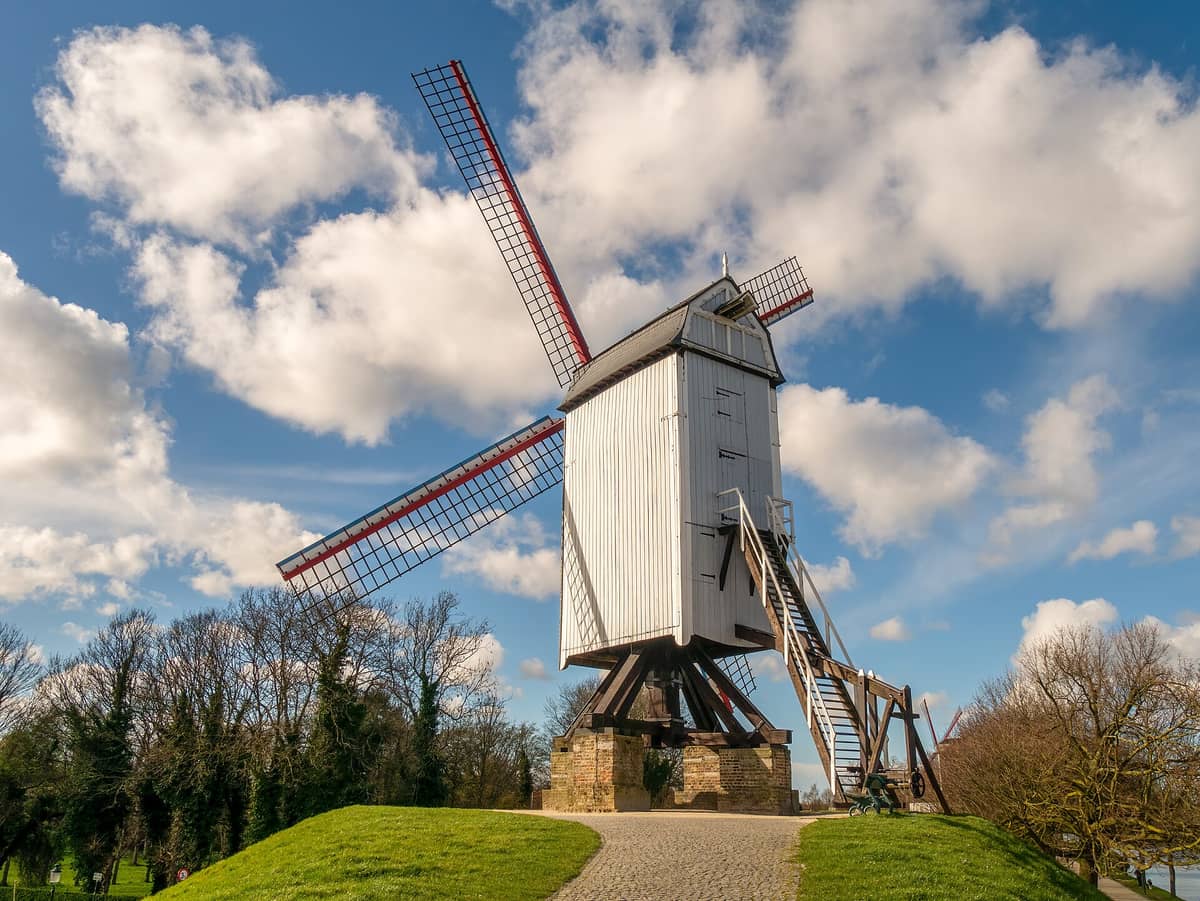
Standing on the grassy earthworks of the Kruisvest, Bruges' four remaining windmills are among the most photogenic and undervisited sights in the city. Sint-Janshuismolen is the only one still grinding grain and open to the public, while the rampart path connecting all four is free to walk at any hour.
Quick Facts
- Location
- Kruisvest, 8000 Brugge, Belgium (eastern ramparts)
- Getting There
- Bus stop 'Brugge Kruispoort' (De Lijn); 15-20 min walk from Markt or Burg
- Time Needed
- 30-45 min for the rampart walk; add 30-45 min for Sint-Janshuismolen interior
- Cost
- Rampart path free. Sint-Janshuismolen: €5 adults (incl. 65+), €4 ages 18–25, €2 ages 13–17, free under 13
- Best for
- Photographers, families, walkers, and anyone wanting a break from the crowded historic centre
- Official website
- www.museabrugge.be/en/visit/locations/sint-janshuismolen
What You're Looking At: Four Mills, One Open to Visitors
Bruges once had more than two dozen windmills ringing its medieval walls. Today four survive on the eastern ramparts, all clustered along a raised green earthwork called the Kruisvest. Their names are Sint-Janshuismolen, Koeleweimolen, Bonne-Chièremolen, and Nieuwe Papegaai, and together they form one of the most recognisable silhouettes in the city.
Of the four, Sint-Janshuismolen (Sint-Janshuis Mill) is the only one where grain is still actively ground and the only one open for interior visits. It is managed by Musea Brugge, the city's municipal museum network, and entry costs €5 for adults. The other three mills are visible from the outside as you walk the rampart path, but do not allow interior access. Koeleweimolen, for reference, is a wooden grain mill originally from the village of Meulebeke that was rebuilt here in 1996-1997 on a site where milling has taken place since at least the 16th century.
💡 Local tip
The Kruisvest rampart path and all four windmill exteriors are free to visit at any time of day. You only need a ticket if you want to enter Sint-Janshuismolen itself.
The Rampart Walk: What the Path Actually Feels Like
The Kruisvest is a wide, grassy earthen embankment that curves along the eastern edge of Bruges' historic centre. The path along it is flat, broad, and mostly unshaded. On a clear morning, the light comes in low from the east and catches the wooden sails of the mills at an angle that makes them glow. This is the best time to photograph them: before 10:00, when the tourist foot traffic is still thin and the shadows are long.
The surface underfoot is a mix of packed earth and worn grass. It is generally firm and easy to walk, but can become muddy along the edges after rain. Bruges receives rainfall fairly evenly across the year, with November typically the wettest month, so waterproof footwear is a practical choice outside of summer. The walk between the mills is short, perhaps ten minutes end to end, but many visitors slow down to sit on the grass, watch cyclists pass on the adjacent lane, or look out over the low-lying fields to the east.
By mid-afternoon in summer, the path draws a mixed crowd: local families with children, cyclists following the city's ring route, and tour groups who have come from the canal quarter nearby. The atmosphere is noticeably quieter here than at the Markt or the Rozenhoedkaai, and that contrast is part of the appeal. Even at peak hours in July, the space is large enough that it never feels packed.
The Kruisvest sits within the broader Kruisvest ramparts area, which also includes the Kruispoort gate, one of the city's surviving medieval city gates, a short walk from the windmills.
Tickets & tours
Hand-picked options from our booking partner. Prices are indicative; availability and final rates are confirmed when you complete your booking.
Historium Bruges entrance tickets
From 19 €Instant confirmationFree cancellationBruges food tour with full meal
From 139 €Instant confirmationFree cancellationBruges walking audio guided tour
From 9 €Instant confirmationBruges Family Walking Tour
From 259 €Instant confirmationFree cancellation
Inside Sint-Janshuismolen: The Working Mill
Sint-Janshuismolen is open from 1 April to 2 November, Tuesday through Sunday (closed Mondays), from 09:30 to 12:30 and again from 13:30 to 17:00. From 3 November to 31 March it is closed, except that from December onward it opens only on the second Sunday of each month during the same hours. Plan around these gaps: arriving on a Monday or outside the summer season without checking the schedule is the most common visitor mistake.
The mill sits atop a raised earthen mound and entering it means climbing a narrow wooden staircase. The interior is compact and low-ceilinged, smelling of old timber and grain dust. On days when the wind is sufficient, the millstones run, and you can watch grain being ground in much the same way it was processed here centuries ago. The sound of the mechanism, a slow rhythmic creak punctuated by the groan of the wooden gears, is surprisingly loud up close.
The experience is brief but genuinely informative. A visit to the interior typically takes 20 to 30 minutes. There is no long exhibition to walk through: this is a working building, and the interest lies in watching it function rather than reading panels. Children tend to respond well to it for exactly this reason.
⚠️ What to skip
The interior of Sint-Janshuismolen involves steep wooden stairs and narrow spaces. It is not accessible for visitors with limited mobility or those who cannot manage uneven, steep steps. There is no lift or alternative access route.
Historical Context: Why Bruges Had So Many Mills
During the medieval period, Bruges was one of the most important trading cities in northern Europe, and its mills played a direct economic role. Grain was a primary commodity, and the flat, wind-exposed ramparts around the city were ideal sites for mills. The earthen walls themselves, built as defensive fortifications, doubled as the raised platforms that gave the mills the height and wind exposure they needed.
As the city's economic importance declined and industrial milling replaced wind power, most of Bruges' mills disappeared. The four that remain are survivors of a much larger network, and their presence on the ramparts today is partly the result of active conservation decisions by the city. Koeleweimolen, for instance, was not original to this site but was brought from Meulebeke and rebuilt here in the 1990s to restore the visual character of the rampart line. The city has treated the windmills as part of its identity in much the same way it has preserved its canal network and medieval streetscape.
If you are interested in the broader architectural history of Bruges, the Bruges Gothic architecture guide puts the city's medieval building traditions into useful context.
Photography: Getting the Best Shots
The mills photograph best from the grassy area directly in front of them, slightly below the mound level, which allows you to frame the sails against the sky without needing a wide-angle lens. Early morning in spring and summer offers the cleanest light and the fewest people in frame. Late afternoon in autumn is worth considering too: the low golden light from the west backlights the sails and the brick of the Kruispoort gate in the distance.
One practical note: on overcast days, which are common given Bruges' maritime climate, the mills can look flat against a grey sky. In those conditions, shifting your angle to include the green earthworks and surrounding trees adds depth and foreground interest. The rampart path itself, seen from a slightly elevated position near one of the mills, makes a strong lead-in line toward the others.
💡 Local tip
For drone photography, be aware that Bruges' historic centre has airspace restrictions. Check current Belgian CAA rules before flying. Ground-level shots are more than sufficient given the height of the mounds.
Combining the Windmills with Nearby Sights
The Kruisvest windmills are at the eastern edge of the historic centre, roughly equidistant from the Sint-Anna quarter to the south and the Dampoort area to the north. This position makes them a natural endpoint or turning point on a walking loop of the city's less-visited eastern side.
The Kantcentrum (Lace Centre) and the Jeruzalemkerk are both within a ten-minute walk to the south-west, in the Sint-Anna quarter. These two form a logical pairing with the windmills for a half-day route through a part of Bruges that most day-trippers skip.
Alternatively, walk south along the rampart path toward the Minnewater and the Begijnhof. The full walk from the windmills to the Begijnhof follows the green ring of the city walls and takes roughly 30-40 minutes at a relaxed pace, passing the Poertoren tower along the way. This is one of the better ways to see Bruges' outer ring without retracing the same canal-side streets.
For a well-structured walking route that incorporates the windmills, the Bruges walking tour guide includes the Kruisvest as part of a longer loop of the historic centre.
Is It Worth Your Time?
The Bruges Windmills are not a dramatic or immersive experience in the way that the Groeningemuseum or the Basilica of the Holy Blood are. The exterior visit is free, brief, and pleasant, but not particularly informative unless you read the context beforehand. The interior of Sint-Janshuismolen adds genuine substance, especially if you visit on a day when the mill is running, but it is a small space and a short visit.
Where the windmills genuinely earn their place is as part of a longer walk. The Kruisvest path is one of the few places in central Bruges where you can move at pace, breathe open air, and see the city from outside its canal-lined core. For visitors staying more than a day, making time for this walk is worthwhile. For those with only a few hours in Bruges, the windmills are better treated as a backdrop to a rampart walk than as a destination in themselves.
Visitors who want only indoor museum experiences, or who have limited mobility, may find the exterior-only option underwhelming and the interior inaccessible. The rampart path is also exposed to wind and rain, which, in a city with roughly 130–150 wet days per year, is a real consideration in autumn and winter.
Insider Tips
- Sint-Janshuismolen closes on Mondays during the summer season and has very limited winter opening hours (second Sunday of each month only from December). Check the Musea Brugge website before making a specific trip.
- The mills are most visually striking when their sails are turning. Wind-dependent operation means there is no guarantee, but the mill is more likely to be running on breezy afternoons in spring and autumn than on still summer days.
- The grassy mound directly in front of Sint-Janshuismolen is a good spot for a quiet picnic with a view. There are no cafés on the rampart path itself, so bring your own food and drinks.
- Cyclists can follow the signed inner ring route along the Kruisvest, which passes all four windmills. Renting a bicycle to loop the ramparts is a practical way to combine the windmills with the Minnewater and Gentpoort in one outing.
- If you visit in winter, the lack of foliage on the surrounding trees actually improves sightlines to the mills. The second-Sunday winter openings of Sint-Janshuismolen are quietly attended and worth planning around if you are already in Bruges off-season.
Who Is Bruges Windmills (Kruisvest) For?
- Photographers looking for iconic Bruges imagery outside the canal quarter
- Families with children who respond well to working mechanical demonstrations
- Walkers and cyclists completing a loop of the city's rampart ring
- Visitors on a second day in Bruges who have already covered the main historic centre
- Travellers exploring Bruges on a budget, since the exterior visit and rampart walk are entirely free
Nearby Attractions
Other things to see while in Kruisvest & City Ramparts:
- Gentpoort (Ghent Gate)
Gentpoort, or Ghent Gate, is one of four surviving medieval city gates that once guarded the entrances to Bruges. The interior museum closed permanently in 2020, but the gate itself stands freely accessible on the southern edge of the old city, forming a compelling stop on any walk along the Kruisvest rampart trail.