Gentpoort (Ghent Gate): Bruges' Medieval Southern Threshold
Gentpoort, or Ghent Gate, is one of four surviving medieval city gates that once guarded the entrances to Bruges. The interior museum closed permanently in 2020, but the gate itself stands freely accessible on the southern edge of the old city, forming a compelling stop on any walk along the Kruisvest rampart trail.
Quick Facts
- Location
- Gentpoortstraat, 8000 Brugge — southern edge of the historic centre
- Getting There
- Bus stop Brugge Katelijnepoort (Ruzettelaan); Brugge railway station is walkable in ~20 minutes
- Time Needed
- 15–30 minutes to view the exterior; 1–2 hours if walking the full rampart circuit
- Cost
- Free — exterior always accessible; interior museum permanently closed since 1 January 2020
- Best for
- Architecture enthusiasts, history walkers, photographers, and anyone doing the Kruisvest rampart route
- Official website
- www.visitbruges.be/nl/wat-te-doen/cultuur-en-erfgoed/gentpoort
What Gentpoort Actually Is (and Isn't)
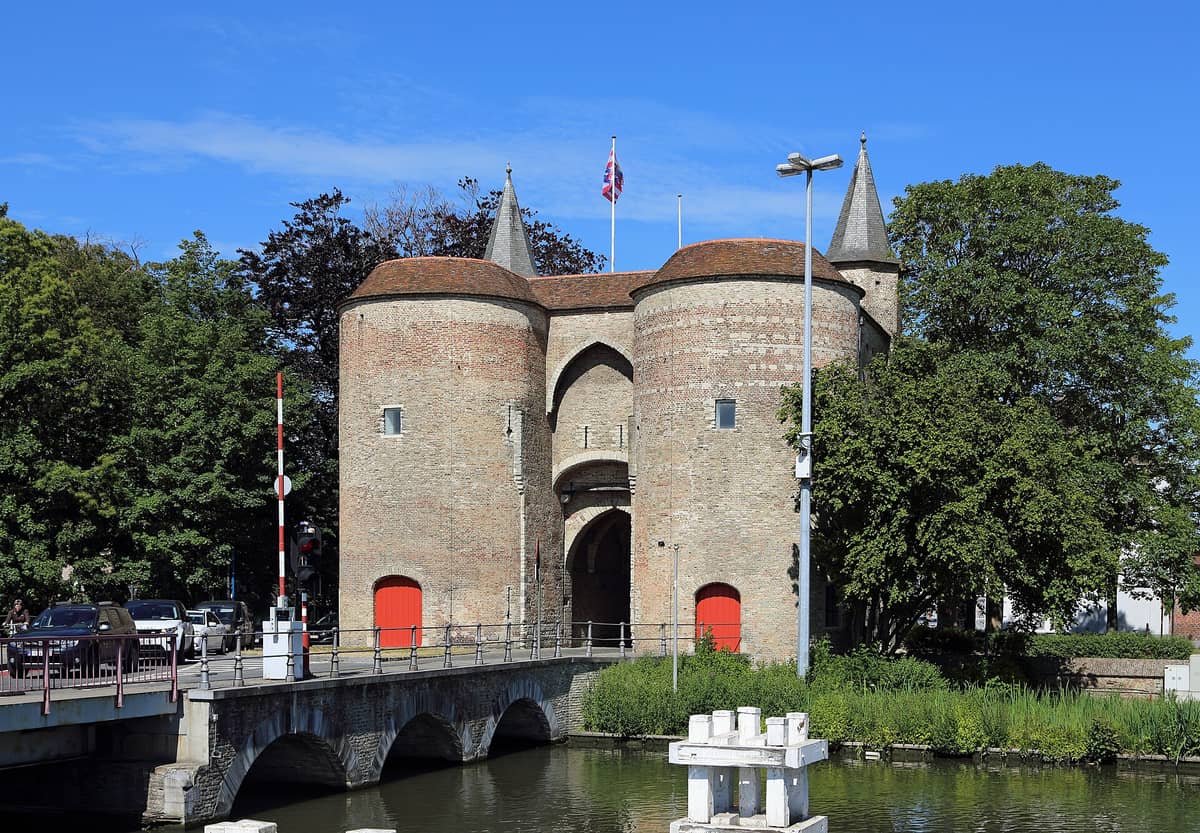
Gentpoort is one of only four medieval city gates that survive from Bruges' original ring of fortifications. The name translates directly as 'Ghent Gate', reflecting its position on the southern road that once led travellers toward Ghent. Alongside the Kruispoort, Smedenpoort, and Ezelpoort, it represents what remains of a defensive circuit that once enclosed the entire medieval city.
For years, the gate's interior housed a small municipal museum presenting the history of Bruges' city gates and defensive works. That museum closed in 2020 and has not reopened. The gate itself, however, is fully visible from the exterior at any hour, at no cost.
⚠️ What to skip
The Gentpoort interior museum is closed as of 2020. There is no admission, no exhibition, and no tower access. Visits here are exterior only. Do not plan your trip around going inside.
The Architecture: Reading the Gate
Standing in front of Gentpoort, the scale of medieval defensive thinking becomes concrete. The gate is built in the characteristic late-medieval Flemish style: a large brick gatehouse flanked by two drum towers with crenellated parapets. The main archway, wide enough for loaded carts, sits at street level, framed by stone detailing that contrasts with the red-brick mass above it. The towers rise several storeys, with narrow windows that served as lookout and archer positions rather than sources of light.
The construction dates to the medieval period, consistent with Bruges' peak as one of the wealthiest trading cities in northern Europe. At that time, the city gates were not merely military installations. They were also toll collection points, controlling the flow of goods into the city and generating revenue for the municipality.
If you want to understand the gate in the context of Bruges' broader medieval fortifications, the windmills at Kruisvest sit along the same defensive circuit to the northeast, offering a different expression of the same era's urban engineering. The full Kruisvest ramparts route connects these landmarks on foot.
Tickets & tours
Hand-picked options from our booking partner. Prices are indicative; availability and final rates are confirmed when you complete your booking.
Historium Bruges entrance tickets
From 19 €Instant confirmationFree cancellationBruges food tour with full meal
From 139 €Instant confirmationFree cancellationBruges walking audio guided tour
From 9 €Instant confirmationBruges Family Walking Tour
From 259 €Instant confirmationFree cancellation
The Experience at Different Times of Day
Early morning is the most rewarding time to visit Gentpoort. By 8am, the light falls low and warm across the brick face of the towers, and the surrounding streets are quiet. The gate sits where Gentpoortstraat meets the outer ring road, and at this hour you can stand in the roadway without competing with traffic for a clear line of sight. The textures of aged brick, the green patina on the stone details, and the asymmetry of centuries of repair work are all visible without distraction.
By mid-morning, the area picks up. Cyclists using the rampart path pass regularly, and buses run along the outer ring. The gate is not a stopping point for most tour groups, which tend to concentrate in the Markt and Burg area, so even at peak tourist hours the atmosphere here is comparatively calm. Afternoons can bring harsher light from the west, which flattens the texture of the facade for photography. Overcast days, common in Bruges through autumn and winter, actually produce more even and interesting photographic conditions.
At dusk, the gate is occasionally lit. The illuminated towers against a dark sky make for a dramatic image, though the lighting is not guaranteed on every evening and is more reliable in the colder months when darkness falls early.
Getting There and Walking the Rampart Route
Gentpoort sits at the southern end of Gentpoortstraat, at the boundary between the historic centre and the outer ring road (Gentpoortvest). The nearest bus stop is Brugge Katelijnepoort on Ruzettelaan. From Brugge railway station, the walk is a straightforward one through the southern part of the old city. Parking is available at the Parking Katelijne facility on Gentpoortvest, making this one of the more car-accessible points on the rampart circuit.
The gate makes most sense as part of a longer walk rather than a standalone destination. The Kruisvest greenway runs along the outer edge of the former city walls and connects Gentpoort with the other surviving gates and the windmills to the north. Cyclists will find this route particularly satisfying. For context on planning such a walk, see the Bruges walking tour guide, which covers the rampart circuit in detail.
💡 Local tip
There is a public toilet facility nearby, which makes this a useful rest point if you are mid-walk along the rampart circuit.
Historical Context: Bruges Behind Its Walls
Bruges reached its commercial height between the 12th and 15th centuries, when it served as one of the primary trading hubs of the Hanseatic League and the main cloth market for northern Europe. The city's defensive infrastructure, including its ring of gates, was built and maintained during this period of wealth. The gates were practical investments: they allowed the city to regulate trade, extract tolls, and in times of conflict, control access entirely.
By the time the city's prosperity declined, largely due to the silting of the Zwin waterway that had connected Bruges to the sea, the gates remained as physical markers of the city's former extent. Most were demolished in the 18th and 19th centuries as the old walls lost their strategic value and were seen as obstacles to modern traffic. The four surviving gates, including Gentpoort, were preserved partly through civic pride and partly through the kind of administrative inertia that sometimes works in favour of old buildings.
For a fuller picture of Bruges' medieval architectural legacy, the Bruges Gothic architecture guide covers the broader context of the city's building heritage, from the gates and churches to the civic halls.
Photography Notes
The gate photographs best from the city-side approach, looking south through the arch toward the outer ring road. This angle captures the full height of both towers framing the central passage. A wide-angle lens handles the vertical scale without excessive distortion. The outer (south) face of the gate is broader and more photogenic, showing the full drum tower profile, but requires crossing the ring road to get sufficient distance.
Overcast lighting is preferable for architectural detail shots. In direct sunlight, the south face casts deep shadow across the arch opening, which can work well for dramatic framing but obscures the middle-ground detail. Golden hour on a clear day, from the city side looking south, produces warm tones on the brick and enough contrast to read the stone details clearly.
Is It Worth the Trip Alone?
As a standalone destination, Gentpoort is a minor stop. Without the interior museum, there is no exhibition, no climb, and no reason to linger for more than 15 to 20 minutes. If you are in Bruges for a single day and working from a tight itinerary, this is not a priority over the Groeningemuseum, the Begijnhof, or a canal boat.
Where Gentpoort earns its place is as a waypoint. If you are doing the full rampart walk, combining the gate with the Minnewater lake and the Begijnhof to the west creates a coherent southern circuit that takes two to three hours and rewards the effort. In that context, Gentpoort is a genuine highlight rather than a footnote.
Visitors who struggle with uneven cobblestone surfaces or significant walking distances should note that this area involves some road crossing and the surrounding streets are not always smooth. The gate itself has no interior to enter, so there are no stairs or access concerns for the exterior visit.
Insider Tips
- Approach from inside the city (north side) rather than arriving directly from the ring road parking. The city-side view gives a much stronger sense of what it meant to pass through this gate historically.
- If you visit on a weekday morning, the surrounding streets are used by local commuter cyclists and have an everyday Bruges character that feels markedly different from the tourist-heavy centre.
- The rampart greenway running northwest from Gentpoort toward the windmills is flat, paved, and shaded in summer. It is an excellent option for anyone who wants to walk or cycle without dealing with cobblestones.
- Combine Gentpoort with the Katelijnepoort area nearby and the walk south toward Minnewater. This triangle covers three distinct types of medieval urban infrastructure, all within easy walking distance, without entering a single paid attraction.
- In winter, when daylight is short and the gate is sometimes illuminated by early evening, a late-afternoon visit gives you both good natural light on the facade and a chance to see the illuminated gate against the darkening sky, all within a single hour.
Who Is Gentpoort (Ghent Gate) For?
- Architecture and medieval history enthusiasts who want to see Bruges' defensive ring beyond the more photographed central monuments
- Walkers and cyclists doing the full Kruisvest rampart circuit, for whom the gate is a natural waypoint
- Photographers looking for strong structural subjects away from the crowded canal viewpoints
- Travellers on a budget who want meaningful medieval heritage without admission fees
- Visitors staying in the southern part of the historic centre who want a short, purposeful walk from their accommodation
Nearby Attractions
Other things to see while in Kruisvest & City Ramparts:
- Bruges Windmills (Kruisvest)
Standing on the grassy earthworks of the Kruisvest, Bruges' four remaining windmills are among the most photogenic and undervisited sights in the city. Sint-Janshuismolen is the only one still grinding grain and open to the public, while the rampart path connecting all four is free to walk at any hour.